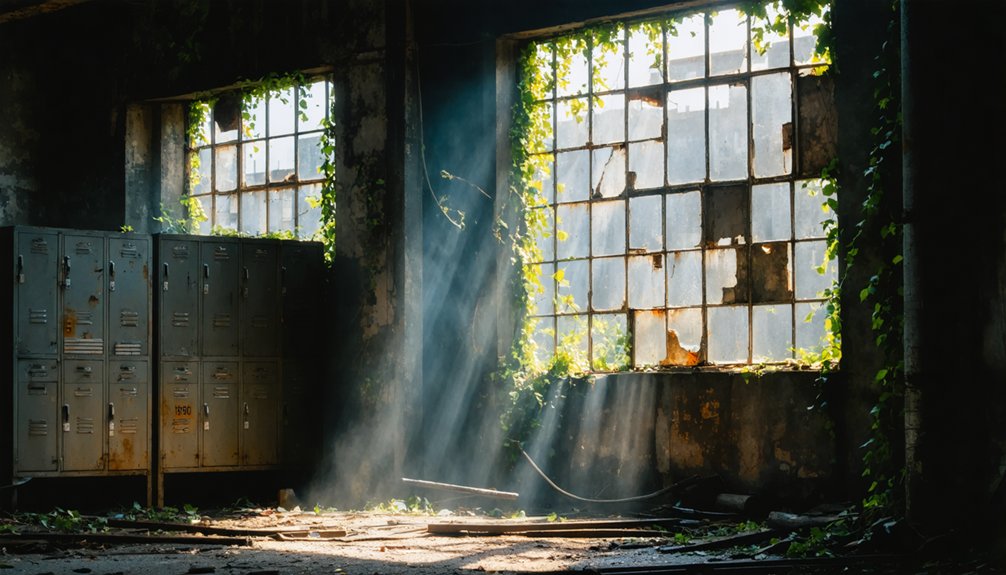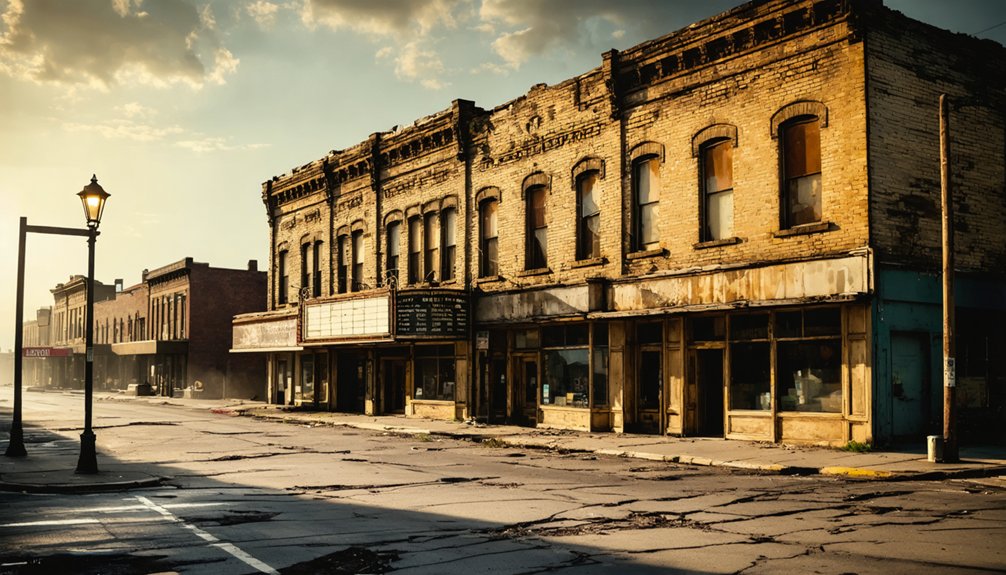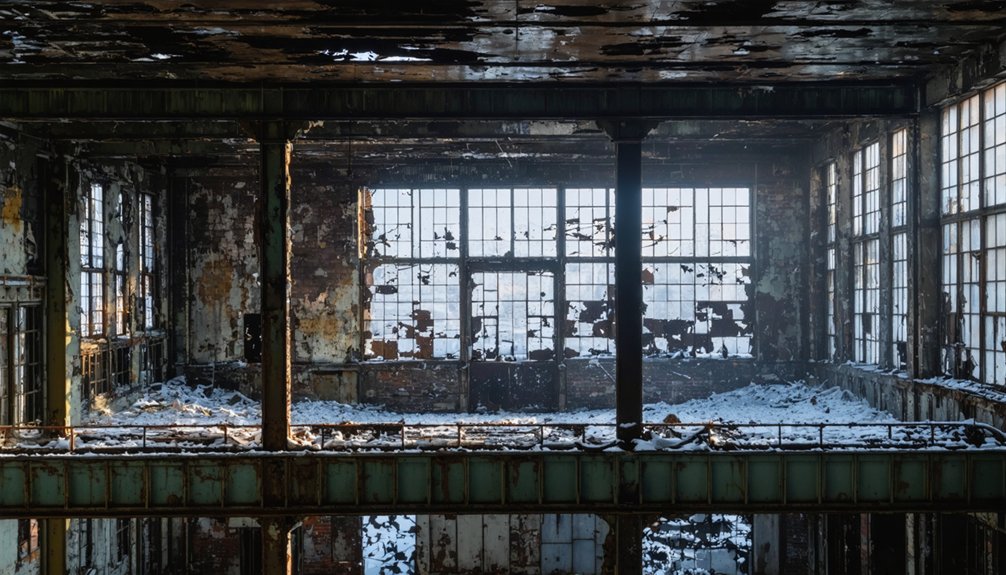
You’ll find several notoriously haunted Rust Belt ghost towns across America’s industrial heartland. Centralia, Pennsylvania smolders with an underground fire and prophetic curse. Gary, Indiana’s abandoned steel mills echo with industrial accidents. Thurmond, West Virginia harbors railroad spirits and phantom train whistles. Picher, Oklahoma’s toxic mining legacy creates an apocalyptic backdrop for paranormal activity. Fayette, Michigan’s iron smelting ruins document unexplained phenomena. Each decaying industrial landscape tells ghostly tales of America’s manufacturing past.
Key Takeaways
- Centralia, Pennsylvania features an underground coal mine fire burning since 1962, creating sinkholes and toxic gases that drive paranormal tales.
- Gary, Indiana transformed from America’s steel giant to a haunted industrial landscape with spirits reportedly lingering near abandoned furnaces.
- Thurmond, West Virginia preserves ghostly railroad history, with visitors reporting phantom train whistles and apparitions of early 1900s workers.
- Picher, Oklahoma harbors toxic mining remnants including 178 million tons of contaminated chat piles and 14,000 abandoned mineshafts.
- Carrie Furnaces in Pittsburgh and Fayette, Michigan feature preserved industrial ruins where paranormal investigators document unexplained phenomena tied to worker hardships.
The Eerie Legacy of Centralia: Pennsylvania’s Eternal Flame Town
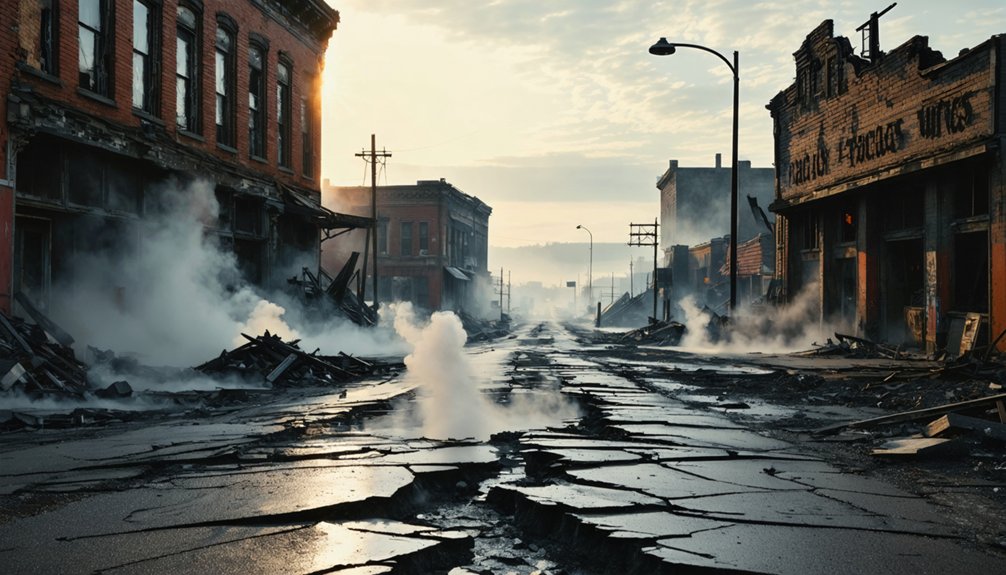
Deep within the heart of Pennsylvania’s coal country, Centralia stands as a haunting reminder of humanity’s precarious relationship with the earth beneath our feet.
What began as a thriving mining town in 1866 now exists as little more than ghostly remnants, consumed by an underground inferno ignited in 1962 when trash burning in an abandoned pit set a coal seam ablaze.
Centralia’s folklore includes Father McDermott’s 1869 curse, which eerily predicted the town’s destruction while sparing only St. Ignatius Church.
As toxic gases seeped from the ground and sinkholes devoured streets and homes, residents gradually fled. The tragic turning point came in 1980 when a local boy nearly lost his life after falling into a sudden sinkhole, dramatically increasing public awareness of the dangers lurking beneath the town.
Despite warnings from the Pennsylvania Department of Environmental Protection’s Stay Out, Stay Alive program, curious visitors continue to be drawn to this dangerous site.
Gary, Indiana: Where Steel Mills Whisper to the Dead
Once the pride of American industrial innovation, Gary, Indiana now stands as a haunting monument to the rise and fall of the American steel industry. Founded in 1906 by U.S. Steel, this planned industrial city transformed desolate sand dunes into America’s largest steel manufacturing complex.
Today, industrial ghosts haunt the landscape where 12 blast furnaces once roared. The massive Gary Works, though still operational, whispers tales of economic decline through its rusting infrastructure. The city’s population has dwindled to less than half of its 1960 peak when it reached 178,320 residents. The once-thriving Gary Works has seen its workforce dramatically shrink from over 30,000 employees in the early 1970s to just over 2,000 today.
The skeletal remains of American industry reach spectral fingers skyward, monuments to capitalism’s broken promises.
- Steel mill spirits reportedly manifest near abandoned furnaces, where workers perished in industrial accidents.
- The city’s rapid construction on marshland, completed by 1908, created an unsettled foundation both physically and metaphysically.
- Environmental devastation from unregulated industrial processes has left a toxic legacy that some believe traps restless energies.
Thurmond, West Virginia: The Railroad Ghosts of Coal Country
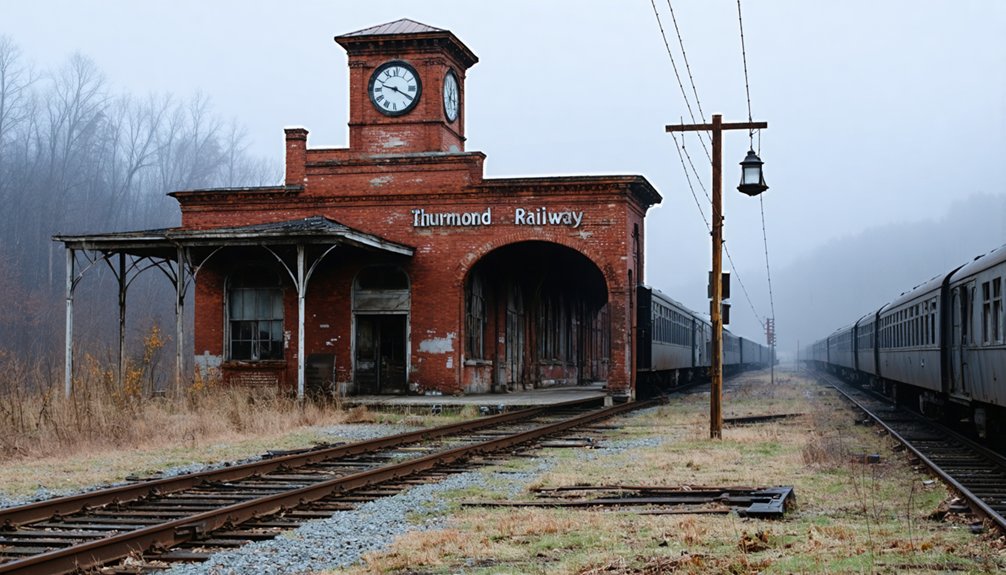
You’ll find Thurmond’s story emblematic of boom-and-bust industrialization, transforming from a prosperous railroad hub that handled more freight than Cincinnati to an atmospheric ghost town preserved by the National Park Service.
The town’s distinctive dual personality—Captain Thurmond’s strict alcohol-free zone juxtaposed against the notorious Dun Glen Hotel area with its 14-year poker game, violence, and vice—created a cultural legacy ripe for supernatural lore.
The abandoned storefronts, empty houses, and restored depot now stand as silent witnesses to coal country’s glory days, attracting visitors who report unexplained sounds of steam whistles, phantom train lights, and spectral figures in period clothing moving through the fog-shrouded gorge. By 1910, the town’s economic might was undeniable, generating $4.8 million in freight revenue which represented a fifth of the C&O Railroad’s total earnings. With approximately 75,000 passengers traveling through the town in 1910, Thurmond became one of the most significant rail transport hubs in the region.
Thurmond’s Railroad Prosperity
Nestled in the narrow valley of the New River, Thurmond transformed from a modest 73-acre plot acquired by Captain William D. Thurmond in 1873 into the C&O Railway‘s busiest freight center.
At its zenith, ghostly locomotives hauled more spectral freight through this remote junction than Cincinnati and Richmond combined. The town’s strategic position along the mainline made it essential for steam engine maintenance and refueling.
- You’d find Thurmond handling 15 passenger trains daily and serving 75,000 annual passengers during its 1910-1920s peak.
- Without direct road access until 1921, the town existed purely for the railroad, creating an isolated industrial microcosm.
- The prosperity attracted coal barons, rail workers, and entrepreneurs who established some of West Virginia’s wealthiest banks.
Thurmond’s economic dynamism pulsed with the rhythm of steam whistles echoing through the valley. Today, visitors can explore this nearly abandoned town with its historic main street offering glimpses into its once-vibrant past. The introduction of diesel locomotives ultimately triggered the town’s decline, as the need for coal-powered train services diminished dramatically.
Prohibition-Era Wild Days
While the sound of locomotive whistles defined Thurmond’s industrial rhythm, the town’s notorious underbelly thrived in defiance of Prohibition laws that swept through West Virginia in 1914—six years before the national ban.
Despite official restrictions, Thurmond’s vice economy persisted through its network of seedy hotels and boarding houses. The Dun Glen Hotel became a centerpiece for gambling and illicit activities until it burned down in 1930, symbolically marking the end of an era.
Across the river, another infamous establishment served as a hub for underground operations. This contradicted the wishes of Captain William Thurmond, who had initially imposed a town-wide ban on drinking and gambling when the town was founded. For researchers and historians seeking information about this complex history, disambiguation pages help separate Thurmond, West Virginia from other locations sharing the same name.
The town’s reputation for violence, treachery, and murders during this period contributed to reports of ghostly hauntings that persist today. These paranormal activities are often attributed to restless spirits of those who died violently during Thurmond’s lawless heyday—victims of a town where anything went, until suddenly, it didn’t.
Modern Paranormal Activity
Today, Thurmond’s vacant buildings and silent railyard serve as a stage for three distinct types of paranormal phenomena reported by visitors and paranormal investigators alike.
The town’s sudden economic collapse following the change from steam to diesel locomotives left residual energy that manifests in spectral sightings throughout the National Park Service-preserved ghost town.
- Ghostly encounters near the railroad depot often feature phantom train whistles and the sounds of bustling passengers from the early 1900s when 95,000 travelers passed through annually.
- Apparitions of railroad workers appear performing their duties around the abandoned switching yard, particularly at dusk.
- Unexplained cold spots and electronic equipment malfunctions occur in buildings connected to Thurmond’s once-notorious reputation for “treachery and murder.”
These phenomena connect directly to the town’s traumatic shift from economic powerhouse to abandonment.
Mineral Point, Wisconsin: Lead Mining Spirits and Cornish Hauntings
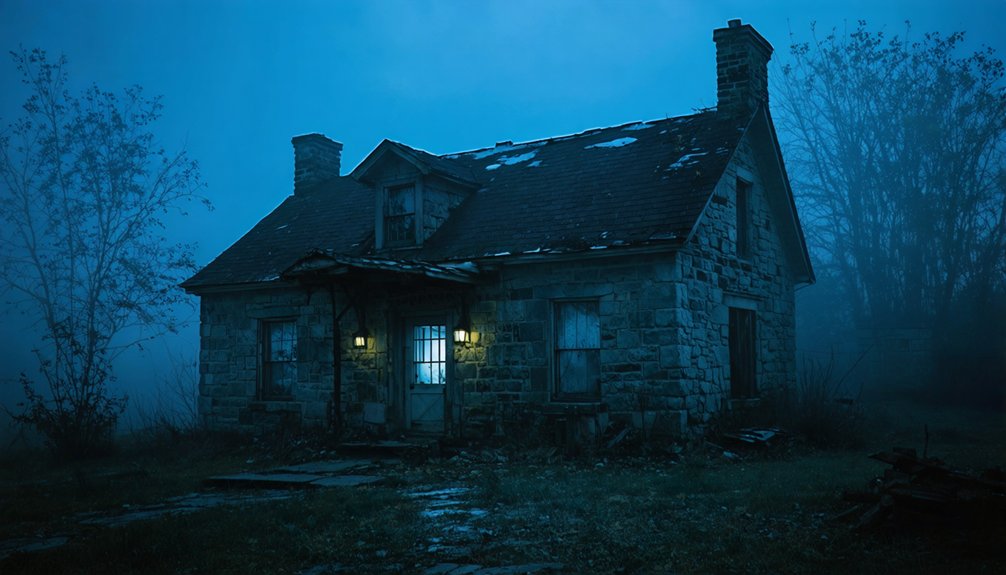
When you explore Mineral Point’s historic streets, you’ll encounter Wisconsin’s earliest mining settlement where skilled Cornish immigrants established a distinctive cultural footprint visible in preserved stone cottages and persistent folklore.
The Walker House, an 1836 inn frequented by miners, now hosts “The Colonel,” a spectral figure in period attire who manifests near the bar area through unexplained footsteps and whispers.
These hauntings connect directly to the town’s boom-and-bust mining economy, where early residents brought supernatural beliefs like “Tommy Knockers” and “Piskies” that continue to influence the paranormal narrative of this National Register-listed community.
Cornish Mining Heritage
The rugged shores of Cornwall found a spiritual twin in Mineral Point, Wisconsin, where skilled Cornish miners transplanted not only their technical expertise but possibly their supernatural beliefs beginning in the 1820s.
These immigrants transformed the region into a national lead-mining powerhouse, constructing distinctive stone cottages that still stand today as symbols of their cultural resilience.
Cornish culture permeated deeply into Mineral Point’s identity, with mining folklore emerging from the “badger holes” that gave Wisconsin its nickname.
- Experience the architectural legacy at Pendarvis State Historic Site, where preserved miners’ cottages showcase authentic Cornish stonework
- Explore Merry Christmas Mine Hill’s trails featuring remnants of once-thriving mining operations
- Witness living traditions during the annual Cornish Festival celebrating ancestral heritage through language, genealogy, and cultural performances
Ghostly Hotel Appearances
As the Cornish mining heritage took root in Mineral Point, supernatural elements emerged alongside industrial progress, particularly within the town’s historic accommodations.
The Walker House, built in 1836 by Joseph Gobb, stands as the epicenter of haunted hospitality, where ghostly encounters mirror the cyclical patterns of the region’s spectral phenomena.
You’ll find this bed-and-breakfast’s haunted legacy connected to the violent deaths that once plagued the mining community—bar fights and confrontations that claimed miners’ lives have imprinted themselves on the structure.
The Ridgeway Ghost reportedly manifests in 40-year cycles, reflecting trauma from the mining heyday’s violent disputes.
These apparitions coincide with Walker House’s evolution from miners’ lodging to tavern to boarding house, creating layers of supernatural activity that persist despite restoration efforts that rescued the building from disrepair.
Picher, Oklahoma: Toxic Ghosts of a Mining Disaster
Once a thriving hub of American industrial might, Picher, Oklahoma emerged in 1913 following the discovery of vast lead and zinc deposits that would ultimately prove both its blessing and curse.
The town’s toxic legacy lives on through ghostly echoes of abandoned structures, with 86% deemed unstable after mining ceased in 1967.
If you visit Picher today, you’ll find:
- 178 million tons of contaminated chat piles towering like monuments to industrial negligence
- A landscape scarred by over 14,000 abandoned mineshafts slowly filling with acidic water
- The remnants of a once-prosperous community of 14,000 residents, officially dissolved in 2009
Environmental catastrophe and structural collapse hazards forced complete evacuation, transforming this former producer of World War I materials into America’s most hazardous ghost town—a cautionary tale of unrestrained industrial exploitation.
Carrie Furnaces: Spectral Steelworkers of Pittsburgh
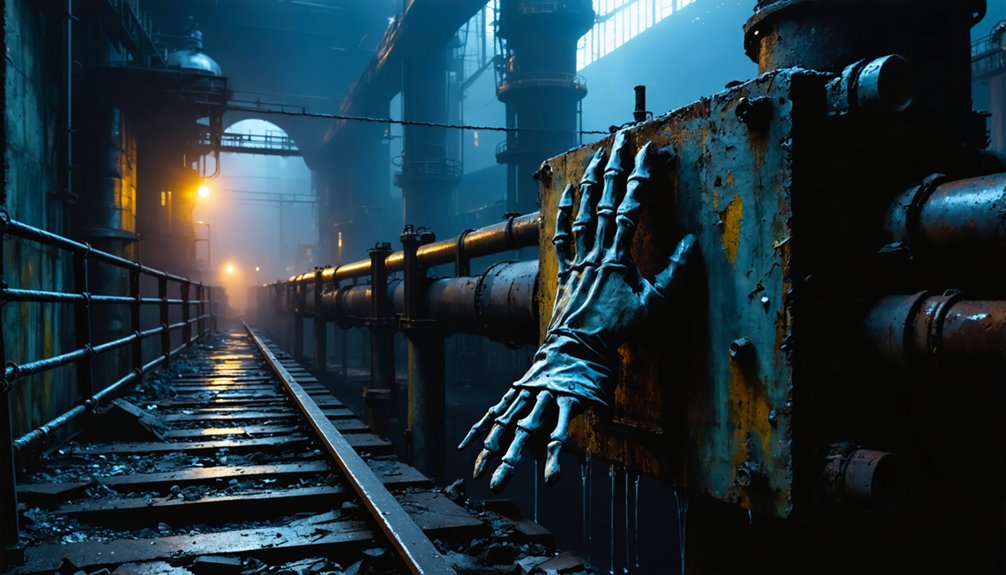
Standing like rusted sentinels along the Monongahela River, Carrie Furnaces #6 and #7 represent the last vestiges of Pittsburgh’s once-mighty steel empire that helped forge America’s industrial backbone.
Constructed in 1907, these 92-foot towers operated continuously until 1978, weathering economic collapse when the 1973 oil crisis decimated American steel.
For 25 years, the abandoned site became a haven for urban explorers who reported ghostly apparitions and sounds of spectral machinery echoing through empty chambers.
Nature reclaimed the industrial landscape until Rivers of Steel fought to preserve this slice of freedom—saving it from demolition in 1988 and securing National Historic Landmark status in 2006.
Today, you can experience the complex’s haunting presence as it stands frozen in time, a memorial to the 15,000 steelworkers whose labor and legacy continue to resonate through its rusted bones.
Moonville, Ohio: The Tunnel Where the Lantern Man Still Walks
While Pittsburgh’s steel furnaces tell tales of industrial ghosts, deep in the forested hills of southeastern Ohio lies a different kind of haunted relic—the infamous Moonville Tunnel.
This solitary stone arch, once serving the Marietta and Cincinnati Railroad through a thriving mining town, now stands as the centerpiece of Moonville legends. The tunnel’s notorious reputation stems from multiple documented fatalities, including engineer Theodore Lawhead’s tragic death in the 1880s, whose spirit allegedly continues his duties posthumously.
- Witness accounts describe spectral lantern sightings—phantom lights that appear, vanish, then reappear farther down the abandoned tracks.
- The dangerous single-track design claimed numerous lives, creating a perfect storm for paranormal activity.
- Today, you can explore the tunnel and cemetery remnants via converted hiking trails, where the Lantern Man still allegedly patrols his eternal route.
Cairo, Illinois: River Town Phantoms at the Confluence

At the strategic confluence of America’s two greatest rivers—the Mississippi and Ohio—Cairo, Illinois harbors an exceptionally dark and troubled past that manifests in its abundant paranormal activity.
The town’s Cairo hauntings stem from centuries of violence, beginning with Native American displacement and continuing through the Underground Railroad tunnels discovered beneath Levee Street in 1998.
Most notorious among historical ghosts is Will James, whose 1909 lynching represents one of America’s most horrific hate crimes. Locals report seeing his apparition near the town square where the mob hanged, shot, burned, and dismembered him.
Former Underground Railroad sites experience inexplicable cold spots and whispers, while Fort Defiance—built by Ulysses S. Grant during the Civil War—produces phantom sounds of military drills.
This once-thriving river port of 15,000 now shelters only 2,000 living residents, leaving ample space for the dead.
Exploring the Paranormal Activity in Donora’s Deadly Smog
You’ll encounter reports of shadowy figures emerging from the yellow fog that suffocated Donora during those fateful days in 1948, their forms said to materialize in areas where mortality rates were highest.
Residents claim to hear whispering sounds resembling labored breathing near the former zinc works site, particularly during atmospheric conditions similar to the deadly inversion that trapped pollutants over the town.
These paranormal manifestations, alongside unexplained cold spots and electronic disturbances, correlate geographically with documented “dead zones” where vegetation never fully recovered from the toxic exposure.
Poisoned Mists Linger
Decades after the deadly smog event of 1948 subsided, residents of Donora report encountering spectral phenomena that many attribute to the souls of those who perished in the catastrophic industrial disaster.
The toxic legacy of hydrogen fluoride and sulfur dioxide that once choked this steel mill town now manifests, according to witnesses, as a spectral fog that appears on cool autumn nights—particularly around October 26-31, the anniversary of the tragedy.
- Local paranormal investigators document recurring sightings of shadowy figures wandering with lanterns, reminiscent of Dr. Rongaus maneuvering through the deadly haze.
- Electronic equipment frequently malfunctions near the former Zinc Works site, where the highest concentration of pollutants originated.
- Respiratory distress, coughing, and difficulty breathing affect visitors to certain locations, even when air quality readings show normal conditions.
Shadowy Lung Whispers
While the deadly industrial smog of 1948 cleared from Donora’s skies long ago, residents continue to report unexplained phenomena that many attribute to the victims of this environmental catastrophe.
Walking through Donora’s streets at dusk, you might encounter the “shadowy whispers” described by locals—ghostlike figures emerging from foggy patches, particularly near the former zinc and steel operations.
These apparitions reportedly manifest as dark silhouettes struggling to breathe, their labored respiratory sounds carrying on still nights.
Emergency responders’ lantern-lit journeys through impenetrable smog have transformed into spectral memories embedded in local folklore.
The “shadowy lung whisper,” as it’s known academically, represents both literal respiratory distress and metaphorical haunting—an invisible killer preserved in cultural consciousness alongside the Smog Museum’s more tangible artifacts.
Fayette, Michigan: Ironworks Hauntings on the Upper Peninsula
Nestled on Michigan’s Upper Peninsula along the limestone shores of the Garden Peninsula, Fayette stands as one of the most atmospheric and reportedly haunted ghost towns in the American Rust Belt. Founded in 1867 as an iron smelting operation, this once-thriving industrial community declined after forests depleted and new steelmaking methods emerged.
Today, efforts to breathe new life into dwindling populations and abandoned structures are evident through revitalization efforts in Michigan cities. Local governments are collaborating with organizations to rehabilitate historic districts, encouraging tourism and community engagement. As these initiatives take shape, the potential for transformation and growth becomes increasingly tangible, rekindling the spirit of these once-bustling towns.
Today, paranormal investigations regularly document unexplained phenomena around the preserved blast furnaces and worker housing where immigrant laborers toiled in harsh conditions.
Eerie whispers and unexplained shadows haunt Fayette’s industrial ruins, echoing the suffering of forgotten workers.
- More than 20 original structures remain, creating an ideal setting for ghost sightings that many attribute to the hardships endured by Finnish, Norwegian, and Canadian workers.
- Annual fall paranormal events require pre-registration for night access to the historic site.
- The town’s vigilance committee, lawlessness, and sudden economic collapse contribute to theories about trapped spirits and residual energy.
Frequently Asked Questions
Are Ghost Hunting Tours Available in These Rust Belt Towns?
You’ll find limited ghost tour availability in Rust Belt towns, with some offering structured daytime tours rather than unrestricted haunted location access due to safety concerns from structural instability and environmental hazards.
What Paranormal Equipment Works Best for Rust Belt Hauntings?
Ever wonder what lurks in those decaying industrial shadows? You’ll need EMF detectors to measure residual energy from industrial accidents and spirit boxes for communicating with former workers—both excel in rust belt’s metal-rich environments.
Do Abandoned Industrial Machines Exhibit Paranormal Activity?
You’ll discover that abandoned machines often host industrial spirits, with electromagnetic disturbances, inexplicable sounds, and mechanical movements indicating machinery hauntings—though environmental factors may offer alternative explanations for these phenomena.
Which Rust Belt Town Has the Highest Documented Ghost Sightings?
Like smoke rising from its eternally burning underground, Centralia, Pennsylvania rises above all other Rust Belt towns in ghost sighting statistics. You’ll find its haunted location history includes over fifty years of documented paranormal phenomena.
Can Visitors Stay Overnight in Any Haunted Rust Belt Locations?
You’ll find virtually no official overnight accommodations within haunted Rust Belt ghost towns themselves. Safety hazards, legal restrictions, and absent infrastructure preclude formalized overnight ghostly experiences in these deteriorating locations.
References
- https://nightofthejack.com/2025/01/23/top-creepy-ghost-towns-in-america/
- https://www.christywanders.com/2024/08/top-ghost-towns-for-history-buffs.html
- https://www.losethemap.com/scariest-ghost-towns-in-the-world/
- https://www.geotab.com/ghost-towns/
- https://www.hipcamp.com/journal/camping/texas-ghost-towns/
- https://en.wikipedia.org/wiki/Lists_of_ghost_towns_in_the_United_States
- https://www.atlasobscura.com/lists/americas-best-preserved-ghost-towns
- https://www.legendsofamerica.com/centralia-pennsylvania/
- https://pabucketlist.com/the-rise-and-fall-of-centralia-pas-toxic-ghost-town/
- https://www.jeffreydonenfeld.com/blog/2009/12/exploring-the-ghost-town-of-centralia-pennslvania/