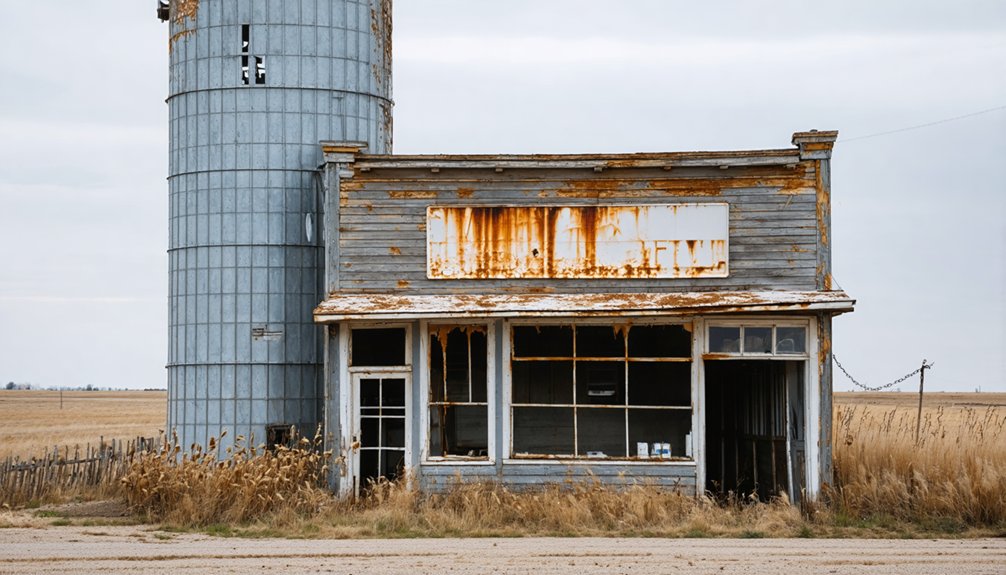
You’ll find the Midwest dotted with haunting ghost towns that reveal America’s economic evolution. Cairo, Illinois thrived as a Civil War-era river port processing 500,000 railroad cars annually before bridges ended its ferry dominance. Picher, Oklahoma boomed with $20 billion in lead mining before environmental devastation forced evacuation. Other notable sites include pre-Columbian Cahokia, Empire’s iron mining legacy, and the brief-lived Beer City in Oklahoma’s lawless territory. These abandoned communities hold countless stories within their silent structures.
Key Takeaways
- Cairo, Illinois rose as a vital Civil War river port before declining when bridges eliminated ferry operations, leaving behind abandoned historical structures.
- Picher, Oklahoma flourished as a lead and zinc mining town before environmental contamination led to its designation as a Superfund site.
- Cahokia, Illinois was once North America’s most sophisticated pre-Columbian settlement with 20,000 residents before being mysteriously abandoned by 1400 CE.
- Bonnell, Indiana exemplifies railroad town decline, featuring an 1864 stone arch railroad culvert that stands as an engineering marvel.
- Empire, Michigan transitioned from mining to tourism after its iron mine, which produced 1.2 million tons annually, closed in 2016.
The Rise and Fall of Cairo, Illinois: America’s Forgotten River Port
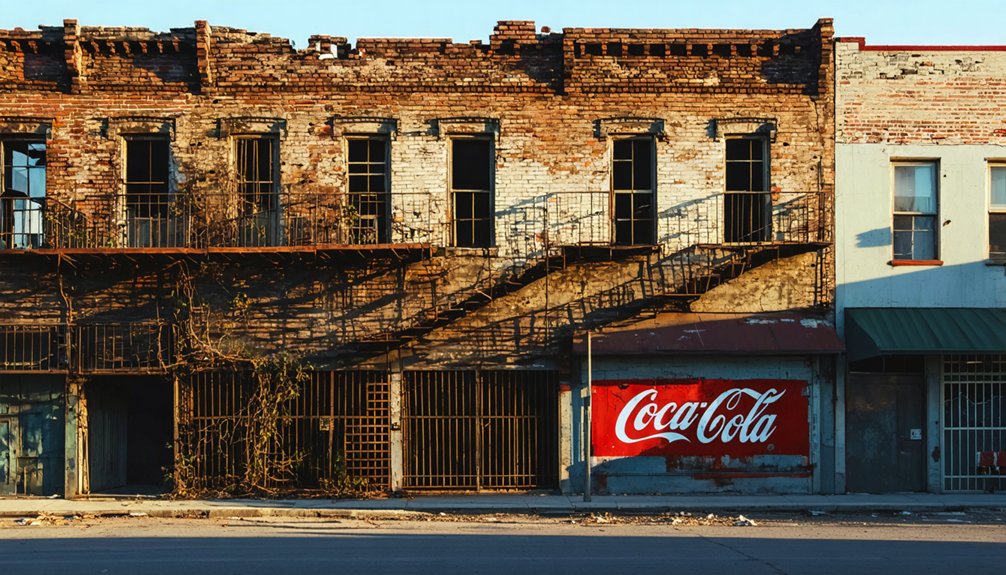
Nestled at the strategic confluence of the Ohio and Mississippi Rivers, Cairo, Illinois represents one of America’s most dramatic examples of urban rise and decline.
You’ll find the remains of what was once a booming river port established in 1837, reaching its zenith during the Civil War when it served as a vital Union supply base under General Grant.
Cairo’s economic prosperity peaked in the late 1800s when millions of tons of goods flowed through its port and nearly 500,000 railroad cars crossed its ferries annually.
The city’s economic decline began in the early 20th century when the completion of bridges in 1929 and 1937 eliminated ferry operations.
Modern engines replaced steamboats, railroads rerouted, and racial tensions intensified.
Famous author Charles Dickens was among the notable historical figures who visited the once-prominent Port of Delivery during its heyday.
The city also played a significant role in the Underground Railroad, with hidden storage bins discovered in 1998 that once concealed fugitive slaves.
Today, barely 2,000 residents remain among abandoned structures that whisper of Cairo’s forgotten significance.
Picher, Oklahoma: From Mining Prosperity to Toxic Ghost Town
While Cairo suffered a slow economic decline, Picher, Oklahoma represents an environmental catastrophe that transformed a thriving mining community into America’s most toxic ghost town.
Picher’s history began in 1913 with Harry Crawfish’s lead and zinc discovery, quickly developing into a boomtown that reached 14,252 residents by 1926. This mining legacy produced over $20 billion in ore and supplied more than 50% of lead and zinc used in World War I. It’s important to note that “Picher” is a geographical name referring to multiple distinct locations, though this Oklahoma ghost town is perhaps the most infamous.
However, decades of extraction created 14,000 mine shafts and massive chat piles containing heavy metals. The environmental impact devastated public health, with residents suffering from lead poisoning, silicosis, and developmental disorders. The EPA eventually designated the area a Superfund site in 1983, recognizing the severe contamination of soil and groundwater.
Beer City: The Wild West Oasis of the Oklahoma Panhandle

Unlike the environmentally ravaged town of Picher, Beer City emerged in the Oklahoma Panhandle as a product of legal ambiguity rather than natural resources.
Situated in the ungoverned “No Man’s Land” just three miles south of Liberal, Kansas, this frontier settlement thrived on defying neighboring states’ Prohibition laws from 1888 to 1890.
You’ll find Beer City’s history defined by frontier lawlessness—a haven where cowboys, cattle dealers, and outlaws sought liquor, gambling, and prostitution without legal interference.
Madams like “Pussy Cat Nell” operated profitable brothels while saloons flourished during cattle-shipping seasons.
When the 1890 Organic Act incorporated the Panhandle into Oklahoma Territory, Beer City vanished as quickly as it appeared. Beer City exemplifies the pattern of whiskey towns flourishing along the boundaries between territories until Oklahoma achieved statehood in 1907.
Today, only private farmland remains, though ghost stories persist about buried bootlegger treasures and spirits of former residents haunting this once-infamous “Sodom and Gomorrah” of the plains. Similarly, the nearby Sod Town was infamous for harboring the notorious Chitwood gang of horse thieves and outlaws.
Empire, Michigan: A Mining Legacy Within National Parkland
When you explore Empire and its satellite settlements in Michigan’s Upper Peninsula, you’ll witness the stark shift from industrial boomtowns to carefully preserved historical sites within the Sleeping Bear Dunes National Lakeshore.
The copper mining and logging operations that once dominated the region from the 1840s through the early 1900s have left behind a landscape of archaeological remnants, including mine shafts reaching depths of over 5,000 feet and sawmill foundations that tell the story of Michigan’s resource-driven past. Similar to Clifton in the Kiwana Peninsula, which had a peak population of 700 in 1877, these settlements rapidly declined after resource depletion. Mining towns like Freda offered minimal accommodations with miners living in simple boarding houses that cost just $1.00 per month to rent.
Today, these ghost towns serve as educational landmarks where tourism has replaced the extractive industries that originally built these communities, allowing visitors to connect with Michigan’s industrial heritage while enjoying protected natural surroundings.
Industrial Rise and Fall
As you drive along Lake Michigan’s northern shore within Sleeping Bear Dunes National Lakeshore, the massive excavation of Empire Mine stands as a tribute to industrial ambition and environmental transformation.
This colossal operation—spanning 1.5 miles wide and 1,200 feet deep—once represented Michigan’s largest iron mine, producing over 1.2 million tons of pellets annually. Cleveland Cliffs Iron Company’s technological innovations, particularly pelletization, kept American steel competitive globally throughout the 20th century. The mine’s engineering achievements included state highway relocation and dam construction for creating essential water reservoirs.
After more than a century of operations, the 2016 closure marked the end of Empire’s industrial heritage, leaving behind the largest open-pit mining scar east of the Mississippi.
This economic shift forced the region to pivot from extraction to tourism and conservation. The mine’s integration into protected parklands represents a compelling narrative of industrial capitalism’s rise and eventual reconciliation with environmental preservation. Similar to the Copper Country historic sites, visitors can explore remnants of this industrial past through guided tours and educational programs.
Preserved Mining Infrastructure
The silent sentinels of Empire Mine’s industrial past now stand preserved within Sleeping Bear Dunes National Lakeshore, offering visitors unprecedented access to America’s iron mining heritage.
You’ll witness remarkable mining relics including the massive 225-ton kiln stretching 115 feet long and standing 18.5 feet in diameter, central to the pelletization process that revolutionized American steel production.
Historic preservation efforts have maintained the autogenous grinding system—America’s first and globally pioneering two-stage grinder—where ore crushed itself into fine dust.
The sprawling 1.5-mile-wide, 1,200-foot-deep pit represents the largest excavation east of the Mississippi.
As you explore these industrial monuments, you’ll appreciate the engineering achievements that powered five decades of production before the 2016 closure, transforming raw hematite and magnetite into the pellets that built America’s industrial might.
Tourism Replaces Industry
Empire Mine’s transformation from industrial powerhouse to heritage tourism destination represents one of the most successful post-industrial conversions in the American Midwest.
When Cleveland-Cliffs ceased operations in 2016, the massive 1.5-mile-wide pit didn’t become a liability but an asset within the region’s heritage tourism strategy.
You’ll find the site now operates within an extensive network of preserved mining locations, including the Keweenaw National Historical Park, which documents 7,000 years of copper mining history.
The industrial transformation is particularly evident at the Cliffs Shaft Mining Museum in Ishpeming, where volunteers create educational experiences that honor mining communities spanning from the Civil War through World Wars era.
This economic pivot replaces mining infrastructure with tourism facilities while preserving engineering achievements like the 225-ton kilns and relocated state highways that once supported America’s largest open pit east of the Mississippi.
Bonnell, Indiana: Witness to the Quiet Decline of Rural America
Founded as a railroad town during the mid-19th century expansion, Bonnell, Indiana represents a poignant example of America’s forgotten rural communities.
The town’s Bonnell history is anchored by its 1864 stone arch railroad culvert, an engineering marvel that once facilitated economic significance through interconnected rail lines.
Today, you’ll find only two remaining homes and deteriorating railroad infrastructure, including stone abutments from a former trestle crossing.
This Level 3 ghost town exemplifies the rural decline that reshaped America’s heartland as transportation patterns evolved.
The causes of industrial decline in California are multifaceted, involving shifts in technology, globalization, and changes in labor dynamics. Many once-thriving industries have struggled to adapt to these new economic realities, leading to significant job losses. As communities grapple with these changes, the landscape of California is rapidly transforming, often leaving behind remnants of its industrial past.
The abandoned commercial district and vanishing structures tell a story of economic shifts that favored urban centers over small railroad communities.
The privately-owned site now faces preservation challenges, with its historic structures at risk of collapse—tangible reminders of how transportation changes can reshape rural America.
Harrisburg, Utah: Pioneer Settlement Preserved in Time
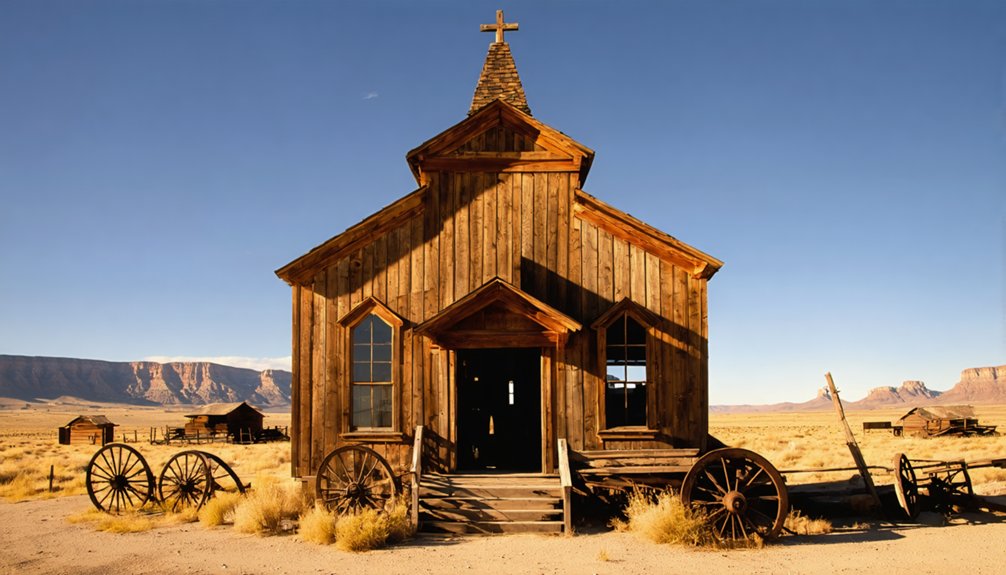
Nestled within the vivid red rock landscapes of Washington County, Utah, Harrisburg stands as a tribute to the resilient pioneer spirit of mid-19th century Mormon settlers. Founded in 1859 by Moses Harris, this settlement initially thrived at the confluence of the Virgin River and local creeks.
Harrisburg history reveals how pioneers faced devastating challenges—the 1862 Virgin River flood, grasshopper infestations, and tensions with Native Americans defending their ancestral lands. These pioneer struggles ultimately led to abandonment by 1895.
Today, you’ll find the Adams House (built 1862-1865) as the primary remaining structure, with stone cottage ruins visible on both sides of I-15.
Despite its ghost town status, Harrisburg offers year-round access for those seeking connection to Utah’s settlement era.
Galena, Kansas: The Lead Mining Boom That Went Bust
In Galena’s once-bustling mining district, you’ll discover how the 1877 discovery of lead ore transformed farmland into a world-leading zinc production center within decades.
The boom rapidly attracted immigrants and companies, with nearly 2.9 million tons of zinc and 700,000 tons of lead extracted before operations ceased around 1970.
Despite remediation efforts since the 1980s, you can still observe the environmental aftermath in the form of contaminated groundwater, mine collapses, and chat piles that continue to shape this now-diminished community.
Mining’s Meteoric Rise
A chance discovery in the spring of 1877 transformed the quiet Kansas landscape into a hive of industrial activity when local young men found lead ore on Egidius Moll’s property.
Within mere months, rival mining companies established Empire City and Galena on opposite sides of Short Creek, attracting thousands of fortune-seekers who excavated shallow pits to extract the valuable galena ore.
The lead mining industry catalyzed explosive development as the population surged from zero to 3,000 in just two months, eventually peaking around 10,000 by the early 1900s.
The Kansas City, Fort Scott & Gulf Railroad’s arrival in 1879 revolutionized operations, enabling deeper mining and efficient ore transportation.
This economic impact rippled through the community, funding paved streets, city services, and diverse businesses that thrived alongside the expanding zinc-lead operations.
Environmental Legacy Remains
While mining brought prosperity to Galena, its environmental aftermath continues to haunt the landscape today. The town’s legacy includes over 4,000 acres covered in waste mine tailings that released metal-bearing dust into surrounding areas.
You’ll find evidence of environmental contamination throughout the region, with lead, zinc, and cadmium dispersed across the Tri-State Mining District.
Mining impacts extended beyond visible scars to affect human health. Studies revealed statistically significant associations between Galena exposure and numerous diseases, including stroke and chronic kidney disease.
Though extensive cleanup efforts have occurred since 1993, with 12.9 million cubic yards of mine waste removed and 602 residential properties remediated, the environmental legacy persists.
Modern regulatory frameworks now guide ongoing restoration efforts, including stream reclamation and native prairie revegetation to control runoff.
Cahokia, Illinois: From Indigenous Metropolis to Abandoned Settlement
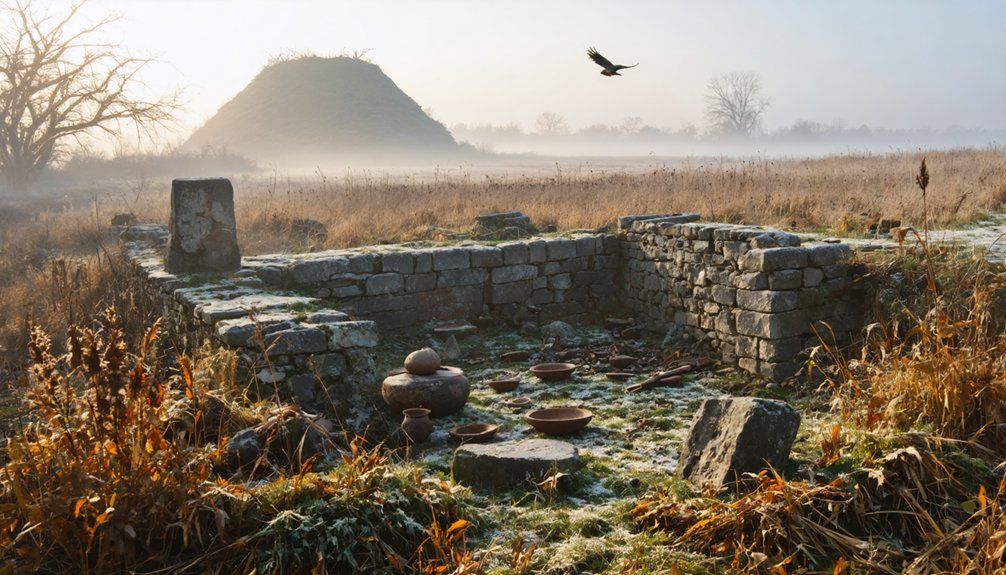
Before the European colonization of North America, Cahokia stood as the continent’s most sophisticated pre-Columbian settlement north of Mexico, flourishing between 1000 and 1400 CE as a metropolitan hub of the Mississippian culture.
At its height around 1100 CE, you’d have encountered a thriving city of 20,000 people centered around the massive Monks Mound—still the largest prehistoric earthwork in the Americas.
Imagine walking through ancient Cahokia—20,000 people living around a massive earthwork unmatched in prehistoric America.
This Indigenous culture practiced complex religious ceremonies, including ritual human sacrifices that maintained social order.
By the late 12th century, however, Cahokia began declining after a major fire, with evidence of increasing warfare and social instability.
The metropolis was completely abandoned by 1400 CE, its Cahokia legacy largely forgotten until French colonists established a nearby settlement in 1698-99.
Bodie, Missouri: Gold Rush Ghosts of the Midwest Frontier
You’ll find Missouri’s forgotten gold boom immortalized in Bodie, where prospectors flocked following an 1859 discovery that briefly transformed the settlement into a thriving frontier community.
The town’s preserved structures offer a glimpse into the harsh realities of Midwest mining life, complete with saloons, churches, and the remnants of a once-vibrant Chinatown district.
Original mining equipment remains scattered throughout the site, including stamp mills and ore processing machinery that powered the economic engine of this boom-and-bust settlement.
Missouri’s Forgotten Gold Boom
When gold was discovered in Missouri’s Mono Basin region in July 1859 by William S. Bodey and E.S. Taylor, few could foresee the forgotten fortunes that awaited.
Bodey tragically perished during a snowstorm that winter, lending his name to the mining district that would later boom.
While initially overshadowed by nearby silver discoveries, everything changed in 1874 when miners Eshington and Lockberg struck an extraordinarily rich vein in the failed Bunker Hill mine.
This discovery transformed a small settlement into a thriving town of 8,000-10,000 residents by 1879.
Mining legends grew as the town produced over $30 million in gold before 1942.
The boom lasted less than a decade before economic decline set in.
Frontier Life Preserved
While Missouri’s gold boom ultimately faded, one remarkable town stands as a living museum of frontier ambition. Bodie, originally named after prospector William S. Bodey, transformed from a modest mining camp to California’s third-largest city by 1880, though a painter’s misspelling changed its name permanently.
The town’s frontier architecture remains in “arrested decay,” with approximately 170 structures still standing—from saloons to homes—providing an authentic glimpse into Wild West urban development.
Cultural artifacts inside these buildings remain exactly as residents left them, stocked with period goods. This preservation philosophy makes Bodie one of America’s most complete examples of a mining boomtown.
Now a State Historic Park and National Historic Landmark, Bodie welcomes 200,000 annual visitors seeking connection to a time when gold fever drove rapid development and lawless frontier living.
Mining Equipment Remains
Rusty remnants of mining’s golden era litter the landscape of Bodie, Missouri, telling a silent but powerful story of technological innovation and human ambition.
You’ll discover ore carts, stamp mills, and rusting rails that once facilitated gold extraction during the 1870s boom. These ghost town artifacts chronicle the evolution from manual to mechanized processing methods that revolutionized frontier mining.
Throughout Missouri’s Lead Belt, where 80% of the nation’s lead once originated, mining relics include preserved drill bits, ore crushers, and conveyor structures.
In Perry County, abandoned mills like Brady’s Mill showcase water-powered technology essential for mineral processing. The region’s abandoned shafts—some now submerged—provide a glimpse into miners’ working conditions.
These archaeological treasures, scattered across Missouri’s ghost towns, preserve the technical ingenuity that fueled America’s mineral rush.
Elkhorn, Wisconsin: When the Railroad Passed By
The arrival of the Milwaukee Road’s branch line in the late 19th century transformed Elkhorn, Wisconsin, from a small agricultural village into a thriving commercial center. Known as the “Bobby Line,” this rail connection linked Elkhorn to Eagle, passing through Troy, and revolutionized the transport of agricultural products and manufactured goods.
The railroad impact extended beyond commerce, spurring population growth and establishing Elkhorn’s importance as the Walworth County seat.
This economic shift proved short-lived, however. When the tracks were torn up in 1933, Elkhorn experienced significant decline. Businesses relocated, commerce dwindled, and the town’s regional significance diminished.
Unlike typical ghost towns, Elkhorn survived this setback, preserving its historic character and county government functions.
Today, you’ll find the “Christmas Card Town” tradition continues, celebrating a cultural identity that emerged after the railroad’s abandonment.
Frequently Asked Questions
Are There Paranormal Reports From These Midwest Ghost Towns?
Yes, paranormal investigations document ghostly encounters at sites like the Villisca Axe Murder House, where you’ll experience children’s voices and moving objects, and Missouri State Penitentiary’s notorious “bloodiest 47 acres.”
Can Visitors Legally Explore These Abandoned Towns Today?
Yes, you can legally access many ghost towns through organized tours, state parks, or historical society programs. Follow visitor guidelines at sites like St. Deroin, which offers interpretive trails within protected boundaries.
What Valuable Artifacts Have Been Recovered From These Sites?
Silent yet eloquent, artifacts speak volumes about our past. You’ll find mining tools, prison bars, household items, and transportation relics recovered from these sites, each providing significant historical context for understanding Midwest frontier life and development.
How Have Local Governments Addressed Preservation Versus Demolition?
You’ll find local governments balancing preservation policies with demolition debates, as seen in Council Bluffs’ saving of Squirrel Cage Jail and BLM’s restoration of Orson B. Adams Home in Harrisburg.
Which Ghost Towns Show Potential for Future Redevelopment?
Astonishingly transformable ghost towns like Thurmond, West Virginia offer you unprecedented redevelopment opportunities through heritage tourism, while towns embracing “reverse NIMBYism” and economic potential through niche industries (wind farms, call centers) present viable investment possibilities.
References
- https://beerconnoisseur.com/articles/infamous-wild-west-ghost-town-beer-city-oklahoma/
- https://dnrhistoric.illinois.gov/research/sitepages/timeline.html
- https://www.geotab.com/ghost-towns/
- https://www.legendsofamerica.com/gt-ghosttownseast/
- https://www.youtube.com/watch?v=lfj6aeZEVJY
- https://battlegroundhistory.com/american-midwest/
- https://www.atlasobscura.com/lists/abandoned-places-midwest
- https://wildwestcity.com/old-west-ghost-towns/
- https://en.wikipedia.org/wiki/Lists_of_ghost_towns_in_the_United_States
- https://hiddenmidwest.com/midwest-ghost-towns-a-hikers-guide-to/