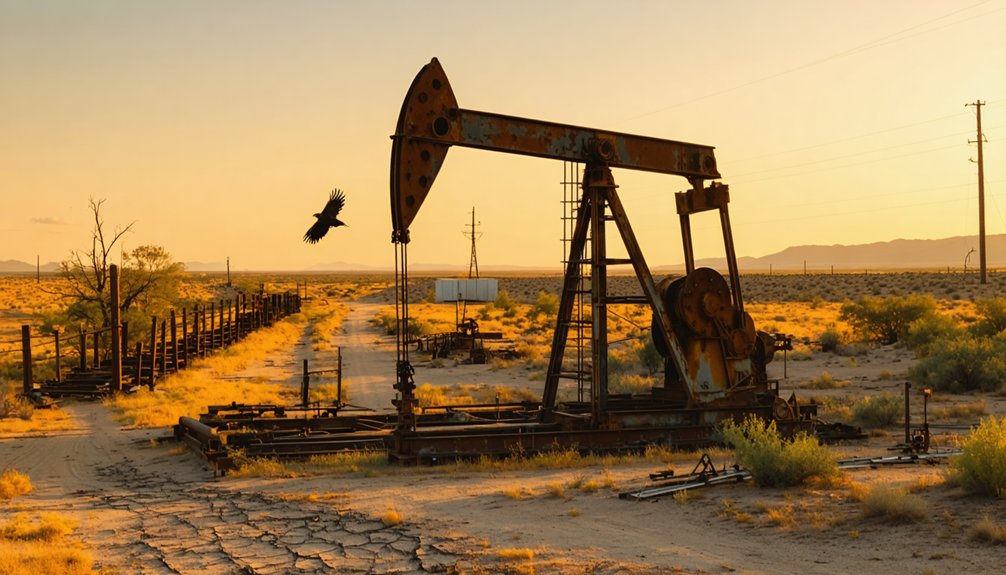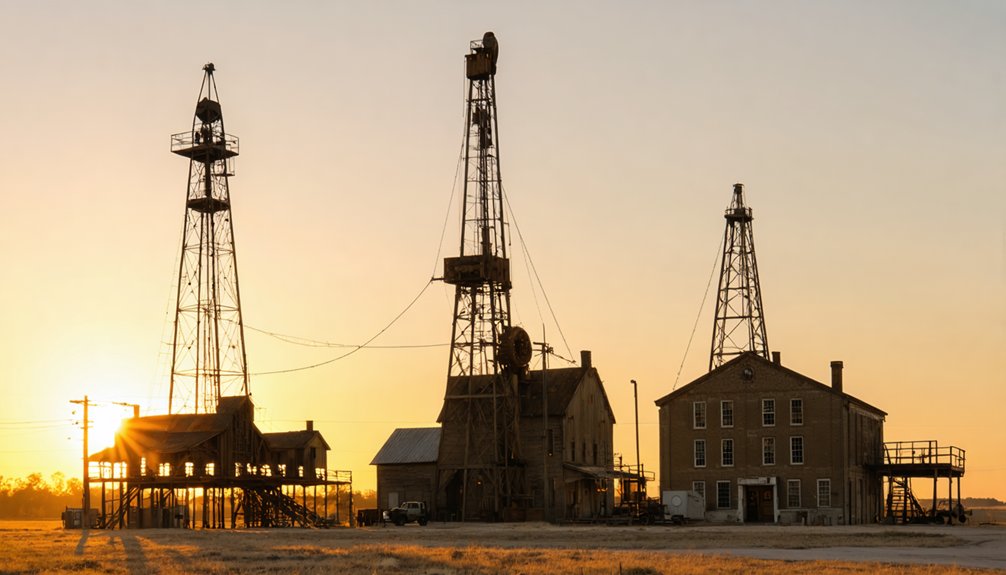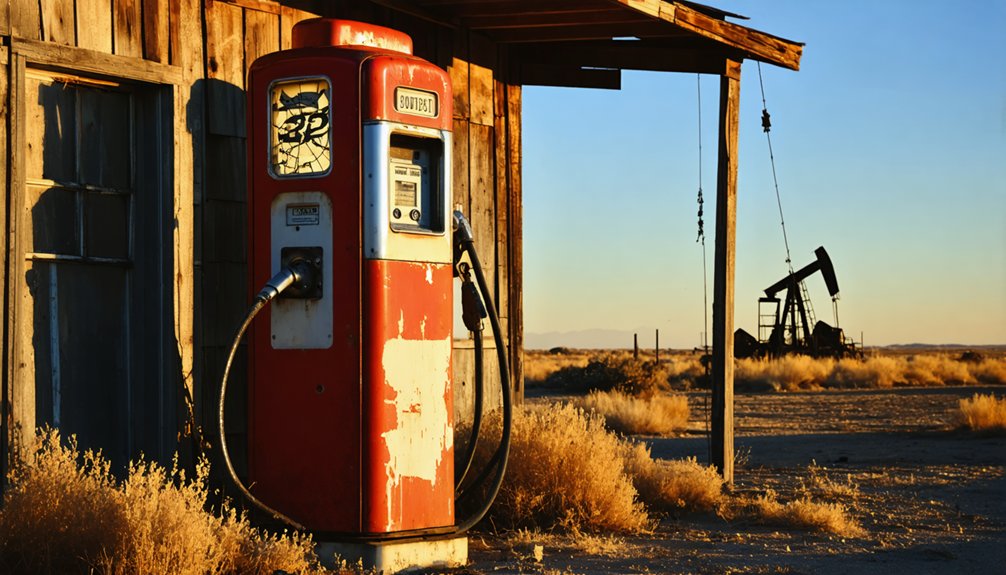
America’s abandoned oil towns offer fascinating glimpses into petroleum’s boom-and-bust legacy. You’ll find California’s Mentryville with its 13-room mansion, Pennsylvania’s Pithole where 15,000 residents vanished within months, and Oklahoma’s lawless Whizbang with stone ruins. Don’t miss Texas’s Sour Lake, Texaco’s birthplace, or Montana’s Garnet with its preserved structures. These silent monuments to industrial ambition reveal America’s complex relationship with resource extraction.
Key Takeaways
- Mentryville, California features Mentry’s thirteen-room mansion and California’s first schoolhouse from 1885 at the site of the state’s first successful oil well.
- Pithole, Pennsylvania offers stone foundations of a once-thriving metropolis that produced one-third of America’s petroleum in 1865.
- Bodie, California maintains over 100 structures in “arrested decay,” including authentic interiors of the Boone Store and remnants of 65 saloons.
- Whizbang (DeNoya), Oklahoma displays scattered stone foundations and crumbling ruins from a lawless 1920s boomtown that once housed 10,000 residents.
- Sour Lake, Texas showcases remnants of early oil infrastructure including the historic site of the Fee No. 3 well that launched Texaco.
Mentryville: California’s Preserved Oil Camp With Historic Structures
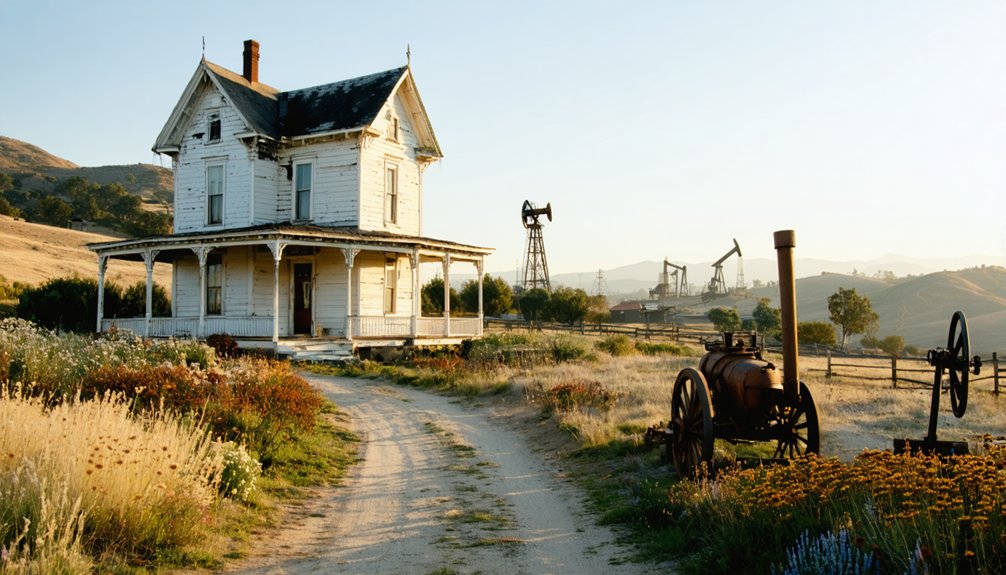
When Charles Alexander “Alec” Mentry struck California’s first commercially successful oil well in 1876, he unknowingly launched what would become one of the most significant petroleum settlements in American history.
Mentryville history begins with Pico No. 4 well, which operated continuously for 114 years until 1990. You’ll find this preserved landmark showcases authentic oil boomtown culture with three key structures: Mentry’s thirteen-room mansion, California’s first schoolhouse built in 1885, and a period barn that supported operations. The area offers beautiful hiking trails that lead visitors through the Santa Susana Mountains with views of historical oil derricks.
The emerald-green oil extracted here fueled the creation of what would eventually become Chevron.
Though alcohol was prohibited within town limits, this tight-knit community of up to 100 families flourished until the 1930s.
Despite its prohibition on alcohol, this closely-connected community thrived for decades with a vibrant population of hardworking families.
Workers earned competitive wages, with experienced drillers making up to $4 per day while unskilled laborers received around $2.50 daily.
Now maintained as California Historical Landmark No. 516, Mentryville offers you a rare glimpse into America’s petroleum pioneering legacy.
Pithole: Pennsylvania’s Rapid Rise and Fall Near Oil Creek State Park
Within the oil-soaked hills of western Pennsylvania, Pithole stands as perhaps the most dramatic example of America’s volatile petroleum boom-and-bust cycle. This quintessential boomtown emerged in 1865 after spectacular oil discoveries, transforming from wilderness to a metropolis of 15,000-20,000 residents in mere months.
At its apex, Pithole’s oil wells accounted for one-third of America’s petroleum production, boasting 57 hotels, a theater, churches, and Pennsylvania’s third-busiest post office. The town’s infrastructure developed with remarkable speed, including complete water works and fire department services. The economic liberty this black gold provided proved fleeting, however, as wells began running dry by 1866. Samuel Van Syckel revolutionized the industry by installing the first oil pipeline in October 1865, drastically reducing transportation costs.
When exploring Pithole history today near Oil Creek State Park, you’ll find only stone foundations where a vibrant city once stood—its meteoric 500-day rise and catastrophic fall preserving valuable lessons about resource dependency and economic freedom’s fragile nature.
Whizbang (DeNoya): Oklahoma’s Wild Boomtown Transformed to Ruins
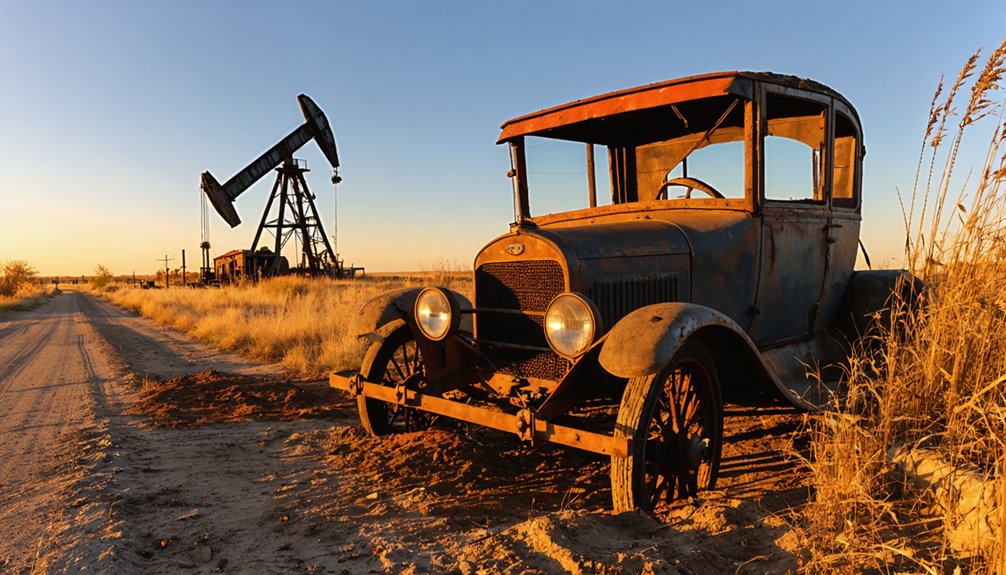
You’ll find few relics more evocative of America’s oil rush than Whizbang, which exploded into existence virtually overnight in 1921 when Ernest W. Marland’s 101 Ranch Oil Company struck wells producing up to 2,500 barrels daily.
Within months, this Osage County boomtown—officially named DeNoya despite locals’ preference for its colloquial title—housed over 300 businesses amid a notoriously lawless atmosphere where violence and shootouts were commonplace.
Visitors were drawn to the town’s infamous Jake joints where dangerous bootleg alcohol like Jamaican Ginger could be purchased during Prohibition.
The town’s prosperity proved as fleeting as its rise was meteoric, with diminishing oil production eventually transforming this once-bustling community into the abandoned ghost town that remains today. Today, explorers can still find visible foundations of buildings and sidewalk remnants lining the former streets of this historical oil town.
exploring abandoned towns in California offers a glimpse into the past and showcases the unique stories each location holds. Many adventurers are drawn to these forgotten places, eager to capture their eerie beauty and the remnants of life that once thrived. Among the crumbling structures and overgrown landscapes, one can almost hear the echoes of history whispering through the wind.
Wild 1920s Oil Rush
Black gold transformed the quiet Oklahoma prairie into a raucous boomtown virtually overnight when Ernest W. Marland’s 101 Ranch Oil Company struck oil in 1921, releasing over 600 barrels daily. The discovery sparked immediate oil prosperity, with subsequent wells producing up to 2,500 barrels per day from the rich Burbank field.
You’ll find Whizbang’s story emblematic of America’s unbridled frontier spirit—a place where fortunes were made amid boomtown chaos. Over 300 hastily constructed buildings housed oil workers, gamblers, and bootleggers who flocked to this lawless community. The town’s curious name originated from a popular magazine of that era, reflecting the period’s cultural influences.
The indigenous Osage tribe, whose land yielded this wealth, witnessed their territory pump out 319 million barrels by 1930. This extraordinary wealth came with notorious violence and disorder, making Whizbang one of Oklahoma’s most dangerous yet economically vibrant settlements. At its peak, the town boasted a population of 10,000 residents seeking opportunity in the oil-rich landscape.
Downtown Overnight Success
When oil erupted from Ernest W. Marland’s well in 1921, Whizbang materialized virtually overnight near Burbank, Oklahoma.
Within months, over 300 business establishments populated this boomtown, serving the influx of workers drawn to wells producing up to 2,500 barrels daily.
Named after a popular humor magazine (though some attribute it to the Osage description of machinery sounds), Whizbang’s moniker captured its wild spirit before a dignified postmaster renamed it DeNoya after a prominent Osage family.
The town’s economic significance stemmed from the Burbank field—part of the Osage “underground reservation” that generated more wealth than all American gold rushes combined. Like many similar settlements, Whizbang is now classified as a ghost town with no remaining inhabitants.
Today, Whizbang exists only in ghost town folklore, its oil boom legacy a reminder of America’s restless entrepreneurial spirit and the transient nature of resource-dependent settlements.
Ghostly Remains Today
Visitors to the former site of Whizbang (later DeNoya) today will find little more than scattered stone foundations and crumbling ruins nestled in the Oklahoma landscape at N36 45.911 W96 42.461, just outside Pawhuska.
These silent remnants stand as potent symbols to America’s tumultuous oil boom narratives, preserving the ephemeral nature of resource-driven prosperity.
As you walk among these weathered stones, you’re treading upon ghost town history that once vibrated with the chaos of three hundred businesses and countless fortune-seekers.
What began as Marland’s empire and transformed into a lawless boomtown now serves as a profound historical marker.
The site’s transformation from bustling industry to abandoned relic offers a contemplative space for those seeking to understand the transitory nature of American industrial development and unfettered capitalism.
Sour Lake: Birthplace of Texaco and Early Texas Refining
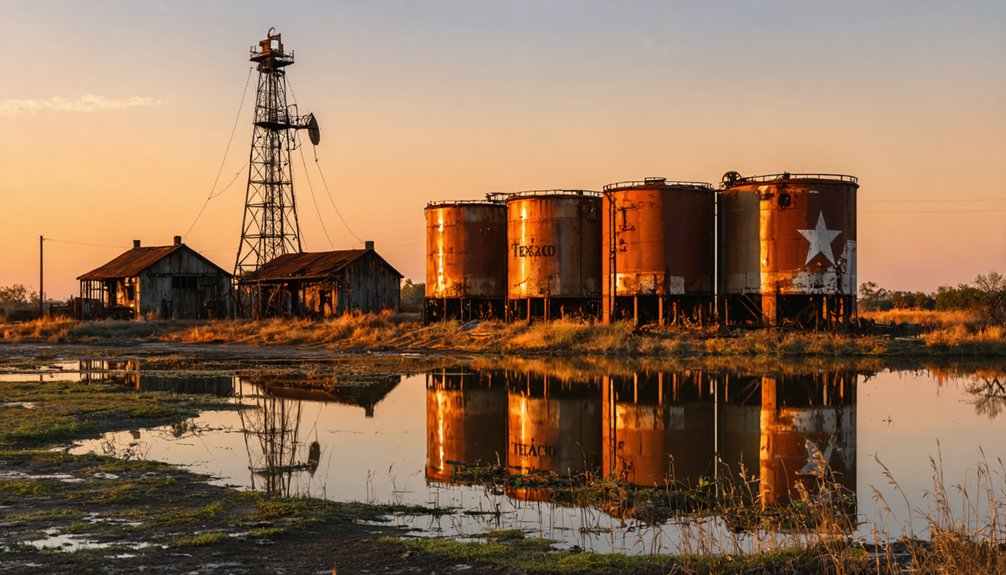
As you traverse Sour Lake today, you’ll find scant evidence of the momentous 1903 gusher that birthed what would become Texaco, transforming this once-popular health resort into a pivotal location in American petroleum history.
Cullinan and Schlaet’s strategic gamble at Sour Lake not only secured their company’s future but established early refining infrastructure that connected this small Texas community to Port Arthur through an elaborate pipeline network, fundamentally altering the region’s economic trajectory.
The environmental legacy of this rapid industrialization remains evident in the landscape, where abandoned derricks and refinery remnants stand as silent testimonials to the boom-bust cycle that defines many early American oil towns. The Texas Company’s Fee No. 3 well, celebrated during the town’s centennial, saved the young company from bankruptcy and launched a petroleum empire.
Historic Gushers and Refinery
The transformation of Sour Lake from a modest mineral springs destination to the birthplace of an oil empire began in the mid-1800s when settlers and Native Americans first utilized natural oil seeps for medicinal purposes.
Sour Lake’s significance in American petroleum history was cemented in March 1902 when the area’s first commercial gusher erupted from 683 feet below the earth.
By 1903, the Texas Company (later Texaco) struck substantial oil here, validating their risk-taking exploration. You can still find remnants of early oil production infrastructure that once processed the high-quality crude trapped in salt dome formations similar to those at Spindletop.
The region’s first Gulf Coast refinery, established in 1898, processed about 100 barrels daily of lubricating oil, setting the foundation for Texas’s industrial revolution along its coastal waters.
Texaco’s Founding Legacy
Birthplace of an American oil titan, Sour Lake transformed from a mineral springs retreat into the cradle of what would become Texaco, one of the petroleum industry’s most enduring legacies.
When Joseph Cullinan‘s third well gushed on his 365-acre option in 1903, you’d witness the Texaco legacy spring forth from East Texas soil. The company, initially capitalized at $3 million with backing from visionaries like John Gates, rapidly developed infrastructure connecting the Sour Lake fields to their Port Arthur refinery via a ninety-mile pipeline system.
The iconic five-pointed star, suggested by a young Italian worker, emerged as a symbol of oil innovation that would soon blanket America.
Boom-Bust Environmental Impact
Long before modern environmental regulations shaped industrial development, Sour Lake’s evolution from peaceful mineral springs to bustling oil town carved an indelible ecological footprint across East Texas.
When you visit today, you’ll witness the scars of unrestrained drilling that once disturbed salt domes and oil sands, leaving behind a landscape forever altered by the 1902 boom.
The environmental restoration efforts can’t fully erase the legacy of abandoned wells and industrial pollution that followed the rapid decline after 1912.
What began as indigenous peoples’ careful use of natural oil seeps transformed into intensive resource extraction that stressed local aquifers and ecosystems.
The remnants of this boom-bust cycle offer a poignant reminder of how unbridled industrial ambition reconfigured both community and environment in the pursuit of progress.
Three Sands: Oklahoma’s Ghost Town With Visible Oil Field Remnants
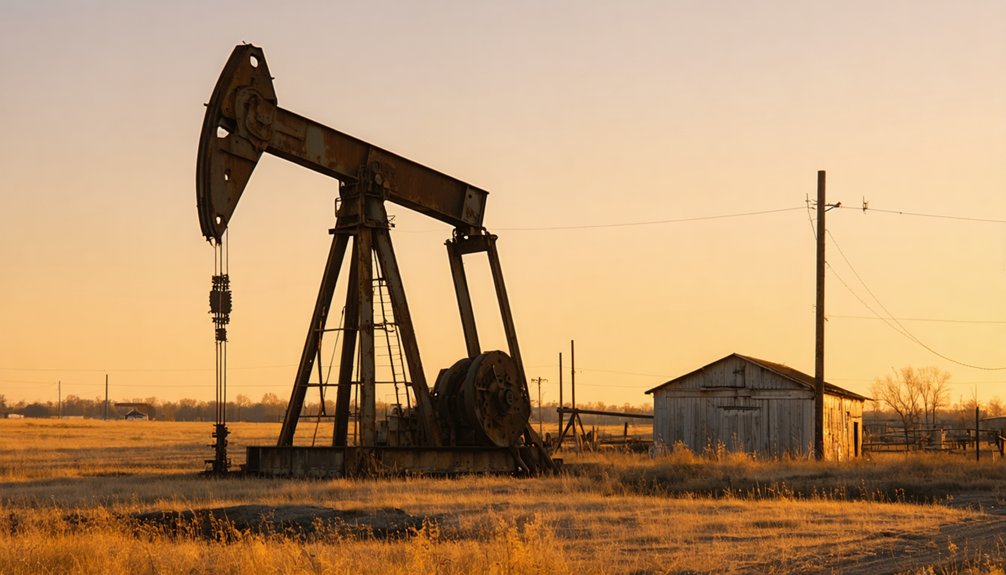
Nestled on the boundary between Kay and Noble counties in Oklahoma, Three Sands stands as a tribute to America’s tumultuous oil history, where remnants of a once-thriving petroleum hub remain visible across the landscape.
Established in 1921 following the discovery of oil in the Tonkawa-Three Sands field, the town experienced rapid prosperity before collapsing in 1926.
Today, your ghost town exploration will reveal foundations of former businesses, weathered derricks, and abandoned oil field infrastructure—testifying to the boom-and-bust cycle that defined America’s early petroleum industry.
The site offers unparalleled oil field history, with visible stone foundations and remnants of camps that housed workers during the boom years.
Visit the nearby Cherokee Strip Museum to contextualize your experience among exhibits documenting Oklahoma’s petroleum heritage.
Corsicana Oil Field: Where Texas Petroleum History Began
You’ll discover Texas’ first commercial oil history at Corsicana, where the accidental 1894 water-well drilling unexpectedly yielded petroleum at 1,035 feet depth.
Powell’s surprising gusher in the late 1890s exemplified the field’s importance, transforming this small trade center into the birthplace of Texas’s petroleum industry with hundreds of wells dotting even residential yards.
The preserved derrick viewing areas allow you to witness the physical remnants of this pioneering oilfield that predated Spindletop and produced nearly 44 million barrels over its century-long operational history.
Texas’ First Commercial Oil
The accidental discovery of oil in Corsicana, Texas, in 1894 marked the pivotal beginning of the state’s illustrious petroleum history, preceding the renowned Spindletop gusher by seven years.
When contractors drilling for water struck oil at 1,035 feet, they unwittingly launched Texas’ commercial oil industry.
Powell’s Surprise Gusher
After Corsicana’s initial oil discovery set Texas petroleum history in motion, Powell’s unexpected gusher in 1900 cemented Navarro County’s significance in America’s oil narrative.
The Powell discovery came after two failed drilling attempts, with perseverance finally rewarded on January 7, 1900. By 1924, production peaked at an astonishing 40 million barrels annually, transforming the region’s economic landscape.
- Visit the weathered derricks that once extracted 56,000 barrels daily during peak production years
- Explore ruins of hastily built housing that sheltered thousands of workers during the 1923 boom
- Witness the pioneering rotary drilling technology sites that revolutionized American oil extraction
- Examine the geological formations that trapped Navarro County’s petroleum treasures beneath sandstone layers
The gusher impact extended beyond economics, influencing Texas’ first drilling regulations and establishing technological precedents.
Preserved Derrick Viewing
While Powell’s gusher propelled Texas into petroleum prominence in 1900, Corsicana’s original oil field had already laid the groundwork for this transformation five years earlier.
Today, you can witness this pivotal chapter in American industrial independence through preserved wooden derricks that once towered 85 feet above residential yards.
These surviving structures offer unparalleled insights into early derrick technology and oil extraction methods that sparked the Texas petroleum revolution. As educational landmarks, they document the technical ingenuity that fueled America’s energy ascendance in the late 19th century.
The preservation efforts honor Corsicana’s pioneering spirit while showcasing the practical tools of energy independence.
When you stand before these weathered sentinels, you’re experiencing the authentic birthplace of Texas oil—predating the famous Spindletop gusher by seven transformative years.
Bodie State Historic Park: Western Mining and Oil Heritage Frozen in Time
Nestled amid the rugged terrain of California’s Eastern Sierra, Bodie State Historic Park stands as one of America’s most authentic and meticulously preserved ghost towns, offering visitors an unparalleled glimpse into the boom-and-bust cycle of Western mining communities.
Following William Bodey’s gold discovery in 1859, this boomtown swelled to 10,000 residents by 1879, only to face abandonment by 1942.
Today, you’ll find over 100 structures maintained in “arrested decay,” precisely as inhabitants left them.
- Explore authentic interiors of the Boone Store and Miner’s Union Hall
- Witness remnants of 65 former saloons that once serviced the raucous mining population
- Discover the multicultural dimensions through preserved Chinatown structures
- Examine the bank vault and other buildings that tell the story of Bodie’s dramatic rise and fall
Slick: From 5,000 Residents to Oklahoma Ghost Town

Once a thriving hub of Oklahoma’s early petroleum industry, Slick emerged from a quiet cotton field into a raucous boomtown virtually overnight following Thomas B. Slick’s discovery well in 1919.
Nicknamed “King of the Wildcatters,” Slick’s legacy lives in this town’s remarkable history.
When you visit today, you’ll find haunting remnants of what was once home to 5,000 souls. The population decline tells a stark tale of boom-and-bust economics—from thousands in 1920 to just 422 by 1930 as oil prospects dried up.
The abandoned railway tracks, grass-cracked sidewalks, and repurposed depot-turned-Baptist church stand as evidence of fleeting prosperity.
Only a single store and filling station remain where bustling streets once accommodated countless cafes, hotels, and pool halls.
Permian Basin: Abandoned Well Sites and Industrial Archaeology
The vast Permian Basin, spanning western Texas and southeastern New Mexico, harbors thousands of abandoned well sites that constitute a troubling industrial archaeology of America’s petroleum history.
The Permian Basin’s abandoned wells form a haunting industrial graveyard—testament to petroleum’s complicated legacy on American soil.
These remnants tell a story of boom-and-bust economics that’s left nearly 8,900 orphan wells in Texas alone, with Pecos County containing over 600 such relics.
- Visit the 200-foot Kelton Ranch sinkhole—a stark monument to the environmental risks posed by improper abandonment
- Observe the contrast between active pumpjacks and nearby abandoned infrastructure dating back decades
- Witness the ongoing plugging operations where workers combat methane leaks from deteriorating well casings
- Explore former worker camps now reclaimed by desert, standing as symbols of transient prosperity
Garnet: Montana’s Preserved Resource Boom Community
While the Permian Basin’s abandoned oil infrastructure reveals the industrial aftermath of petroleum extraction, Montana’s gold rush history offers a different but equally compelling window into America’s resource boom legacy.
When you visit Garnet, you’ll discover Montana’s best-preserved ghost town—a symbol of America’s pioneering spirit. Garnet history encompasses its 1860s origins as a gold mining community that flourished until the early 1940s.
You’ll observe how mining techniques evolved from simple placer mining with pans and sluices to sophisticated hard rock operations at sites like the Nancy Hanks Mine, which yielded approximately $300,000 in gold.
The town’s abandoned structures—including hotels, saloons, and residences—stand frozen in time since World War II drew away the last residents, leaving intact furnishings that tell the authentic story of western resource boom-and-bust cycles.
Frequently Asked Questions
Are Children Allowed to Explore Abandoned Oil Town Structures?
Absolutely not. In a million years, you shouldn’t permit children’s unguided exploration of these hazardous structures. Instead, you’ll find child safety properly maintained through official guided tours where historical significance meets regulatory compliance.
What Safety Equipment Should Visitors Bring to Abandoned Oil Sites?
You’ll need hard hats, steel-toed boots, cut-resistant gloves, safety goggles, respirators, gas detectors, first aid kits, and communication devices. Follow visitor guidelines and safety precautions meticulously when exploring these historical sites.
Do Any Abandoned Oil Towns Still Have Active Petroleum Seeps?
Yes, you’ll encounter nature’s persistent gift at Katalla, Alaska, where active seeps audibly bubble through the muskeg, and near Utah’s Mexican Hat Field—both retaining their historic significance despite abandonment.
Can Metal Detectors Be Used at These Historic Locations?
No, you’re generally prohibited from metal detecting at historic oil towns. Federal and state regulations protect these sites from disturbance, reflecting legitimate historical preservation concerns despite limitations on personal exploration freedom.
Are Overnight Stays Permitted in Any Preserved Oil Ghost Towns?
Like rare desert blooms, ghost town accommodations are scarce in preserved oil towns. You’ll rarely find overnight stays permitted, though nearby lodging often supplements oil town tours for enthusiastic history seekers.
References
- https://www.okhistory.org/publications/enc/entry?entry=GH002
- https://www.geotab.com/ghost-towns/
- https://www.youtube.com/watch?v=oW66pgyhMYM
- https://www.thestoryoftexas.com/discover/campfire-stories/oil-worker
- https://grist.org/abandoned-oil-gas-wells-permian-texas-new-mexico/
- https://okmag.com/blog/a-ghostly-site/
- https://www.epa.gov/mo/town-flood-and-superfund-looking-back-times-beach-disaster-nearly-40-years-later
- https://en.wikipedia.org/wiki/Pithole
- https://savingplaces.org/guides/ghost-towns-on-route-66
- https://wheregalswander.com/mentryville-oil-ghost-town-rich-in-history/