America’s haunted farming communities reveal supernatural phenomena deeply rooted in historical trauma. You’ll find documented cases like the Bell Witch haunting in Tennessee, where violent manifestations terrorized an entire family. Colonial Virginia farmhouses harbor spectral residents, while the Midwest experiences unexplained crop failures and livestock deaths defying scientific explanation. Family secrets, property disputes, and the dark legacy of poor farms contribute to these persistent hauntings. The soil itself remembers what human history tries to forget.
Key Takeaways
- Poor Farms established during the Industrial Revolution housed vulnerable populations and are now sites of reported paranormal activity.
- The Bell Witch Haunting (1817-1821) is America’s most documented supernatural farm occurrence, featuring physical assaults and manifestations in crop fields.
- Unexplained crop failures and livestock deaths without evidence of disease persist in farming communities despite scientific investigation.
- Paranormal phenomena often correlate with historical trauma, property disputes, and burial sites within agricultural landscapes.
- Colonial farmhouses in Virginia display ghostly apparitions, disembodied voices, and sensations of being watched in basement spaces.
The Tragic Legacy of America’s Poor Farms
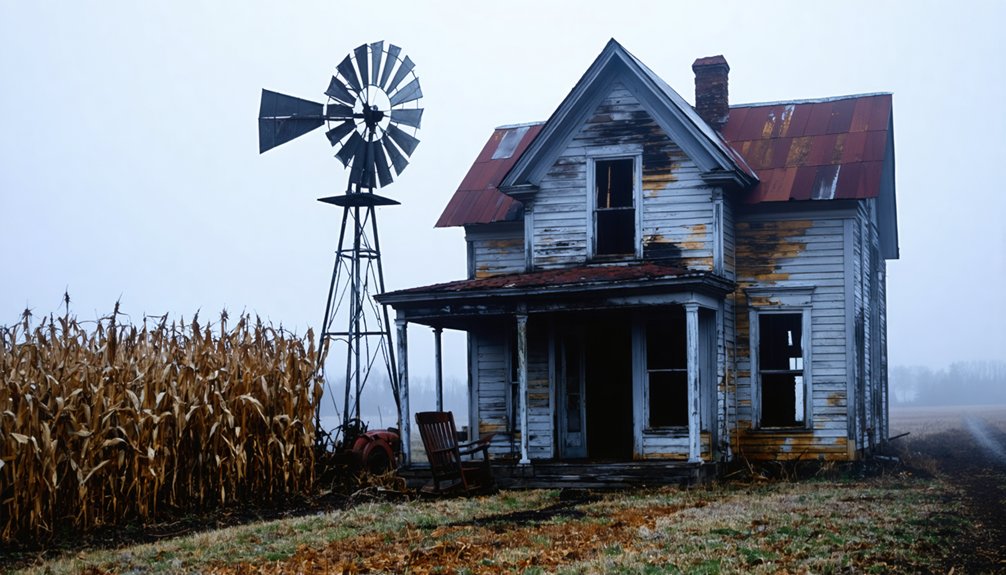
While the idyllic image of American rural life typically conjures visions of family farms and tight-knit agricultural communities, a darker institution once dotted the countryside throughout the nineteenth and early twentieth centuries.
You’d find these “poor farms” across America’s landscape, established during the Industrial Revolution as cost-saving measures for local governments. Their poor farm legacy reveals a complex system where society warehoused its most vulnerable—widows, orphans, the mentally ill, and the financially destitute.
Residents exchanged labor for basic sustenance, working adjacent farmland to make operations self-sufficient. This arrangement emerged during a time when American agriculture was transforming through mechanical innovations that greatly increased productivity elsewhere. Despite agricultural success in some counties, most facilities prioritized economic expediency over humane treatment, with contemporary observers describing deplorable conditions.
The poor exchanged backbreaking labor for meager provisions while counties sacrificed dignity at the altar of frugality.
These institutions embodied significant societal impacts, reflecting the prevailing belief that poverty stemmed from personal failing rather than systemic issues—a perspective that stigmatized residents as “inmates” of their circumstances. At the time, poor farms were actually considered humane solutions to address the complex social problems of the era.
Bell Witch: America’s Most Documented Rural Haunting
When you examine Tennessee’s rural folklore, you’ll find no phenomenon more meticulously documented than the Bell Witch haunting, where an entity known as “Kate” terrorized the Bell family’s Robertson County farmstead from 1817 to 1821.
Your exploration of this supernatural case reveals Kate‘s increasingly violent manifestations—from mysterious animal apparitions to physical assaults on Betsy Bell and the patriarch John Bell Sr., whom the entity ultimately claimed to have poisoned.
The Bell Witch case stands as uniquely American agricultural horror, featuring elements specific to Southern farm life: encounters occurring in crop fields, interactions with enslaved workers, and a disturbing intersection of frontier isolation with supernatural torment. Even prominent figures like Andrew Jackson experienced the entity’s power when his troops reportedly fled after an encounter with the spirit. The legend sparked widespread fascination again in 1937, when locals reported strange incidents and crowds gathered to witness the witch’s promised return 110 years after the original haunting ended.
Supernatural Farm Encounters
Among America’s rich tapestry of rural hauntings, the Bell Witch phenomenon stands as perhaps the most thoroughly documented supernatural occurrence in the nation’s agricultural history.
You’ll find this extraordinary case situated near Tennessee’s Red River, where from 1817 to 1821, the Bell family endured persistent paranormal activity amidst their haunted harvests. The legend has been preserved in approximately twenty books detailing the haunting, with Martin Ingram’s 1894 work often considered the definitive account.
The entity manifested through diverse means—invisible forces pulling bedsheets, chains dragging across floors, and appearances resembling spectral livestock.
What distinguishes this case is its extensive witness corroboration, including community members and allegedly Andrew Jackson himself.
Most chillingly, it remains the only case where a supernatural entity received official blame for a death—John Bell’s poisoning.
The property’s paranormal legacy continues through the Bell Witch Cave, where visitors still report disembodied voices, apparitions, and unexplained sensations—testament to the enduring mystery. Tourists can explore this fascinating history with Bell farm tours available for approximately $20, which includes access to the infamous cave and a replica of the original homestead.
Kate’s Terrifying Presence
As the Bell Witch haunting escalated beyond mere unexplained sounds, the entity soon revealed its identity as “Kate” or “Old Kate Batts’ witch,” establishing itself as America’s most documented agricultural poltergeist.
You’d have encountered a supernatural force with remarkable abilities—speaking audibly, mimicking voices with regional accents, and physically manifesting as invisible hands or peculiar animals like a dog with a rabbit’s head.
Kate’s manifestations evolved from knocks and scratches to violent assaults, leaving Betsy Bell unconscious with welts and pin marks. The haunting seemed to specifically target John Bell’s family during 1817 to 1821, a period well-documented in Robertson County’s history.
Kate’s motivations appeared deeply personal—expressing particular vendetta against John Bell Sr., whom she eventually poisoned with a mysterious black liquid, and actively preventing Betsy’s marriage. After John Bell’s death on December 20, 1820, a strange vial was discovered at his bedside, further linking the witch to his demise.
This shape-shifting entity drew hundreds of visitors to the Tennessee farmstead, including Andrew Jackson himself, whose party reportedly fled in terror.
When the Land Turns Against Its Keepers
The inexorable shift from agricultural prosperity to abandonment often begins subtly, with environmental factors gradually undermining farming communities’ sustainability.
You’ll notice this transformation throughout America’s heartland, where once-thriving regions face ecological upheaval and economic distress.
Consider the Great Plains states, where Dust Bowl devastation of the 1930s destroyed countless farming communities, a pattern now repeating through modern agricultural challenges.
In the southern Appalachians, hemlock woolly adelgid infestations create ghostly forests of dead trees within just four years, fundamentally altering land viability.
Much like haunted house entrepreneurs who face seasonal income challenges, farming communities struggle with financial instability that threatens their continued existence.
Land abandonment accelerates when critical infrastructure collapses.
Communities like King County, Texas—with its 87:1 cattle-to-human ratio—teeter on extinction’s edge.
When schools close, highways divert, or major employers depart, the remaining social fabric unravels rapidly, leaving only echoes of agricultural prosperity.
Texas leads the nation with 26 rural hospitals closed since 2010, triggering cascading effects that threaten the very existence of surrounding farming communities.
Ghostly Echoes in Colonial Farmhouses
Colonial farmhouses throughout America’s eastern seaboard bear silent witness to centuries of human tragedy, triumph, and unexplained phenomena that defy rational explanation.
You’ll discover ghostly apparitions most concentrated in Virginia’s historic triangle, where the Peyton Randolph House (circa 1715) manifests disembodied voices, moving objects, and inexplicable physical sensations.
In Yorktown’s Nelson and Cole Diggs houses, spectral whispers and visions of colonial-era residents persist as if frozen in time.
The basement spaces prove particularly active, where visitors report feeling watched or even restrained by unseen forces.
Native American children’s spirits haunt sites of forced assimilation, their presence a reflection of unresolved historical trauma.
These manifestations, documented by figures like Lafayette and contemporary residents alike, transform colonial architecture into portals where past and present uneasily coexist.
Agricultural Disasters and Supernatural Explanations
When investigating unexplained crop failures throughout America’s agricultural regions, you’ll find persistent patterns of destruction that defy conventional meteorological explanations—particularly in the Midwest’s corn belt and California’s Central Valley.
You’ll encounter documented cases of entire livestock herds perishing simultaneously without evidence of disease, predation, or poisoning, phenomena frequently attributed to supernatural entities rather than natural causes in both historical records and contemporary farmer testimonials.
These agricultural anomalies often coincide with reported paranormal activity, including unexplained lights hovering over fields and nocturnal sounds that correspond precisely with areas of subsequent crop damage.
Unexplained Crop Failures
While agricultural disasters like drought and flooding account for billions in documented crop losses across America, certain farming communities have long reported inexplicable crop failures that defy scientific explanation.
When you examine regions like Kansas, where wheat losses exceeded $1 billion in 2023, you’ll find farmers describing unexplained phenomena surrounding partial field failures—patches where crops simply won’t grow despite identical soil conditions.
In Texas, where drought claimed 80% of crops, isolated pockets of land remain mysteriously barren even after precipitation returns.
These crop anomalies persist across generations of farming families, particularly in communities with documented paranormal histories.
Agricultural scientists attribute most losses to climate factors—the $21.94 billion in 2023 losses primarily stemmed from drought and extreme weather—yet these localized failures remain stubbornly resistant to scientific analysis, preservation efforts, or insurance classification.
Livestock Death Patterns
Beneath the surface of documented agricultural livestock losses lies a perplexing pattern of animal deaths that transcends conventional veterinary explanation in several American farming communities.
While official data catalogs machinery-related accidents and occupational hazards as primary causes of agricultural fatalities, localized accounts suggest alternative explanations.
In regions where livestock hauntings have been reported, farmers document mysterious overnight cattle deaths without predation marks or disease symptoms. These phenomena often correspond with historical trauma on the land—former battlefields or indigenous burial grounds.
The phantom cattle phenomenon, where deceased animals’ silhouettes appear in morning fog, remains particularly prevalent in Midwestern communities with pre-colonial agricultural histories.
Agricultural safety researchers acknowledge these unexplained mortality clusters exist alongside documented causes but remain scientifically unclassifiable within current veterinary frameworks, challenging our understanding of rural agricultural disasters.
Family Secrets Buried in the Fields
Across America’s remote farming communities, family secrets have been literally interred within the soil that sustained generations. The discovery of hidden ledgers from families like the Pritchards reveals meticulous documentation of lineages, often concealing inbreeding practices and disappearances beneath seemingly mundane records.
These agricultural enclaves developed distinct family rituals around burial and harvest, isolating themselves from outside scrutiny.
These rural bloodlines cultivated their own ceremonial darkness, burying both bodies and truth beyond society’s prying eyes.
Your exploration of these forgotten histories might reveal:
- Standing graves where the deceased were buried vertically to “maintain watch” over living descendants
- Hidden cellars containing artifacts from forbidden harvest feasts, suggesting cannibalistic practices
- Evidence of family separation, where members deemed “undesirable” were institutionalized or concealed from society
The Appalachian region proves particularly rich with such discoveries, where family burial grounds frequently contain both ancestral remains and the evidence of their secretive practices.
Frontier Property Disputes and Lingering Spirits

As America’s frontier expanded westward during the 19th century, the seemingly straightforward process of claiming land became entangled in a complex web of conflicting legal systems, cultural differences, and violent confrontations that continue to manifest spiritually in rural communities.
You’ll find ghostly hauntings concentrated in regions where property disputes were most contentious—particularly in New Mexico’s Costilla Valley, where Hispano settlers and Anglo-American interests clashed over the Sangre de Cristo Land Grant.
In addition to these haunting tales, the abandoned ghost towns of Virginia offer a glimpse into the past, where once-thriving communities succumbed to time. Walking through their empty streets and derelict buildings, one can almost hear the echoes of lives that were once vibrant. Each town holds its own story of prosperity turned to desolation, leaving behind remnants that intrigue both local explorers and history buffs alike.
These spirits emerge from the violent enforcement of ill-defined property claims, especially in regions like Wyoming, where cattle barons hired gunmen to eliminate homesteaders.
The collision of Anglo-capitalist land development with traditional Mexican communal holdings created not just legal conflicts but spiritual wounds.
Areas with “floating land grants” and contested water rights remain particularly susceptible to paranormal activity—echoes of frontier justice gone tragically awry.
Preserving Haunted Agricultural Heritage
The preservation of haunted agricultural heritage represents a multifaceted endeavor where spectral phenomena intersect with tangible farming traditions, creating unique conservation challenges for rural communities.
Haunted farmsteads embody our cultural crossroads where ghostly whispers meet the weathered wisdom of rural tradition.
You’ll discover that haunted narratives serve as vehicles for transmitting agricultural knowledge across generations, while ecological restoration of these sites physically manifests the land’s memory of exploitation and renewal.
- Document oral histories from farming communities to preserve intangible cultural elements alongside paranormal accounts
- Support sustainable farming practices that reveal “positive hauntings” through biodiversity recovery on previously degraded farmland
- Develop heritage tourism collaborations between preservationists and tour operators that emphasize the Appalachian, Midwestern, or Southern agricultural contexts of haunted sites
These preservation efforts ultimately safeguard both spectral phenomena and agrarian traditions that might otherwise vanish from America’s rural landscape.
Frequently Asked Questions
Can Paranormal Activity Impact Livestock Fertility and Reproduction Rates?
You’ll observe livestock behavior changes when paranormal phenomena intersect with regional fertility rituals. Agricultural communities maintain precise supernatural practices believing they directly enhance reproduction rates through established metaphysical mechanisms.
What Role Did Indigenous Sacred Sites Play in Farm Hauntings?
You’ll find Menominee raised ridge farmlands in Wisconsin remain haunted because settlers’ desecration of sites with spiritual significance disrupted ancestral connections. Your farm’s paranormal experiences likely stem from violated cultural reverence to these sacred grounds.
How Did Weather Anomalies Correlate With Documented Paranormal Events?
You’ll notice distinct weather patterns—electromagnetic fluctuations, barometric pressure drops, and localized cold anomalies—consistently preceding ghostly apparitions. These meteorological conditions create ideal energy fields for paranormal manifestations within specific regional environments.
Were Paranormal Occurrences More Common on Properties With Water Features?
As clear as day, your property’s water features markedly heighten paranormal activity. Records indicate water spirits appear frequently near ponds and rivers, with ghostly reflections manifesting most commonly during evening changes.
Did Farming Implements Ever Become Instruments of Unexplained Phenomena?
Yes, you’ll find haunted tools frequently manipulated by unseen forces in American farming hauntings, particularly at the Bell Farm where spectral tractors and implements became extensions of supernatural aggression, moving independently despite their static nature.
References
- https://www.paraholics.com/p/haunted-poor-farm-the-real-ghost
- https://www.natickhistoricalsociety.org/news/2025/11/2/the-haunted-house-of-bacon-brook-a-new-look-at-the-land-beneath-natick-community-organic-farm
- https://www.agweb.com/news/crops/crop-production/ghost-house-forgotten-american-farming-tragedy
- https://www.terrorfarm.com/new-index
- https://customshousemuseum.org/news/the-bell-witch-the-scariest-ghost-story-in-tennessee/
- https://nchauntedfarm.com/about-scariest-haunted-house-in-north-carolina/
- https://usghostadventures.com/haunted-stories/the-bell-family-farm/
- https://www.geotab.com/ghost-towns/
- http://www.ers.usda.gov/amber-waves/2005/september/farm-poverty-lowest-in-u-s-history
- https://en.wikipedia.org/wiki/History_of_agriculture_in_the_United_States