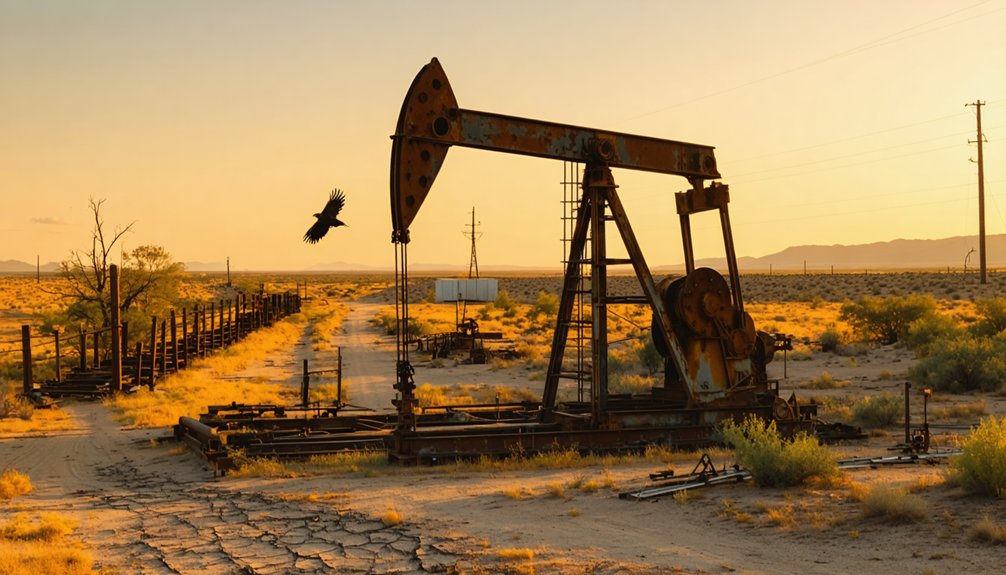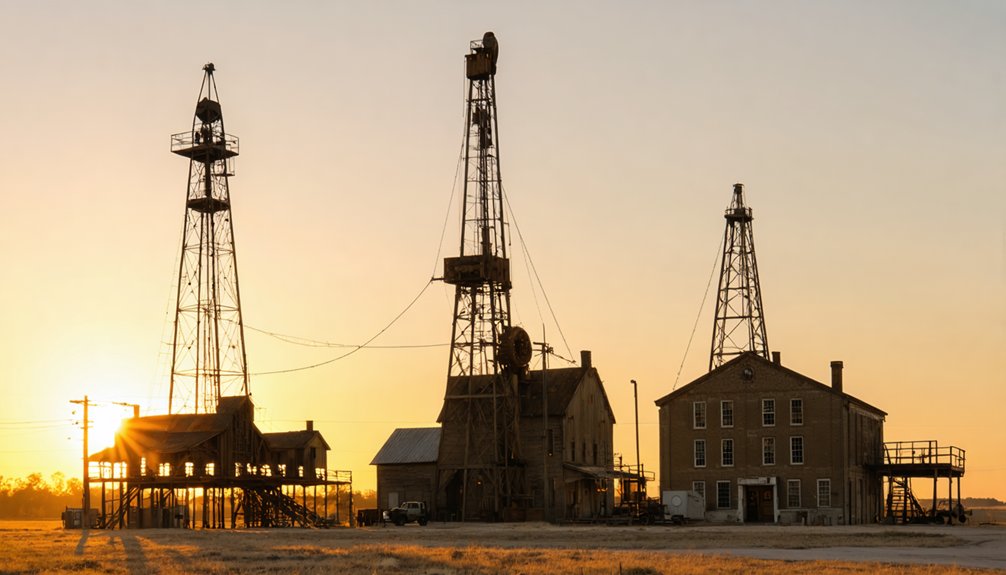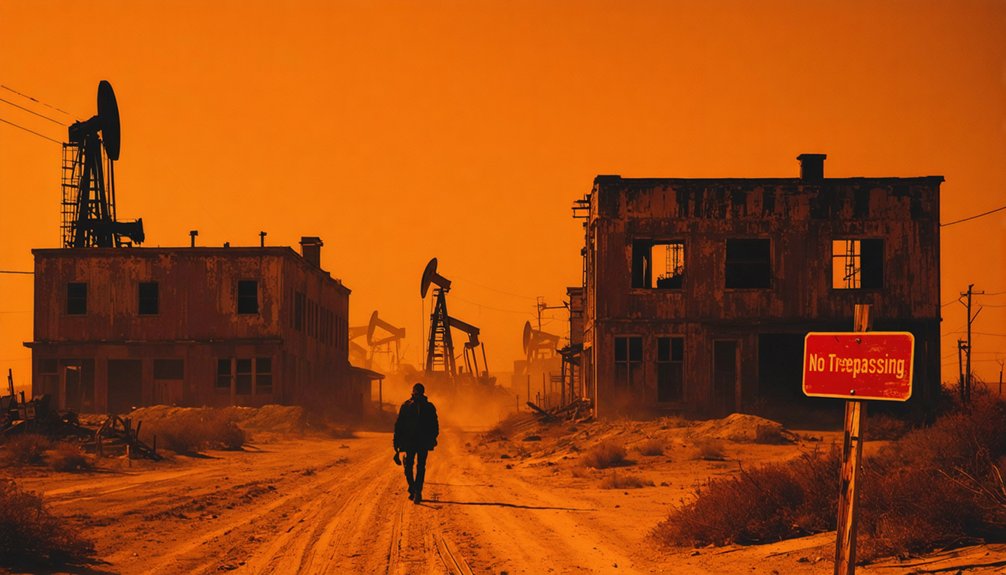
When exploring abandoned oil towns, prioritize safety with proper gear: respirators, steel-toed boots, gloves, and hard hats. Research legal considerations first—many sites have separate mineral rights and trespassing laws. Document your journey with waterproof cameras while watching for environmental hazards like stunted vegetation or unusual oil sheens. Connect with local communities to understand historical context and contribute to citizen science initiatives. The secrets buried beneath these forgotten landscapes await your careful discovery.
Key Takeaways
- Always prioritize safety with proper gear including respirators, steel-toed boots, gloves, and hard hats when exploring abandoned oil infrastructure.
- Research legal considerations beforehand, as mineral rights may differ from surface rights and trespassing could lead to environmental liability.
- Utilize technology such as offline maps, GPS devices, and magnetometers to safely locate and navigate industrial sites and hidden hazards.
- Document findings responsibly with proper photography equipment while respecting historical contexts and potential environmental contamination.
- Engage with local communities to gather historical insights and consider participating in citizen science initiatives to help with remediation efforts.
Identifying the Safety Risks of Abandoned Oil Infrastructure
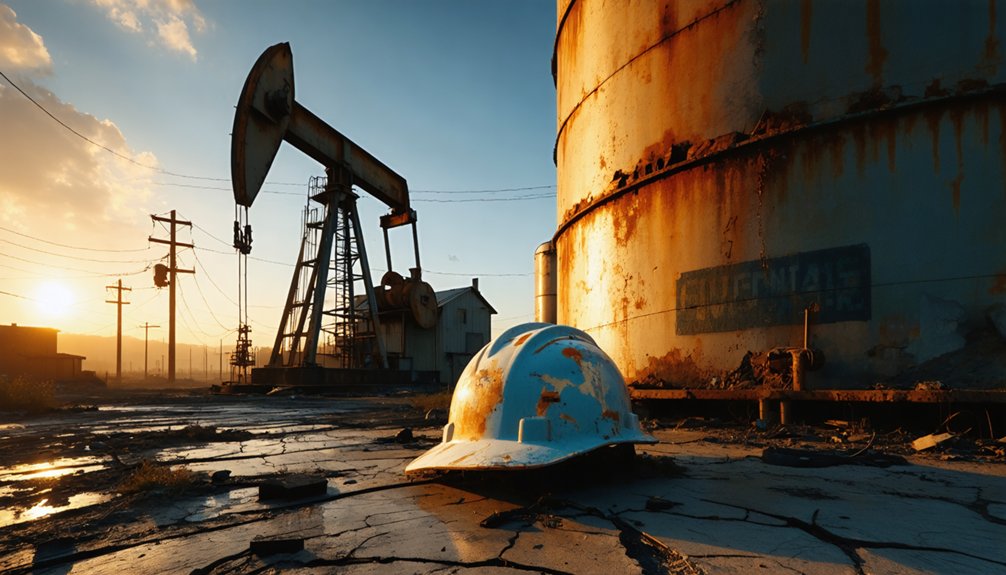
Five major safety risks lurk beneath the surface of abandoned oil towns, transforming these once-thriving industrial hubs into potential danger zones.
As you explore these ghost towns, watch for unstable infrastructure hazards—corroded tanks and platforms ready to collapse without warning. Hidden well casings and flowlines, often concealed by vegetation, create treacherous tripping hazards. Current regulatory failures have allowed approximately 3.5 million abandoned wells to exist across the United States without proper remediation.
You’re also facing invisible contamination risks from leaking chemicals that poison groundwater and soil. Deadly gases like methane and hydrogen sulfide silently accumulate, posing explosion and respiratory threats. These abandoned sites can release harmful toxins like benzene, which have devastating long-term effects on the surrounding environment.
Invisible killers lurk in abandoned oil towns, where toxic chemicals and deadly gases threaten life with every step.
Don’t be fooled by seemingly solid ground—sinkholes can open suddenly beneath your feet where wells have compromised underground stability. The danger intensifies with poor documentation, as many hazardous wells remain unrecorded and untreated.
Essential Gear and Equipment for Urban Exploration
You’ll need essential safety equipment including respirators, helmets, and proper footwear before venturing into abandoned oil town structures where hazards lurk around every corner.
Equip yourself with quality documentation tools—a waterproof camera with extra batteries, notebook, and measuring tools—to capture the fascinating architectural details and historical elements you’ll encounter.
Don’t overlook vital navigation gear like offline maps, compass, and communication devices that will keep you oriented and connected when exploring these forgotten industrial landscapes. A reliable headlamp provides illumination in dark corridors and basement areas where natural light cannot reach. Consider carrying a robust, waterproof backpack to protect your equipment from the elements while maintaining mobility through deteriorating structures.
Safety Gear Priorities
When venturing into the skeletal remains of forgotten oil towns, your survival hinges on having the right protective gear.
Your safety equipment priorities should follow a hierarchy based on the most common threats these decaying structures pose.
- Respiratory protection – Dust respirators with activated charcoal filters shield your lungs from asbestos, mold spores, and toxic particles lurking in stale air.
- Rugged footwear – Steel-toed, water-resistant boots with puncture-proof soles prevent injuries from rusty nails and collapsed flooring.
- Hand protection – Cut-resistant tactical gloves balance dexterity with protection, allowing you to handle debris while preventing lacerations. A comprehensive first-aid kit should always be carried to address minor injuries that may occur during exploration.
- Head and eye shields – A hard hat with mounted headlamp protects against falling debris while illuminating your path through the darkness. Always pack backup batteries to ensure your light source remains operational throughout your exploration.
Documentation Tools
Documenting your expedition into the ghostly corridors of abandoned oil towns requires specialized tools that balance durability with functionality.
Prioritize a full-frame mirrorless camera with long-exposure capability for capturing the haunting details that smartphones miss in low light. Mount it on a lightweight tripod to nail those atmospheric shots when darkness envelops forgotten machinery.
Layer your documentation techniques with both digital and analog systems—GPS devices with offline maps paired with traditional compass and paper backups guarantee you’ll record your route even when technology fails.
Your photographic strategies should include varied lighting tools: a high-lumen flashlight for illuminating vast spaces and a headlamp for hands-free operation during precise camera work. A quality camera allows you to capture high resolution images of architectural details and artifacts that tell the story of these abandoned places. For safety reasons, be sure to inform trusted contacts of your exploration plans before venturing into these deserted locations.
Don’t forget voice recorders to capture the eerie ambience that photographs alone can’t convey.
Traversing the decaying infrastructure of abandoned oil towns demands navigation equipment that won’t falter when you’re deep inside forgotten industrial complexes.
Your freedom to explore relies on redundant navigation systems that function when cellular signals disappear beneath layers of concrete and steel.
- GPS Navigation devices with offline capability – critical for maintaining your bearings when exploring multi-level structures where disorientation happens quickly
- Offline Maps loaded onto both smartphone and dedicated GPS units guarantee you’ll never lose your way back to civilization
- Traditional compass and paper maps serve as fail-safe backups when batteries die or electronics malfunction. Having physical maps as backup to electronic devices is absolutely essential for safety during exploration.
- Headlamps with multiple lighting modes keep your hands free for climbing while illuminating structural details that might reveal hidden passages or potential dangers. The Petzl ACTIK CORE Headlamp with 450 lumens output provides exceptional visibility in the darkest corners of abandoned structures.
Understanding Legal Considerations Before Your Visit
Although abandoned oil towns possess a magnetic allure for explorers, you’ll need to navigate a complex web of legal considerations before setting foot on these properties.
Remember that mineral rights often exist separately from surface rights, meaning you can’t assume vacant land is free to access. The original operators hold legal rights to equipment and infrastructure, even if abandoned.
Land that appears abandoned may still be legally protected through separate mineral and infrastructure rights.
You’re obligated to report any abandoned wells you discover to state environmental agencies—it’s not just good citizenship, it’s your legal duty.
Trespassing on these properties could expose you to environmental responsibilities if contamination spreads. Don’t disturb wells or equipment, as this might trigger cleanup liability.
Always secure proper permissions from current landowners, and check local regulations regarding abandoned property access.
Researching Historical Context and Well Documentation
Before exploring any abandoned oil town, you’ll need to examine well records maintained by state agencies, historical societies, and sometimes tribal authorities to understand what lies beneath the surface.
As you prepare for your journey to discover ghost towns in Arizona, consider researching their history and significance, as each town has its own unique story and artifacts waiting to be uncovered. Additionally, connecting with local historians can provide invaluable insights and guidance, enhancing your exploration of these fascinating remnants of the past. Whether you’re seeking adventure or a deeper understanding of history, these ghost towns are sure to offer an unforgettable experience.
Create or acquire detailed maps that mark abandoned well sites, structures, and potential hazards, noting that many wells remain undocumented or were plugged using outdated methods.
Tracking ownership transfers through county records can reveal which companies might still bear legal responsibility for site remediation, though many wells have been orphaned as companies dissolved or declared bankruptcy.
Understanding Well Records
Five critical types of well records form the foundation of any serious oil town exploration.
When you’re tracing an abandoned site’s history, the documentation reveals operational timelines, resource potential, and regulatory compliance status.
You’ll need to navigate state geological surveys and local historical societies, pushing past bureaucratic barriers to uncover the truth beneath the surface.
Prioritize these records in your hunt:
- Drilling permits – they reveal initial authorization details and property boundaries
- Production history logs – these track resource output over the well’s lifespan
- Abandonment records – documenting closure methods and reasons for decommissioning
- Geological surveys – mapping subsurface formations and resource assessments
Don’t be deterred by incomplete archives or proprietary restrictions.
The freedom to explore depends on your persistence through fragmented record systems.
Mapping Abandoned Sites
Cartographic treasures from the past century hold the key to uncovering America’s forgotten petroleum landscape.
You’ll find remarkable success using historical map analysis techniques that leverage AI systems trained on USGS topographic maps dating back to 1884. These advanced algorithms can spot those telltale hollow black circles marking oil wells with up to 98% precision.
When exploring abandoned site preservation, cross-reference AI-identified locations with state registries to discover wells missing from modern databases.
Verify your findings using field magnetometers to detect buried steel casings or analyze satellite imagery for surface structures. The technology pinpoints locations within 10 meters—critical accuracy when you’re standing in Oklahoma’s overgrown fields or California’s developed suburbs, searching for industrial relics that time forgot.
Tracking Ownership Transfers
Tracing the ownership labyrinth of abandoned oil wells requires detective-level determination as you navigate through decades of complex mineral rights transfers. Your freedom to explore these historical paper trails hinges on methodical research and persistence through county records.
When examining ownership documentation, follow these essential steps:
- Start with the current surface owner’s deed, then work backward to identify when mineral rights were first severed.
- Search county deed records for transfers spanning at least 20 years to establish a complete chain of title.
- Document all mineral deed transfers, noting specific rights conveyed and consideration paid.
- Verify proper recording of all transfers to identify potential gaps in title examination.
Don’t overlook division orders and W-9 forms—these reveal vital ownership percentages and tax information that could reveal the final pieces.
Spotting Environmental Warning Signs at Former Well Sites
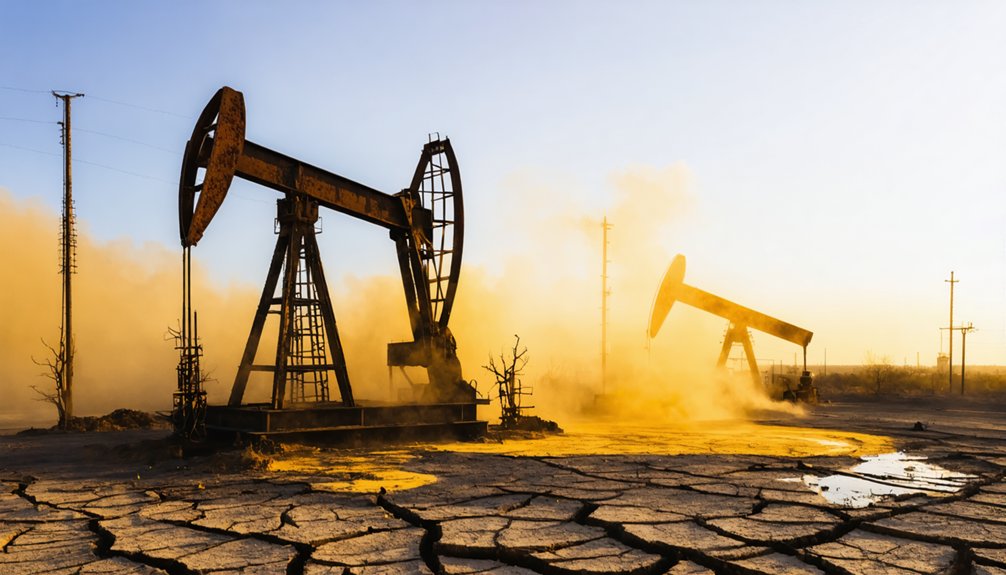
When exploring abandoned oil towns, your ability to recognize environmental warning signs could be the difference between a safe expedition and a hazardous encounter with toxic legacy contaminants. Trust your senses as you investigate these forgotten landscapes.
Look for stunted vegetation, dead zones, or unusual oil sheens on water surfaces. The absence of wildlife speaks volumes about environmental impacts. Be alert to bubbling water, strange odors, or visible rust and debris around wellheads. These aren’t mere aesthetic blemishes—they’re warnings.
Remember that invisible dangers lurk beneath the surface. Methane is odorless but deadly, while soil may harbor radioactive materials and carcinogens.
With 4.6 million Americans living within 1 km of orphaned wells, community awareness of these hazards remains essential for those seeking adventure in these industrial ruins.
Photographing Ghost Towns Without Disturbing Evidence
Capturing the haunting beauty of abandoned oil towns requires a delicate balance between documentation and preservation. Your lens serves as witness to history without leaving footprints behind.
Photography is silent testimony to forgotten places—preserving memories without disturbing the delicate traces of lives once lived.
Practice these preservation ethics while mastering composition techniques that respect these fragile time capsules.
- Set up your equipment on stable ground away from structures, using telephoto lenses for distant details rather than disturbing spaces.
- Work with available light—position yourself to capture natural illumination rather than moving artifacts for better exposure.
- Document methodically with wide establishing shots before moving to details, creating context without rearrangement.
- Shoot in RAW format while maintaining detailed logs of your finds, allowing proper documentation without repeated visits.
Connecting With Local Communities and Their Stories
Beyond the silent facades and rusted equipment lies the beating heart of abandoned oil towns—the people whose lives intertwined with the industry’s rise and fall.
Their community narratives reveal truths no historical marker can capture.
Attend town halls and cultural gatherings where residents share oral histories that expose environmental injustices and celebrate resilience.
Connect with local advocates who’ve witnessed the toxic legacy firsthand—they’ll guide you to overlooked stories of displacement and adaptation.
Support revitalization efforts by participating in cleanup projects or patronizing local businesses that preserve the town’s heritage.
When approaching community members, lead with transparency about your intentions and practice respectful listening.
Remote oil territories present a labyrinth of geographic challenges that demand equal parts preparation and adaptability.
Navigating oil territories requires meticulous preparation matched with the flexibility to adapt when nature inevitably disrupts your plans.
You’ll face geographic barriers that can transform an adventure into a survival situation without proper planning. Extreme weather, unstable ground, and wildlife hazards compound the inherent terrain challenges of these forgotten industrial landscapes.
When venturing into these isolated domains, always:
- Prepare redundant navigation systems—GPS with offline maps, compass, and physical topographic charts
- Plan for seasonal access limitations, as routes may become impassable during rain or snow
- Verify resource locations using multiple data sources to overcome mapping inaccuracies
- Establish communication protocols with emergency contacts, as cellular networks are typically non-existent
Your freedom to explore these territories hinges entirely on respecting their unforgiving nature.
Contributing to Citizen Science Efforts During Your Exploration
While exploring abandoned oil towns, you’ll discover unique opportunities to contribute meaningfully to scientific research through citizen science initiatives.
The Orphan Wells Locations Survey invites your direct citizen engagement, allowing you to document forgotten well coordinates using GPS and field notes.
Arm yourself with smartphone-based magnetometer apps to detect buried well casings, then submit your findings to central databases. You’re not just exploring—you’re generating essential data for methane emissions research and environmental remediation.
After brief training on identification protocols, you’ll join a network of explorers whose collective efforts help protect community health and create remediation jobs.
Through data sharing with researchers like Dr. Natalie Pekney, your weekend adventure transforms into significant scientific documentation that informs federal plugging initiatives across Pennsylvania, Texas, and beyond.
Frequently Asked Questions
How Much Should I Budget for a 3-Day Abandoned Oil Town Expedition?
You’ll need a whopping $600-$1,200 for your epic expedition! Pack expedition essentials wisely and follow smart budgeting tips to explore freely while covering transportation, accommodation, safety gear, and emergency funds.
What Wildlife Hazards Exist Near Abandoned Oil Infrastructure?
You’ll encounter wildlife trapped in equipment, toxic chemical leaks poisoning animals, hazardous materials contaminating habitats, and dangerous gases. Prioritize wildlife safety by watching for distressed creatures and avoiding unstable structures.
Can I Collect Artifacts or Samples From Abandoned Oil Sites?
You’ll need legal permissions first—collecting artifacts without them risks hefty fines. Consider ethical implications too; these sites hold valuable historical context that’s destroyed when items are removed indiscriminately.
Are Abandoned Oil Towns Accessible During Winter Months?
Most aren’t. Winter accessibility plummets as unplowed roads freeze over. You’ll need snowmobiles or skis, plus survival gear for oil town safety. The adventure’s thrilling but potentially deadly—plan meticulously.
How Do I Identify Sinkholes or Unstable Ground Around Old Wells?
Like nature’s warning flags, look for round depressions, cracks in pavement, and wilting vegetation. You’ll need magnetometers for sinkhole detection, while GPR and LiDAR improve ground stability assessment around wells.
References
- https://www.texastribune.org/2016/12/21/texas-abandoned-oil-wells-seen-ticking-time-bombs/
- https://pubs.acs.org/doi/10.1021/acs.est.2c03268
- https://www.statista.com/statistics/1135734/us-abandoned-oil-gas-wells/
- https://abcnews.go.com/US/abandoned-oil-gas-wells-us-bring-fears-leak/story?id=116764814
- https://www.journals.uchicago.edu/doi/10.1086/719383
- https://www.landapp.com/post/what-are-the-risks-of-abandoned-wells
- https://www.fws.gov/story/abandoned-oilfield-equipment
- https://www.planetizen.com/news/2024/12/133316-silent-threat-americas-abandoned-oil-wells-and-danger-beneath
- https://welldonefoundation.org/orphaned-oil-and-gas-wells-are-dangerous-to-our-water-and-air-supplies/
- https://www.alleghenyfront.org/abandoned-oil-and-gas-wells-emit-carcinogens-and-other-harmful-pollutants-groundbreaking-study-shows/