America’s abandoned utopian communities dot the Northeast and Midwest, with notable sites like New Harmony (Indiana) and Brook Farm (Massachusetts) accessible to explorers. You’ll need permission before visiting these often private properties, and should bring proper equipment—respirators, sturdy footwear, and cameras with wide-angle lenses. Document these crumbling monuments ethically, respecting their physical fragility while capturing their architectural innovations and philosophical aspirations. The weathered facades conceal profound stories of American idealism.
Key Takeaways
- Secure legal permission before exploring sites as many abandoned communities are on private property requiring owner consent.
- Bring essential equipment including a full-frame camera, wide-angle lenses, sturdy tripod, and respirator for safe documentation.
- Visit notable preserved sites like New Harmony, Indiana with 180 historic structures or the National Historic Landmark Village of Zoar.
- Respect site integrity by following “take only photos, leave only footprints” principles and avoiding publishing exact locations.
- Inform someone of your itinerary when visiting remote locations with limited cellular coverage for safety.
Mapping the Lost Utopias: Where to Find Historical Community Sites
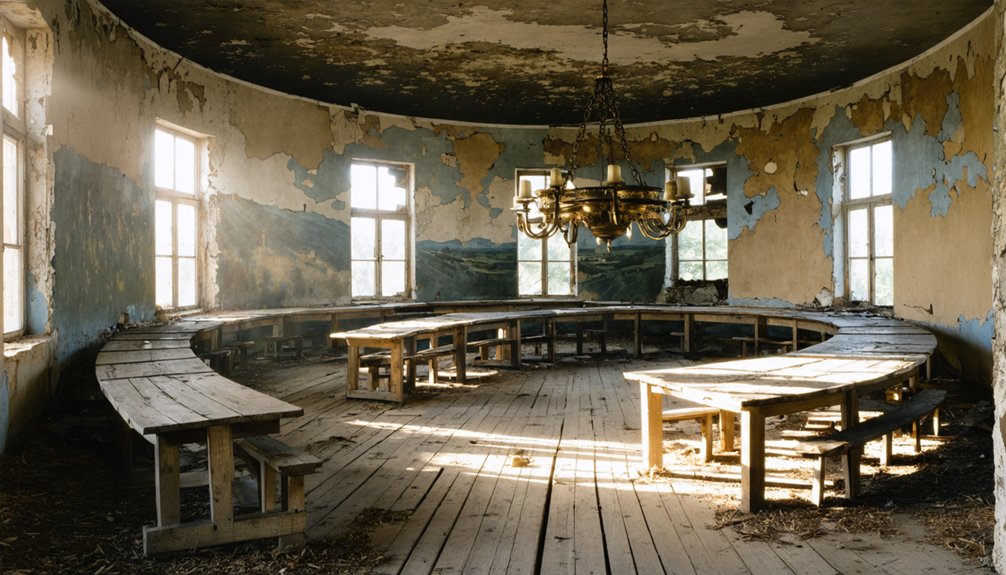
Scattered across America’s forgotten landscapes, the skeletal remains of utopian dreams lie half-buried in time, waiting for the curious traveler to uncover their stories.
You’ll find these lost communities concentrated in two distinct regions: the intellectual experiments of the Northeast—Brook Farm’s transcendentalist ruins in Massachusetts and Oneida’s mansion house in New York—and the practical agricultural communes of the Midwest, including New Harmony’s 180 historic structures in Indiana.
The historical significance of these sites varies dramatically.
Some utopian communities became national treasures, while others faded to whispers on forgotten land.
Pennsylvania’s Harmony and Economy settlements stand as National Historic Landmarks with preserved brick dwellings, while more obscure experiments like Valcour Island’s free-love community and Shalam’s 3,000-person settlement near El Paso have faded almost entirely from collective memory, leaving only fragments for the archaeological imagination to reconstruct. The Harmonists, led by George Rapp, constructed innovative buildings and established a self-sufficient economy during their time in Indiana. The Amana Colonies in Iowa represent one of the longest-lived communal societies with seven historic villages that maintained their religious and economic independence well into the 20th century.
Exploring the Architectural Legacy of America’s Utopian Dreams
You’ll find in these weathered structures the encoded philosophies of utopian dreamers, whose design choices—from Brook Farm’s expansive galleries to Shaker villages’ purposeful simplicity—reveal their alternative visions for American society.
The physical remains you encounter today—crumbling phalansteries and wind-sculpted facades—stand as material evidence of communities that once sought to reshape human relationships through intentional architectural language. The Sea Ranch development similarly aspired to create harmonious living through farm-like clusters that would foster neighborly connections while avoiding traditional suburban patterns.
These architectural artifacts preserve not just building techniques but entire ideological systems, allowing you to read the aspirations of past social experiments in the placement of courtyards, the width of gathering spaces, and the integration of structures with surrounding landscapes. Each community faced the common dilemmas of balancing communal priorities with individual needs, often reflected in their territorial boundaries and spatial arrangements.
Distinctive Design Elements
Though abandoned and forgotten by many, America’s utopian communities left behind architectural footprints that reveal their radical visions for reimagined social living.
exploring abandoned places in America offers a unique glimpse into the dreams and ambitions of those who sought to create alternative lifestyles. Each site tells a story of hope and ambition, showcasing the remnants of creativity and community spirit that once thrived. With every exploration, there’s an opportunity to uncover hidden histories and understand the complexities of human aspiration.
You’ll discover design principles that prioritized communion with nature—Wright’s Usonian homes with their locally-sourced materials and seamless indoor-outdoor flow, or Sea Ranch’s wind-sculpted structures that mimicked surrounding cypress trees.
These visionaries rejected conventional housing arrangements. They clustered dwellings to foster communal bonds while preserving individual identity. Underfloor heating systems replaced intrusive radiators; carports supplanted garages. Wright’s vision extended beyond individual homes to entire communities, as demonstrated by his Broadacre City model displayed at Rockefeller Center in 1935.
Dark wood cladding blended with shadowed forest understory, creating architectural harmony with the landscape. These unbuilt or partially realized designs contributed significantly to the architectural thought evolution by pushing boundaries beyond conventional practice.
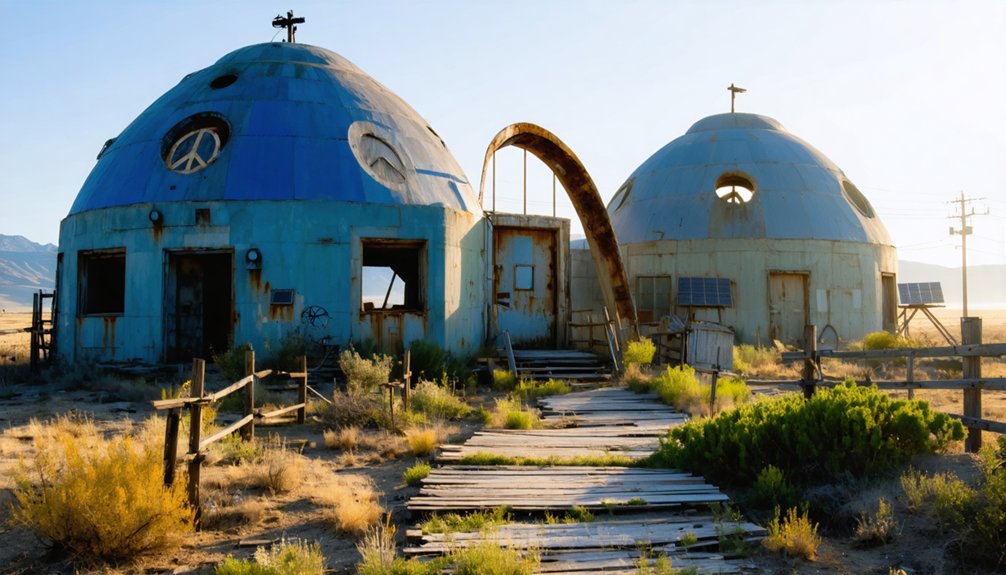
What remains are fragments of experimental dreams—concrete pads, weathered plywood walls, and rusting hydronic systems—physical manifestations of communities that dared to rethink not just buildings, but the very structure of American society.
Material Culture Preservation
While utopian dreams faded into obscurity, their physical remnants endure as monuments to radical social experiments across America’s landscape.
You’ll find these communities’ souls embedded in their weathered materials—locally quarried stone, hand-formed brick, and timber harvested from surrounding forests.
The cultural significance of these structures transcends mere buildings; they’re manifestations of collective idealism.
At abandoned sites like Zoar and New Harmony, preservation challenges intensify with each passing season as nature reclaims what humans once imposed upon it. The Village of Zoar in Ohio stands as a testament to this rich heritage, recently recognized as a National Historic Landmark for its exceptional value to the nation. Similarly, Savannah’s unique layout reflects an early American anti-urban vision, designed specifically to counter the problems of crowded city living.
The intentional material choices—dark woods blending with forest shadows, clustered dwellings preserving common lands—reveal ecological consciousness decades before environmentalism emerged.
When you walk these forgotten pathways, you’re traversing the physical artifacts of alternative visions for American life, each brick and beam testifying to possibilities that never fully materialized.
Preparing for Your Visit: Essential Tips for Utopian Site Explorers
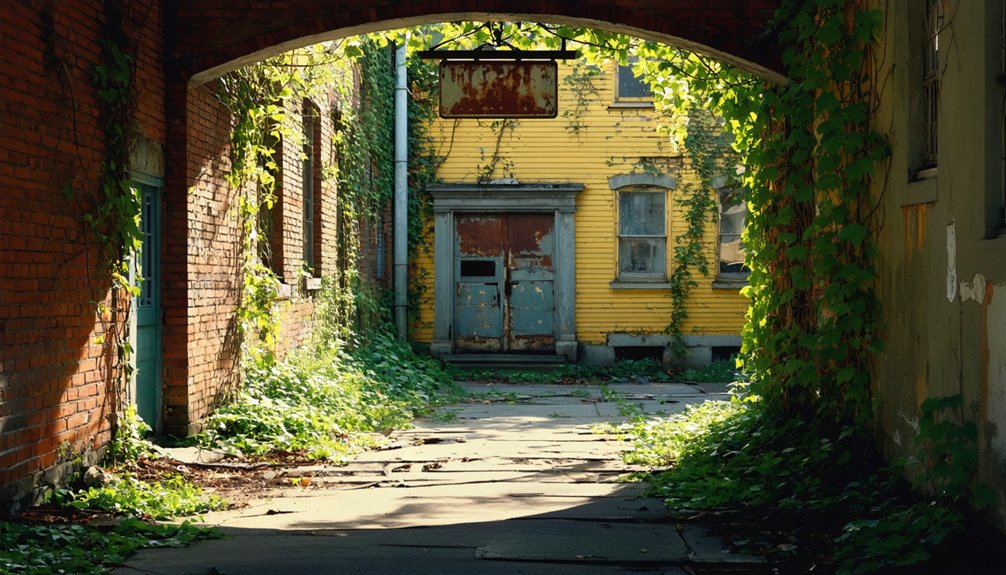
Before initiating a journey to explore America’s abandoned utopian sites, thorough preparation can mean the difference between a successful expedition and a disappointing or dangerous outing. These architectural ghosts demand both respect and caution.
Assess your target sites for legal considerations before departure—many remnants lie on private property where trespassing carries significant penalties. When permission is secured, document your findings with discretion, respecting any photography restrictions. Bring research materials about communities like Brook Farm whose transcendentalist philosophy shaped its brief existence before financial collapse.
Legal vigilance is paramount—utopian ruins often hide behind private property laws and permission protocols.
Embrace safety precautions amid the decaying infrastructures. The weathered beams and crumbling foundations that once housed idealistic dreams now present physical hazards. Equip yourself with sturdy footwear, first-aid supplies, and navigation tools as you tread where utopian experiments faltered.
Remote locations often lack cellular coverage, so inform others of your itinerary before venturing into these forgotten landscapes where collective dreams eroded against practical realities. Some sites like New Harmony, Indiana reflect the ambitious vision of Robert Owen, whose experiment in economic equality ultimately dissolved due to internal conflicts despite its noble intentions.
Beyond the Ruins: Understanding the Ideological Foundations
Beneath the weathered timbers and crumbling foundations of America’s abandoned utopian settlements lies a complex architecture of ideological frameworks that once animated these experimental communities.
As you explore these sites, you’ll encounter distinct philosophical debates that shaped their trajectory—from the religious communalism of Shaker and Rappite settlements to Owen’s secular cooperative economics that faltered within two years.
You’ll recognize how Transcendentalist ideals transformed into rigid Fourierist doctrines at Brook Farm, where artistic expressions flourished despite economic experiments that ultimately failed.
The physical remnants—communal buildings, workshops, and fields—represent more than architectural curiosities; they embody community ideals that prioritized collective welfare over individual gain.
These abandoned spaces whisper of both visionary ambition and structural vulnerability, revealing the delicate balance between ideological purity and practical sustainability.
Photography Guide: Capturing the Essence of Abandoned Communities
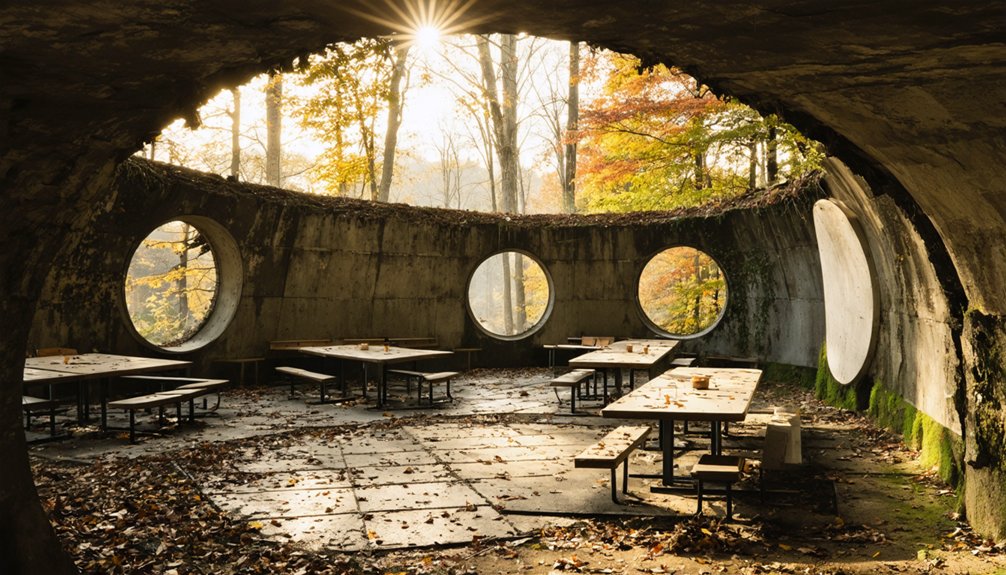
To capture abandoned utopian settlements effectively, you’ll need a full-frame camera with wide-angle lenses (14-35mm) and a sturdy tripod for the inevitable low-light conditions among decaying structures.
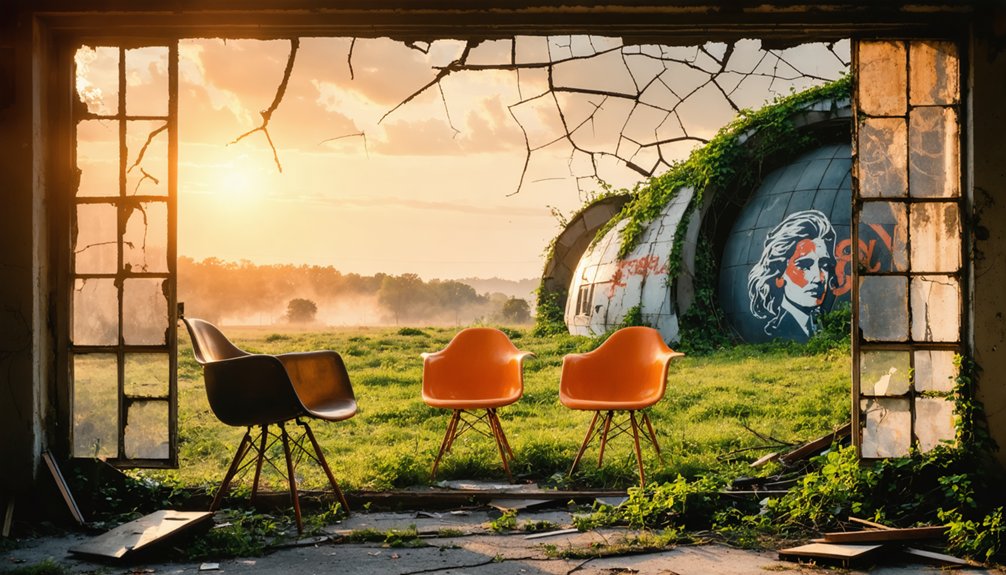
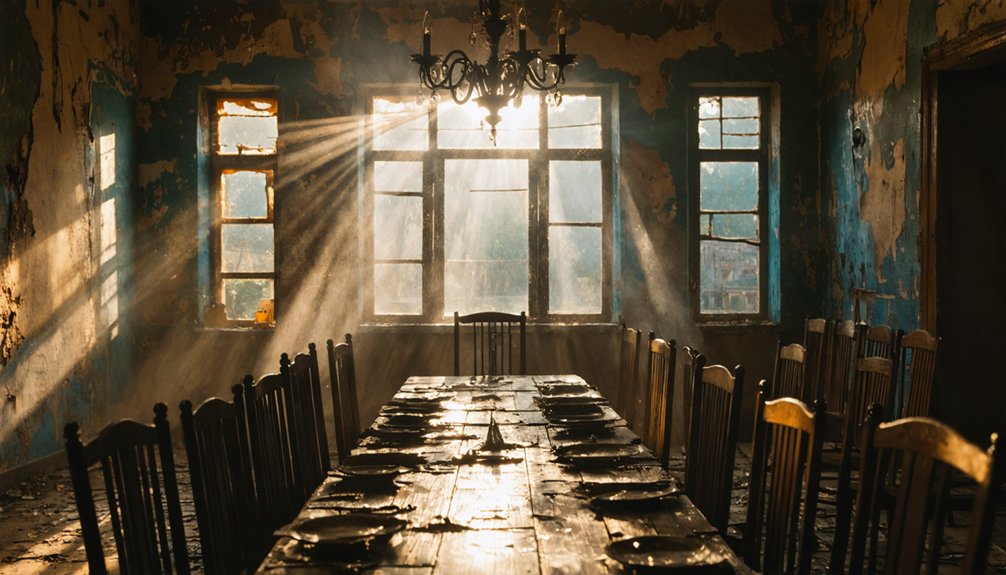
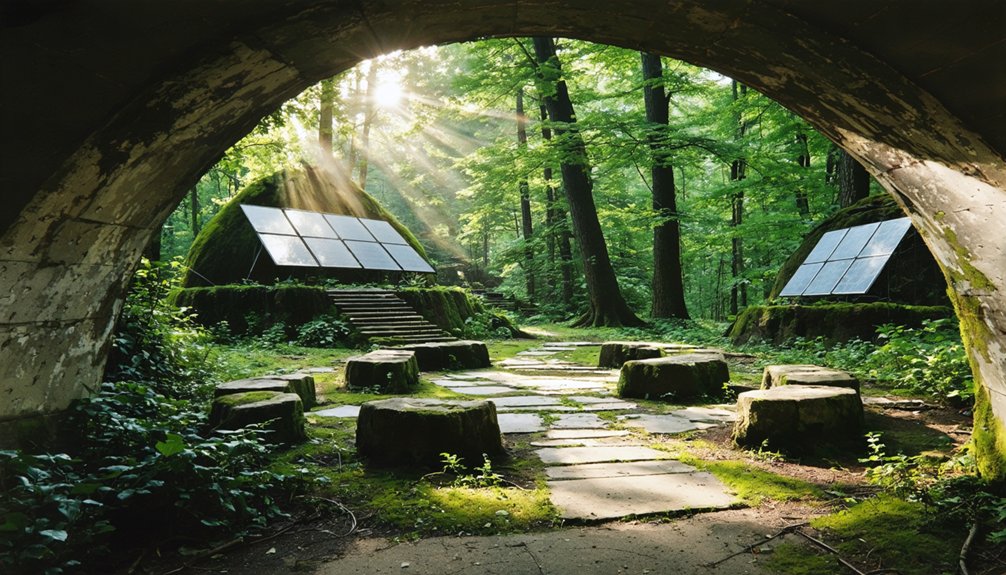
Your compositions should emphasize the tension between human aspiration and natural reclamation—seek moments where golden hour light cuts through broken windows or where shadow patterns reveal architectural bones beneath the encroaching wilderness.
When documenting these fragile historical sites, remember that your presence leaves an impact—obtain necessary permissions, avoid disturbing artifacts, and maintain a respectful distance from unstable structures that might collapse under your weight.
Equipment for Ruin Photography
Documenting decaying utopias demands specialized equipment that balances technical precision with adaptability in unpredictable environments.
Your tripod stability becomes non-negotiable when capturing long exposures in dim communal halls where light filters through broken windows. Lens versatility allows you to shift between architectural context and intimate artifacts—wide-angles reveal the skeletal framework of collective dreams while macro lenses extract stories from abandoned personal effects.
Protect yourself as you protect your gear. Respirators shield your lungs from the particulate memories of failed societies, while sturdy boots navigate the physical collapse of ideological structures.
Carry redundant power sources; batteries drain quickly in the cold emptiness of abandoned spaces. Your headlamp, preferably with red-light capability, becomes both practical tool and symbolic beacon illuminating forgotten pathways through America’s experimental communities.
Light and Shadow Play
Light reveals truth in architectural corpses, baring the skeletal remains of American utopian experiments through deliberate photographic technique.
You’ll extract their essence through shadow techniques that accentuate peeling paint and structural decay—each dark pocket telling stories of collective dreams dissolved.
Maximize natural sunlight during mid-morning hours when rays pierce broken ceilings, creating dramatic contrasts that highlight communal spaces where idealism once flourished.
For deeper exploration, employ light manipulation with LED sources to emphasize forgotten architectural details and overhead beams otherwise consumed by darkness.
Consider monochrome to simplify and evoke historical melancholy, or preserve color to document nature’s reclamation of these failed social experiments.
In both approaches, the interplay between illumination and shadow transforms abandoned utopian ruins from mere dereliction into profound archaeological narratives of American ideological fervor.
Ethical Documentation Practices
Ethical documentation transcends mere photographic technique when exploring abandoned utopian settlements, demanding a rigorous moral framework that honors both legal boundaries and historical dignity.
Always secure ethical permissions before entering sites—research property records and obtain written consent when possible. When access is granted, preserve site integrity by adhering to the “take only photos, leave only footprints” principle.
Avoid publishing precise locations of vulnerable communities; instead, focus on telling their stories without compromising their physical remains.
Share your work with careful consideration, removing geotags and metadata that might endanger these fragile historical monuments. Your documentation becomes part of these places’ legacies—approach this responsibility with reverence.
Remember that preservation of these failed utopias serves future generations seeking to understand our collective yearning for better ways of living.
Seasonal Considerations: When to Visit Different Utopian Settlements
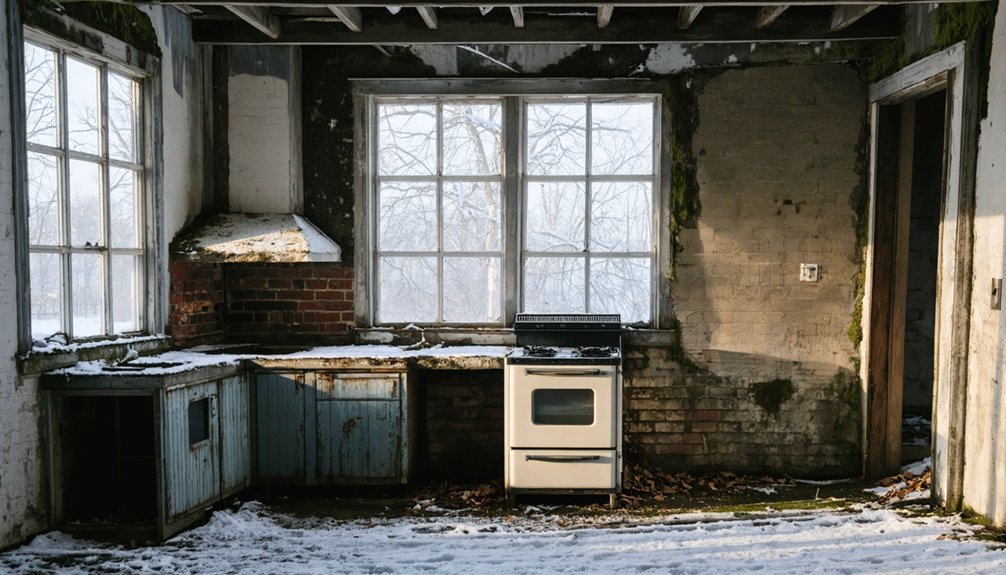
When planning your expedition to America’s abandoned utopian communities, seasonal timing becomes critical to experiencing these architectural remnants as their founders might’ve envisioned them.
Most settlements—including Shaker Villages, Brook Farm, and Harmonist communities—open their gates primarily May through October, when rusted hinges creak and weathered floorboards bear witness to summer visitors.
You’ll encounter winter’s silence at nearly all sites; New Harmony’s Indiana grounds remain accessible year-round, though its museums hibernate from December through March.
Fall offers dual rewards: thinning crowds and amber-hued landscapes frame the decaying idealism of these once-thriving communes. Canterbury and Sabbathday Lake Shaker Villages become particularly evocative against autumn’s palette.
Spring brings seasonal activities at Pleasant Hill and Hancock, where visitor experiences authentically connect with the rhythmic labor these communities once practiced.
Frequently Asked Questions
Are Paranormal Investigations Permitted at Abandoned Utopian Community Sites?
You’re legally permitted only with explicit owner permission. Your paranormal permissions must align with investigation ethics—trespassing compromises both your freedom and the archaeological integrity of these haunting communal remnants.
How Did Utopian Communities Handle Medical Care and Childbirth?
Over 90% of utopian communities offered free medical care. You’ll find their alternative medicine practices deeply intertwined with communal childbirth, where midwives used herbal remedies learned from indigenous knowledge—healthcare as collective liberation rather than individual burden.
What Original Artifacts Can Visitors Legally Collect From These Sites?
You can’t legally collect original artifacts. Federal and state laws mandate artifact preservation at heritage sites. Your freedom to explore exists alongside legal restrictions protecting these haunting remnants of utopian dreams.
Did Any Utopian Communities Successfully Integrate With Indigenous Populations?
Nearly 95% of utopian experiments failed at indigenous cultural exchange. You’ll find no significant integration success stories, only coexistence challenges where idealistic communities perpetuated colonial patterns rather than achieving genuine cross-cultural harmony.
How Did Gender Roles Differ in Secular Versus Religious Utopian Experiments?
You’ll find secular utopias embraced gender equality through shared labor and political voice, while religious communes preserved traditional roles. Both experimented with communal living, but secular ones dismantled domestic gender boundaries more radically.
References
- https://open.baypath.edu/his114/chapter/utopian-communities/
- https://historycollection.com/10-american-utopian-communities-rose-perfection-dramatically-collapse/
- https://fee.org/articles/the-dark-side-of-paradise-a-brief-history-of-americas-utopian-experiments-in-communal-living/
- https://www.nps.gov/articles/000/secular-utopias-in-america.htm
- https://en.wikipedia.org/wiki/List_of_American_utopian_communities
- https://www.britannica.com/story/american-utopias
- https://guides.loc.gov/chronicling-america-early-utopian-communities
- https://www.yesmagazine.org/health-happiness/2022/06/01/american-communes-failed-experiment
- https://www.indianamuseum.org/historic-sites/new-harmony-historic-site/
- https://www.legendsofamerica.com/ah-utopias/