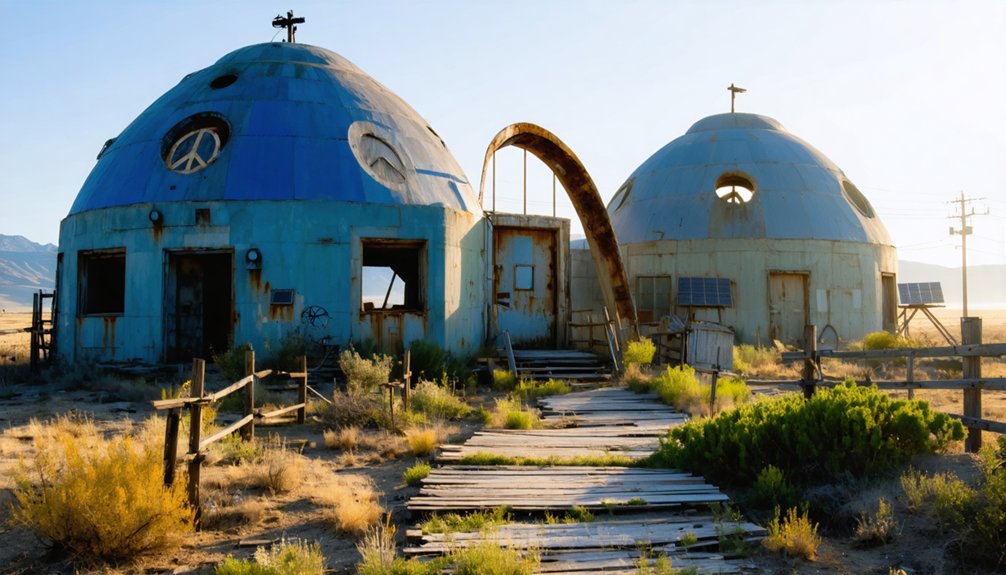
When exploring abandoned utopian settlements like Brook Farm or Fruit Hills, you’ll need proper permissions and safety gear (FFP3 respirators, sturdy boots). Document sites non-invasively through photography without flash, respecting the “leave no trace” principle. Research property ownership through county records before visiting, and carry documentation of permissions. These crumbling foundations and repurposed buildings offer glimpses into America’s radical social experiments—each weathered stone tells a story of collective dreams.
Key Takeaways
- Secure proper permission from property owners by researching county records before visiting utopian settlement ruins.
- Equip yourself with protective gear including respirators, sturdy boots, and first aid supplies for safe exploration.
- Visit preserved sites like Brook Farm’s archaeological foundations or the now-inactive Shaker villages for accessible experiences.
- Document discoveries through non-invasive photography while adhering to “leave no trace” principles.
- Consider joining authorized tours of sites like Ephrata Cloister instead of exploring unmarked ruins independently.
The Remnants of America’s Religious Commune Experiments
As you explore the weathered remains of America’s religious commune experiments, you’ll encounter the profound influence of Second Great Awakening evangelical Protestantism, which shaped the fundamental beliefs of most utopian communities.
You’ll discover traces of German pietistic societies like Ephrata Cloister, established in the 1730s—America’s oldest communal experiment. These religious communes practiced intentional isolation while awaiting prophecies, often embracing biblical literalism and unconventional views on marriage.
The Rappites demonstrate how economic prosperity emerged under centralized leadership, with 600 followers pooling resources to acquire Pennsylvania land in 1804.
Similarly, Shaker communities expanded to eighteen major societies by 1836, sustaining communal living through conversion, child indenturing, and orphan adoption.
Today, only Sabbathday Lake Shaker Village in Maine remains active, while abandoned structures throughout the Northeast and Midwest stand as evidence to these bold social experiments. These experiments often reflected a nostalgic response to the rapid shift from pre-capitalist farm culture to market economy after 1815.
In Iowa, the landscape reveals multiple communal settlements including the Amana Society, which established seven distinct villages along the Iowa River after purchasing extensive farmland in 1855.
Lost Transcendentalist Visions: Brook Farm and Beyond
You won’t find any original structures when visiting Brook Farm today, as the Phalanstery—the community’s ambitious building project designed to house all members—burned to the ground in 1846 before completion, accelerating the commune’s financial collapse.
This devastating fire symbolized the broader dissolution of Transcendentalist communal experiments, which struggled to balance idealistic philosophy with practical sustainability despite attracting intellectual luminaries like Hawthorne and Fuller.
The 179-acre National Historic Landmark in West Roxbury now offers only interpretive markers rather than tangible ruins, requiring visitors to imagine the utopian community that once attempted to merge intellectual pursuits with agricultural labor. The community was founded and led by Ripley, a former Unitarian minister who envisioned a more equitable society. The community’s founding principles aimed to insure natural union between intellectual and manual work, a core objective that distinguished Brook Farm from other contemporary social experiments.
The Phalanstery Fire
When the ambitious three-story Phalanstery erupted into flames on March 3, 1846, it marked not only the destruction of Brook Farm’s central infrastructure but also the symbolic collapse of one of America’s most notable transcendentalist experiments.
The uninsured $7,000 structure—designed to house 14 families with communal dining and lecture spaces—was reduced to ashes within two hours, likely due to a defective chimney. Boston firefighters arrived too late. This catastrophic loss accelerated the community’s financial collapse, contributing to a $17,445 debt that forced complete dissolution by 1847. The failure particularly devastated George Ripley, who had championed the community’s transition to Fourierist principles. The community had been restructured in 1844 to adopt the social theories of Charles Fourier, transforming from a transcendentalist experiment into an early socialist venture.
- The melted glass and charred remains you’ll find today represent the extinguished flame of a revolutionary social vision.
- Walking these grounds, you’re traversing the exact moment America’s transcendentalist utopian movement pivoted.
- Each scattered ruin challenges you to question whether alternative communities can withstand practical challenges.
Transcendentalist Ideals Dissolved
Why did Brook Farm’s lofty transcendentalist ideals ultimately dissolve into pragmatic failure?
You’ll find the answer in the community’s gradual philosophical shift away from Ripley’s original vision. The change from pure transcendentalist principles to Fourier’s socialist structure marked the beginning of community disintegration.
Despite equal pay for men and women and the integration of intellectual and manual labor, Brook Farm lacked critical support from influential transcendentalists like Emerson and Alcott.
The loss of Nathaniel Hawthorne, who departed after realizing physical demands limited his writing time, exemplifies the fundamental tension between individual creativity and communal obligation. Hawthorne later transformed his brief experience into The Blithedale Romance, a novel that captured the idealistic atmosphere while maintaining fictional distance. The devastating fire in 1846 further accelerated the community’s decline, destroying their newly constructed building and deepening their financial troubles.
This transcendentalist decline accelerated when the community renamed itself “Phalanx” in 1844, signaling an ideological transformation that strayed from its founding philosophy of self-reliance toward structured utopianism.
Visible Ruins Today
Remnants of idealism stand scattered across the 179-acre historic site of Brook Farm in West Roxbury, Massachusetts, where physical traces of America’s transcendentalist experiment have largely surrendered to time and flame.
Historical preservation efforts focus on archaeological foundations and the solitary 1890 print shop—one of few surviving structures. The original Hive farmhouse (1977), phalanstery (1846), and Margaret Fuller Cottage (1984) all succumbed to fire, severely limiting visible architecture that once housed these freedom-seekers. Founded by George and Sophia Ripley in April 1841, the community sought to create a balanced society where work and leisure served the greater good.
- Excavated foundations reveal ghostly outlines where communal activists once reimagined American society
- Gethsemane Cemetery stands as silent witness to subsequent transformations—from utopia to poor farm to orphanage
- Archaeological layers contain communal artifacts spanning 5,000 years of human habitation, each fragment telling its own liberation story
Mapping the Forgotten Utopian Settlements of the Midwest
Throughout the American Midwest, a constellation of forgotten utopian settlements once dotted the landscape, their ambitious social experiments now largely erased from both physical maps and historical memory.
You’ll discover these idealistic failures scattered across Iowa, Ohio, and Pennsylvania—places like Fruit Hills, Ephrata Cloister, and the Amana Colonies. Their planned layouts blended European design with organic street patterns, often featuring symbolic rather than functional arrangements.
When exploring, look for remnants of communal longhouses and cooperative structures, though most exist now as unmarked ruins or repurposed buildings. Orson S. Murray, who established Fruit Hills in 1845, vehemently opposed traditional structures as impediments to true social progress.
These forgotten settlements collapsed under practical pressures despite their revolutionary visions of abolishing private property and creating cooperative societies. Their physical traces remain challenging to identify—scattered structures without clear markers, fundamentally serving as unmarked graves of radical social experiments that briefly flourished before succumbing to economic, social, and environmental realities.
Practical Tips for Exploring Abandoned Utopian Sites Safely
When exploring abandoned utopian settlements, you’ll need to secure proper permission from property owners through county records to avoid trespassing charges and potential legal consequences.
Your exploration kit must include protective gear like FFP3 respirators, thick-soled boots, and first aid supplies to mitigate hazards from structural deterioration, toxic materials, and biological contaminants.
Document these historical sites through photographs while maintaining the “leave no trace” principle, preserving artifacts in their original positions and avoiding any removal or rearrangement that could compromise the site’s historical integrity.
Legal Access Matters
Before setting foot on any abandoned utopian site, understanding its legal status constitutes perhaps the most critical step in your exploration preparation.
Research property ownership through county assessor offices to determine who controls the land—original developers, investors, or government entities may retain titles despite appearances of abandonment.
Trespassing laws apply strictly, with violations potentially resulting in fines or criminal charges.
- The thrill of discovery isn’t worth a legal entanglement that could restrict your future exploration freedoms.
- Obtaining written permission transforms your status from trespasser to welcomed visitor.
- Each document you gather serves as a shield against arbitrary enforcement.
Carry documentation of your research and permissions on-site, and consider joining authorized tours for legal access to otherwise restricted utopian remnants.
Pack Proper Gear
Proper gear selection forms the foundation of safe exploration, transforming your abandoned utopia adventure from potentially hazardous to manageable. Your gear essentials should include sturdy, ankle-supporting boots and moisture-wicking clothing with long sleeves to protect against environmental hazards while traversing deteriorating structures.
Your packing checklist must prioritize safety equipment: a headlamp with spare batteries, multi-tool, first aid supplies, and signaling device. Don’t rely solely on technology—carry physical maps alongside GPS devices with offline capabilities. Always pack sufficient water and high-energy snacks.
Before entering any structure, verify structural integrity and watch for asbestos, mold, or unstable elements.
Communication tools remain critical—ensure someone knows your exploration plan and expected return time, and consider a satellite communicator for remote locations.
Document Without Disturbing
Five essential principles guide ethical documentation of abandoned utopian sites while preserving their historical integrity.
When capturing these forgotten social experiments, employ non-invasive techniques like rangefinders and GPS mapping rather than physically marking locations. Photograph without flash to prevent degradation of fragile paint or artifacts.
Record your discoveries methodically without publishing exact coordinates that might attract vandals or looters to these vulnerable treasures.
- Feel the whisper of past idealists as you catalog their abandoned dreams without disturbing the physical evidence they left behind
- Experience the thrill of discovery through your lens, knowing your ethical documentation methods protect these sites for future explorers
- Connect with history as your careful records contribute to preserving these monuments to American experimental communities
Photographing Historical Utopian Architecture and Artifacts
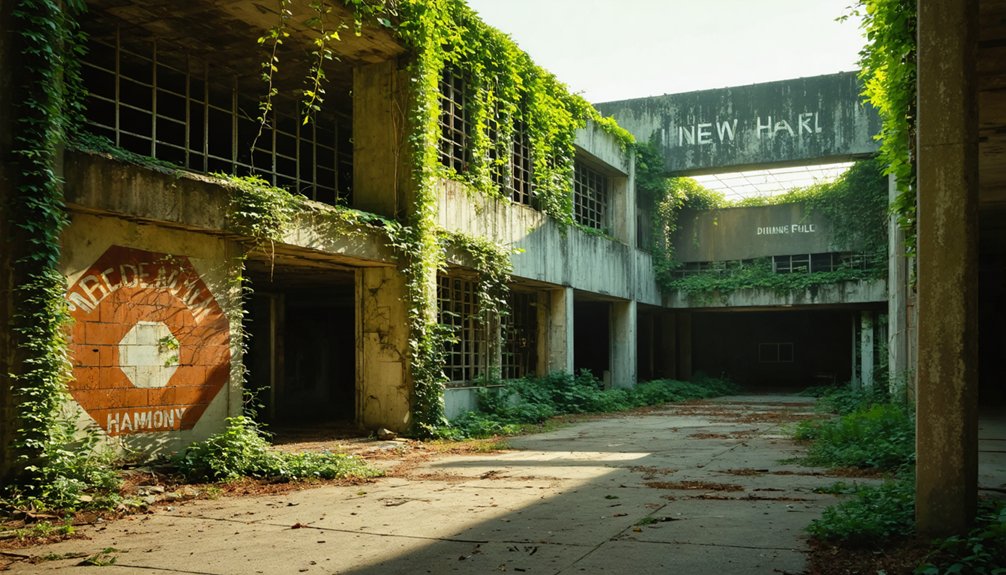
Capturing the echoes of America’s utopian visions requires photographers to master a unique convergence of historical documentation and artistic interpretation.
When approaching sites like Ephrata Cloister or Wright’s Usonian homes, you’ll need to balance wide-angle shots that reveal community layouts with macro photography that documents artifact details and construction techniques.
Utopian aesthetics often manifest in geometric plans, nature-integrated designs, and communal spaces—all elements requiring thoughtful architectural photography techniques.
Utilize natural lighting to highlight the organic integration characteristic of Sea Ranch’s ecological clusters or the austere simplicity of religious settlements.
HDR imaging proves invaluable when balancing exposure in spaces where shadow and light interact with natural materials.
For maximum historical context, consider contrasting black-and-white shots of ruins with color photographs documenting current preservation efforts.
How Failed Economic Models Shaped America’s Utopian Landscapes
Beneath the romantic ruins and architectural remnants you’ll encounter when exploring America’s failed utopian communities lies a fascinating economic narrative of collapse.
These stories reveal how visionaries once sought to create ideal societies, ultimately confronting the harsh realities of human nature and economic limitations. From the rise and fall of vibrant communes to the quiet lessons learned in their wake, these abandoned utopian dreams in America serve as a compelling reminder of the ambition and fragility of our collective aspirations. Each site tells its own tale, inviting us to reflect on what was lost and what might still be possible.
These landscapes were shaped by fundamental economic sustainability failures—collective ownership models undermined productivity decline, while ideological inflexibility prevented necessary market adaptation. Leadership failures often obscured resource management realities, eroding communal trust and accelerating downfall.
- The crumbling walls of New Harmony stand as monuments to how quickly utopian dreams collapse when individual innovation is sacrificed for redistribution.
- Brook Farm’s overgrown fields silently testify to how social constraints strangled economic flexibility.
- The abandoned meeting halls reveal power vacuums where charismatic vision couldn’t overcome practical economic realities.
These physical spaces offer profound historical lessons about the tension between idealistic vision and economic viability that shaped America’s landscape.
Frequently Asked Questions
Can I Legally Remove Artifacts From Abandoned Utopian Sites?
No, you can’t legally remove artifacts. While freedom beckons, artifact preservation requires you to leave items untouched. Legal implications vary between federal lands (strictly prohibited) and private property (owner permission required).
Were Any Utopian Communities Successful in Achieving Their Original Vision?
You’ll find few successful experiments achieved their complete vision, though the Mormon and Shaker communities maintained significant longevity. Their lasting legacies influenced American thought on cooperative living despite most eventual dissolutions.
What Supernatural Occurrences Have Been Reported at These Sites?
You’ll encounter numerous ghost sightings at these locations, from Bodie’s wandering spirits to Centralia’s disembodied voices. Urban legends persist about curses, spectral figures, and unexplained EVPs recorded by paranormal investigators.
How Did Local Indigenous Populations Interact With Utopian Settlements?
Like rivers meeting, Indigenous-utopian relationships flowed between cooperation and conflict. You’ll find cultural exchange varied dramatically—from Meusebach-Comanche treaties representing peaceful coexistence to Puritan exclusivity that accelerated displacement’s historical impact on Native populations.
Are There Any Active Attempts to Revive These Failed Communities?
Yes, numerous revival initiatives exist through community engagement programs, historical preservation projects, and contemporary intentional communities that adapt original principles while addressing economic sustainability challenges their predecessors couldn’t overcome.
References
- https://historycollection.com/10-american-utopian-communities-rose-perfection-dramatically-collapse/
- https://open.baypath.edu/his114/chapter/utopian-communities/
- https://en.wikipedia.org/wiki/List_of_American_utopian_communities
- https://www.britannica.com/story/american-utopias
- https://www.nps.gov/articles/utopias-in-america.htm
- https://www.bunkhistory.org/resources/exploring-the-midwests-forgotten-utopian-communes
- https://www.atlasobscura.com/lists/12-abandoned-utopias-that-didnt-last
- http://www.iowapbs.org/iowapathways/mypath/2638/communal-groups
- https://libcom.org/library/12-early-communes-america
- https://en.wikipedia.org/wiki/Shaker_communities