Colorado’s haunted mining towns offer windows into the state’s gold and silver rush history. Visit St. Elmo to encounter Annabelle Stark’s protective spirit, explore Gilman’s restricted streets from a distance, or hike to Ashcroft for self-guided tours through paranormal hotspots. The high-altitude Tomboy Mine presents challenging terrain with eerie remnants. Always check seasonal accessibility through cotrip.org before setting out. The mountains guard more secrets than first meet the eye.
Key Takeaways
- Explore St. Elmo, Gilman, Ashcroft, and Tomboy Mine for rich mining history and reported paranormal activity.
- Check seasonal access through cotrip.org, as many ghost towns require snowshoes in winter or close during harsh conditions.
- Bring MSHA-approved hard hats, steel-toed boots, and reliable lighting for safe exploration.
- Implement a check-in system with someone aware of your exploration plans in case of emergencies.
- Practice ethical exploration by staying on designated paths and photographing rather than taking physical souvenirs.
The Rise and Fall of Colorado’s Mining Empires
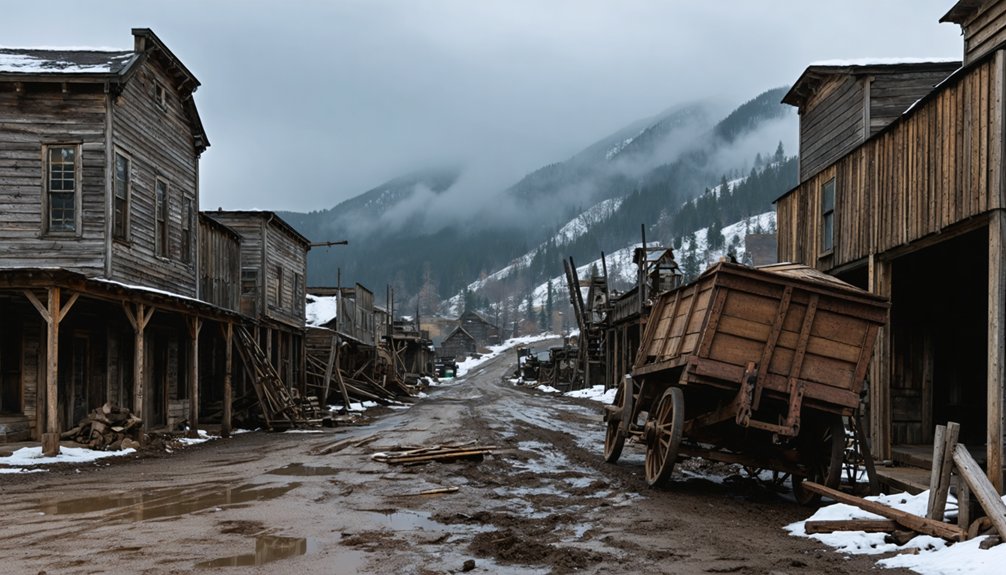
When the glint of gold near Pikes Peak caught prospectors’ eyes in 1859, it transformed Colorado’s landscape almost overnight.
A single discovery in 1859 forever changed Colorado, turning wilderness into bustling civilization with remarkable speed.
You’ll find the remnants of this transformation scattered across the Rocky Mountain terrain, from Central City’s early gold rushes to Leadville’s silver-laden hills.
As you travel west from Denver, you’re following the same routes that brought thousands seeking fortune.
Montana City (now Denver) rose on the South Platte’s banks before spreading outward to Golden, Central City, and beyond.
The 1879 silver discoveries pushed mining communities deeper into the mountains, creating boomtowns like Silverton and Aspen. Leadville experienced a tremendous economic boom as miners extracted valuable silver in California Gulch following these discoveries.
The repeal of the Sherman Silver Purchase Act in 1893 devastated these thriving communities, leading to widespread economic disaster throughout Colorado’s mining regions.
Spectral Encounters in St. Elmo: History and Hauntings
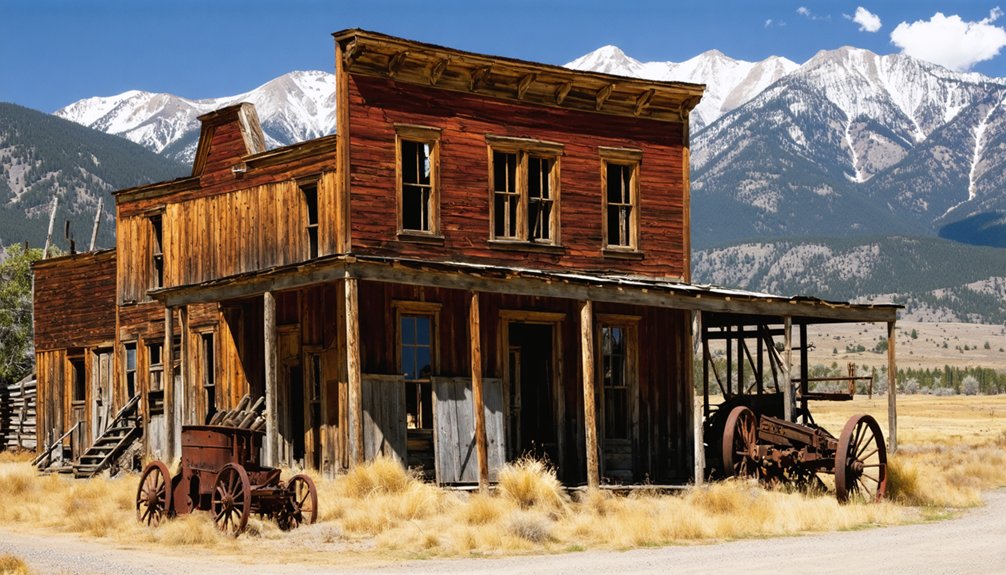
Among Colorado’s ghost towns, St. Elmo stands as a remarkably preserved portal to the past. Founded in 1880 near the lucrative Mary Murphy Mine, you’ll find yourself walking through a once-thriving settlement where nearly 2,000 residents pursued fortune from 1880-1900.
The town’s original name was Forest City, but it was later renamed to the St. Elmo we know today.
As you explore the remaining structures, you’re tracing the footsteps of miners who extracted 220,000 ounces of gold before operations ceased in 1936.
The town’s paranormal reputation centers around specific locations—the Mary Murphy Mine, where ghostly apparitions of victims of mining accidents are frequently reported, and the historic general store, maintained until 1958.
You’re free to investigate these spectral encounters yourself, as St. Elmo’s preserved buildings create a geographic nexus of historical tragedy and unexplained phenomena that draws both history enthusiasts and ghost hunters.
The town’s haunted reputation is enhanced by stories of Annabelle Stark’s ghost, who is said to watch over and protect the property from vandals.
Gilman’s Abandoned Streets: Mining Prosperity to Ghost Town
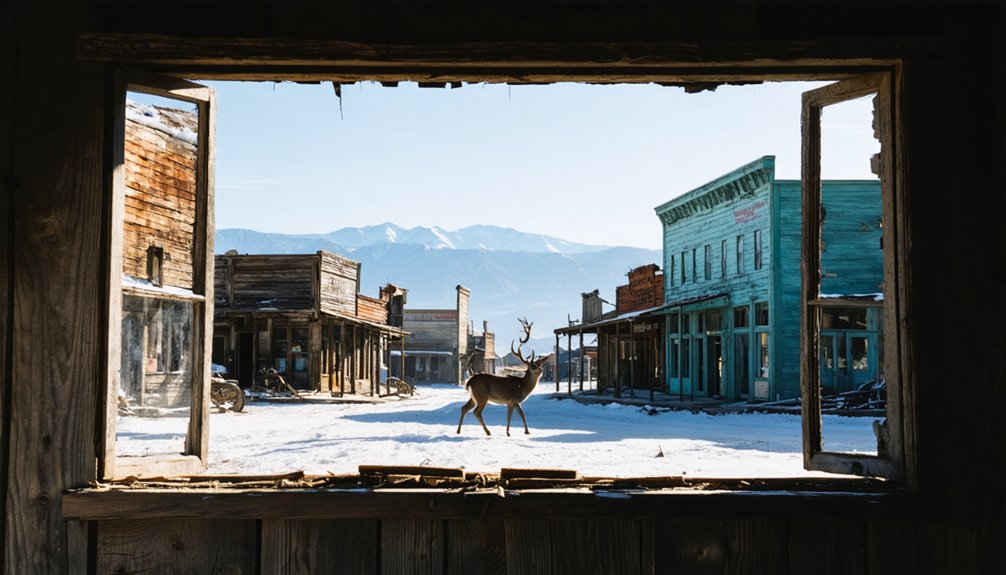
Situated precariously on the steep slopes of Battle Mountain, Gilman’s abandoned streets tell the story of Colorado’s dramatic boom-and-bust mining cycle.
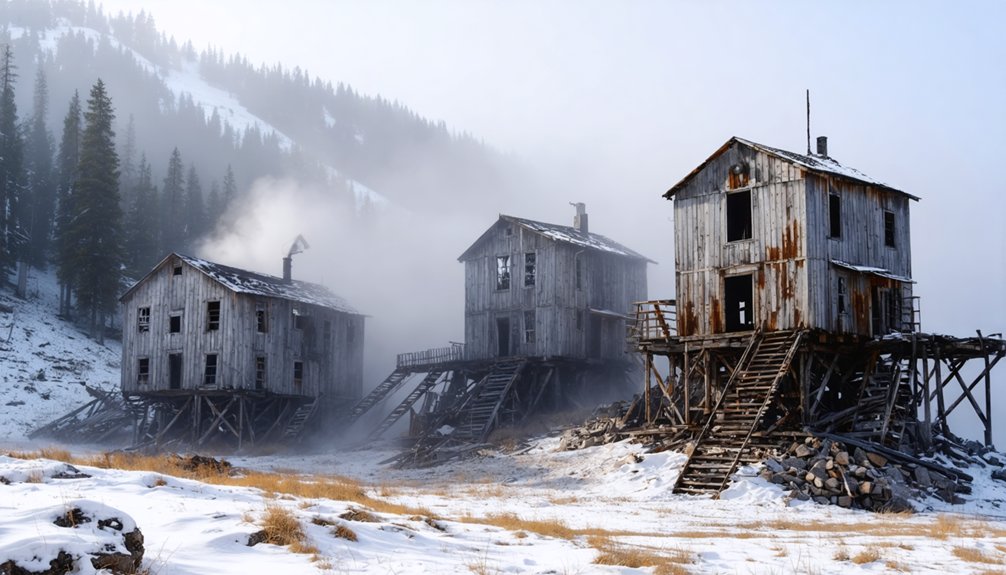
You’ll find a century of mining heritage frozen in time here, where John Clinton established this company town in 1886 during the Silver Boom. Despite its successful run as the most successful town in Eagle County, visitors are now restricted from physical access due to environmental hazards. As you navigate through the remnants, notice how Gilman’s strategic location facilitated the extraction of $12 million in ore during its 1951 peak.
The town’s trajectory shifted from silver to zinc production when New Jersey Zinc Company took control in 1912. The EPA declared Gilman a Superfund site in 1988 due to extensive contamination from decades of mining operations.
Ashcroft: Silver Boom and Supernatural Phenomena
Unlike Gilman’s industrial decline, Ashcroft tells a story of meteoric rise and swift abandonment in Colorado’s rich tapestry of ghost towns.
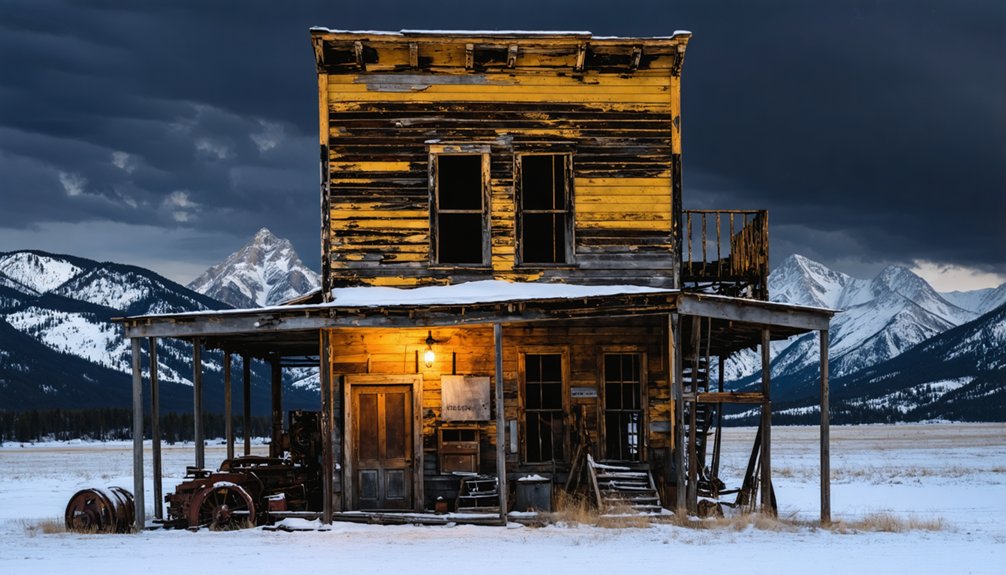
Located 10 miles from Aspen on Castle Creek Road, this former boomtown exploded from a modest camp to a 2,000-person settlement in just three years when silver yielded an extraordinary 14,000 ounces per ton.
Aspen’s forgotten neighbor surged from nothing to thousands in mere seasons, fueled by silver richer than dreams.
You’ll find Ashcroft legends whispered among the remaining structures of the White River National Forest.
The Blue Mirror Saloon and other partially restored buildings house mining artifacts that echo the town’s brief prosperity before the silver veins ran shallow. The town once boasted twenty saloons that served the vibrant mining community during its heyday.
By 1893, Ashcroft had emptied, leaving behind tales of H.A.W. Tabor’s lavish visits and the ghosts of abandoned dreams.
Today, you can wander freely through this National Register site from June to September. Self-guided tours are enhanced by updated signage that provides historical context for visitors exploring the remnants of this once-thriving mining community.
Tomboy Mine: High-Altitude Hauntings at 11,500 Feet
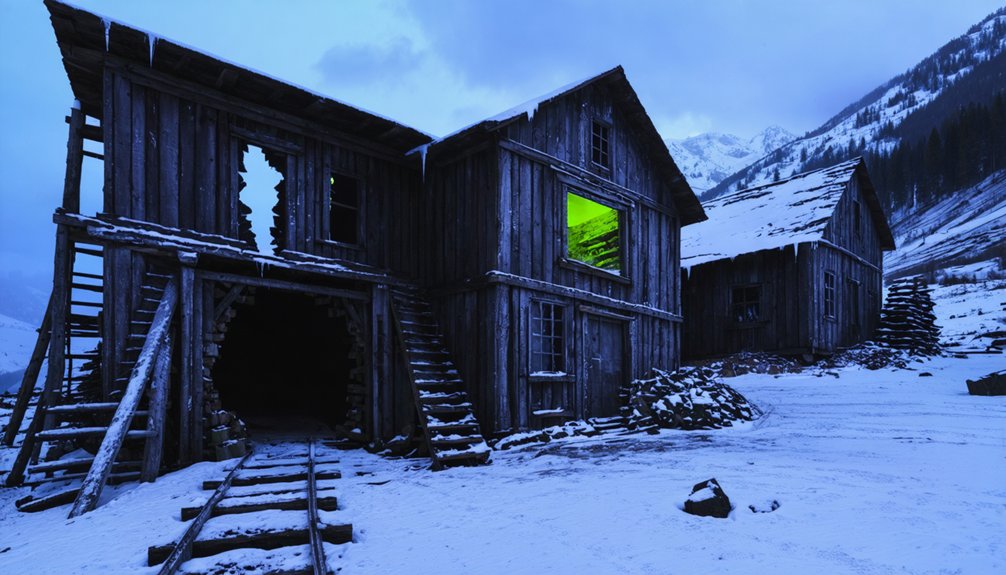
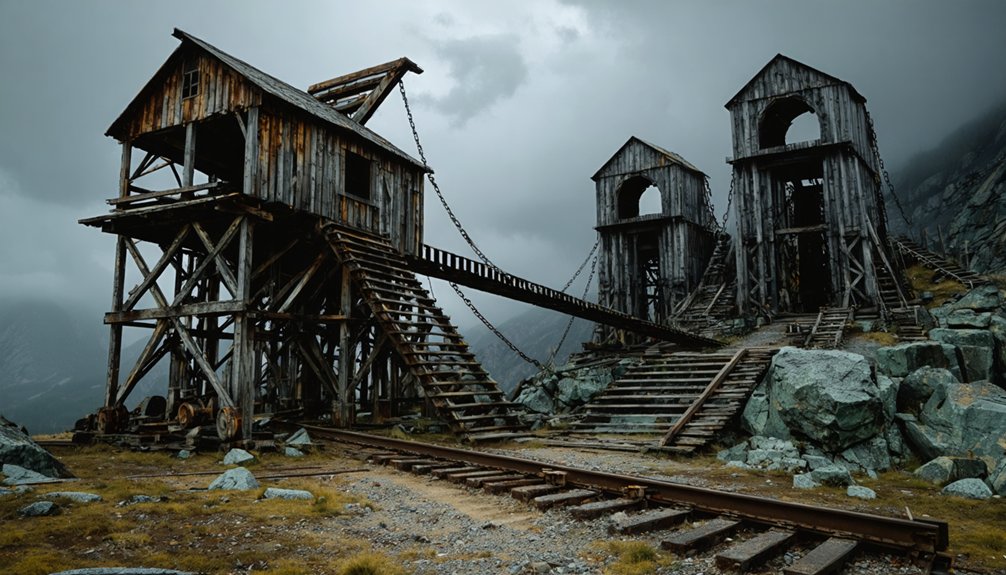
At 11,509 feet, Tomboy Mine’s remnants cling to Savage Basin where miners once extracted gold, silver, and copper while battling treacherous alpine conditions.
You’ll find this remote ghost town just two miles east of Telluride, accessible only via the challenging Tomboy Road that requires high-clearance 4×4 vehicles during summer months. The road was completed in 1901 to connect the mining town to Telluride below.
Despite its harsh environment, Tomboy once supported up to 2,000 residents with sophisticated amenities including a YMCA and tennis courts—unusual luxuries that hint at the spectacular wealth extracted from its 20-mile network of tunnels before its abandonment in 1927. The area was originally called Savage Basin Camp before being renamed after the productive Tomboy Mine.
Perilous Alpine Existence
Perched at a breathtaking 11,500 feet in Colorado’s San Juan Mountains, Tomboy Mine represents one of North America’s highest ghost towns, where miners once braved extreme alpine conditions for the promise of mineral wealth.
The perilous existence at this elevation wasn’t for the faint-hearted, with ghostly remnants now telling tales of those who persisted against nature’s harshest elements.
When visiting this remote outpost, you’ll face:
- Treacherous access via Imogene Pass, Colorado’s second-highest mountain pass
- Sudden temperature drops that can plunge below freezing even on sunny summer days
- Thin air that makes physical exertion considerably more challenging
- Landslide and avalanche zones that have reclaimed portions of the original settlement
Tomboy’s alpine challenges exemplify the freedom-seeking spirit of those who ventured where few dared, creating a community against impossible odds.
Ghostly Mining Prosperity
Though abandoned for nearly a century, Tomboy Mine‘s ghostly structures still whisper tales of Colorado’s golden era when this high-altitude settlement flourished with unexpected prosperity.
You’ll find these mining relics perched at 11,500 feet in Savage Basin, along the rugged path connecting Telluride to Ouray via Imogene Pass. The Rothschilds recognized this location’s value, purchasing it for two million dollars in 1897.
At its peak, nearly 2,000 souls called this alpine outpost home, creating a thriving community complete with YMCA facilities, bowling alleys, and tennis courts—amenities that defied the harsh mountain environment.
Today, as you navigate the treacherous 4×4 trails to this site, ghostly echoes of prosperity linger among crumbling cabins and foundations, testifying to humanity’s determined quest for freedom and fortune in Colorado’s most challenging terrains.
Planning Your Ghost Town Adventure: Seasonal Access Tips
When planning your ghost town adventure in Colorado, understanding the seasonal accessibility patterns becomes critical for a successful expedition.
Many of these towns offer a glimpse into the haunted history of ghost towns, where stories of the past linger in the air. Exploring their remnants can reveal tales of adventure, hardship, and resilience that shaped the region. With each stop, you’ll uncover more about the lives of those who once called these desolate places home.
The summer exploration window (June-September) offers ideal conditions with reliable road access and comfortable hiking temperatures, while winter challenges transform these abandoned settlements into snow-covered wonderlands requiring specialized equipment.
- Independence Ghost Town – Accessible only between Memorial Day and early November due to Independence Pass closures.
- Ashcroft Ghost Town – Requires snowshoes for winter access when Castle Creek Road gates close 1.5 miles before site.
- Creede’s Bachelor Loop – Perfect for summer 4×4 adventures with numerous mining ruins along scenic routes.
- Red Mountain Pass – Presents high-altitude challenges year-round but offers unparalleled photography opportunities during early fall.
Always verify current conditions through cotrip.org or by calling 511 before venturing into these freedom-filled historical landscapes.
Essential Gear and Safety for Exploring Remote Mining Ruins
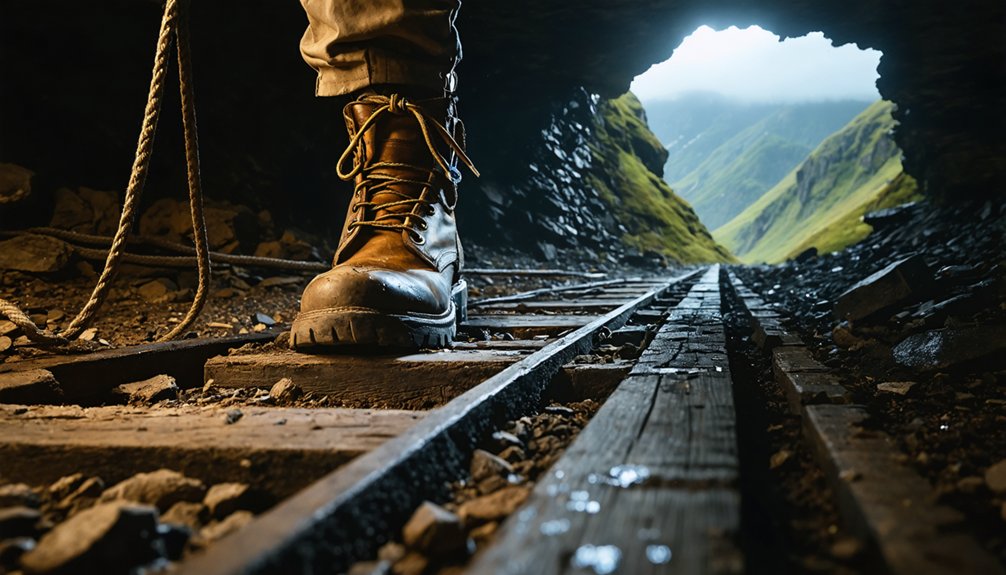
Beyond understanding seasonal access, your expedition to Colorado’s haunted mining towns requires proper preparation with specific gear and safety protocols. When venturing into sites like Animas Forks or St. Elmo, protect yourself with MSHA-approved hard hats, steel-toed boots, and protective eyewear—essential items on your gear checklist.
Navigation through these remote locations demands reliable lighting; equip yourself with cap lamps and backup batteries for dark adits and tunnels. Carry detailed mining maps and GPS devices to prevent disorientation in the labyrinthine ruins scattered across the Continental Divide.
Your safety protocols should include fall protection gear when exploring vertical shafts, communication devices for emergencies, and first aid supplies. Remember to implement a check-in system with someone who knows your exploration timeline and location—freedom in these historic spaces requires responsible preparation.
Capturing the Perfect Ghost Town Photographs
Imagine standing at the edge of Capitol City as the morning light creeps across weathered clapboard storefronts, casting long shadows that tell stories of Colorado’s mining past.
Time freezes where humanity retreated, leaving only wooden sentinels to whisper tales of fortunes found and lost.
Ghost town aesthetics come alive during the golden hours of 7-9 a.m. and 5-7 p.m., when the sunlight bathes abandoned structures in warm, dimensional light.
To capture Colorado’s haunting mining heritage with authentic photography techniques:
- Frame wide establishing shots of St. Elmo’s main street to convey the town’s isolation among mountain peaks.
- Utilize HDR methods at Animas Forks to balance the harsh contrasts between bright skies and shadowed mine entrances.
- Shoot through latticed windows in Independence for layered, mysterious compositions.
- Photograph unique artifacts at Victor and Cripple Creek where mining equipment tells stories of boom-and-bust cycles.
Respecting History: Ethical Exploration of Abandoned Sites

When you explore Colorado’s mining ghost towns like Ashcroft or St. Elmo, you’re traversing a delicate balance between accessing these historic locations and preserving their fragile structures for future generations.
You’ll need to stay on designated paths throughout these remote mountain settlements, respecting both the physical boundaries and cultural significance of each artifact you encounter.
Instead of taking physical souvenirs from places like Independence or Tin Cup, capture these haunting mountain outposts through photographs that document their weathered architecture without disturbing their historical integrity.
Preservation vs. Exploration
Colorado’s abandoned mining towns stand at a critical crossroads between preservation and exploration, as fragile historic structures face mounting pressure from tourism and natural deterioration.
When you visit these remote treasures, you’re maneuvering the delicate balance between preservation challenges and exploration ethics.
Four ways to responsibly experience these historic sites:
- Support local preservation funds like the Ghost Town Club of Colorado that channel 100% of donations directly to restoration projects.
- Visit towns like Animas Forks that have secured National Register status, where your tourism dollars help fund ongoing preservation.
- Join volunteer stewardship programs at places like Santiago Mill to actively participate in site protection.
- Respect no-collection policies at sites like Crystal and St. Elmo, preserving artifacts in their authentic context.
Leave No Trace
Respecting the echoes of history throughout Colorado’s abandoned mining towns requires more than passive observation—it demands active stewardship through leave-no-trace practices.
When visiting sites like Central City or St. Elmo, you’ll preserve their authenticity by staying on established pathways that prevent erosion around fragile structures.
Ethical exploration means photographing, not collecting—artifacts removed from Victor or Animas Forks lose their historical context forever.
Conservation easements protecting places like Independence and Tin Cup depend on your commitment to leaving each weathered timber and rusty nail undisturbed.
Your responsibility extends beyond physical preservation; quiet reverence honors the spirits that many believe still inhabit these spaces.
Photography Not Souvenirs
As you travel among the skeletal remains of Colorado’s mining settlements, ethical photography offers a powerful way to document history without disturbing these fragile sites. Your camera preserves these weathered structures from Cripple Creek to St. Elmo without removing a single artifact.
Consider these ethical photography techniques when exploring these atmospheric locations:
- Capture structures as-found – never rearrange artifacts in Silver Plume or Central City for better composition.
- Avoid flash photography inside delicate buildings like those in Victor or Tincup.
- Keep drone usage compliant with regulations in open areas like Independence or Animas Forks.
- Document without revealing exact coordinates of vulnerable sites such as Ashcroft or Caribou.
These ethical considerations guarantee Colorado’s ghostly mining landscapes remain intact for future explorers to discover on their own terms.
Frequently Asked Questions
Are Children Allowed to Visit These Haunted Mining Towns?
Like stepping through history’s doorway, you’ll find most Colorado ghost towns—St. Elmo, Ashcroft, and others—welcome children, but prioritize child safety through guided tours that provide historical context while avoiding hazardous mining areas.
What Paranormal Investigation Equipment Should I Bring?
Bring EMF detectors for Colorado’s underground tunnels, spirit boxes for clear communication within abandoned shafts, and infrared cameras for those pitch-black mine entrances where entities frequently manifest around St. Elmo and Silverton.
Can I Collect Artifacts or Souvenirs From Ghost Towns?
Like a fox eyeing the farmer’s fence, you shouldn’t take artifacts from Colorado’s ghost towns. Legal regulations strictly prohibit collection—whether in St. Elmo, Central City, or Silver Plume—to guarantee artifact preservation for everyone’s freedom to explore.
Do Any Towns Offer Overnight Accommodation or Camping Options?
Yes, you’ll find historic lodges in St. Elmo, Dunton Hot Springs, and Victor. Campground availability exists near Ironton and Capitol City, but Animas Forks and Ashcroft have limited options nearby.
Are There Guided Ghost Tours With Psychics or Mediums Available?
While some Colorado mining town tours offer ghost hunting opportunities, guided experiences with dedicated psychics or mediums aren’t widely advertised. You’ll find storytelling-focused walks in Golden, Morrison, and Arvada rather than formal psychic readings.
References
- https://www.denver7.com/news/local-news/colorado-ghost-towns-their-past-present-and-future-in-the-rocky-mountains
- https://www.coloradolifemagazine.com/printpage/post/index/id/172
- https://www.uchealth.org/today/ghost-towns-abound-in-colorado/
- https://www.colorado.com/articles/colorado-ghost-towns
- https://www.visitouray.com/ghost-towns
- https://leadville.com/the-ghost-towns-of-leadville-and-beyond/
- https://www.uncovercolorado.com/ghost-towns/
- https://en.wikipedia.org/wiki/List_of_ghost_towns_in_Colorado
- https://westernmininghistory.com/state/colorado/
- https://www.americansky.co.uk/colorado-holidays/explore-colorados-most-fascinating-gold-rush-towns