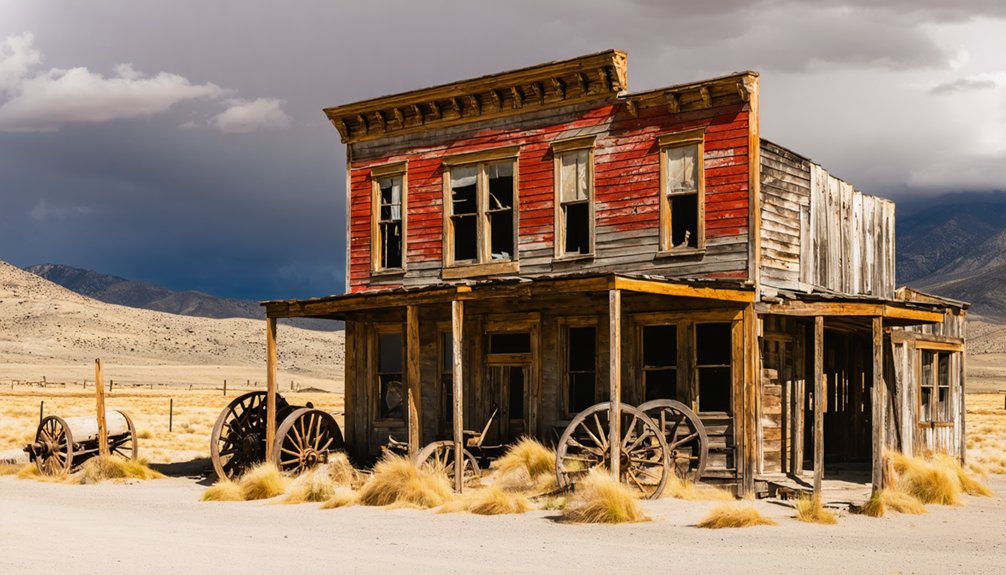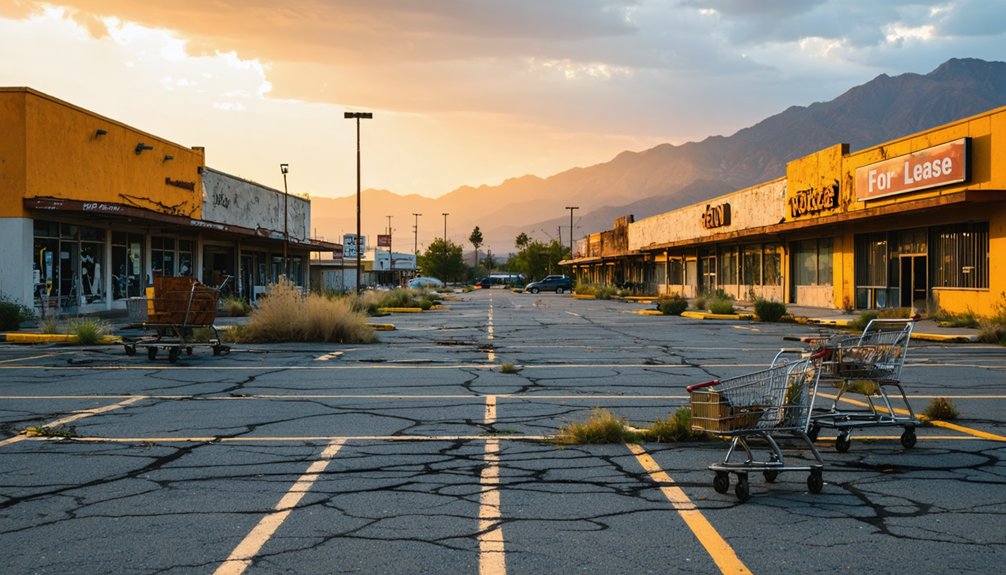
America’s creating modern ghost towns as dozens of cities enter death spirals you can measure in hard numbers. Detroit’s 30% vacancy rate leads the pack, while Cleveland, Buffalo, and Pittsburgh could lose a quarter of their populations by 2100. You’re watching 1.3 million vacant homes nationwide, retail vacancies climbing to 6%, and foreclosures surging 32% year-over-year. Nearly half of America’s 30,000 cities face population decline by century’s end, driven by infrastructure failures, tax base collapse, and accelerating middle-class flight that creates self-reinforcing decay. The data reveals which regions face the steepest contraction and why traditional interventions won’t reverse these systemic failures.
Key Takeaways
- Nearly half of America’s 30,000 cities face population decline by 2100, creating modern ghost towns across the nation.
- Detroit leads with 30% housing vacancy, while Cleveland, Buffalo, and Pittsburgh could lose quarter of their populations.
- Rust Belt and Northeast cities suffer most, with Vermont and West Virginia potentially losing 80% of their urban areas.
- Infrastructure failures like Jackson’s water crisis and surging foreclosures accelerate urban abandonment and middle-class flight.
- Shrinking tax revenues prevent maintenance investments, creating self-reinforcing decay cycles that empty once-thriving communities.
Cities at Highest Risk of Abandonment
Urban decline follows predictable patterns: deteriorating infrastructure cascades into service failures, violent crime accelerates middle-class flight, and shrinking tax revenues prevent the very investments needed to reverse the spiral.
You’ll find this death spiral accelerating in Jackson, where water system failures compound poverty affecting a third of residents. Baltimore’s 16,000 vacant buildings and 58.1 murders per 100,000 residents signal systemic collapse despite attempted interventions.
East St. Louis demonstrates how structural failure creates self-reinforcing decay—18,000 residents trapped in above-average violent crime zones. Chicago’s 573 murders in 2024 and Oakland’s ninth-place ranking among fastest-declining cities reveal municipal governance failures.
Without immediate community resilience programs and public private partnerships addressing root causes, these cities risk complete abandonment by 2030.
Population Loss Accelerating Across America
You’re witnessing a historic demographic shift as U.S. population growth hit 0.5% in 2025—the slowest rate outside the pandemic—driven by net international migration plummeting from 2.7 million to 1.3 million in one year.
If current policy trends continue, America could experience its first population decline since 1970 as early as 2026, with projections showing net migration potentially turning negative for the first time in half a century.
This acceleration compounds existing regional disparities, as the nation approaches a critical inflection point where deaths will exceed births by 2030, leaving immigration as the sole buffer against widespread depopulation.
Cities Losing Residents Fast
Why are major American cities hemorrhaging residents at unprecedented rates? San Francisco’s population plummeted 8.29% since 2019—the sharpest decline among 117 major cities. You’re witnessing systemic failure: Detroit leads with 713,777 residents fleeing, followed by Cleveland at 396,815. The pattern’s clear across the Rust Belt, where Toledo, Rockford, and Flint continue shrinking despite urban renewal initiatives.
Recent data reveals accelerating losses: Philadelphia shed 15,000 residents last year, while Chicago approaches a critical tipping point in 2025. Oakland, Portland, Birmingham, and Baltimore join the top dying cities of 2026. State-level trends confirm this exodus—New York lost 1.58% of its population between 2020-2021, Illinois 0.89%.
The root cause? Government overreach strangling affordable housing options and economic opportunity.
Migration Patterns Reshape America
America’s population growth has decelerated to just 0.5% between July 2024 and July 2025—marking the slowest expansion since the pandemic’s 0.2% rate in 2021. You’re witnessing a demographic transformation driven by collapsing international migration trends, which plummeted from 2.7 million in 2024 to 1.3 million in 2025.
Immigration policies have accelerated decline timelines by decades—population leveling expected in 2026 rather than 2081. Without continued immigration, deaths will exceed births starting 2030, triggering sustained contraction.
Meanwhile, domestic migration patterns are shifting: the Midwest gained 16,000 residents through net domestic movement, reversing previous losses exceeding 175,000. These internal relocations can’t offset the migration collapse. By 2056, growth stops entirely.
Your freedom to move, work, and build communities faces constraints from policy choices reshaping America’s demographic future.
Vacant Homes and Empty Storefronts on the Rise
You’re witnessing a systematic collapse of America’s built environment as 1.3 million homes sit vacant nationwide and retail vacancies climb to 6% in cities like St. Louis.
The crisis deepens when you examine extreme cases—Detroit’s 30% vacancy rate for homes empty over two years, or Toledo’s ZIP 43604 where 15.7% of properties stand abandoned.
Building permit data reveals developers have lost confidence in these markets, effectively freezing new construction while existing structures deteriorate into permanent blight.
Retail Vacancy Rates Climb
Walk through most American shopping districts today, and you’ll notice something unsettling: the “For Lease” signs are multiplying, even as the overall numbers suggest resilience. U.S. retail vacancy‘s expected to peak at 4.4% by mid-2026, while shopping centers already hit 5.7%—up 40 basis points from last quarter.
The divergence reveals systemic fractures:
- Urban cores like San Francisco and Seattle face elevated vacancies, while suburban markets thrive despite growing tenant demand
- New construction’s plummeting 37% in 2026, creating artificial scarcity that masks underlying weakness
- Regional disparities intensify: New Orleans and Buffalo see 240-basis-point jumps as demographics shift
- Tight labor market pressures force retailers to consolidate, even as net absorption stays barely positive at 16 million square feet
Central planning through zoning restrictions compounds these distortions.
Abandoned Properties Reach 30
Foreclosure filings surged 32% year-over-year in January 2026, hitting 40,534 properties nationwide—the 11th consecutive month of annual increases that’s transforming neighborhoods into patchworks of abandonment. The foreclosure crisis intensifies as lenders initiated proceedings on 26,369 properties while completing 4,714 repossessions, up 59% annually.
Delaware’s distressed housing market leads with one foreclosure per 1,983 units, followed by Nevada and Florida. Rising property taxes compound everyday cost pressures, forcing homeowners into default. You’re witnessing forced liquidation reshape pricing mechanisms—distressed inventory pulls comparable sales downward, creating feedback loops that penalize solvent homeowners.
While levels remain below 2009’s 3.9 million filings, the trajectory mirrors early acceleration patterns from past crises. Pennsylvania, Texas, and California concentrate the highest foreclosure starts, signaling regional vulnerabilities that policy interventions haven’t adequately addressed.
Building Permits Plummet Nationwide
Building permit applications collapsed to 1.425 million units in 2025, down from pre-pandemic peaks of 1.9 million and marking a 25% retreat from 2021’s construction boom—a contraction that’s leaving development pipelines dangerously thin while existing housing stock deteriorates.
You’ll notice permit fluctuations reveal deeper systemic cracks:
- Regional differences expose economic fragmentation: Northeast and Midwest permits rose while the South hemorrhaged 4.1%, signaling capital flight from once-booming markets
- Multi-family surges mask single-family collapse: December’s 18.1% apartment spike conceals declining homeownership pathways
- Regulatory barriers strangle supply: Zoning restrictions and approval delays compound permit declines, trapping communities in scarcity
- Infrastructure decay accelerates abandonment: Without new construction offsetting obsolescence, entire neighborhoods face functional obsolescence
These trends concentrate vacancy where freedom-seekers need housing most.
Construction Activity Grinding to a Halt
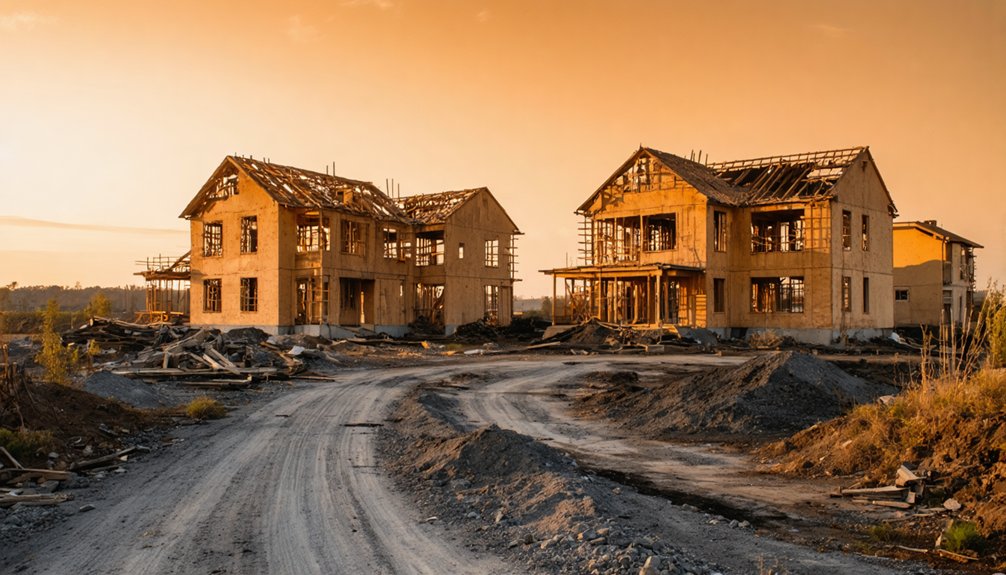
How quickly can a city’s construction pipeline collapse when market fundamentals shift? You’re watching construction work backlogs evaporate across multiple markets as developer challenges mount. Southwest Florida tells the story clearly—permits crashed over 60% from 2022 to 2024 as investors recognized oversupply risks.
Akron leads the nation in construction abandonment, with permits down 69% year-over-year. The pattern reveals systemic problems: when population growth stalls, builders can’t justify breaking ground. Detroit’s 1% population decline translates directly into 15% fewer permits. St. Louis mirrors this dynamic with 22% fewer starts following its 6.6% population drop.
Federal policies accelerated the trend—buyout programs removed over 20% of housing stock in flood-prone zones, eliminating any construction rationale. The pipeline isn’t slowing—it’s frozen.
Projections Show Thousands of Cities at Risk by 2100
While construction stalls reveal immediate distress, demographic projections expose structural collapse on a civilizational timeline. Nearly half of America’s 30,000 cities face population decline by 2100, threatening 12-23 percent of urban residents. Climate refugees and economic migrants will reshape the national landscape.
The impact on cities varies dramatically by region:
- Northeast and Midwest suffer most severely – Vermont and West Virginia could see 80 percent of cities shrink
- Growing states aren’t immune – Texas and Utah face significant urban contraction despite current expansion
- Major metros face reversal – Cleveland, Buffalo, and Pittsburgh could lose quarter of their populations
- Infrastructure becomes unsustainable – transit systems, water networks, and power grids designed for larger populations will fracture
You’re watching demographic mathematics override political promises about endless growth.
Economic Pressures Driving Urban Decline
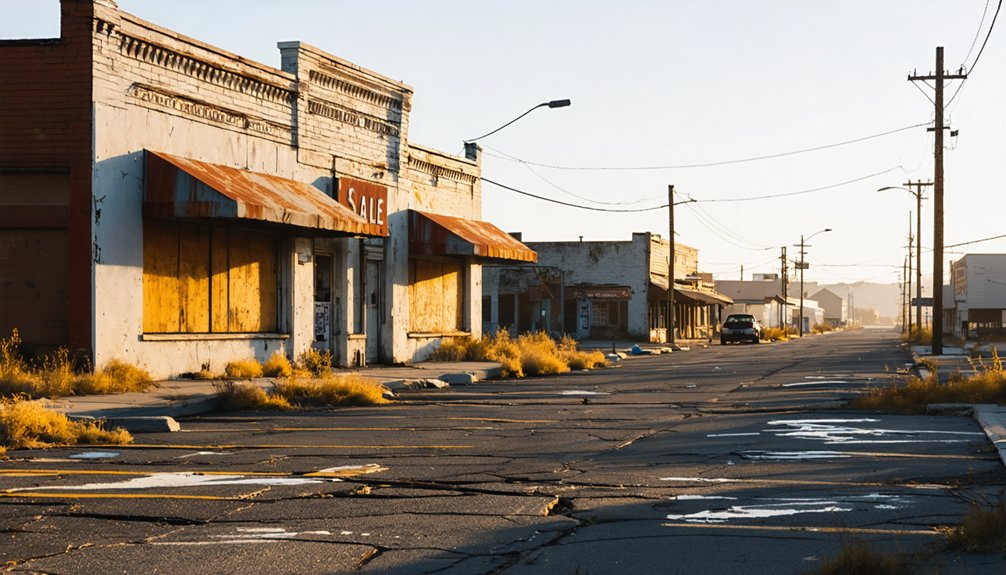
Economic collapse doesn’t announce itself with a single headline—it compounds through interconnected pressures that hollow out cities from within. You’re watching property taxes surge 20-30% while insurance premiums climb, forcing residents to choose between housing costs and household survival.
Municipal debt obligations compound as tax bases shrink—St. Louis lost 6.6% of its population while building permits dropped 22%. High interest rates and record household debt accelerate urban depopulation trends, creating fiscal death spirals. Gary, Indiana’s collapse from 175,000 to 65,000 residents exemplifies how industry busts trigger cascading failures.
Tourism-dependent cities face $29 billion in revenue losses, slashing budgets and services. These aren’t temporary downturns—they’re structural breaks where economic viability evaporates, leaving communities unable to fund basic infrastructure or retain productive citizens.
Infrastructure Failures Pushing Residents Away
Fiscal collapse creates the conditions for infrastructure failure, but deteriorating systems deliver the final blow that drives residents out permanently. You’ll find the infrastructure burden becomes unbearable when maintenance costs exceed revenue capacity.
When infrastructure costs outpace revenue, the maintenance burden becomes impossible—forcing residents to abandon cities built for populations that no longer exist.
Jackson’s 2022 water crisis left 150,000 residents without clean service for weeks. Detroit faces repeated water quality violations while ghost infrastructure serves emptying neighborhoods.
The pattern reveals diminishing population resilience:
- Aging Texas homes suffer foundation failures, stripped copper, and structural neglect
- Combined sewer overflows contaminate streets during storms despite federal regulations
- Outdated electrical systems fail under climate pressures in shrinking cities
- Roads cost $30 per resident in sprawling areas—triple dense neighborhoods
Port Arthur maintains systems built for twice its current population. When basic services become unreliable, remaining residents recognize the exit signs.
The Role of Demographics in Urban Shrinkage
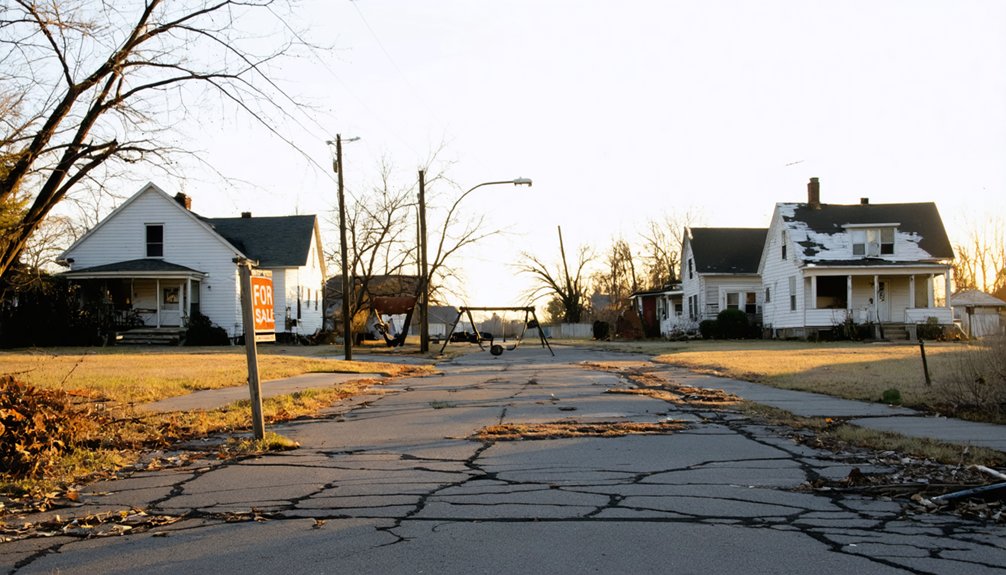
Demographic forces determine which cities survive and which become ghost towns, operating through mechanisms more predictable than economic shocks alone. You’re witnessing aging populations and low birthrates create self-reinforcing decline cycles across nearly half of U.S. cities.
Europe’s shrinking cities demonstrate this pattern clearly—older residents remain while younger, qualified workers leave first, accelerating demographic burdens.
Meanwhile, you’ll find millennials’ larger cohort size has reversed Gen X outflows in select urban neighborhoods, but this redistribution isn’t universal. Cities attracting educated, prime-age workers grow their tax bases. Those losing young families face compounding challenges: fewer workers supporting more retirees, declining school enrollment, and reduced consumer spending.
Immigration has buffered some urban centers, particularly where Hispanics offset white population declines. Without demographic renewal through births or migration, your city enters an irreversible spiral.
Regional Patterns of American Ghost Towns
Where ghost towns cluster reveals the extractive and speculative patterns that shaped America’s settlement geography. The regional distribution patterns expose how boom-bust cycles left concentrated ruins across distinct zones.
Geographic ghost town clusters show systematic abandonment:
- Southwest dominance – Texas leads with 511-550 towns (Spindletop oil collapse), California holds 346 (mining busts), and Kern County alone totals 113 abandoned settlements
- Great Plains density – Kansas claims 308 towns from Dust Bowl failures, while Oklahoma and South Dakota each exceed 240 from 1930s agricultural collapses
- Mountain West concentrations – Colorado, Nevada, and Utah host hundreds from 1880-1940 mineral rushes; Montana’s Bannack exemplifies boom-town archaeology
- Northeast scarcity – Rhode Island has one ghost town, Connecticut four, as modern development absorbed failed settlements
You’ll find freedom’s costs written in these abandoned coordinates.
Frequently Asked Questions
What Happens to Property Values in Areas Becoming Ghost Towns?
You’ll see declining property values plummet 10-20% as populations exodus, while unoccupied real estate surges past 18% vacancy rates. This systematic collapse erodes your equity and traps homeowners in markets returning to 2009-level distress conditions.
Can Declining Cities Reverse the Trend and Attract Residents Back?
You’ll find cities can climb back from the brink through strategic livable city infrastructure investments and robust civic engagement programs. Philadelphia’s downtown revival proves data-driven policy interventions work, though reversing decline demands sustained commitment and community-led solutions.
How Do Ghost Towns Impact Surrounding Communities and Regional Economies?
Ghost towns erode your regional economy through cascading business closures and tax base deterioration. You’ll witness weakened community identity as local commerce fails, property values plummet, and essential services vanish—creating systemic decline that spreads outward, threatening neighboring areas’ economic stability.
One striking example of this phenomenon can be seen in the abandoned towns in California that once thrived during the gold rush era. As these towns fall into disrepair, their once vibrant histories fade, leaving behind only remnants of their former lives. The lack of maintenance and investment not only erases cultural heritage but also discourages potential tourists, further deepening the economic void.
What Government Programs Exist to Help Stabilize Declining Urban Areas?
“A stitch in time saves nine”—you’ll find government aid programs like CDBG and HOME grants support urban renewal initiatives through community-driven development, though recent budget cuts threaten local autonomy over housing and revitalization decisions.
Should People Sell Their Homes Before Their City Becomes a Ghost Town?
You’ll need to evaluate your city’s trajectory carefully. If population trends show persistent decline and remote work opportunities aren’t attracting newcomers, selling before market values drop further preserves your financial freedom and mobility options.