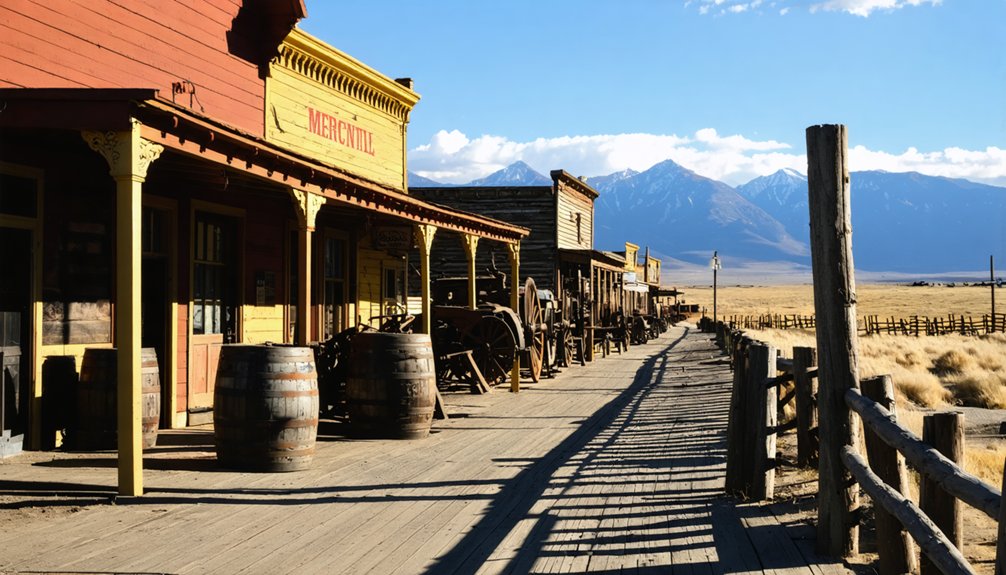
Newburyport, California boomed during the 1850s Gold Rush as miners flocked to this Sierra Nevada foothill settlement. You’ll find its remnants scattered across the desert landscape today, accessible via unpaved roads requiring high-clearance vehicles. The town flourished briefly before gold veins ran dry, causing rapid abandonment. Surviving structures like the Bottle House and restored Schoolhouse tell stories of frontier resourcefulness and ambition. The silent ruins hold more tales of boom-and-bust America.
Key Takeaways
- Newburyport emerged in California’s Sierra Nevada foothills during the 1850s Gold Rush before being abandoned when gold veins dried up.
- The town experienced rapid population decline in late 2022, with economic factors and sand dune encroachment forcing families to leave.
- Visitors need high-clearance vehicles to explore the ruins, where chimneys, rooftops, and walls emerge from encroaching sand.
- Notable landmarks include the restored Schoolhouse, Mining Museum, and the Bottle House made entirely from glass bottles.
- Preservation challenges include harsh desert conditions, vandalism, and limited funding for restoration efforts.
The Origins of a California Boomtown
Nestled among the rugged foothills of the Sierra Nevada Mountains, Newburyport emerged in the early 1850s as one of California’s promising boomtowns during the tumultuous Gold Rush era.
While researching Newburyport’s history presents challenges due to limited documentation, this settlement followed the familiar pattern of rapid development that characterized many mining communities of the period.
Like its contemporaries, Newburyport likely sprang up overnight as prospectors, merchants, and fortune-seekers converged on promising mining claims. Unlike its Massachusetts namesake, this California settlement never developed the extensive maritime trade that characterized coastal communities of the era.
Towns like Newburyport materialized suddenly—hastily assembled communities united by the singular pursuit of golden opportunity.
The boomtown legacy of such settlements reflects America’s pioneering spirit—communities built on hope, ambition, and the promise of instant wealth.
Though details of its specific founding remain elusive, Newburyport represents an important chapter in California’s transformation during the mid-19th century gold fever. Unlike the original Newburyport, which gained prominence as a Tea Party birthplace, the California settlement’s history was primarily shaped by mining rather than political revolution.
Gold Rush Dreams and Harsh Realities
You’d hardly recognize the bustling settlement that sprang up when New England prospectors, particularly those from Newburyport and Amesbury, abandoned established lives for California’s promise of instant wealth.
Your fellow “Forty-Niners” quickly transformed this Sierra Nevada foothill location into a makeshift community, constructing temporary shelters and primitive mining operations that extracted coarse gold nuggets through placer mining techniques.
The miners initially used simple panning for gold methods before transitioning to more complex systems as easily accessible deposits diminished.
The town became part of the massive migration that saw hundreds of thousands of people travel to California from various regions and countries, creating a diverse population that reflected the international appeal of gold discovery.
What you wouldn’t have anticipated was how swiftly this transient population would disperse when seasonal constraints, depleted gold deposits, and the harsh realities of isolated canyon living eventually rendered your boomtown another abandoned relic of gold rush fever.
Miners’ Hopeful Beginnings
When news of gold discovery in California spread in 1848, thousands of hopeful fortune-seekers abandoned their previous lives in pursuit of dreams that would rarely materialize.
You’d have left behind family, stability, and comfort, your hopeful aspirations fueled by newspaper reports of easy riches waiting to be claimed.
The journey tested your adventurous spirit whether you chose the six-month sea voyage around Cape Horn, the disease-ridden Panama crossing, or the dangerous overland trail.
Upon arrival, instead of gold-lined streams, you’d have found overcrowded camps, exorbitant prices, and fierce competition.
The daily reality became backbreaking labor in harsh conditions, where success stories were exceptional rather than common.
Most “Forty-Niners” discovered that their golden dreams would dissolve into the muddy waters of California’s rivers, leaving them with empty pockets and calloused hands.
San Francisco saw its population plummet as 75% of men rushed to the goldfields, leaving businesses shuttered and homes abandoned.
Ships from Salem like the bark Eliza carried not just prospectors but essential supplies to support the growing migration westward.
Boomtown’s Rapid Expansion
As California’s gold discovery transformed from rumor to international sensation, boomtowns erupted across the landscape with astonishing speed, their populations swelling beyond recognition within weeks.
Newburyport settlers joined nearly 300,000 others who poured into California between 1848-1855, establishing communities where basic mining techniques evolved rapidly from simple panning to complex placer operations and deep “coyoteing” shafts. The discovery by James Marshall in January 1848 sparked this unprecedented migration to California goldfields.
- Miners created their own governance systems and codes, with Mexican Californians establishing the earliest regulations.
- Social dynamics grew increasingly complex as Chinese, European, and Latin American miners arrived by 1851.
- Mining settlements transformed into commercial centers as entrepreneurs like Samuel Brannan established supply stores.
- Environmental changes occurred swiftly as water diversion, deforestation, and land disturbance accompanied the frenzied gold extraction.
Among these gold-seekers was David W. Nason who, like many Forty-Niners, traveled from the East Coast in 1849 and documented his experiences in a journal that included a poem about celebrating Thanksgiving in a California cabin.
Eventual Abandonment Causes
Despite the golden promises that lured thousands to Newburyport, the town’s inevitable abandonment took root in the profound disconnect between settlers’ dreams and the harsh California frontier reality.
The primary causal factors emerged quickly as the precious gold veins ran dry by the mid-1850s. You’d have witnessed businesses shuttering one by one as miners departed for richer claims elsewhere.
The abandonment timeline accelerated when the town’s economic foundation collapsed, with wages plummeting and jobs vanishing almost overnight. This pattern of boom and bust characterized many California ghost towns throughout the state’s history.
Without adequate infrastructure, you’d have struggled against disease, malnutrition, and the unforgiving climate. Unlike the real Newburyport in Massachusetts founded in 1764, this California settlement lacked the historical foundation to weather economic downturns. The town’s remote location and depleted natural resources made farming nearly impossible.
As families fled these deteriorating conditions, Newburyport’s community fabric unraveled completely, leaving behind empty buildings to slowly decay in the California sun.
Notable Buildings and Landmarks
Architectural treasures of Newburyport’s bygone era remain prominently displayed throughout the ghost town, offering visitors a glimpse into its 1880s heyday.
Unlike Calico’s five original buildings, Newburyport’s historic structures have weathered time differently. You’ll find mining artifacts scattered across the landscape, telling stories of the town’s industrial past.
- The restored Schoolhouse stands as the most intact building, allowing you to step back in time and photograph its authentic interior.
- An impressive Mining Museum showcases tools and equipment used by the pioneers who sought fortune in these hills.
- Several repurposed historic buildings now house modern businesses while maintaining their original facades.
- The nearby Bottle House, constructed entirely from glass bottles, represents the resourcefulness of early settlers.
The Decline and Abandonment

If you’d visited Newburyport in the early 1980s, you would’ve witnessed the beginning of severe economic deterioration as sand dunes gradually consumed homes and infrastructure.
The financial strain of combating relentless sand accumulation, exacerbated by county road maintenance practices that dumped sand on the downwind side between 1979-1991, forced many families to abandon their increasingly unlivable properties.
As homes disappeared beneath advancing dunes, the community’s social fabric unraveled, transforming a once-vibrant neighborhood along Route 66 into the silent, sand-buried ghost town you’ll find today.
Economic Hardships Strike
As Newburyport’s once-thriving economy began to crumble in recent years, the community faced a perfect storm of financial challenges that would ultimately lead to its ghost town status.
You’d witness the housing market collapse firsthand as home values plummeted by over 20% since 2022, with foreclosures spreading across neighborhoods like wildfire.
- Commercial vacancies skyrocketed to 22%, leaving strip malls desolate and storefronts shuttered.
- Unemployment reached 5.9%, forcing residents to abandon their homes in search of work.
- Local restaurants and retailers experienced devastating revenue losses, with closures increasing 12%.
- Once-promising luxury developments stood half-finished, their model homes gathering dust.
Despite sporadic discussions about economic recovery and community resilience, Newburyport’s dependency on tourism and retail made it particularly vulnerable when these sectors collapsed simultaneously.
Population Exodus Pattern
The population decline began rapidly in late 2022 when Newburyport’s once-vibrant community started emptying at an alarming rate.
Unlike typical ghost towns that emptied gradually over decades, Newburyport’s population dynamics revealed a dramatic collapse in just months.
Historical census data is unavailable for this specific California settlement, making it difficult to chart precise migration trends.
Based on comparable ghost towns like Bodie and Calico, we can infer that economic factors likely accelerated the exodus, with families departing in waves rather than all at once.
Without access to Newburyport’s specific records, researchers must rely on broader California ghost town patterns to understand what happened here.
The absence of detailed documentation itself speaks to how completely this community disappeared from California’s landscape.
Visiting the Ruins Today
Hidden beneath shifting sands of the Mojave Desert, Newburyport’s remnants offer intrepid explorers a haunting glimpse into California’s abandoned past.
You’ll need a high-clearance vehicle to navigate the unpaved terrain off historic Route 66. As you trek across the dunes, you’ll discover chimneys, rooftops, and walls emerging from their sandy tombs—silent sentinels of a forgotten era.
- Bring ample water, sun protection, and navigation tools—GPS can reveal street layouts beneath the sand
- Visit during cooler months to avoid extreme Mojave heat and dangerous conditions
- Watch for partially buried structures, chain-link fences, and abandoned vehicles as you explore
- Exercise caution around unstable ruins and deep sand that may conceal hazardous debris
Preservation Efforts and Historical Significance

While larger ghost towns like Calico have enjoyed substantial restoration funding and tourist attention, Newburyport’s preservation story reflects a more common fate among California’s abandoned mining settlements.
The town’s historical recognition exists primarily through regional registries and academic studies rather than physical restoration.
You’ll find preservation challenges abound here—harsh desert conditions accelerate deterioration while vandalism threatens remaining structures.
Unlike Calico’s revival under Walter Knott’s patronage, Newburyport benefited only briefly from industrial attempts like the 1915 cyanide plants that extracted residual silver from abandoned ore.
Today, local historical societies occasionally advocate for this forgotten piece of California’s mining heritage, but without major financial sponsorship, Newburyport continues its slow return to the desert from which it emerged.
Legends and Ghost Stories of Old Newburyport
Unlike many ghost towns that boast colorful supernatural folklore, Newburyport presents a curious anomaly in paranormal history—it exists primarily as a historical footnote rather than a hotbed of spectral activity.
When you explore the folklore origins of this elusive location, you’ll discover a conspicuous absence of ghostly encounters typically associated with abandoned California settlements.
- No documented hauntings or paranormal investigations exist for Newburyport, unlike famous ghost towns like Bodie or Calico.
- The name is often confused with Newbury Park in Ventura County, which itself lacks ghost town status.
- Historical records contain no mentions of spectral residents or supernatural phenomena.
- Regional ghost story traditions from California’s Gold Rush era completely omit Newburyport from their narratives.
Frequently Asked Questions
Are There Any Remaining Inhabitants Living in Newburyport Today?
No, you won’t find current residents in Newburyport today. It’s completely abandoned, with only crumbling structures remaining as evidence to its historical significance in California’s desert frontier development.
What Natural Disasters Contributed to Newburyport’s Abandonment?
Based on available records, you won’t find earthquake impact or flood damage as abandonment factors. Newburyport, California doesn’t exist as a documented ghost town. You’re likely confusing it with Newberry Springs or another location.
Can Visitors Take Artifacts From the Ghost Town Site?
No, you can’t take artifacts from the site. California’s ghost town regulations strictly prohibit removal to guarantee artifact preservation. You’ll face fines or charges if caught disturbing this protected historical context.
Which Nearby Towns Absorbed Newburyport’s Fleeing Population?
Like ships passing in the night, Newburyport’s population migration remains undocumented in historical records. You won’t find verified information about which towns absorbed its residents, despite the historical significance of California’s ghost towns.
Has Newburyport Ever Appeared in Films or Television Shows?
There’s no credible evidence that Newburyport has appeared in any film locations or television references. Unlike popular filming sites like Calico Ghost Town, this obscure desert settlement remains absent from entertainment databases.
References
- https://www.seacoastonline.com/story/news/local/portsmouth-herald/2019/01/07/a-tale-two-port-cities/6367635007/
- https://www.newburyhistory.org/blog/2022/4/1/chasing-duncan
- https://www.exploratography.com/blog-cal/buried-homes-newberry-springs-california
- https://www.latimes.com/archives/la-xpm-1990-05-03-vl-421-story.html
- https://www.youtube.com/watch?v=pYV5eh6laMo
- https://www.youtube.com/watch?v=zF_Y9eJDTrQ
- https://californiathroughmylens.com/stagecoach-inn-museum/
- https://en.wikipedia.org/wiki/Newberry_Springs
- https://www.newburyportchamber.org/visitors-guide/history-of-newburyport/
- https://ppreservationist.com/newburyport-history/