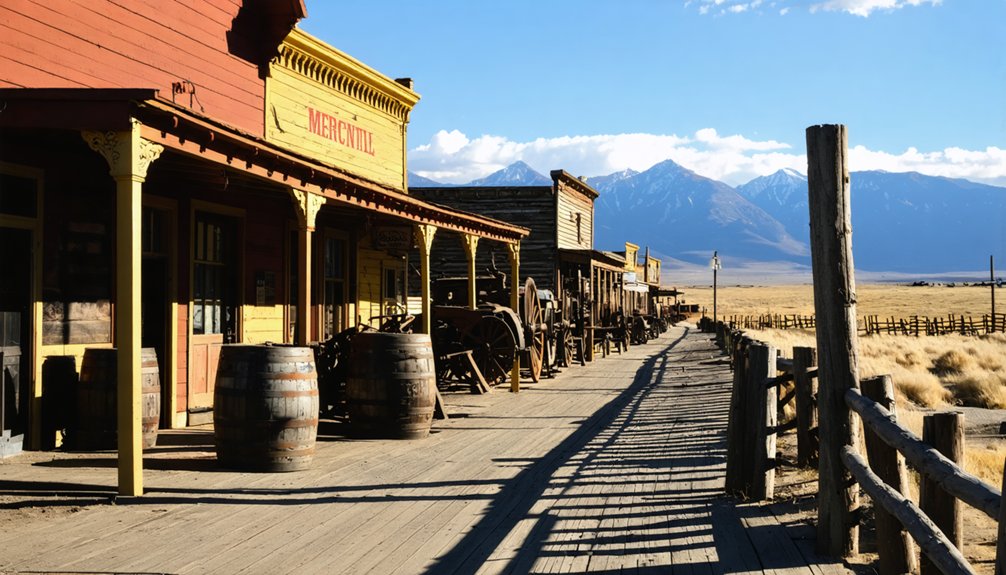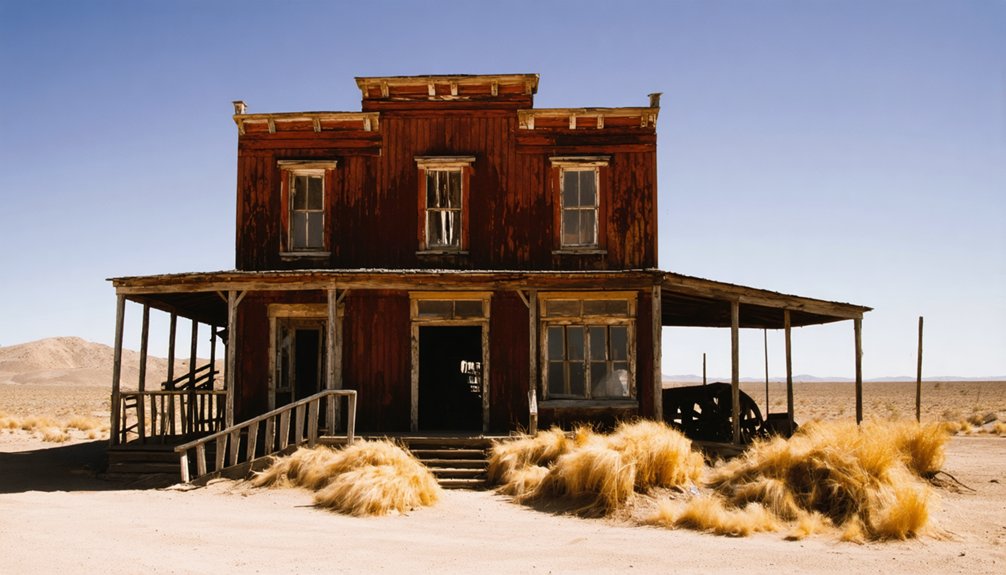
You won’t find Nome, California on modern maps – this Gold Rush boomtown exploded from 18,000 to 165,000 residents after 1898 gold discoveries at Anvil Creek. Once Alaska’s largest community, Nome produced $50 million in gold before deposits dwindled by the early 1900s. Catastrophic fires (1905-1934) and the Great Depression sealed its fate. Today, only scattered ruins remain where nature has reclaimed this cautionary tale of boom-and-bust resource economies.
Key Takeaways
- Nome originated during California’s gold rush, transforming from a small settlement to a booming town of 20,000 people by 1900.
- Gold discoveries in 1898 yielded over $50 million in the first decade, making Nome temporarily Alaska’s largest community.
- Residents faced harsh living conditions in tents and driftwood cabins while performing demanding physical labor in subarctic environments.
- Nome declined due to gold depletion, catastrophic fires between 1905-1934, and the Great Depression forcing abandonment.
- Few weathered structures remain today, with no established historic park, as nature has largely reclaimed the former mining boomtown.
The Gold Rush Origins of Nome
As you explore Nome’s origins, you’ll find it emerged amid the unprecedented population explosion that saw California grow from 18,000 non-Native residents to 165,000 within just three years.
Gold discoveries throughout the Sierra Nevada foothills spawned numerous settlements like Nome, as fortune-seekers from across America, China, Europe, and South America flocked to California’s promising terrain. Many hopeful miners were among the 49ers who risked their lives on dangerous journeys to reach the goldfields. By the end of the decade, these individual prospectors were largely replaced by organized capital and machinery as the easily accessible gold deposits became exhausted.
Mining Operations and Economic Heyday
While gold was first discovered in the Nome region on Anvil Creek in September 1898, it was the subsequent beach mining operations that truly transformed this remote Alaskan outpost into an economic powerhouse.
You’d be astounded by the scale of extraction—over one million dollars in gold from the beaches in 1899 alone, with the broader region yielding nearly $50 million during the first decade. This economic boom attracted upwards of 20,000 gold seekers by 1900, making Nome Alaska’s largest community.
The goldfields yielded exceptional treasures, including Alaska’s second-largest gold nugget at 182 troy ounces from Anvil Creek. Like California mines, Nome’s operations faced considerable environmental challenges from hydraulic mining techniques.
Alaska’s gold legacy sparkles with remarkable finds, including the massive 182-troy-ounce nugget unearthed at Anvil Creek.
Despite this prosperity, Nome’s gold mining heyday proved short-lived. Operations like the Big Hurrah underground mine opened with promise but closed after only a few years, foreshadowing the inevitable economic decline. The development of the Iditarod Trail in 1911 provided crucial transportation infrastructure connecting Nome to other parts of Alaska.
Daily Life in a Bustling Mining Community
When Nome transformed from a mere encampment to a bustling mining community, residents initially faced primitive living conditions that reflected the settlement’s hasty establishment. You’d have found yourself among prospectors living in tents and driftwood cabins, gradually replaced by log structures as the population stabilized.
Daily routines centered on demanding physical labor in harsh subarctic conditions. While beach gold mining proved relatively accessible compared to other rushes, you’d still endure long hours in cold, wet environments. The devastating Bering Sea storm of September 1900 further complicated mining efforts, forcing adaptations to equipment and techniques.
Community dynamics were shaped by a diverse yet imbalanced population—predominantly male miners, gamblers, and merchants, with marginalized Alaska Natives. The population rapidly increased from a few thousand to nearly 28,000 within months due to the gold rush excitement. Despite limited law enforcement and frequent claim disputes, civilization gradually took hold through emerging institutions like schools, churches, and wireless telegraph service by 1904, creating a semblance of order amid frontier chaos.
The Decline and Abandonment
When you walk the deserted streets of Nome today, you’re witnessing the aftermath of three devastating factors that precipitated its abandonment.
The depletion of gold reserves coincided with catastrophic fires that razed significant portions of the town between 1905 and 1911, destroying infrastructure that was never rebuilt. The most notable fire occurred in 1934, which destroyed most of the original Gold Rush structures. Similar to other boom-and-bust cycle communities, Nome’s prosperity was intrinsically tied to resource extraction and market forces.
These calamities, coupled with the economic stranglehold of the Great Depression, forced remaining residents to abandon their homes and businesses, transforming a once-thriving mining hub into the silent ghost town you can explore today.
Depletion of Mining Resources
The gold rush in Nome, Alaska ultimately faced the same fate as countless other mining booms throughout history—a gradual decline triggered by resource depletion.
By the early 1900s, the easily accessible gold that once lined the beaches and streams began disappearing at an alarming rate. Individual prospectors found themselves struggling against this growing resource scarcity.
Mining depletion forced a dramatic shift from simple panning operations to more capital-intensive dredging techniques. Large companies with expensive equipment replaced the independent miners who’d first populated the area. World War II caused further disruption when the government issued a closedown order for mining operations in 1942, redirecting labor and equipment to defense projects. This action stemmed from Executive Order L-208, which deemed gold extraction non-essential during wartime priorities.
Despite these industrial efforts, the finite nature of Nome’s mineral wealth became increasingly apparent. The diminishing returns led to a predictable pattern seen in countless other resource-dependent settlements—population decline, shuttered businesses, and the gradual transformation from bustling boomtown to shadow of its former self.
Fires and Natural Disasters
While depleting gold resources steadily eroded Nome’s economic foundation, a series of catastrophic fires and natural disasters accelerated the town’s decline and ultimate abandonment.
The devastating 1934 fire, which began at the Golden Gate Hotel and spread rapidly due to 20-30 mph winds, destroyed most of Nome’s downtown in just four hours. Property damage reached $3 million, leaving residents homeless and obliterating the town’s architectural heritage.
Despite rudimentary fire prevention efforts, wooden structures and harsh weather conditions made Nome perpetually vulnerable.
Natural disasters further sealed Nome’s fate. The October 1913 storm demolished much of Front Street, while recurring coastal erosion and flooding gradually reconfigured the landscape.
You’ll find that disaster preparedness remained minimal, allowing each successive calamity to further diminish population and economic significance until the once-thriving mining community vanished entirely.
Economic Depression Effects
Following the fires and natural disasters that ravaged Nome’s physical infrastructure, economic depression effects delivered the final blow to this once-thriving gold rush community. By 1910, the mines were largely exhausted, with gold production plummeting from its peak of 3.6 million troy ounces. The Panic of 1893 and subsequent worldwide depression severely restricted capital investment in Nome’s mining operations.
You’ll find that these economic shifts triggered dramatic population decline, from 10,000 residents in 1899 to merely 1,852 by 1950. As mining jobs vanished, Nome’s remaining inhabitants turned to subsistence activities and scarce wage employment.
The town’s tax base eroded, crippling municipal services and accelerating outmigration. Despite minor diversification through ivory carving and tourism, Nome never recovered its former prosperity, ultimately succumbing to abandonment.
What Remains Today: Ruins and Landmarks
Unfortunately, remnants of Nome’s once-thriving settlement have largely disappeared from California’s landscape, with only a handful of weathered structures still hinting at its historical significance.
Unlike better-preserved ghost towns like Bodie or Calico, Nome presents a challenging exploration for history enthusiasts seeking tangible connections to California’s mining past.
The ghostly remnants of Nome have mostly succumbed to nature’s reclamation and time’s erosion.
You’ll find no established historic park or maintained historical landmarks to guide your visit. This absence of formal preservation creates both limitation and opportunity—allowing you to experience a truly forgotten piece of California’s frontier story.
The site represents a less commercialized window into the state’s boom-and-bust cycle, where authentic discovery awaits those willing to research beyond established tourist destinations.
Visiting Nome: Tips and Historical Significance

When visiting the remote ruins of Nome, you’ll need thorough preparation including a high-clearance vehicle, abundant water supplies, and emergency equipment for the challenging desert conditions.
Your historical exploration should focus on the scattered mine entrances, foundations of the general store, and remnants of the silver processing facilities that once supported this boom-and-bust community.
Despite its obscurity, Nome offers a compelling window into California’s mining heritage, illustrating how resource depletion and harsh environmental conditions shaped the fate of countless Western frontier settlements.
Essential Safety Preparations
Venturing into Nome’s abandoned landscape requires thorough preparation for safety concerns that could arise in this remote California ghost town. The isolation combined with deteriorating structures creates unique hazards for explorers.
Extensive safety guidelines recommend carrying emergency supplies including first aid kits, sufficient water, and communication devices that function without cellular coverage.
Visitor preparation should include researching Nome’s specific terrain challenges before arrival, as seasonal conditions dramatically affect accessibility. Wearing appropriate footwear with ankle support and protective clothing is essential when traversing unstable building remains and uneven pathways.
Weather patterns can change rapidly in this desert region, making layered clothing advisable year-round.
Always inform someone of your itinerary and expected return time, as Nome’s remote location means emergency services may be hours away if accidents occur.
Historical Remnants Tour
With safety considerations in mind, visitors can now focus on experiencing Nome’s rich historical narrative through its physical remains.
As you explore the remnants of this silver boom-and-bust settlement, you’ll encounter mining bunkhouses, shaft entrances, and primitive structures that tell the story of 19th-century frontier ambition.
The site’s tailings piles and architectural ruins offer tangible connections to the miners who sought fortune during California’s silver rush.
Ghost town preservation efforts have maintained these historical elements while historical interpretation plaques provide context about daily life and economic conditions of the era.
Watch for markers highlighting mining techniques and the social dynamics that shaped Nome’s brief existence.
These physical traces, much like those at Calico or Bodie, represent not just abandonment but a vital chapter in California’s complex mining heritage.
Frequently Asked Questions
Were Any Famous Outlaws or Lawmen Associated With Nome?
No, you won’t find outlaw legends or lawman stories tied to Nome. Historical records meticulously demonstrate this small mining settlement lacked the notorious criminal activity that attracted significant law enforcement figures.
What Indigenous Tribes Inhabited the Area Before Nome Was Established?
You’ll find the Iñupiat were the primary indigenous inhabitants, with St. Lawrence Island Yupik and Central Yup’ik people also contributing to the region’s rich indigenous history and tribal influence before Nome’s establishment.
Did Nome Have Any Unique Local Traditions or Celebrations?
Dusty documents don’t detail distinctive Nome traditions or Nome celebrations. You’ll find historical records surprisingly silent on any unique cultural practices specific to this California silver-mining settlement’s brief existence.
Were There Any Documented Hauntings or Paranormal Activities in Nome?
You won’t find documented ghost sightings in Nome’s historical record. Research reveals no credible paranormal investigations or haunting reports associated with this settlement, unlike other well-known California ghost towns.
How Did Nome Compare to Neighboring Mining Towns in Prosperity?
Nome’s gold rush prosperity was astronomically overshadowed by neighboring mining towns that utilized superior mining techniques. You’d find Nome’s modest output dwarfed by more technically advanced operations in surrounding California districts.
References
- https://californiacrossings.com/best-ghost-towns-in-california/
- https://www.camp-california.com/california-ghost-towns/
- https://californiathroughmylens.com/calico-ghost-town/
- https://www.californist.com/articles/interesting-california-ghost-towns
- https://www.youtube.com/watch?v=OD9M6MP6RRU
- https://capitolmuseum.ca.gov/state-symbols/silver-rush-ghost-town-calico/
- https://en.wikipedia.org/wiki/List_of_ghost_towns_in_California
- https://www.visitcalifornia.com/road-trips/ghost-towns/
- https://maturango.org/tag/california-ghost-towns/
- https://www.britannica.com/topic/California-Gold-Rush