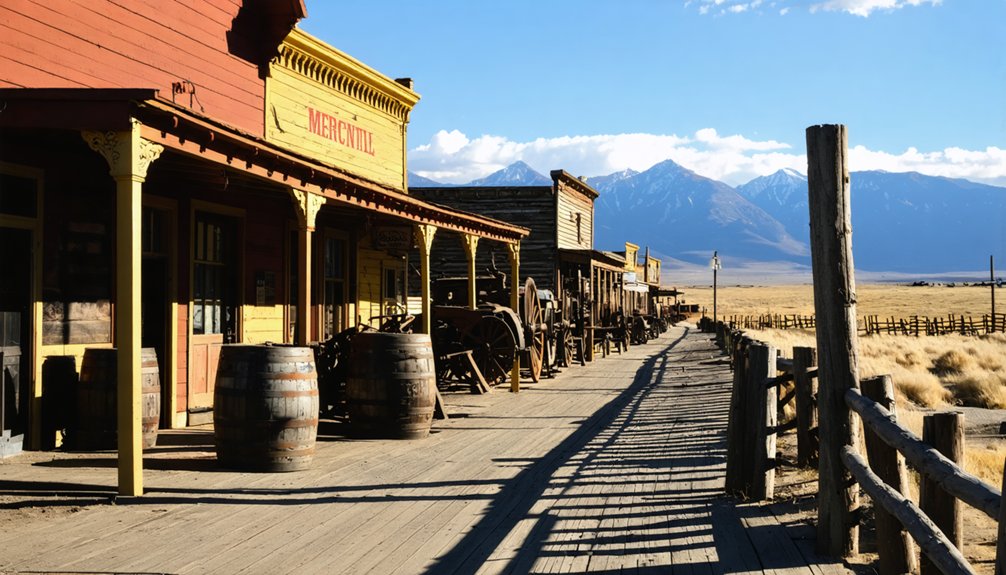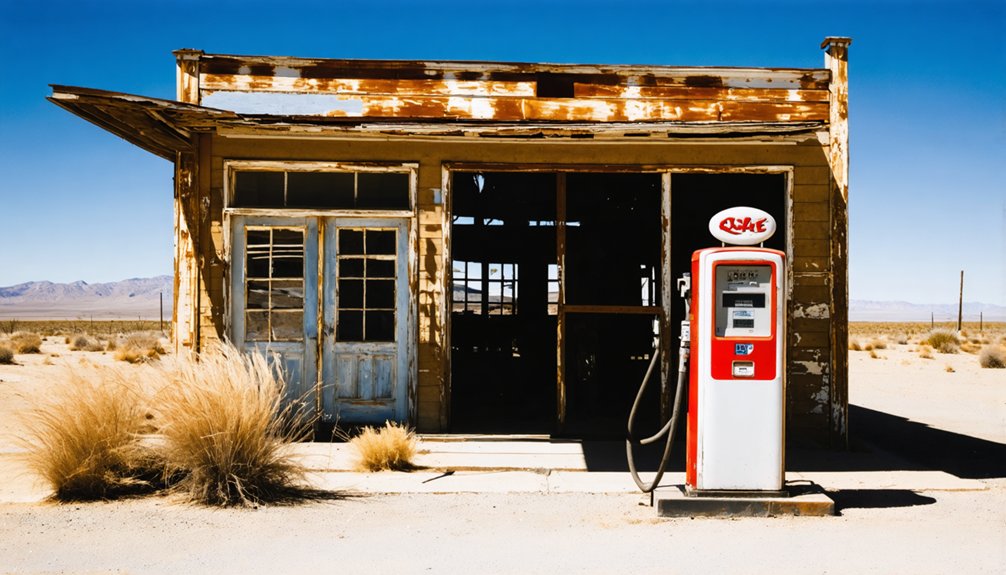
North Muroc emerged in 1910 when the Corum family struck water in the Mojave Desert, naming their settlement by spelling their surname backwards to avoid postal confusion. You’ll find this ghost town‘s remains on what became Edwards Air Force Base, where nearly 300 homesteaders once built lives before military acquisition displaced them by 1951. The harsh desert community’s greatest legacy lives on through its role in breaking the sound barrier and reshaping aviation forever.
Key Takeaways
- North Muroc began as a homestead settlement in 1910 when the Corum family struck water in the Mojave Desert.
- The community thrived with nearly 300 homesteaders until military expansion in the 1930s led to civilian displacement.
- Military takeover was complete by 1951 when the post office closed, effectively ending civilian life in North Muroc.
- The area transformed into Edwards Air Force Base, becoming the site of Chuck Yeager’s historic sound barrier flight.
- Few physical remnants of North Muroc remain due to restricted military access and desert erosion of historical structures.
The Origins of a Backwards Name: How “Corum” Became “Muroc”

The curious reversal of a family name gave birth to one of California’s most historically significant desert settlements. When the Corum family homesteaded the barren landscape in 1910, they couldn’t have known their inverted surname would mark aviation history.
You’re witnessing a clever frontier solution in this ghost town’s name origins. When establishing a post office, the Corums discovered their family name conflicted with “Coram, California.” Rather than surrender their identity, they simply flipped it—”Corum” became “Muroc.”
This practical reversal, common in rural naming conventions, avoided bureaucratic confusion while preserving family legacy. The name stuck, identifying both the settlement and post office from 1910 until 1951, long before jet engines replaced the sounds of homesteaders’ wagons. The area would later become part of Muroc Bombing Range when Lt. Col. H.H. Hap Arnold established it in 1933 for military purposes. What began as a simple homestead would eventually transform into a crucial location that shaped American technological heritage through groundbreaking aviation and automotive racing developments.
Water in the Desert: The Corum Family’s Unlikely Discovery
Beyond their clever naming solution, the Corum family’s most valuable contribution to North Muroc’s development came from what lay beneath the seemingly barren landscape.
In 1910, they struck water at just 19 feet deep—an extraordinary find in the harsh Mojave Desert. This discovery transformed barren earth into potential farmland and attracted nearly 300 homesteaders within months.
You can imagine the excitement when that first water gushed forth, promising life where most saw only desolation. This precious resource became the foundation for community resilience, enabling alfalfa cultivation, livestock raising, and ultimately, permanent settlement. This fertile land allowed residents to raise white Holland turkeys and other poultry as part of their agricultural pursuits.
Ralph Corum’s dedicated efforts in digging shallow wells helped prepare the land for the influx of new settlers.
The Corums’ general store and the area’s first school emerged directly from this water-driven stability. Their legacy of early water conservation and resource stewardship created an improbable oasis that would eventually support military aviation’s future.
Life on the Edge of Rogers Dry Lake (1910-1942)
You’d find the Muroc homesteaders battling nature’s harshest elements while establishing tentative roots along Rogers Dry Lake’s unforgiving shoreline. Their survival hinging entirely on the scarce water sources the Corum family had discovered.
Their scattered ranches created a tenuous community where families raised modest livestock herds on the sparse vegetation that managed to survive between the massive playas. The Corum family established a general store that became a crucial hub for the growing settlement. Despite these challenges, a determined frontier spirit persisted until 1933, when military interests in the lakebed’s natural “concrete” surface began the inevitable transformation from struggling settlement to essential wartime airfield. The military eventually constructed a replica Japanese warship on the dry lakebed for bombing practice during World War II.
Desert Homesteading Challenges
When homesteaders first staked their claims on the unforgiving edge of Rogers Dry Lake between 1910 and 1942, they couldn’t have fully comprehended the brutal challenges awaiting them in this remote corner of the Mojave Desert.
You’d have faced scorching days followed by freezing nights while struggling to coax crops from soil that received less than 5 inches of rainfall annually. Your homesteader resilience would’ve been tested daily as dust storms ravaged your structures and damaged precious plantings.
Environmental adaptation became essential to survival as you battled soil salinity, isolation from supply routes, and costly transportation of necessities.
Most settlers attempted growing alfalfa and barley while developing mutual aid networks with distant neighbors. Despite these efforts, economic hardships mounted, especially during the Depression.
The early homestead established by the Corum family in 1910 represented the pioneering spirit that characterized North Muroc’s settlement.
Few achieved lasting financial stability, with most abandoning their dreams within a decade. Similar to other Mojave Desert homesteaders, over half of North Muroc’s settlers failed to gain title to their claimed lands.
Water-Driven Settlement Growth
The discovery of a shallow water table just 19 feet beneath the parched Mojave Desert surface transformed North Muroc from an uninhabitable wasteland into a tenacious settlement in 1910.
The Corum family, whose reversed name gave Muroc its identity, tapped this life-giving water source, enabling others to follow their pioneering footsteps.
You’d have witnessed Effie Corum’s determination as she drove her buggy across the desert collecting signatures for the post office petition, establishing a community lifeline that would serve residents for 41 years.
Against settlement challenges, homesteaders cultivated poultry and established roots along Rogers Dry Lake’s shoreline.
For two decades, these resilient settlers carved out existence on nature’s terms, their water-dependent community spreading slowly across the landscape—unaware their hard-won homeland would eventually disappear beneath military runways. Located at 34°55′23″N 117°52′20″W, Muroc’s elevation of 2,283 feet provided settlers with a strategic vantage point in the vast Mojave Desert.
Ranching Among Dry Lakes
Nestled along the margins of Rogers Dry Lake, ranching operations in North Muroc embodied the stubborn resilience of desert pioneers between 1910 and 1942. Following the Corum family’s arrival, scattered homesteaders carved out a living through specialized ranching techniques adapted to the harsh terrain.
You’d find desert livestock operations characterized by:
- Hardy sheep and cattle breeds that could thrive on sparse desert vegetation
- Elaborate water conservation systems connecting distant wells to grazing areas
- Seasonal rotations that maximized limited resources during drought cycles
Your livelihood demanded self-sufficiency as you’d travel miles to market your livestock. The isolated existence fostered a fiercely independent spirit among ranchers, who relied on mutual aid from neighbors when hardship struck. During brief rainy seasons, ranchers took advantage of standing water that temporarily collected on the lakebed to supplement their water supplies.
This tenacious way of life persisted until military expansion gradually claimed the land, forever changing North Muroc’s landscape.
From Post Office to Ghost Town: North Muroc’s Brief Existence
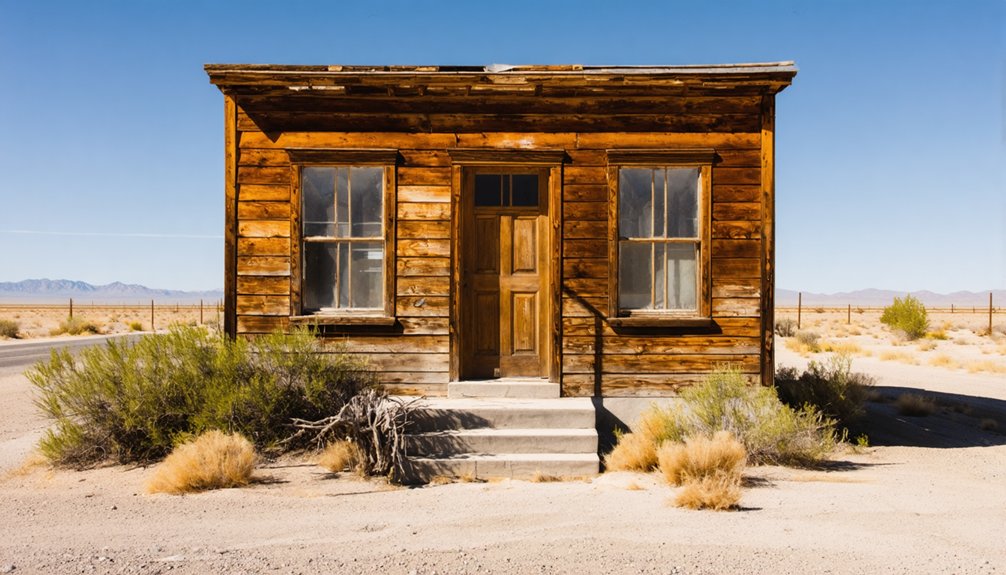
If you’d visited North Muroc in its prime, you’d have found the post office serving as the settlement’s beating heart from 1910 until its closure in 1951—connecting scattered ranchers through mail and commerce despite the harsh desert isolation.
The military’s gradual acquisition of land for what would become Edwards Air Force Base began in the 1930s, steadily transforming Muroc from a civilian settlement into a strategic military installation.
Rural Post Office Hub
Though barely a mark on most historical maps, North Muroc‘s transformation from isolated desert outpost to vanished settlement began with the establishment of a humble post office in December 1910.
This crucial institution, housed in the Corum brothers’ general store, became the heart of desert homesteader life. Effie Corum’s determined signature-gathering across the harsh Mojave secured this lifeline for the community.
The post office’s impact on the area can’t be overstated:
- It served as the primary community gathering spot where scattered settlers exchanged news and formed bonds.
- Beyond postal services, the location provided essential supplies otherwise unavailable for miles.
- The Corums offered additional assistance with water wells and land clearing, encouraging settlement expansion.
The name “Muroc” itself—a reversal of “Corum”—stands as evidence to the family’s enduring desert legacy.
Military Acquisition Timeline
When military eyes first turned toward the vast Mojave expanse in 1932, the quiet community of North Muroc had no inkling it was living on borrowed time.
Lt. Col. “Hap” Arnold’s search for bombing ranges sealed North Muroc’s fate. By 1933, the War Department’s land negotiations were underway, with military strategy demanding isolation for dangerous training operations.
You’d have witnessed surveyors from Bakersfield in 1940, mapping what locals felt was undervalued land seized through eminent domain.
President Roosevelt’s Executive Order 6588 formalized the Muroc Bombing and Gunnery Range in February 1934, but acquisitions continued until 1939.
The military methodically consumed the area, transforming from tent encampments to permanent installations. What began as occasional bombing exercises evolved into a cornerstone of America’s aviation development, eventually erasing North Muroc from existence.
Final Settlement Remnants
Three weathered buildings clustered around a humble post office marked the heart of North Muroc‘s fleeting existence.
This community hub, established in 1910 at the Corum brothers’ store, served as the lifeline for scattered homesteaders braving the harsh desert landscape.
You’ll find no physical traces today—everything lies buried beneath Edwards Air Force Base runways, sacrificed to America’s aviation legacy.
The settlement’s fate unfolded in three distinct phases:
- Birth – Named by reversing “Corum” to avoid postal conflicts
- Service – Operated continuously as a fourth-class post office until 1951
- Surrender – Gradually absorbed by military expansion beginning in 1933
What remains isn’t stone or wood but the freedom-seeking spirit of those early pioneers who claimed this unforgiving terrain as their own.
Desert Ranching: Economic Struggles in the Mojave
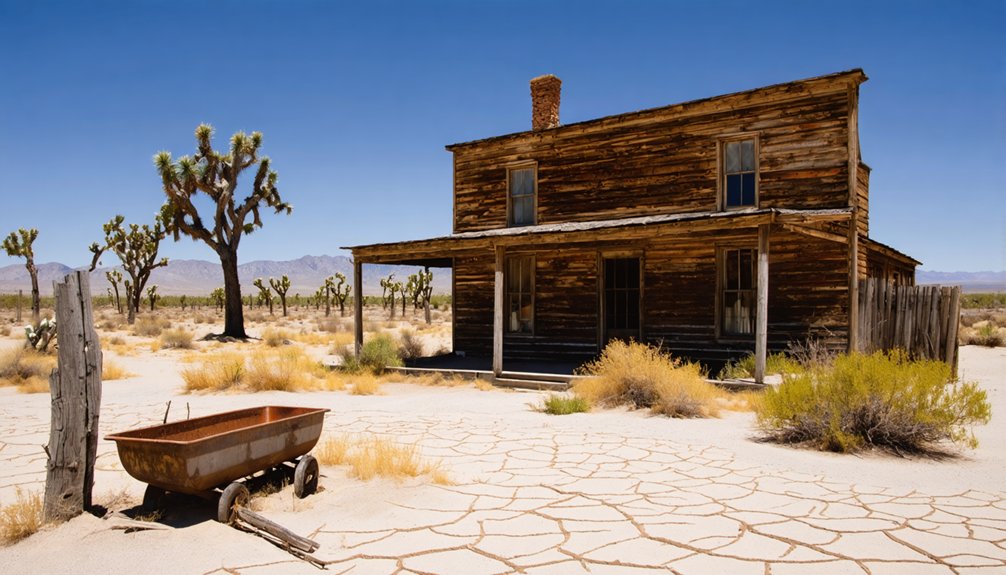
Many ambitious ranchers ventured into the harsh Mojave Desert following the 1870s, establishing cattle operations across its vast, unforgiving landscape.
You’d have witnessed these pioneers battling constant economic sustainability challenges as they built their dreams on parched earth.
Water scarcity defined their existence. When you’re running cattle in the Mojave, every drop counts. Ranchers constructed windmills and wells, but drought years devastated their livelihoods. Overgrazing quickly depleted the fragile desert vegetation, creating a downward spiral of productivity.
These isolated operations faced brutal market realities too. Without reliable transportation networks, getting beef to market proved costly and difficult. As mining interests competed for the same precious water sources, ranching challenges multiplied.
Military Acquisition and the End of Civilian Settlement
As Lieutenant Colonel Henry H. “Hap” Arnold surveyed the vast expanse of Muroc Dry Lake in August 1932, you could almost see his vision taking shape—a remote bombing range far from civilian populations where pilots could train without endangering residents.
The military expansion that would transform this land began formally when President Roosevelt signed Executive Order 6588 in 1934, though Army Air Corps operations started in 1933.
This acquisition spelled the end for North Muroc’s civilian settlement through:
- Establishment of the Muroc Bombing and Gunnery Range as a sub-post of March Field
- Construction of permanent military infrastructure following Pearl Harbor
- Complete civilian displacement by 1951 when the Muroc post office closed forever
What began as the Corum brothers’ homestead (Muroc is “Corum” spelled backward) became America’s premier flight test center at the expense of its original settlers.
Transformation From Homestead to Aerospace Testing Ground
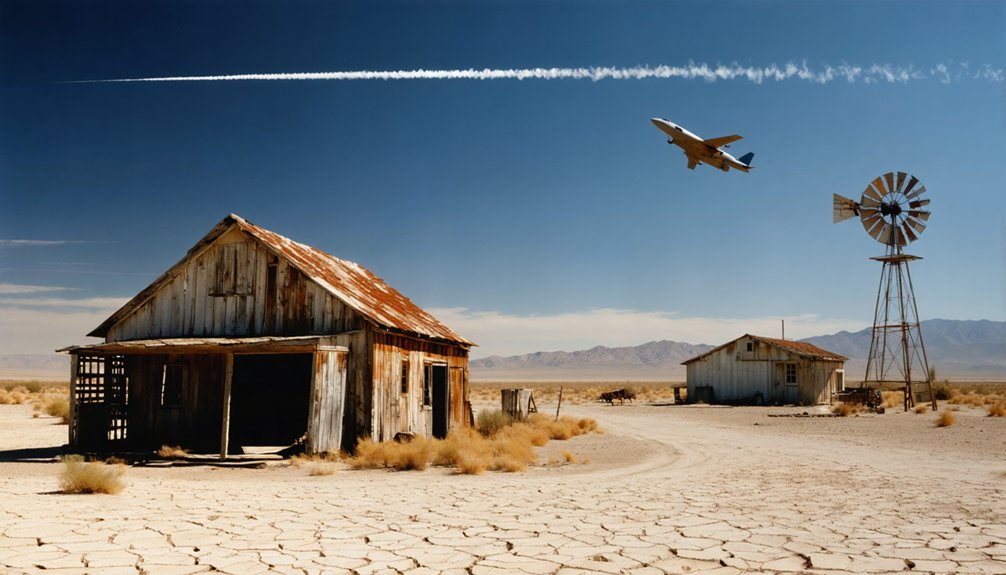
While the Corum family’s homestead seemed destined to remain a modest desert settlement in 1910, fate had grander designs for the parched Mojave landscape they’d chosen.
You’d hardly recognize the transformation that occurred as military interests overtook civilian life in the 1930s and 40s.
When “Hap” Arnold identified the flat, clear-weather landscape as perfect for military aviation in 1932, Muroc’s destiny changed forever.
Despite community resilience, civilian presence gradually disappeared beneath expanding runways.
The settlement that once celebrated turkey farming and community gatherings became hallowed ground for aviation milestones when America’s first turbojet arrived in 1942, followed by the historic XP-59A flight that October.
The Sound Barrier Legacy: How Muroc Changed Aviation History
As you explore North Muroc‘s abandoned streets, you’re walking the same ground where Chuck Yeager‘s orange Bell X-1 rocket plane shattered the sound barrier on October 14, 1947, reaching Mach 1.06 at 43,000 feet above Rogers Dry Lake.
The desolate Mojave Desert landscape you see today once echoed with sonic booms as experimental aircraft dropped from B-29 bombers pushed aviation’s boundaries at the facility that would become Edwards Air Force Base.
You’re standing on hallowed aviation ground where a small desert outpost transformed American aerospace history, serving as the launching point for supersonic flight and establishing the foundation for space exploration to come.
Yeager’s Historic Flight
On October 14, 1947, the silent skies above Muroc Air Force Base witnessed humanity’s definitive conquest of a barrier once thought impenetrable.
Chuck Yeager, nursing broken ribs known only to his trusted friend Jack Ridley, pushed the bullet-shaped “Glamorous Glennis” beyond what many considered impossible.
Yeager’s legacy was cemented as he:
- Accelerated to Mach 1.06, approximately 700 mph at 43,000 feet
- Experienced an otherworldly silence as he outran his own sound waves
- Triggered the world’s first deliberate sonic boom, announcing mankind’s liberation from subsonic constraints
This feat transformed Muroc into the epicenter of supersonic innovation, disproving theories of an impenetrable “barrier” and releasing decades of aerospace advancement.
You’re standing on hallowed ground where human determination conquered physics, forever changing aviation’s boundaries and opening the skies to unlimited possibility.
Desert Testing Grounds
Yeager’s historic flight represents merely the pinnacle of Muroc’s revolutionary aerospace saga.
Before breaking the sound barrier, this desolate patch of Mojave Desert transformed from a simple wooden building with tents into the cradle of America’s aviation future.
You’re standing on hallowed ground where military innovation began in June 1940.
Rogers Dry Lake’s flat, isolated terrain provided the perfect canvas for secret test flights that would redefine flight itself. The P-59 Airacomet and XP-80 Shooting Star first stretched their wings here, launching the turbojet revolution away from prying eyes.
This barren landscape witnessed countless aviation milestones as experimental rocket programs and jet technology flourished.
What began as a remote bombing range evolved into the nerve center of aerospace advancement, forever changing how you experience the freedom of flight.
Mapping a Vanished Community: Tracing North Muroc’s Footprint
Though the desert winds have long since erased most physical traces, mapping North Muroc‘s vanished footprint requires piecing together fragments of historical records and geographical markers.
This ghost town‘s layout can be partially reconstructed through aerial survey imagery captured before the military acquisition, revealing the scattered ranch settlement that once thrived at 35°00′18″N 117°49′08″W.
The surrounding area is dotted with abandoned sites on North Shore, each telling a story of past prosperity and subsequent decline. Nature has begun to reclaim these forgotten structures, with overgrown vegetation enveloping the remnants of human habitation. As one explores the terrain, the sense of history is palpable, drawing attention to the once vibrant community that has long been erased from memory.
If you’re determined to trace this forgotten community, focus on:
- The Santa Fe Railroad water stop established in 1882 as your primary reference point
- The Corum family homestead with its 19-foot well, marking the settlement’s heart
- The convergence of desert roads connecting to Antelope Valley that formed Muroc’s lifelines
Standing on Rogers Dry Lake today, you’re walking atop the buried history of pioneers who carved freedom from this harsh landscape.
Preserving the Memory of Kern County’s Desert Settlement
Despite the relentless march of time, preserving North Muroc’s memory has become a passionate mission for local historians and military archivists alike.
You’ll find the community’s historical significance captured primarily through archival maps, photographs, and oral histories from descendants of the Corum family and other original settlers.
When you explore local museums, you’ll discover collaborative exhibits highlighting the transformation from hopeful homesteading community to vital military installation.
The preservation focuses on documenting the settlers’ struggles with desert farming and their agricultural aspirations, while celebrating their contribution to aviation history.
You’ll notice challenges persist – physical remnants are scarce, base access is restricted, and desert erosion threatens what little remains.
Nevertheless, community narratives endure through educational outreach programs that connect today’s residents with their pioneering past.
Frequently Asked Questions
Are There Any Remaining Structures or Ruins of North Muroc Today?
You’ll find virtually no remaining buildings or historical artifacts at North Muroc today. Its ghostly traces have vanished, leaving only memories where freedom-seekers once carved their California dreams.
What Happened to the Corum Family After Military Acquisition?
You’ll find the Corum family’s legacy was severed when military impact forced their relocation. They scattered to urban areas, likely Los Angeles or Kern County, leaving behind only their name in Muroc’s history.
Did Indigenous Peoples Inhabit the Area Before the Corum Settlement?
While settlers claimed virgin wilderness, Indigenous history tells a different story. You’ll find Yurok and Tolowa tribes thrived in Northern California’s coastal regions, their cultural significance deeply rooted in these ancestral lands.
Were There Any Schools or Churches in North Muroc?
You’d find minimal ghost town education in North Muroc—just a single schoolhouse from 1912. Religious institutions were virtually nonexistent, with no churches built before the military takeover erased civilian life.
What Natural Disasters Affected North Muroc During Its Existence?
You’d witness relentless drought as your primary nemesis, transforming daily life into a struggle. While earthquake impacts remained minimal, the occasional flash flood risks paradoxically threatened your water-starved desert settlement.
References
- https://www.youtube.com/watch?v=D3qsbO8GDsw
- https://claybornglobal.com/IHF/index.php/Edwards_AFB
- https://en.wikipedia.org/wiki/List_of_ghost_towns_in_California
- https://en.wikipedia.org/wiki/Muroc
- https://lacountylibrary.org/antelope-valley-local-history/
- https://pubs.usgs.gov/of/1963/0146/report.pdf
- https://digital-desert.com/blog/the-evolution-of-muroc-from-desert-wasteland-to-aviation-and-racing-hub/
- https://www.space.com/29543-edwards-air-force-base.html
- https://en.wikipedia.org/wiki/Edwards_Air_Force_Base
- https://www.nasa.gov/wp-content/uploads/2023/04/sp-4530.pdf