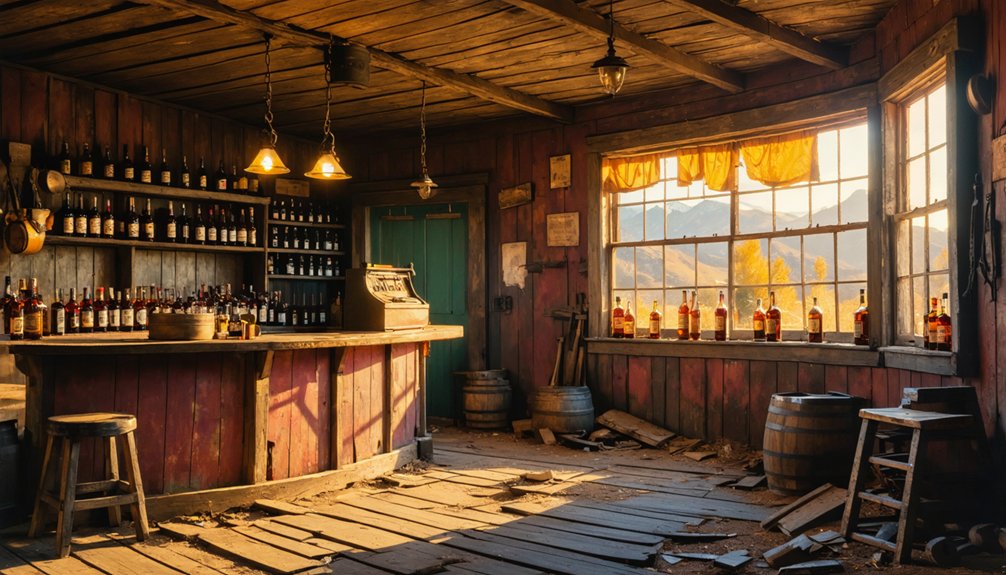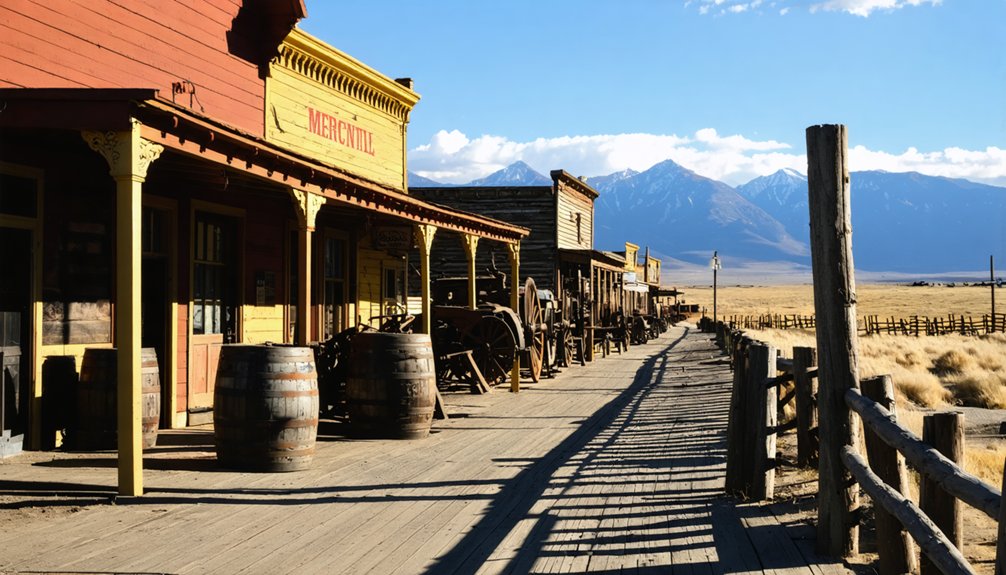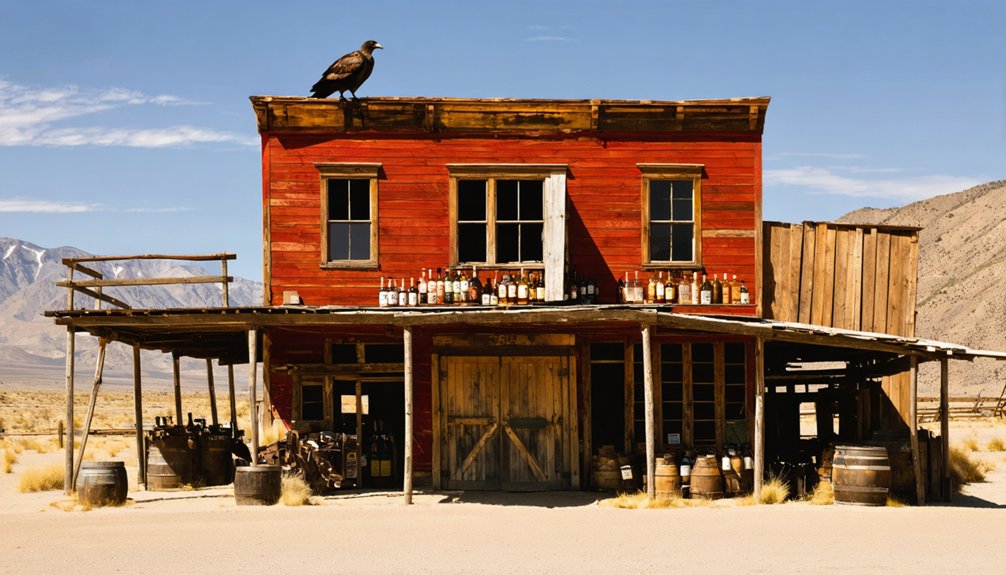
North Shore, once a thriving resort destination on the Salton Sea (1958-1970), now stands as a haunting ghost town. You’ll find abandoned structures, including Albert Frey’s modernist yacht club, deteriorating amid toxic shores. Environmental collapse from agricultural runoff, catastrophic flooding from Hurricane Kathleen in 1976, and rising salinity transformed this celebrity playground into an apocalyptic landscape. A small community persists among the ruins, while nearby Salvation Mountain offers a colorful contrast to North Shore’s sobering environmental cautionary tale.
Key Takeaways
- North Shore transformed from a thriving desert destination with 1.5 million annual visitors into a ghost town following environmental collapse.
- The North Shore Beach and Yacht Club, once Southern California’s largest marina, was abandoned after Hurricane Kathleen’s devastating impact in 1976-77.
- Toxic agricultural runoff, increasing salinity, and catastrophic flooding destroyed North Shore’s tourism economy and infrastructure.
- Abandoned hotels, skeletal docks, and salt-crusted shorelines now characterize the apocalyptic landscape of this former celebrity playground.
- A small resilient community persists amid the ruins, preserving the history of this ghost town situated along the toxic Salton Sea.
The Salton Riviera’s Golden Era (1958-1970)
While today North Shore sits as a crumbling monument to abandoned ambitions, the period between 1958 and 1970 marked the zenith of the Salton Riviera’s prosperity and prominence.
You would’ve witnessed a thriving destination that attracted over 1.5 million annual visitors to its championship golf course, yacht clubs, and vibrant shoreline communities.
The “American Riviera” transformation included extensive infrastructure development with hotels, vacation homes, and commercial districts catering to weekend tourists.
Celebrity sightings became common as the area competed with Palm Springs for desert luxury appeal.
Recreational activities centered around the nation’s most productive fishery, where introduced species like orange mouth corvina and sargo thrived.
Water sports enthusiasts flocked to the shallow lake while the adjacent wildlife refuge supported millions of migratory birds, creating a unique paradise that balanced entertainment with natural splendor.
The lake’s resort status was amplified by its location in the fertile Imperial Valley where agricultural development had been booming since the 1920s.
The 1960 grand opening of the North Shore Beach and Yacht Club Estates marked a significant milestone in the area’s development as a premier recreational destination.
Celebrity Playground of the Desert
Glamour and stardom converged in the desert as North Shore’s rise coincided with the broader Coachella Valley‘s emergence as a celebrity sanctuary.
While Palm Springs claimed primary status among desert celebrity retreats, North Shore benefited from the region’s Hollywood connections established decades earlier.
Though Palm Springs reigned supreme, North Shore’s star quietly rose on Hollywood connections forged long before.
You’d find echoes of the same desert glamour that attracted stars like Sinatra, Monroe, and Presley to the area. The clean desert air and outdoor activities contributed to the region’s appeal among health-conscious celebrities. The “two-hour rule” in actor contracts made the Coachella Valley an ideal escape—close enough to film sets yet far enough for privacy.
Stars who frequented El Mirador Hotel and the Racquet Club occasionally ventured eastward to emerging lakeside developments. The North Shore Beach and Yacht Club, once the largest marina in Southern California, attracted celebrities looking for desert recreation with a waterfront twist.
The architectural influence of Desert Modernism, with its integration of natural elements and landscape, extended to North Shore’s development, though with less permanence than its western counterparts.
The North Shore Beach and Yacht Club Legacy
No symbol better represents North Shore’s ambitious heyday than the modernist masterpiece standing sentinel along the northeastern shore of the Salton Sea.
Designed by Albert Frey in 1958, the North Shore Beach and Yacht Club’s ship-inspired architecture—with its curved prow, porthole windows, and signature yellow fiberglass panels—epitomizes mid-century modernism at its finest.
You’re witnessing a structure that once hosted celebrities like Jerry Lewis during an era when the Salton Sea attracted more visitors than Yosemite.
Though floods and increasing salinity forced its closure by 1984, the yacht club’s recreational legacy endured through its 2010 restoration as a museum and current status as a community center. The restoration was part of a $2 million development approved by Riverside County to revitalize the area.
Despite environmental devastation, this National Register-listed landmark remains a compelling reminder of North Shore’s complex history of both ambition and decline. Located at the intersection of Sea View Drive and Marina Drive, it continues to stand as a testament to the area’s once-thriving resort community.
Environmental Collapse and Ecological Devastation
As the Salton Sea‘s pristine blue waters transformed into a toxic soup over decades, North Shore witnessed firsthand the devastating ecological collapse that would eventually seal its fate as a ghost town.
The environmental degradation accelerated as agricultural runoff introduced pesticides and chemicals, while increasing salinity killed fish populations that once thrived in these waters.
You’re seeing the results of an ecological crisis where over 100 square miles of contaminated lakebed now lie exposed, releasing toxic dust that carries far beyond the community. During a significant dust storm in 2022, wind speeds reached over 60 miles per hour, creating thick curtains of hazardous sediment.
- Wind whipping across exposed playa, lifting clouds of fine toxic dust skyward
- Fish carcasses rotting along shorelines, their silver bodies dulled by death
- Empty bird nests abandoned amidst shrinking wetland habitats
- Air quality monitors displaying alarming red numbers during dust storms
- Children carrying inhalers as everyday accessories against the poisoned air
What was once a popular recreational destination in the 1950s and 1960s has now become a haunting reminder of environmental negligence.
The Storms That Sealed North Shore’s Fate
In 1977, a hurricane swept through the Salton Sea region with unprecedented ferocity, demolishing the North Shore Beach and Yacht Club infrastructure that had remarkably survived previous meteorological assaults.
You wouldn’t recognize the pre-storm paradise where celebrities once gathered, as the hurricane transformed partially completed developments into skeletal remnants—abandoned sewers, vacant roads, and isolated street signs standing as eerie monuments to failed ambition. These decaying structures evoke the same sense of historical significance found in the ghost towns along Minnesota’s North Shore.
The storm’s devastation proved financially insurmountable for developers who, facing the dual catastrophe of environmental degradation and structural obliteration, permanently abandoned their reconstruction efforts, effectively washing away the last vestiges of North Shore’s resort aspirations. Similar to what happened at Shasta State Historic Park, the natural disaster significantly altered the landscape and left behind ruins that now serve as a testament to the area’s past.
Devastating Tropical Impacts
The tropical storms that ravaged the Salton Sea region throughout the 1970s ultimately delivered the fatal blow to North Shore’s once-promising future.
These catastrophic tropical storm impacts transformed the landscape from a thriving resort destination into an ecological nightmare. You’d scarcely recognize the environmental aftermath that followed—as rising waters engulfed beachfront properties while simultaneously concentrating agricultural pollutants to lethal levels.
- Skeletal docks emerging from receding waters like prehistoric remnants
- Boarded windows of the North Shore Yacht Club staring like vacant eyes
- Salt-crusted shorelines where celebrities once lounged now devoid of life
- Empty marina slips where fishing boats once proudly displayed their catches
- Abandoned two-story motel structures standing as hollow monuments to faded dreams
Flooding vs. Rebuilding Efforts
While North Shore’s developmental trajectory initially defied the Salton Sea’s volatile nature, the catastrophic flooding events of the mid-1970s shattered any remaining hopes for the community’s sustainability.
Hurricane Kathleen’s unprecedented 8-foot water level surge in 1976, followed by another hurricane in 1977, demolished nascent infrastructure and overwhelmed rebuilding efforts before they could materialize.
You’ll find the stark evidence of these failed rebuilding challenges in the aftermath—partially completed developments abandoned by investors who couldn’t secure funding for flood damage repairs.
The few completed structures, empty roads, and street signs stand as monuments to development ambition crushed by environmental reality.
Though protective measures like dikes and retaining walls were eventually constructed around surviving communities like Bombay Beach, they represented last-ditch survival tactics rather than genuine revitalization—too little, too late for North Shore’s once-promising future.
Washed-Away Resort Dreams
Hurricane-force winds tore through the Salton Riviera in the mid-1970s, permanently extinguishing what had once been California’s brightest resort development.
The 1977 hurricane delivered the coup de grâce to North Shore’s washed away dreams, forcing developers to abandon mid-construction projects across the landscape.
You’ll find ghostly remnants of a paradise that once hosted more annual visitors than Yosemite.
- Empty 48-unit celebrity motel stands as a hollow shell against the desert backdrop
- Concrete boat ramps lead nowhere, jutting into polluted waters no vessel will touch
- Palm trees—once symbols of luxury—now dead sentinels lining abandoned streets
- Boarded windows of the once-prestigious yacht club stare blindly across toxic waters
- Half-finished foundations mark where resort ghostliness replaced vibrant construction
Abandoned Infrastructure and Empty Dreams
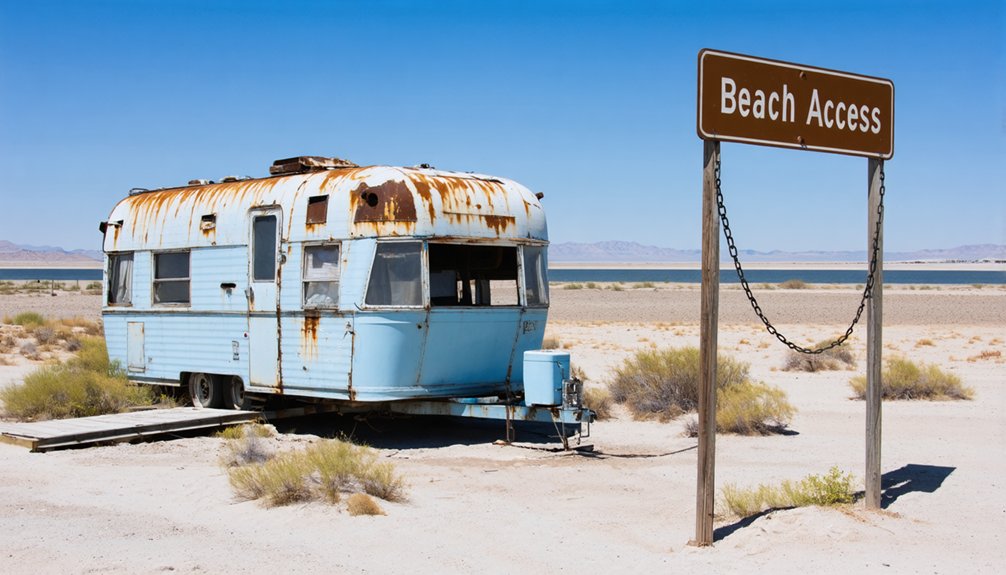
Devastated by environmental catastrophes and economic collapse, the North Shore region now presents a haunting tableau of abandoned infrastructure that stands as evidence to unrealized aspirations.
You’ll find cracked, unmaintained streets forming a ghostly grid where vibrant communities once thrived. The partially completed houses and dilapidated trailers—many roofless and weather-ravaged—silently testify to capital stranded in unfulfilled developments.
The 1970s flooding and hurricanes initiated this decline, while rising salinity and agricultural runoff sealed North Shore’s fate. Former marinas and boat ramps have deteriorated into heaps of corroded metal and disintegrating concrete.
Environmental calamities began North Shore’s fall; toxic waters finished the job. Once-proud marinas now rust silently.
Despite the economic decline, you’ll notice how nature steadily reclaims these abandoned buildings, with vegetation overtaking foundations. Some remaining residents reject the poverty tourism their community now attracts, clinging tenaciously to their land and legacy amid the ruins.
Life Among the Ruins: Current Residents and Community
Despite the apocalyptic landscape that surrounds them, a small but resilient community of permanent residents continues to call North Shore home.
These individuals navigate unique social dynamics while engaging in community preservation efforts, creating meaningful connections amid isolation. You’ll find them gathering for informal events, sharing oral histories, and collaborating on preservation grants that sustain their unconventional lifestyle.
- Elderly caretakers tending to weathered structures with reverent hands
- Remote workers hunched over laptops in restored cabins, satellite dishes perched precariously on sun-bleached roofs
- Neighbors exchanging homegrown produce across property lines defined by rusted fences
- Hand-painted signs directing occasional tourists to impromptu historical exhibits
- Evening gatherings around fire pits where tales of North Shore’s heyday are passed to younger generations
From Resort Destination to Ghost Town Economics
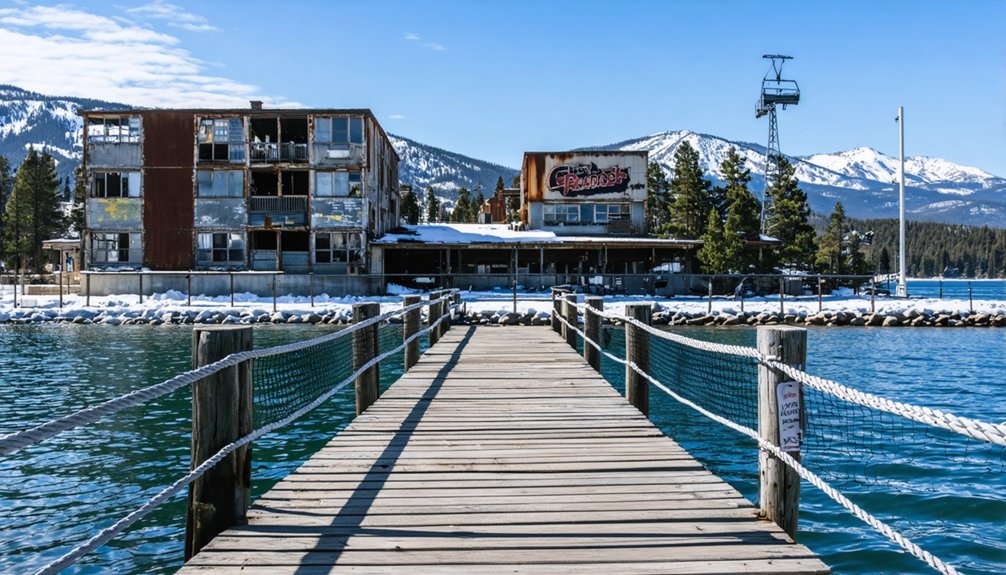
You’re witnessing the aftermath of North Shore’s dramatic economic reversal, where a $2 million marina and luxury amenities that once attracted Hollywood celebrities now stand abandoned.
The area’s shift from “Miracle Salton City by the Desert Sea” to a Class D ghost town represents one of California’s most striking tourism boom-bust cycles, with infrastructure investments becoming worthless as environmental problems mounted.
Today, abandoned buildings in California stand as haunting reminders of the past, with their crumbling facades telling stories of lost opportunities. Each structure echoes the ambitions that once filled the area, transforming into a landscape where dreams faded alongside the relentless sun. As nature gradually reclaims these sites, the juxtaposition of decay against the backdrop of California’s historic allure captivates wanderers and historians alike.
Former high-value real estate developments sit incomplete and decaying, their concrete foundations reclaimed by the harsh desert environment that once served as the backdrop for sailing regattas and vibrant social events.
Boom-Bust Tourism Cycle
North Shore’s dramatic transformation from a booming resort destination to a desolate ghost town illustrates the fragility of tourism-dependent economies when environmental conditions deteriorate.
You’d scarcely recognize today’s abandoned landscape as the same place that once attracted 1.5 million visitors annually—exceeding Yosemite’s attendance.
This classic tourism cycle moved swiftly from development to decline as the Salton Sea’s ecosystem collapsed.
– Frank Sinatra and Bing Crosby mingling at the yacht club while boats gleam in the marina
- Families water-skiing across blue waters, unaware of the environmental disaster brewing beneath
- $20 million in investment evaporating as flooding destroyed infrastructure
- Abandoned motel rooms with furniture still in place, frozen in time
- Decaying buildings surrounded by toxic shores where celebrities once vacationed
- Endangered Yuma Clapper Rails calling through dense marsh reeds at dawn
- Thousands of snow geese lifting off agricultural fields in synchronized flight
- Desert pupfish darting through brackish ponds beneath the scorching sun
- Snowy plovers camouflaged against the salt-crusted shoreline
- Visitors scanning for birds from the observation tower near Rock Hill
- https://www.camp-california.com/california-ghost-towns/
- https://www.legendsofamerica.com/ca-saltonsea/
- https://www.outoftheoffice4good.com/post/exploring-the-almost-ghost-town-of-bombay-beach-ca
- http://freepages.rootsweb.com/~gtusa/history/usa/ca/north-shore.htm
- https://www.youtube.com/watch?v=W5mTYUUjdHA
- https://www.themodernpostcard.com/the-salton-sea-a-ghost-of-former-glory-in-the-california-desert/
- https://en.wikipedia.org/wiki/North_Shore
- https://www.placesthatwere.com/2015/04/salton-sea-north-shore-yacht-club-and.html
- https://www.youtube.com/watch?v=lIxpQjvENFo
- https://www.onlyinyourstate.com/experiences/california/never-completed-abandoned-place-southern-ca
Failed Investment Infrastructure
While investors poured millions into the Salton Sea‘s ambitious development projects during the 1950s, they couldn’t have foreseen the catastrophic financial losses awaiting them.
The North Shore Beach and Yacht Club, once Southern California’s largest marina, epitomized these failed investments.
Celebrities like Frank Sinatra and Bing Crosby frequented this “miracle in the desert,” complete with boat facilities, the 48-unit North Shore Motel, and extensive recreational amenities.
The Salton Sea National Wildlife Refuge Today
Established as one of California’s last major wetland sanctuaries, the Salton Sea National Wildlife Refuge today encompasses approximately 37,000 acres of diverse habitats including marshes, open water, brackish ponds, shoreline, agricultural fields, and desert uplands.
The refuge’s wildlife conservation efforts provide critical stopover and nesting habitat for migratory birds along the Pacific Flyway, supporting over 100,000 birds annually. Active habitat management includes water level manipulation, prescribed burning, and an 869-acre farming program that feeds 30,000 wintering geese and other migrants.
Salvation Mountain: A Colorful Beacon in the Desert
Rising dramatically from the arid desert landscape near the Salton Sea, Salvation Mountain stands as an extraordinary folk art monument that exemplifies one man’s unwavering devotion to spreading a message of universal love.
Leonard Knight’s artistic vision transformed this three-story, 50-foot-tall adobe structure into a vibrant symbol of faith over a 30-year period beginning in 1984.
You’ll find rich cultural symbolism throughout the installation—biblical verses, a “Sea of Galilee” at the base, a prominent red heart in the middle, and a cross at the summit.
After facing demolition threats in 1994, community support saved this desert landmark. Now officially recognized as historically significant, the mountain continues to welcome visitors who can ascend its yellow brick road pathway, experiencing firsthand Knight’s enduring message that “God is LOVE.”
Frequently Asked Questions
Is North Shore’s Water Safe for Swimming Today?
Yes, current water quality meets swimming standards. You’re likely safe during dry conditions, but avoid water contact for 72 hours after rainfall when bacterial contamination increases from runoff.
Are There Any Plans to Restore North Shore to Its Former Glory?
Like Lazarus rising, you’ll witness North Shore’s renaissance through the Heritage Legacy Project. They’re actively restoring historic cottages, with $55 million invested in careful restoration efforts balancing preservation with environmental stewardship and community involvement.
What Health Risks Do Current Residents Face Living Near the Salton Sea?
You’ll face severe respiratory issues from toxic hydrogen sulfide emissions, airborne dust containing pesticides, and increasing salinity levels that trigger algal blooms, all of which compromise your lung function and neurological health.
Can Visitors Legally Explore Abandoned Buildings in North Shore?
You cannot legally enter abandoned buildings without permission as abandoned property regulations prohibit trespassing. Consider authorized ghost town tours instead to experience North Shore’s remnants without legal consequences.
How Does North Shore’s Air Quality Affect Surrounding Communities?
Like toxic fingers reaching into neighboring towns, North Shore’s air pollution infiltrates surrounding communities, dramatically increasing respiratory illnesses, forcing school closures during dust events, and compromising community health across the entire region.
References