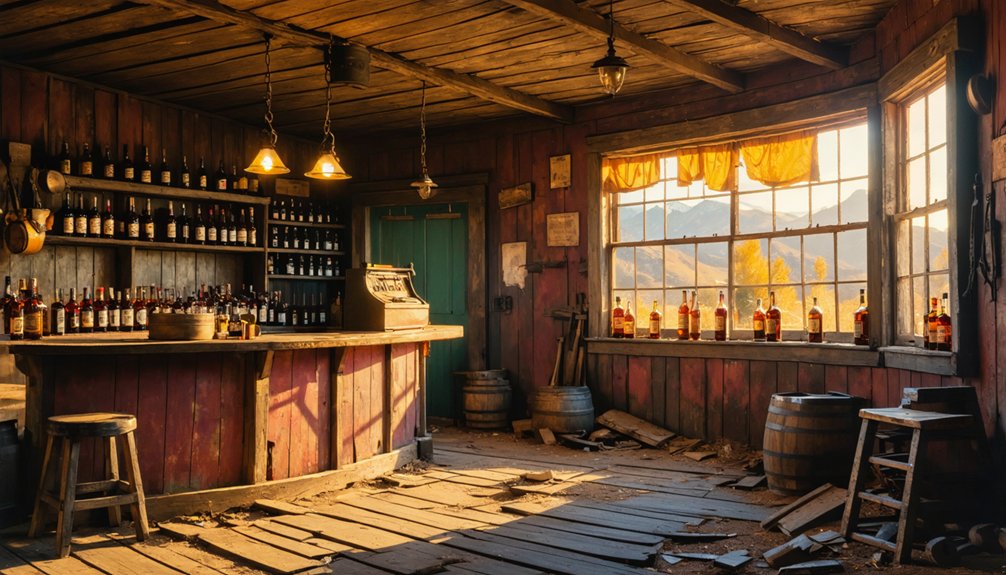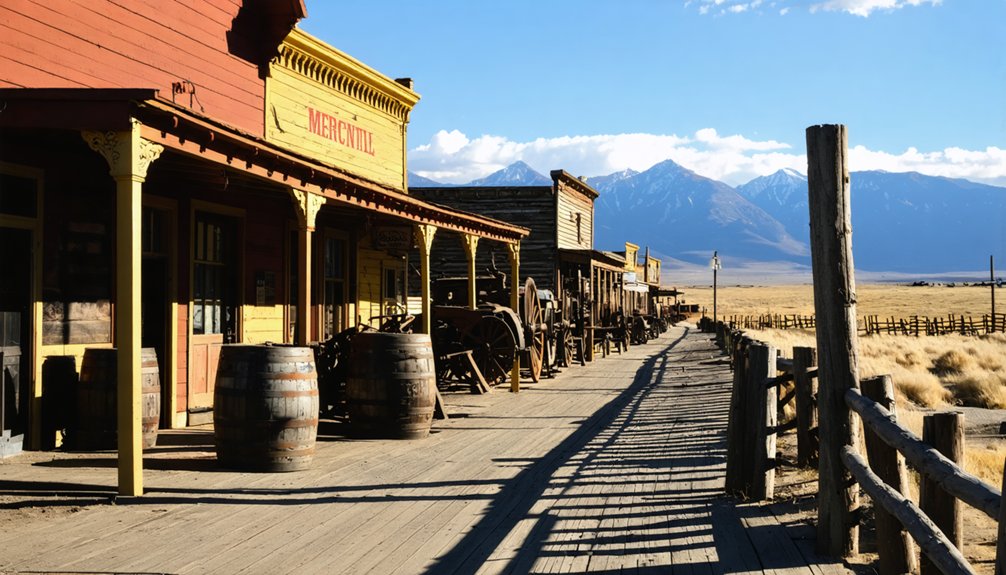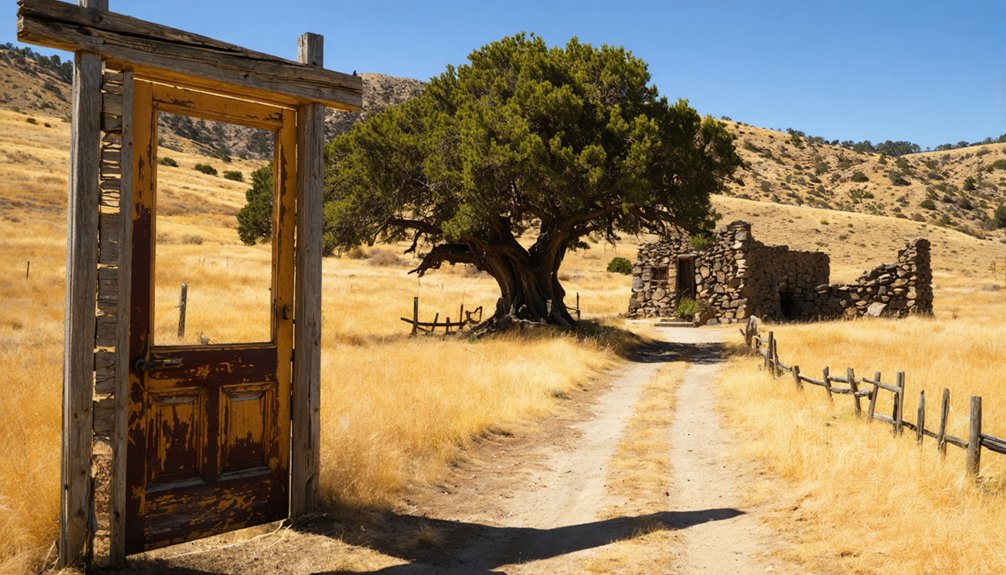
Nortonville was a thriving coal mining town established in 1855 on Mount Diablo’s slopes. Welsh immigrants formed its cultural backbone until economic decline in 1885 forced nearly 1,000 residents to migrate north. Today, you’ll find only Rose Hill Cemetery and ruins within Black Diamond Mines Regional Park. You can explore over 60 miles of trails showcasing mining remnants while experiencing what remains of this once-vibrant community’s legacy.
Key Takeaways
- Nortonville was established in 1855 after Noah Norton discovered coal, becoming a thriving mining community with over 5,000 residents.
- The Black Diamond Coal Mining Company abandoned operations in 1885, triggering mass migration and transformation into a ghost town.
- Nearly 1,000 residents, including 194 Welsh miners, relocated to Black Diamond, Washington, taking buildings and community infrastructure with them.
- Rose Hill Cemetery remains as a historical record with over 200 documented graves of immigrant miners and their families.
- Today, Nortonville exists within Black Diamond Mines Regional Park, offering trails and exhibits showcasing its mining history.
The Birth of a Coal Mining Community (1855-1861)
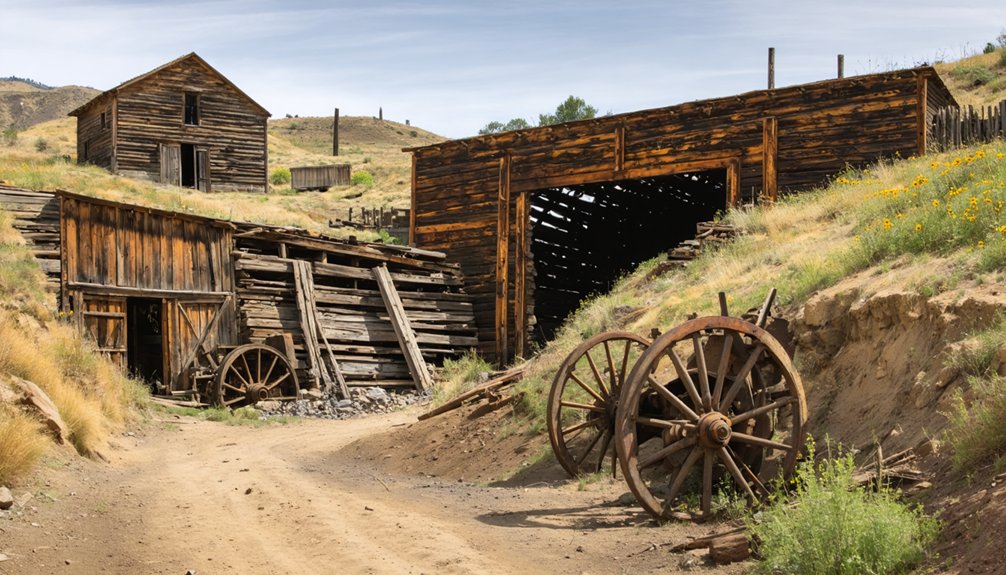
Three key events shaped Nortonville’s beginnings in the late 1850s: Noah Norton’s discovery of the Black Diamond coal seam, the establishment of a mining operation on Mount Diablo’s slopes, and the strategic development of transportation infrastructure.
When Norton, a Welsh coal miner, founded the town around 1861, he didn’t just build his own home—he laid the groundwork for significant community growth.
As mining expanded to six miles of tunnels by 1860, roads connecting to Clayton and New York Landing (later Black Diamond Landing) enabled efficient coal transport.
The workforce diversity quickly became notable as Welsh, English, German, Italian, and American miners converged on this promising opportunity. The influx of experienced miners was crucial as the demand for coal had drastically reduced prices from ∂35 per ton to more affordable rates by the late 1860s.
What began as single men seeking work evolved into families establishing roots, transforming a mining outpost into a vibrant community at the foot of Mount Diablo.
The coal extracted from these mines was primarily used to fuel steamship boilers in nearby towns, driving economic development throughout the region.
Welsh Immigrants and Cultural Heritage
The Welsh immigrants formed the backbone of Nortonville’s cultural identity throughout its boom years, bringing with them centuries of mining expertise from South Wales.
You’ll find their influence woven into every aspect of community life, from the Welsh choirs that gathered to sing traditional songs to the distinctive culinary traditions like currant-filled Welsh cookies that graced family tables.
These skilled miners commanded higher wages than other ethnic groups, reflecting their valued expertise. In the 1890s, Welsh families commonly gathered to pick wild currants for their traditional cookies. They maintained strong cultural preservation through tight-knit community organizations and Protestant religious practices.
When Nortonville’s mines began to decline between 1882-1885, many Welsh families relocated together to Black Diamond, Washington, following mining superintendent Morgan Morgans.
This collective migration demonstrates how Welsh traditions remained intact even as communities moved, ensuring their cultural heritage would survive beyond Nortonville’s eventual abandonment. The population in Black Diamond quickly grew to 3,500 residents by the early 1900s as these immigrant families established new roots.
Life in a 19th Century Mining Town
While coal fueled Nortonville’s economic engine, daily life in this bustling 19th century mining community presented harsh realities that residents endured with remarkable resilience.
You’d find yourself living in tight clusters of hastily built cabins with varying conditions—from primitive shelters with sack windows to more substantial two-room dwellings. Many miners lived alone, contributing to the transient nature of mining communities. Daily routines revolved around exhausting work shifts followed by domestic chores like cooking on stone fireplaces and preserving limited food supplies. Women were particularly scarce in these mining settlements, as they comprised only 700 of 40,000 arrivals to California by ship in 1849.
- Fire threatened your wooden home constantly, with entire sections of town sometimes lost to flames.
- Your entertainment options included saloons, gambling, and traveling theater productions.
- The absence of formal churches meant religious services often occurred informally in streets.
Despite these challenges, a sense of community formed among the 5,000 residents who called this rugged landscape home.
The Black Diamond Coal Mining Company
The Black Diamond Coal Mining Company, formally established on June 15, 1861, transformed Nortonville from a small settlement into a bustling coal hub with organized operations stretching from California to Washington.
You’ll find their corporate timeline particularly interesting, as they shifted from pure mining to land development through their Southport Land and Commercial subsidiary by 1890.
When disasters struck the mines, the company implemented response protocols that, while primitive by today’s standards, represented some of the earliest organized industrial safety measures in California’s history.
The company eventually expanded their mining operations to Washington Territory where they established mines near Jones Lake after Victor Tull’s prospecting revealed coal deposits there.
Their mining operations at Nortonville faced numerous challenges including an engine-house fire suspected to be arson and a deadly explosion that claimed seven lives.
Company Formation Timeline
Originating from the discovery of the Black Diamond vein in July 1860, the formation of what would become one of California’s most significant mining operations began when Noah Norton, a Welsh coal miner, filed his initial claim.
The formal incorporation of The Black Diamond Coal Mining Company followed on June 15, 1861, when eight entrepreneurs from Martinez united to capitalize on Nortonville’s coal mining potential.
- P.B. Cornwall’s investment transformed the company, bringing capital that accelerated Nortonville’s community growth.
- The strategic consolidation of the Cumberland and Black Diamond mines created a powerful economic impact on the region.
- By 1866, the company eliminated competition by purchasing the Manhattan Mine, cementing its dominance in California’s coal industry.
The company established headquarters in San Francisco while focusing operations in Nortonville, responding to growing coal demand that would shape local history.
The company produced an impressive 4 million tons of coal from the Mt Diablo Coalfield before operations ceased.
After discovering new coal deposits in Washington Territory, the company relocated first-generation Americans of Welsh and Italian descent from California to establish the new mining town of Black Diamond.
Disaster Response Efforts
Despite facing inherent dangers in Nortonville’s coal mines, The Black Diamond Coal Mining Company implemented limited disaster response protocols that evolved considerably over time.
You’d find miners initially relying on fellow workers’ first aid and primitive evacuation methods using winched rail cars along the ramp slopes.
By 1907, Local 6481 of the United Mine Workers organized in Nortonville, advocating for stronger disaster preparedness and emergency protocols.
While the company initially resisted these safety demands, the growing union membership gradually led to improved systems.
The railroad built in 1868 served dual purposes—coal transport and emergency evacuation.
When operations shifted to Washington Territory in the 1880s, disaster response expertise fragmented.
Later, under Pacific Coast Company ownership, investment in safety measures declined until modernized protocols emerged under Palmer Coking Coal.
Environmental Challenges and Living Conditions
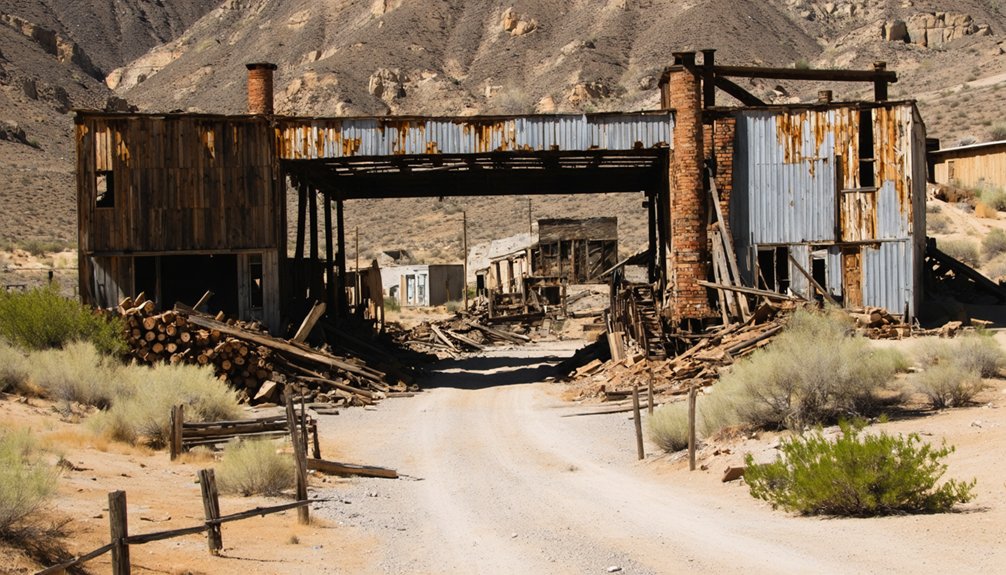
Living in Nortonville presented residents with severe environmental hazards directly stemming from the coal mining operations that dominated the area.
You’d have faced water sources contaminated by acid mine drainage, with Pleasant Run rendered completely lifeless due to low pH levels and sulfate-rich water. Despite ongoing environmental remediation efforts starting in 2006, the legacy of nearly 4 million tons of extracted coal continues to impact water quality throughout the region.
Daily life challenges included:
- Exposure to deadly mine gases like methane and carbon dioxide
- Frequent disease outbreaks including diphtheria, typhoid, and smallpox
- Limited medical access in the isolated, steep terrain
The harsh landscape, marked by sparse vegetation and non-native trees introduced by miners, created a difficult environment for the nearly 1,000 residents who once called Nortonville home.
Disasters That Shaped Nortonville’s Destiny
Nortonville’s fate was sealed by a series of devastating disasters beginning with the catastrophic 1874 fire that nearly destroyed the entire settlement.
You’ll find that deadly mining explosions, such as the 1876 blast that killed thirteen miners including William Gething, created widows and orphans throughout the community.
The town’s suffering compounded when diphtheria, typhoid fever, and other epidemics swept through Nortonville, claiming countless lives while depleting the already fragile mining settlement’s will to persevere.
Catastrophic 1874 Fire
A devastating fire swept through Nortonville on October 16, 1874, marking the first major disaster in the town’s mining history. The intentionally set blaze destroyed essential mining infrastructure, including the hoisting works and engine house at the main shaft head.
You would’ve witnessed remarkable community resilience as townspeople united to combat the advancing flames through coordinated bucket brigades.
The fire aftermath revealed:
- Significant damage to the company’s operational capacity
- First in a series of three catastrophes that would challenge Nortonville
- A display of collective determination that temporarily saved the settlement
This incendiary disaster foreshadowed Nortonville’s eventual fate. Though mining operations continued after reconstruction, the fire initiated a sequence of calamities that would contribute to the town’s abandonment eleven years later when the mines finally closed.
Deadly Mining Explosions
While the 1874 fire marked Nortonville’s first major catastrophe, the deadly mining explosions that followed would exact a far more devastating human toll.
The 1876 Black Diamond Mine disaster became the deadliest, when “black damp” gases released after blasting killed eight miners in total.
You’ll find that these explosions stemmed from methane pockets, accumulated coal dust, and inadequate safety measures.
In the explosion aftermath, grief rippled through the community, leaving immigrant families without breadwinners and the town economy crippled.
Miner memorials once stood in Rose Hill Cemetery, but time and vandalism have claimed many markers.
The disasters accelerated Nortonville’s decline, with fear spreading after each accident.
No significant safety reforms followed, and these tragedies contributed to the eventual abandonment of what you now visit as a ghost town.
Disease’s Devastating Toll
Mining disasters claimed Nortonville’s laborers with sudden violence, but an equally lethal yet more insidious threat stalked the town’s families day by day.
Disease ravaged the community throughout the 1870s, with diphtheria, typhoid fever, and smallpox sweeping through households with devastating impact. Mortality rates soared as primitive medical treatments proved woefully inadequate against these Victorian-era killers.
- Entire families lost multiple children in single epidemics, their tiny graves dotting Rose Hill Cemetery.
- Over 200 souls, many of them children, found their final rest between Nortonville and Somersville.
- Sarah Norton, the town’s respected midwife, stood at the crossroads of birth and death before her own tragic end.
The community’s clannish bonds provided their only defense against this invisible enemy that claimed so many of their youngest and most vulnerable.
Rose Hill Cemetery: Silent Witness to the Past
Perched on a hillside overlooking what remains of Nortonville, Rose Hill Cemetery stands as a somber chronicle of California’s coal mining era. Established in the 1860s, this Protestant burial ground served the region’s mining communities during their operational heyday.
Similar to Nortonville, numerous ghost towns in california’s history offer a glimpse into the once-thriving communities that faded with the decline of mining and industry. These abandoned sites, adorned with crumbling structures and remnants of daily life, tell stories of resilience and the harsh realities faced by those who lived there. Each ghost town carries its own unique narrative, inviting exploration and reflection on the relentless passage of time.
You’ll find over 200 documented graves, with many belonging to children who succumbed to epidemics and miners who perished in industrial accidents.
The cemetery’s most famous resident, midwife Sarah Norton, inspired enduring community folklore. After her 1879 buggy accident, storms repeatedly disrupted her funeral, fueling ghost sightings and her reputation as the “White Witch” who watches over the cemetery’s children.
Though vandalized extensively through the 1970s, restoration efforts by East Bay Park District rangers have preserved this vital historical record of immigrant miners and their families who built California’s largest coal-producing region.
Economic Decline and Abandonment (1885)
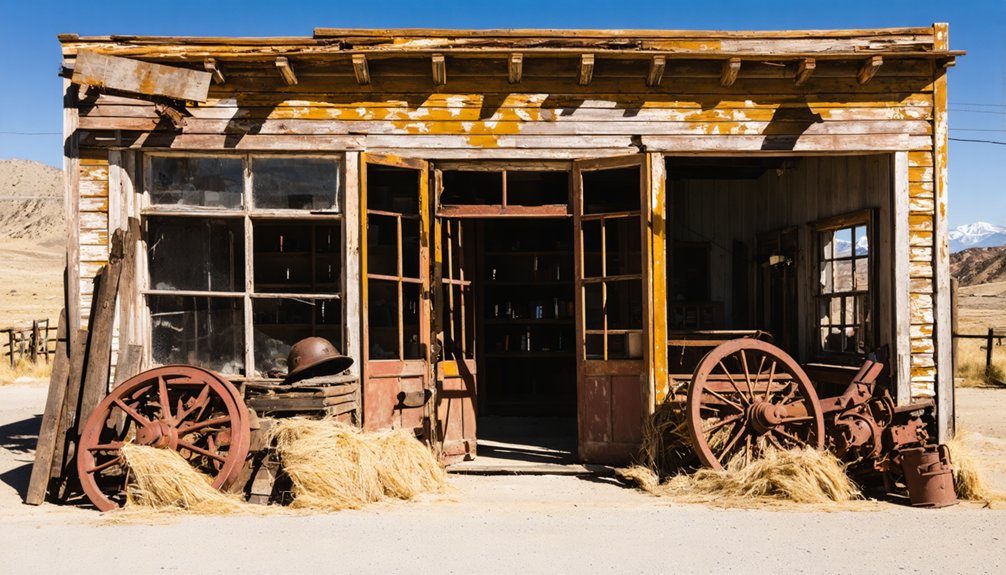
By 1885, Nortonville’s fate was sealed when the Black Diamond Coal Mining Company abandoned its operations for more profitable fields in Washington territory. This economic migration uprooted nearly 1,000 residents, primarily Welsh miners and their families, who followed job opportunities 900 miles north to the newly established town of Black Diamond near Seattle.
The once-thriving community rapidly transformed into a ghost town as:
- Buildings were dismantled or abandoned to decay
- The school, churches, and social halls that defined community resilience emptied
- Crucial infrastructure that supported daily life disappeared
What you see today in the Black Diamond Mines Regional Preserve are only remnants of this vibrant town—exotic trees, scattered foundations, and mining artifacts—silent testimonies to an entire community displaced by industrial priorities and resource exhaustion.
The Great Relocation to Oregon and Washington
When coal quality in the Nortonville mines began to deteriorate in the early 1880s, the Black Diamond Coal Mining Company orchestrated one of the most significant community migrations in Western mining history.
You might be surprised to learn that approximately 194 Welsh individuals, including 124 specifically from Nortonville, relocated to Black Diamond, Washington between 1882 and 1885.
The relocation logistics were impressive: the Columbia & Puget Sound Railroad was extended to transport machinery, equipment, and families.
Mining superintendent Morgan Morgans oversaw this shift, ensuring community bonds remained intact as entire families moved together.
Under Morgan Morgans’ leadership, the community migrated as family units, preserving their social bonds despite the massive relocation effort.
Welsh miners, prized for their expertise, occupied higher positions in the new settlement while maintaining their cultural identity.
Visiting Nortonville Today: Black Diamond Mines Regional Park

You’ll find a network of over 60 miles of trails at Black Diamond Mines Regional Park, including the Nortonville Trail that leads directly to the historic townsite.
The preserve’s mining history comes alive through remnants of buildings and infrastructure, with the Hazel-Atlas mine available for guided tours when open.
Rose Hill Cemetery, a carefully preserved Protestant graveyard containing the final resting places of miners and their families, offers a poignant glimpse into the community’s past.
Trail Network Options
The extensive trail network at Black Diamond Mines Regional Preserve offers visitors multiple routes to explore Nortonville and surrounding historic areas.
The primary 5.06-mile Nortonville/Coal Canyon/Black Diamond loop provides excellent trail accessibility while featuring key historical points like Rose Hill Cemetery and the mysterious Jim’s Place sandstone excavation.
You’ll encounter varied terrain from flat sections to moderate inclines with scenic viewpoints throughout.
- Begin at the Somersville Road entrance, where you’ll find parking and visitor center facilities.
- Choose between multi-use trails or challenging single-track sections tucked between dramatic rock formations.
- Customize your journey by connecting to alternative paths like the Stewartville Trail for shorter or longer adventures.
The preserve’s 60+ miles of trails traverse grasslands, woodland, and chaparral zones, ensuring freedom to explore at your own pace.
Mining History Exhibits
Buried beneath the rolling hills of the East Bay Regional Park District, an extensive network of mining relics tells the compelling story of Nortonville’s industrial past.
At the Greathouse Visitor Center, you’ll discover historical artifacts showcasing both coal and sand mining technologies that shaped this California Historical Landmark.
While exploring the preserve’s 8,533 acres, you’ll encounter remnants of 12 coal mines that produced nearly four million tons of “black diamonds” before closing in 1905.
The guided Hazel-Atlas Mine tour reveals how mining technology evolved when the region shifted to sand mining in the 1920s.
Though the Greathouse portal is temporarily closed for repairs, weekend tours from March through November still offer access to the 950-foot museum section featuring authentic mining equipment and reconstructed workspaces.
Cemetery Preservation Efforts
Rising prominently on a secluded hilltop, Rose Hill Cemetery stands as a poignant memorial to Nortonville’s mining community heritage since the 1860s.
You’ll find this historic Protestant burial ground has survived despite extensive vandalism, with only 80 of 250 gravestones remaining today. The East Bay Regional Park District’s grave marker restoration efforts have become a symbol of preserving this multiethnic mining community’s legacy.
- Rangers use proceeds from history book sales to fund ongoing repairs
- Community involvement includes documentation and mapping of burial sites
- Brick enclosures and wrought iron fences have been carefully rebuilt
When you visit via the Nortonville Trail, please respect these fragile artifacts by avoiding physical contact with gravestones.
Each marker tells a story of the coal miners and families who built this once-thriving community.
Frequently Asked Questions
What Happened to Noah Norton After Founding Nortonville?
After founding Nortonville, you’ll see Noah Norton operated his Black Diamond coal mine until his death in 1871. His legacy lives on through Nortonville’s impact as a once-thriving mining community.
How Did Residents Communicate With Their Welsh Relatives Abroad?
You’d primarily communicate through letter exchanges transported via ship and rail. Later, telegraph messages provided faster connections. Your Welsh churches served as hubs where families shared news from relatives abroad.
Did Any Original Buildings Survive the Town’s Abandonment?
You’ll find almost no original buildings survived; Rose Hill Cemetery remains the primary historical architecture preserved. Despite minimal preservation efforts, only “Jim’s Place” cave dwelling and scattered foundations endure from Nortonville’s heyday.
Were There Any Notable Crimes or Law Enforcement Issues?
You won’t find significant crime statistics in historical records. Law enforcement issues weren’t documented, as the town’s challenges centered on mining accidents and disease rather than criminal activity.
Did Any Families Refuse to Relocate After the Mines Closed?
You’ll find no conclusive evidence of families refusing relocation. While some miners shifted to farming or ranching nearby, these reflected economic adaptations rather than deliberate resistance to company-mandated moves, highlighting both family resilience and relocation challenges.
References
- https://americymru.net/american ghost towns with a Welsh connection – Nortonville
- https://blackdiamondhistory.wordpress.com/2014/06/04/the-town-that-moved-900-miles/
- https://www.cocohistory.com/essays-ghosts.html
- https://www.youtube.com/watch?v=AgWflUgBWdE
- https://www.cocohistory.org/essays/mt-diablo-coal-and-the-fight-between-the-railroads
- https://en.wikipedia.org/wiki/Nortonville
- https://www.ingridtaylar.com/the-ghostliness-of-black-diamond-mines/
- https://sfbayareahistoricparks.weebly.com/sfba-historic-parks/nortonville-and-somersville
- https://claytonhistory.org/history/coal-mining/
- https://en.wikipedia.org/wiki/Black_Diamond_Coal_Mining_Company