Norval flourished briefly as a Gold Rush boomtown in El Dorado County, reaching its peak around 1853 with 2,000 residents and twelve stamp mills. You’ll find this ghost town experienced rapid decline by 1860 as placer deposits depleted, with final operations ceasing by 1878. Today, you’ll need a 4WD vehicle to access the remote ruins, which include partially standing structures and rusted mining equipment. The silent remains tell tales of California’s mining heritage for those willing to venture off the beaten path.
Key Takeaways
- Norval emerged during California’s Gold Rush era, reaching 2,000 residents by 1853 with twelve stamp mills operating at its peak.
- The town declined when placer deposits were exhausted by 1860, with final mining operations ceasing in 1878.
- Daily life featured diverse populations, wooden buildings, unpaved streets, saloons, and eventually churches, schools, and newspapers.
- Current remnants include partially standing structures, household artifacts from the 1880s, and rusted mining equipment in surrounding hills.
- Access requires high-clearance 4WD vehicles, with late spring through early fall offering optimal visiting conditions.
A Hidden Gold Rush Relic in El Dorado County
Among the numerous forgotten settlements scattered throughout California’s Gold Rush territory, Norval stands as one of El Dorado County‘s most enigmatic ghost towns.
While extensively documented mining communities like Coloma and Placerville gained historical prominence, Norval’s story remains largely untold in mainstream Gold Rush narratives.
This hidden settlement emerged during the feverish expansion that followed James Marshall’s 1848 gold discovery at Sutter’s Mill.
Unlike its more celebrated neighboring camps, Norval’s mining legacy developed quietly in the rugged terrain of El Dorado County’s western slopes.
What makes Norval particularly intriguing is its near-complete absence from historical records, despite being situated in one of California’s most thoroughly prospected regions.
Today, only scattered ruins and occasional archival mentions testify to its existence, challenging historians and preservationists to recover its forgotten story.
The area likely contained valuable placer deposits that attracted miners to this remote location during the height of gold fever in the region.
The Rise and Fall of Norval’s Mining Economy
The scattered remains of mining equipment that visitors occasionally stumble upon today tell only a fraction of Norval’s economic story.
The rusted relics barely whisper the economic saga that once echoed through Norval’s bustling streets.
What began as a promising strike in 1851 quickly transformed this Sierra Nevada outpost into a boomtown of over 2,000 residents by 1853, with twelve operating stamp mills processing gold-bearing quartz.
Norval’s prosperity proved fleeting. By 1860, the easily accessible placer deposits had been exhausted, while deeper mining required capital investments beyond local means.
Multiple decline factors converged: decreasing ore quality, rising extraction costs, and the Comstock Lode drawing miners eastward. The economic impacts rippled through the community—businesses closed, miners departed, and infrastructure deteriorated.
Similar to San Francisco’s explosive population growth, Norval experienced the boom and bust cycle characteristic of Gold Rush settlements throughout California.
The town, once vibrant with merchants who often made more money than miners, showcased the economic disparities common throughout California’s gold fields.
When the final mine ceased operations in 1878, Norval’s transformation to ghost town was complete.
Life in a Sierra Nevada Boomtown
While dozens of California boomtowns rose and fell during the Gold Rush, Norval’s vibrant daily life mirrored the typical Sierra Nevada mining community of the 1850s. Packed with thousands of residents from diverse backgrounds, you’d find miners shoulder-to-shoulder with merchants, families, and those seeking fortune in supporting industries.
The town’s mining heritage shaped its physical landscape with hastily constructed wooden buildings lining unpaved, chaotic streets. The discovery of valuable minerals in the area initially attracted prospectors who hoped to strike it rich. Unlike the isolated mining camps of Southern Nevada, Norval benefited from its proximity to financial centers that fueled its rapid development.
- Saloons, gambling halls, and theaters provided essential entertainment after grueling workdays in the mines.
- Ethnic enclaves formed distinctive neighborhoods where immigrants maintained cultural traditions.
- Community dynamics evolved as churches, schools, and newspapers gradually established social structure.
Daily life brought constant hardships—overcrowding, violence, and competition for resources challenged even the most resilient Norval residents.
What Remains: Exploring Norval’s Ruins Today
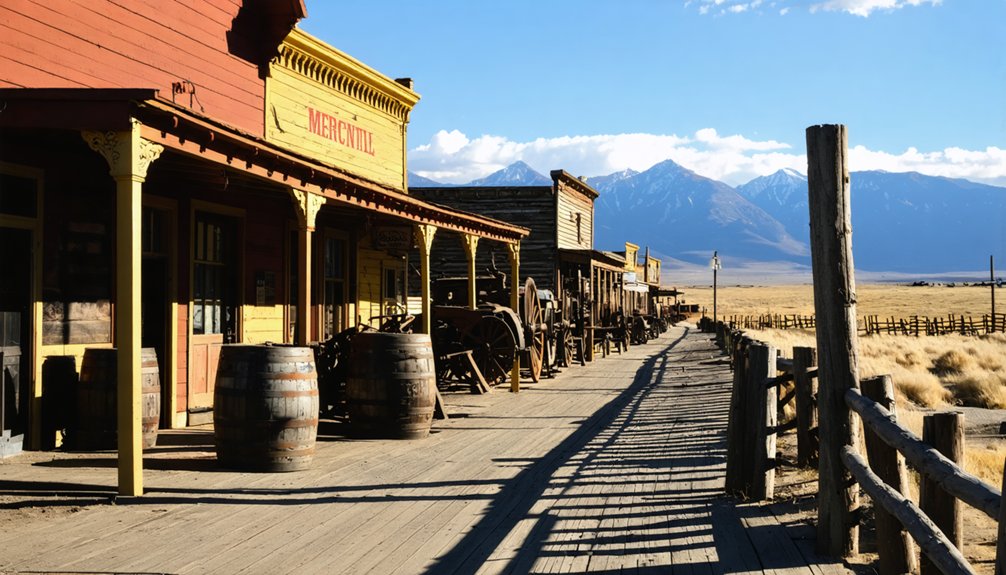
Today’s visitors to Norval encounter a stark contrast to the once-bustling boomtown. The site now stands as a memorial to California’s ephemeral mining history, with only scattered remnants marking its existence.
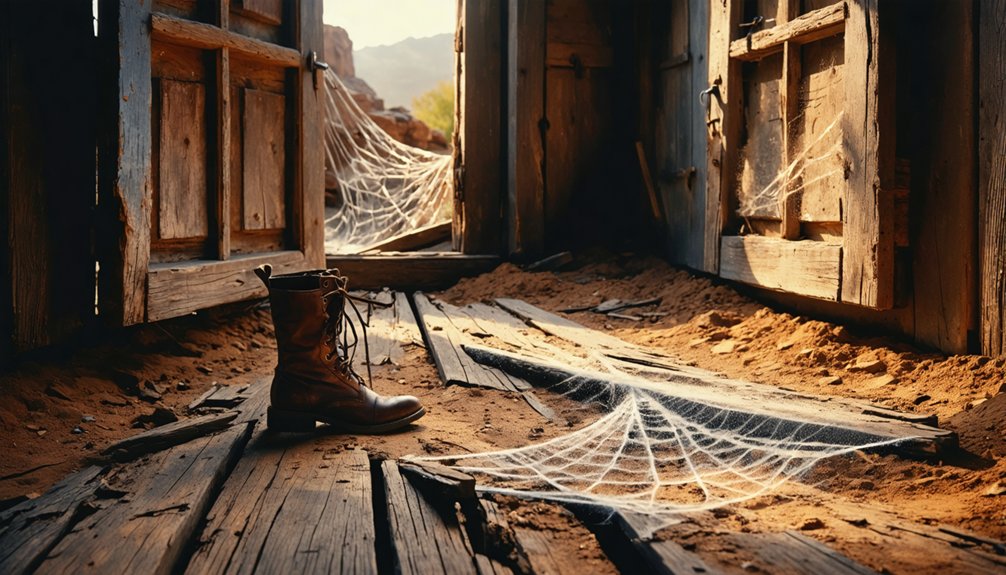
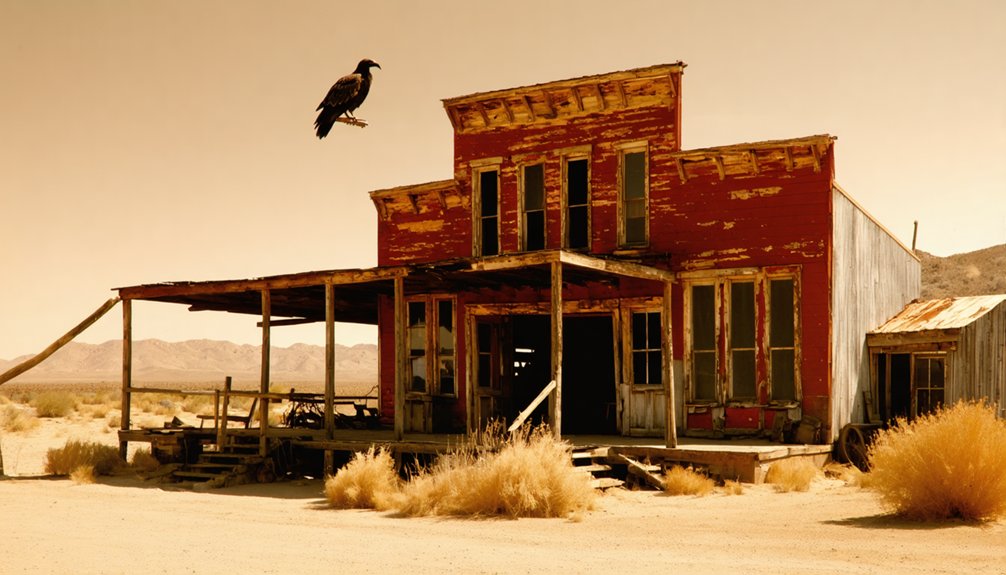
You’ll find partially standing abandoned structures near the former main street, their weathered timbers creaking in the Sierra winds. Recent archaeological findings have uncovered household artifacts dating to the 1880s, offering glimpses into daily frontier life. Like Old Kernville, Norval’s remains tell the story of communities sacrificed to water management projects. Similar to Skidoo, the town experienced a rapid boom and bust cycle within a single decade.
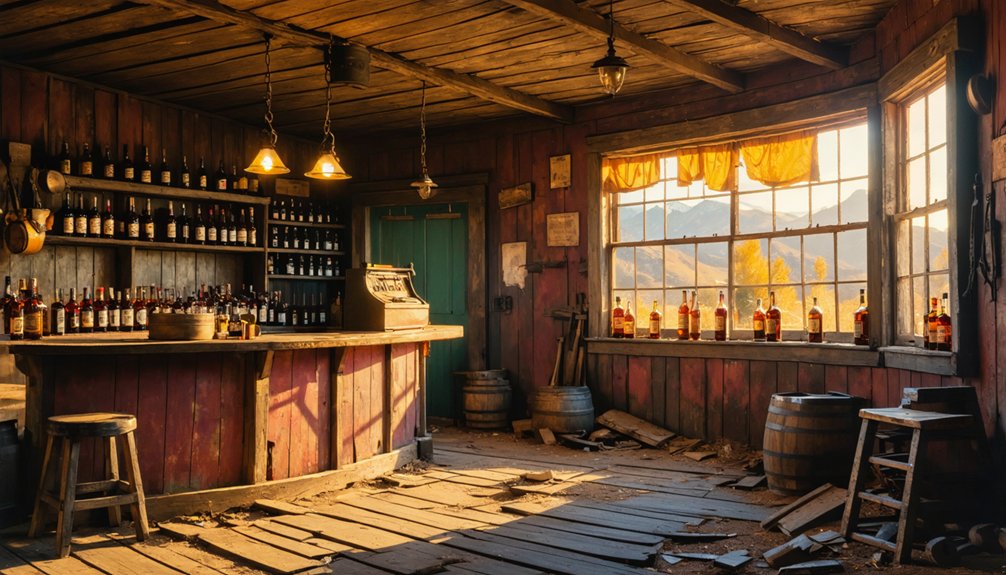
The stone foundation of the assay office remains visible, though overgrown with native vegetation. Rusted mining equipment dots the surrounding hillsides, slowly returning to the earth.
Most striking is the silence that now envelops the landscape where hundreds once sought their fortunes. Norval’s ruins invite contemplation on the transient nature of human ambition in this remote corner of the Western frontier.
Getting There: The Challenge of Reaching a Remote Ghost Town
You’ll encounter formidable dirt roads and steep terrain when approaching Norval, requiring a high-clearance vehicle with four-wheel drive capability, especially after periods of precipitation.
Watch for the abandoned water tower and remnants of the old railroad trestle as your primary navigational landmarks, which become visible approximately two miles before reaching the town site. Historical maps from 1854 to 1886 can provide valuable context for locating this abandoned town site and understanding how the surrounding landscape has changed over time.
Winter access becomes severely limited from November through March due to snow accumulation and mud conditions, making late spring through early fall the ideal visitation window for this remote ghost town. Many visitors note that Norval has been completely abandoned since the early 1900s due to the depletion of natural resources in the area.
Rugged Roads Ahead
Traveling to Norval demands equal parts determination and preparation as this isolated ghost town sits nestled in one of California’s most challenging terrains.
Local adventure guides recommend researching seasonal road conditions before attempting the journey, as winter snow and spring mudslides frequently render access impossible. Your vehicle requirements should match the rugged landscape—high clearance 4WD is non-negotiable for traversing the final unpaved stretch.
- Pack emergency supplies including extra water, food, and warm clothing as cell service disappears approximately 8 miles before reaching the ghost town’s perimeter.
- Consider joining organized convoy tours during summer months when experienced guides lead small groups through the most treacherous sections.
- Document your intended route with someone who isn’t traveling with you, including your expected return time.
While most modern navigation systems fail miserably when tracking the final miles to Norval, several distinct natural landmarks serve as critical waypoints for intrepid explorers.
The journey requires attentiveness to the landscape’s subtle cues rather than digital assistance.
As you approach from the west, watch for the distinctive twin-peaked ridge locals call “Devil’s Horns” – your first indication you’re on the correct path.
Three miles beyond, a solitary Joshua tree marking the trail junction represents landmark significance that can’t be overstated.
The navigation challenges intensify at Rattlesnake Wash, where you’ll need to locate the tilted boulder formation resembling an arrow pointing northeast.
Your final guide will be the abandoned water tower visible on clear days from nearly two miles out, standing sentinel over Norval’s forgotten streets.
Seasonal Access Considerations
Reaching Norval demands not just determination but also careful seasonal planning, as access to this isolated ghost town varies dramatically throughout the year.
Winter snow and spring rains transform dirt roads into challenging obstacles, often resulting in seasonal closures that can extend for months.
- Check current road conditions with local authorities before attempting the journey, especially after storms or during shoulder seasons.
- Bring a four-wheel drive vehicle during non-summer months; standard cars may only reach Norval during dry, favorable conditions.
- Pack essential supplies regardless of season, as no services exist onsite.
Summer offers the most reliable access window, though desert heat brings its own hazards.
Fall provides a balance of moderate temperatures and typically passable roads, making it an ideal time for the freedom-seeking explorer.
Forgotten Stories From Norval’s Brief Heyday
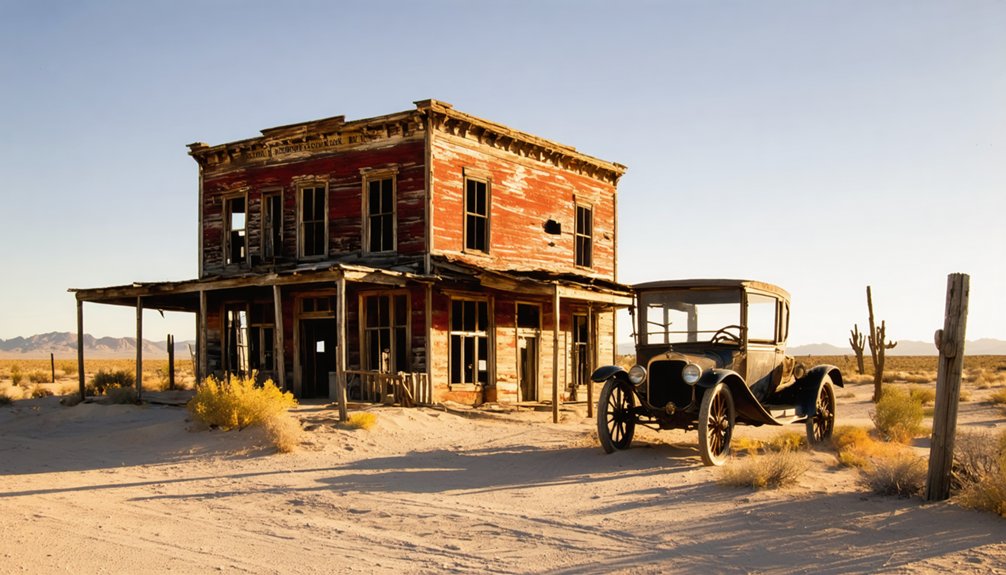
Although Norval’s existence was fleeting, the stories from its brief heyday reveal a tapestry of ambition, hardship, and unexpected moments that defined this forgotten California settlement.
Historical records about this ghost town remain scarce, with many forgotten legends lost to time. The mining tales that once animated Norval’s saloons and boardinghouses now exist only as fragmentary whispers in California’s rich ghost town heritage.
While specific details about Norval’s peak period require further historical investigation, its narrative likely mirrors other boom-and-bust settlements that rose with mineral discoveries and collapsed when resources depleted.
The characters who once walked Norval’s streets—prospectors, merchants, and dreamers—carried stories that deserve resurrection from historical obscurity. Their collective experiences embody the entrepreneurial spirit that characterized California’s formative years.
Norval’s Place in California’s Mining History
Norval’s significance in California’s mining history stems from its position within the Western Mojave Desert mining region, an area known for yielding gold and borax deposits that fueled economic development throughout the late 19th and early 20th centuries.
As you explore Norval’s legacy, you’ll discover its evolution paralleled California’s broader mining narrative:
- Norval mining methods transformed from simple placer techniques to sophisticated shaft systems by 1927, eventually embracing open-pit operations by the 1950s.
- The town’s economic contributions included millions in gold production, creating jobs and infrastructure that connected isolated desert communities.
- Like many California mining settlements, Norval experienced boom-and-bust cycles tied to mineral yields and market fluctuations.
Though less celebrated than other gold rush towns, Norval represents the persistent spirit of mineral extraction that shaped California’s development long after the initial 1848 rush.
Photographing and Documenting a Vanishing Piece of the Past
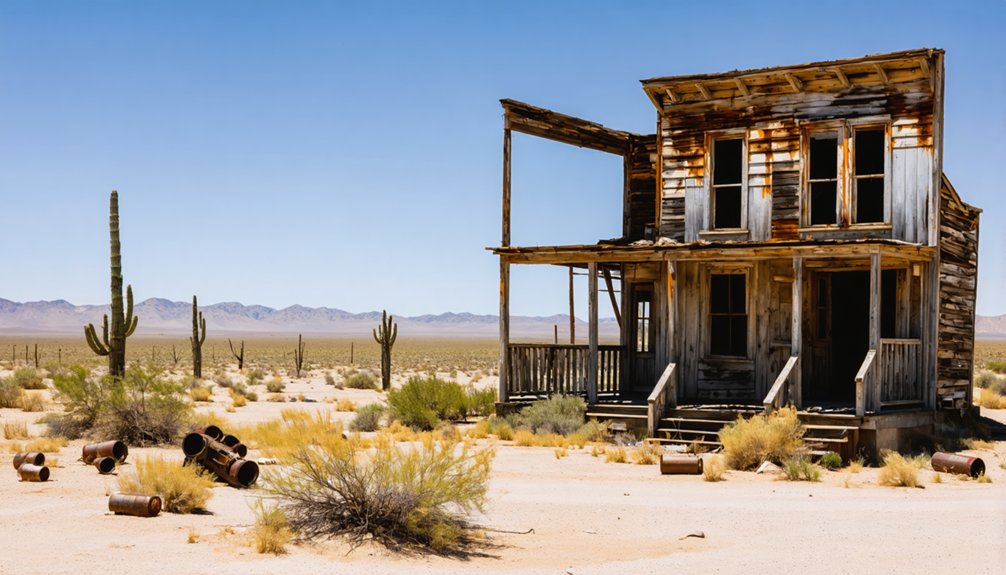
When photographing Norval’s decaying structures, you’ll need to master the interplay of harsh desert light and deep shadows by using polarizing filters and graduated neutral density filters during the golden hours of dawn and dusk.
Your equipment must withstand the elements while remaining portable—weather-sealed cameras, sturdy tripods, and lens protection from sand are essential for documenting these fragile ruins without causing further damage.
Respecting the site’s historical integrity means photographing without moving artifacts, obtaining proper permissions from land management agencies, and sharing your images with historical societies to contribute to the preservation of Norval’s visual record.
Light and Shadow Techniques
Capturing the ghostly essence of abandoned places like Norval demands mastery of light and shadow techniques that transform ordinary ruins into compelling visual narratives.
Visit during golden hours when sunlight stretches across weathered buildings, casting dramatic shadows that emphasize decay. For nighttime exploration, use the full moon’s natural illumination combined with careful light manipulation to reveal hidden textures while maintaining the authentic atmosphere.
- Employ light painting with flashlights or LED panels during long exposures to selectively highlight architectural details while preserving shadow play.
- Position light sources at oblique angles to enhance three-dimensionality and texture in deteriorating structures.
- Combine silhouette techniques with negative space to isolate compelling features against dawn or dusk skies.
Remember that shadows aren’t flaws—they’re essential storytelling elements that add mystery and depth to your documentation of Norval’s fading history.
Equipment for Ruins
The right equipment transforms a casual exploration of Norval’s ruins into a professional documentation project that preserves this vanishing history. Your camera selection matters—a full-frame DSLR or mirrorless camera will capture the nuanced light filtering through collapsed roofs and weathered doorways.
Lens selection dictates your storytelling approach: wide-angles (16-35mm) reveal architectural relationships, while primes (50mm or 85mm) isolate weathered details with striking clarity.
Adjust camera settings for each scenario—bracket exposures in high-contrast doorways and use slow shutter speeds in dim interiors.
Don’t overlook safety and stability. A lightweight tripod prevents blur in long exposures, while sturdy hiking boots and a hard hat protect you from unstable structures.
Bring a GPS device and first aid kit—freedom to explore requires preparation for the unexpected.
Ethical Documentation Practices
Ethical documentation of Norval’s remains begins with the recognition that you’re not merely capturing images but preserving cultural heritage that belongs to everyone.
Your approach requires cultural sensitivity while traversing the remnants of this once-thriving mining settlement, balancing the freedom to explore with respect for history.
When practicing ethical photography at Norval’s abandoned sites:
- Obtain proper permissions before entering properties and never disturb artifacts or structural elements you encounter.
- Respect any human remains or burial sites by avoiding photography or maintaining appropriate distance.
- Share your documentation responsibly, avoiding precise location details that might encourage vandalism or looting.
Your photographs create a permanent record of Norval’s vanishing legacy, making your ethical choices as important as your technical skills.
Frequently Asked Questions
Were There Any Notable Crimes or Outlaws in Norval?
In a town where secrets vanish like desert mirages, you’ll find no documented outlaw legends or crime history in Norval. Historical records reveal nothing significant about criminal activity there, unlike California’s more infamous ghost towns.
What Natural Disasters or Epidemics Affected Norval’s Population?
You’ll find no documented disease outbreaks or environmental changes affected Norval specifically. Historical records don’t mention epidemics or natural disasters impacting this particular settlement’s population decline during its brief existence.
Are There Paranormal or Ghost Stories Associated With Norval?
You’ll find few documented ghost sightings in Norval’s haunted locations. Historical records don’t chronicle paranormal activity in this forgotten settlement, though local whispers persist among freedom-seeking paranormal enthusiasts since the 1950s.
Did Indigenous Peoples Have Settlements Near Norval Before Miners Arrived?
Yes, you’ll find indigenous culture thrived there with established settlement patterns. Local tribes maintained presence in the region for thousands of years, creating sustainable communities long before miners disrupted their ancestral lands.
What Wildlife Hazards Should Visitors Be Aware of Today?
Be vigilant for rattlesnakes, mountain lions, and black bears during wildlife encounters. You’ll need to carry water, sun protection, and maintain distance from abandoned mine shafts as essential safety precautions.
References
- https://www.sfgate.com/obscuresf/article/brief-history-of-a-Bay-Area-ghost-town-17397657.php
- https://thelittlehouseofhorrors.com/bodie-the-cursed-ghost-town/
- https://californiacrossings.com/best-ghost-towns-in-california/
- https://www.youtube.com/watch?v=XZk4MJej_24
- https://www.activenorcal.com/this-northern-california-ghost-town-is-cursed-according-to-its-visitors/
- https://myfamilytravels.com/california-ghost-towns-tourists-rarely-stumble-upon
- https://en.wikipedia.org/wiki/Bodie
- https://www.onlyinyourstate.com/nature/california/underrated-must-visit-state-park-ca
- https://www.camp-california.com/bodie-ghost-town/
- https://westernmininghistory.com/library/25/page1/