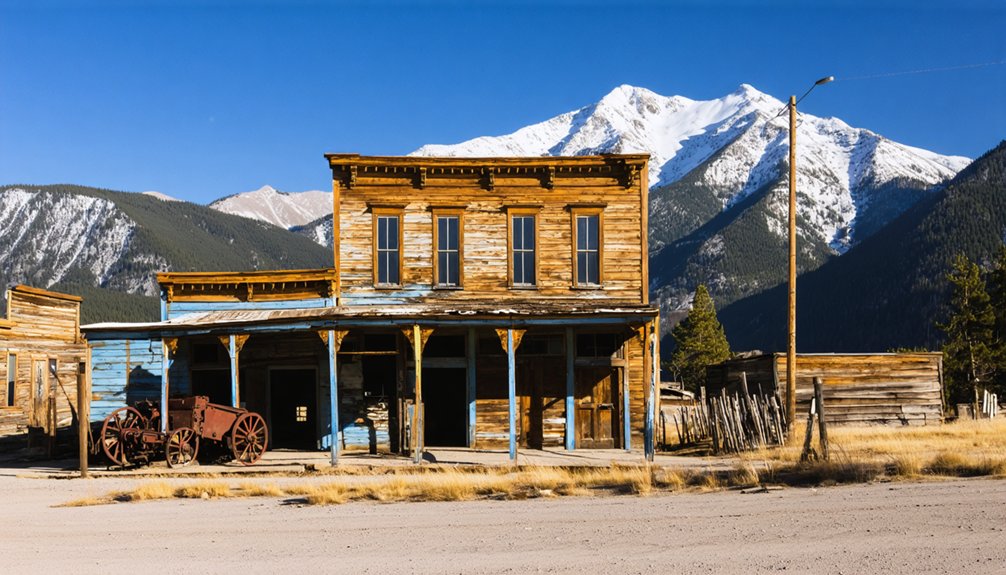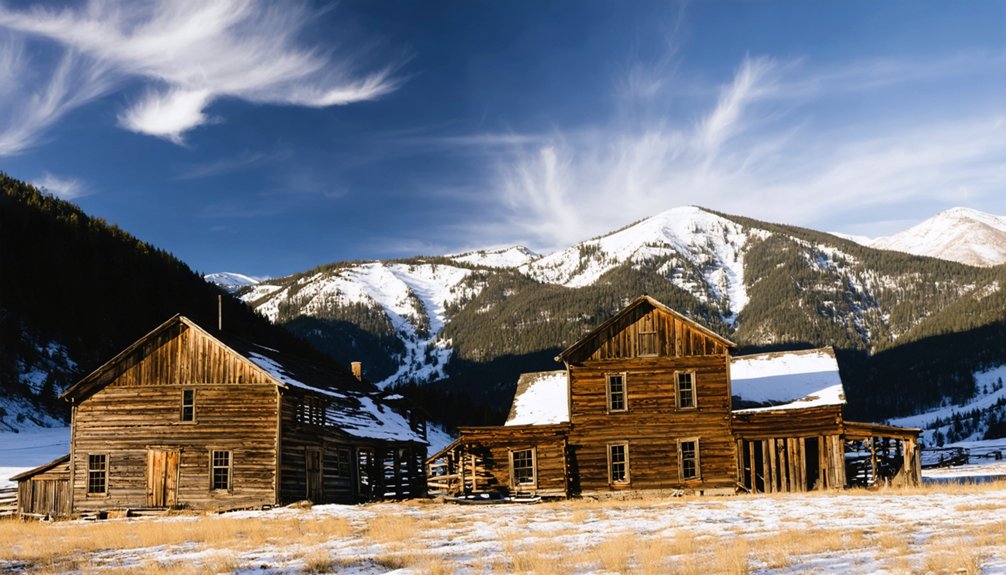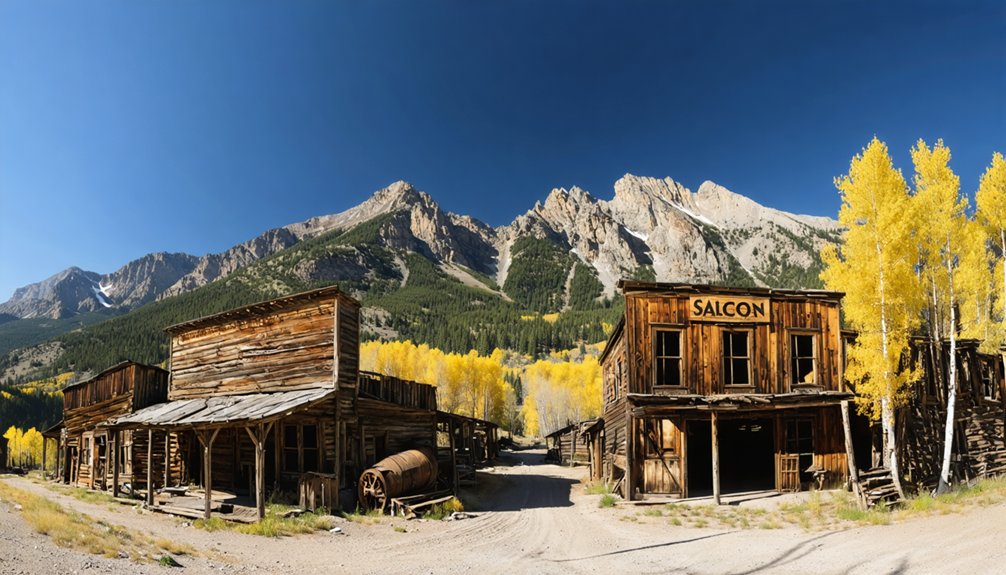
You’ll find Colorado’s ghost towns scattered across elevations from 9,500 to 11,200 feet, where 1870s-1890s mining booms created settlements like St. Elmo, Animas Forks, and Independence before economic collapses triggered abandonment. These sites extracted millions in precious metals—Animas Forks alone produced over 2 million troy ounces of gold—while preserving original structures including hotels, mercantile buildings, and stamp mills. Dearfield represents a distinct narrative as Colorado’s only all-Black agricultural colony, founded in 1910 before the Dust Bowl’s devastation. Below you’ll discover specific preservation details and visiting strategies.
Key Takeaways
- St. Elmo, established in 1881, is Colorado’s best-preserved ghost town with original structures from its silver mining era.
- Animas Forks sits at 11,200 feet and produced over 2 million ounces of gold before fire and market collapse.
- Independence, named for its July 4, 1879 gold strike, preserves structures like the Farwell Stamp Mill at 10,900 feet.
- Ashcroft boomed to 2,000 residents by 1883 before shallow ore deposits caused abandonment; now holds National Register status.
- Dearfield, founded in 1910, was Colorado’s only all-Black agricultural colony before the Dust Bowl triggered its abandonment.
St. Elmo: A Preserved Mining Town Along Chalk Creek
In 1875, prospectors Abner Wright and John Royal discovered a silver deposit in Chalk Creek Canyon that would catalyze one of Colorado’s most enduring mining settlements. You’ll find St. Elmo at 10,000 feet elevation, where mining culture and community flourished after the Denver, South Park & Pacific Railroad arrived in 1881.
The town’s 2,000 residents supported fifty working mines by 1883, with the Mary Murphy Mine extracting 70-100 tons of ore daily through mining technology innovations requiring heavy machinery and substantial capital investment. Though fire devastated the settlement in 1890 and railroad abandonment in 1926 accelerated decline, St. Elmo persisted where others vanished.
Today, you can explore Colorado’s most well-preserved ghost town, where original structures stand evidence to an independent frontier spirit.
Animas Forks: High-Altitude Survivor of the San Juan Mountains
Perched at 11,200 feet in the San Juan Mountains, Animas Forks represents one of Colorado’s highest-elevation mining settlements, where prospectors constructed the first log cabin in 1873 following silver and gold discoveries that triggered an immediate rush to the remote location. The town’s infrastructure quickly expanded to support mining techniques extracting over 2 million troy ounces of gold and 51 million ounces of silver through 1991.
At 11,200 feet, Animas Forks miners extracted over 2 million ounces of gold from Colorado’s San Juan Mountains through 1991.
Peak development included:
- 400 residents with 30+ cabins, hotel, saloons, and newspaper serving the transient workforce
- Otto Mears’ 1875 wagon road connecting isolated mining communities
- Frisco mill’s 1912 construction processing ore from the Bagley Tunnel
The October 1891 fire destroyed 14 buildings, causing $20,000 in damages. Combined with 1893’s silver market collapse, these catastrophes emptied the settlement, though a dozen structures remain under Bureau of Land Management protection.
Independence: Remnants of a Mountain Pass Settlement
At 10,900 feet elevation on Independence Pass, you’ll encounter one of Colorado’s highest ghost town sites, where a gold strike on July 4, 1879, sparked a settlement that swelled from 300 to 1,500 residents within three years.
The town’s remarkable ascent and collapse—producing $190,000 in gold by 1882 but only $2,000 by 1883—left behind preserved log cabin ruins maintained as an archaeological site by the Aspen Historical Society and U.S. Forest Service.
Located 16 miles southeast of Aspen along Highway 82, the remaining structures including the Farwell Stamp Mill, general store, and boarding houses are accessible seasonally from Memorial Day through October when winter snow releases its grip on the pass.
High-Elevation Mining History
Gold prospectors trespassing on Ute tribal lands struck the Independence Gold Lode on July 4, 1879, along the Roaring Fork River approximately four miles from Independence Pass’s summit, christening both their discovery and the subsequent settlement after the patriotic date. Your prospecting endeavors at 10,800 feet elevation would’ve faced brutal conditions—Independence remains one of Colorado’s highest mining camps.
The settlement’s economic trajectory reveals typical boom-bust patterns:
- Population surged from 300 (1880) to 1,500 residents (1882) supporting 40+ businesses
- Miners extracted $190,000 in gold between 1881-1882 (approximately $6 million today)
- Production collapsed to $2,000 by 1883 as shallow veins depleted rapidly
The town served as a critical waypoint along early transportation routes for stagecoaches traversing the treacherous pass toward Steamboat Springs, generating supplemental revenue beyond mining operations.
Historic Structures and Access
Today, Independence’s archaeological landscape preserves several structures that document daily operations in this high-altitude mining settlement. You’ll find the general store structure with interpretive signage, two boarding houses, restored log cabins, and the Farwell Stamp Mill—which processed ore during operational years—all connected by dirt trails. The Aspen Historical Society maintains these remnants as an archaeological preserve, with artifacts displayed at a small museum near a miner’s cabin.
Located 16 miles southeast of Aspen on Highway 82 at 10,900 feet elevation, Independence offers seasonal access through Independence Pass. You can visit from Memorial Day through October, with guided tours available mid-June to Labor Day. A $5 donation is suggested, and strict preservation rules prohibit artifact removal or disturbance—ensuring these structures remain accessible for future explorers seeking Colorado’s mining heritage.
Ashcroft: A Well-Preserved Site Near Aspen
Nestled in an alpine meadow at 9,521 feet elevation where Castle Creek originates, Ashcroft stands ten miles from Aspen as one of Colorado’s most intact ghost towns. Founded in 1880 as Castle Forks City, it boomed to 2,000 residents by 1883 before shallow ore deposits triggered abandonment.
Today, ten structures remain under Aspen Historical Society management since 1974.
You’ll discover authentic frontier lifestyle through:
- Hotel View’s restored two-story structure with original staircase and mountain vistas
- Kinney Mercantile’s museum displaying sleds, mining tools, and period photographs
- Six unrestored buildings maintaining their deteriorated condition with dirt floors and weathered walls
Historical preservation efforts by Stuart Mace, USFS, and AHS earned National Register status in 1975. Small trails connect buildings to Castle Creek and picnic areas, offering unrestricted exploration of Colorado’s mining heritage.
Dearfield: Colorado’s Historic All-Black Settlement
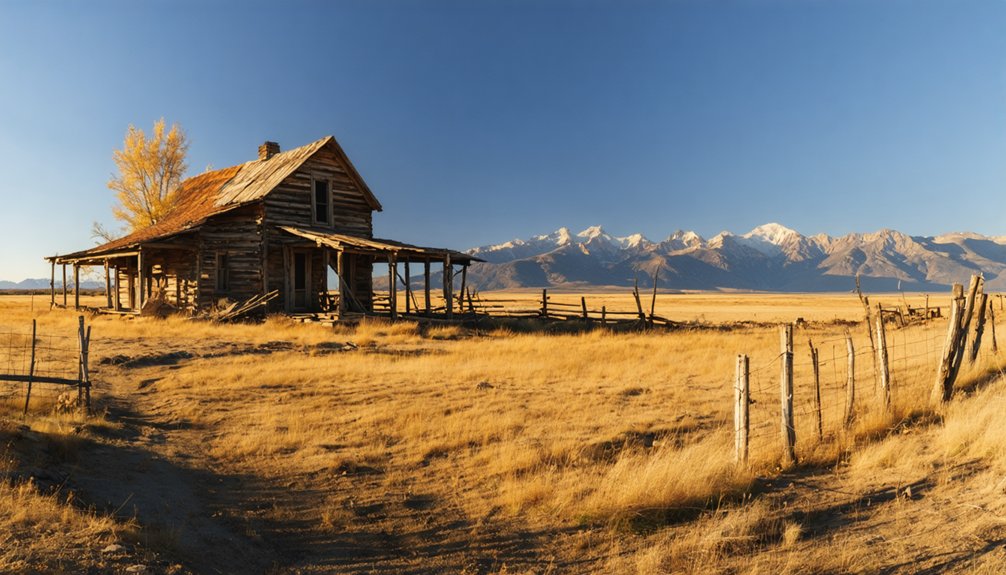
You’ll find Dearfield stands apart from Colorado’s mining ghost towns as the state’s only all-Black agricultural colony, founded in 1910 by Oliver Toussaint Jackson on 320 acres of Weld County desert claim under the Enlarged Homestead Act of 1909. Inspired by Booker T. Washington’s vision of Black economic independence, Jackson established a self-sufficient community that grew from seven families living in tents and dugouts to approximately 300 residents cultivating dry-farmed crops across 19,000 acres by its 1917-1921 peak.
The settlement’s rise and fall—from thriving agricultural hub with concrete block factory and baseball team to Depression-era abandonment—mirrors the broader challenges facing Black homesteaders who lacked irrigation access despite their proximity to the South Platte River.
Founding and Early Vision
Jackson’s ambitious plan addressed post-Emancipation migration patterns:
- Accommodating 200 families seeking economic independence
- Creating Colorado’s only all-Black agricultural settlement
- Offering freedom from discriminatory land practices
He advertised relentlessly across Denver and beyond, attracting settlers from 37 states who’d transform these inhospitable dunes into cultivated fields.
Community Life and Growth
What began as barren sandhills transformed into a thriving community that reached nearly 700 residents during its peak years between 1917 and 1921. You’ll find that 27 families from 37 states built 44 wooden cabins and established essential infrastructure including a concrete block factory, lodge hall, church, restaurant, and grocery store.
The settlement’s agricultural achievements proved remarkable—residents mastered dry farming techniques to cultivate water-intensive crops like watermelons and cantaloupes alongside oats, barley, and corn. Social and cultural activities flourished through Saturday night dances featuring fiddle and banjo music that attracted white visitors for integrated dancing. The community fielded a baseball team competing in Weld County while serving as a weekend destination for Denver residents seeking fishing, hunting, and entertainment in Colorado’s only all-Black agricultural colony.
Decline and Historic Preservation
By the mid-1920s, Dearfield’s agricultural foundation began crumbling under economic and environmental pressures that would ultimately transform the settlement into a ghost town. Declining crop prices triggered homestead failures, while severe drought eliminated dry farming viability.
The 1930s Dust Bowl devastated the remaining population of nearly 700 residents, compounded by Great Depression-era economic pressures.
Key factors in Dearfield’s abandonment:
- Lack of irrigation water rights near the South Platte River prevented sustainable agriculture
- Founder O.T. Jackson remained until his 1948 death, among the final holdouts
- Most residents fled to cities by the 1940s seeking economic opportunities
Today, the Black American West Museum preserves this 320-acre site through strategic land exchanges, protecting NRHP-eligible lots as Colorado’s last major all-Black agricultural colony.
Vicksburg: a Canyon Town With Audio-Guided History
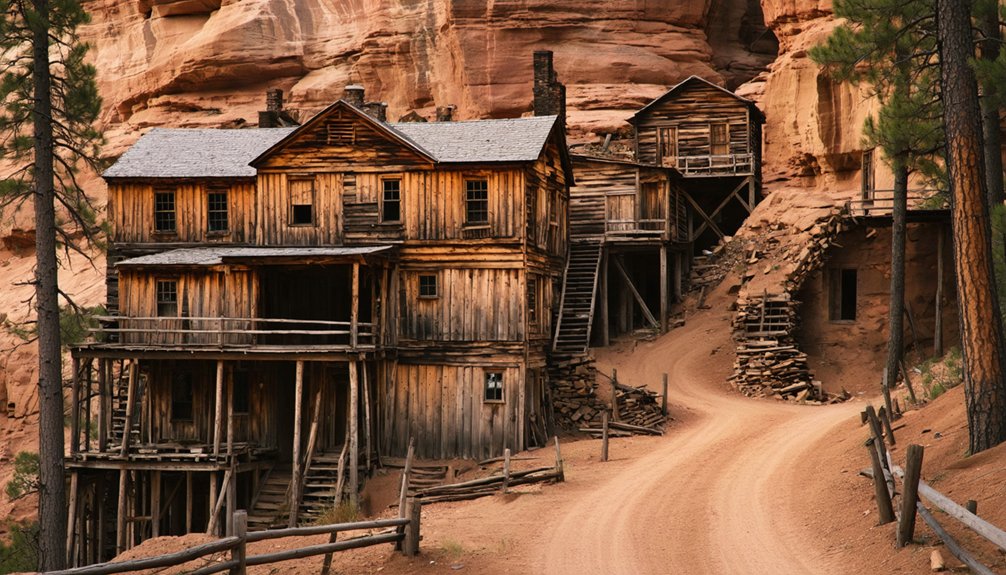
Nestled in Clear Creek Canyon within Chaffee County, Vicksburg stands as one of four historic mining settlements that emerged during Colorado’s mineral boom, sharing the canyon with Rockdale and Beaver City. You’ll find this 1867 ghost town along Highway 24 between Leadville and Buena Vista, accessible via County Road 390. The town’s origin story involves prospectors whose lost burros revealed gold deposits in the creek bed, leading to Vick Keller establishing a general store that gave the settlement its name.
Listed on the National Register of Historic Places since 1977, Vicksburg offers you seasonal access from spring through fall. You can explore restored buildings and a mining museum featuring period equipment. The Chaffee County Historical Society provides audio-guided tours, letting you discover this canyon town’s history independently while original Balm of Gilead trees line the main street.
Winfield: Log Cabins and Mining Heritage
While Vicksburg preserves its canyon heritage through restored buildings and guided tours, Winfield offers you a more remote encounter with Colorado’s mining past in the high country near the Continental Divide. Established in 1861 and formally platted in 1881 at Clear Creek’s forks, this town peaked at 1,500 residents in 1890 before the 1893 silver crash decimated operations.
You’ll find seasonal tourism offerings centered around:
- The restored schoolhouse museum, a rare false-front example operated by the Clear Creek Canyon Historical Society
- Ball Cabin’s mining artifacts documenting the town’s industrial heritage
- Cemetery records revealing 26 burials from 1885-1918, documenting frontier hazards
Four original log structures remain amid modern seasonal cabins. Nearby natural attractions include walking-distance mine sites and an abandoned fish hatchery, complementing this authentic backcountry experience.
Planning Your Colorado Ghost Town Adventure
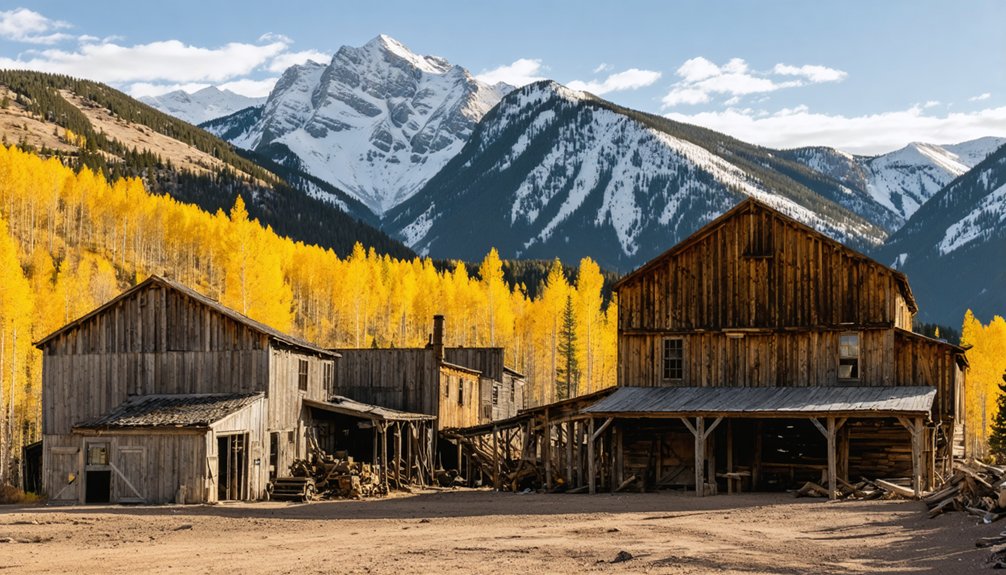
Colorado’s ghost town landscape encompasses over 1,500 abandoned settlements, though only 640 retain visible remains that you can visit today. Your exploration requires strategic planning around elevation challenges and seasonal accessibility—sites like Carson at 12,000 feet and Animas Forks above 11,000 feet face winter closures and avalanche risks.
Transportation methods vary considerably: St. Elmo welcomes regular vehicles, while the Alpine Loop’s 65-mile dirt network demands high-clearance vehicles or ATVs to reach Animas Forks, Carson, and Eureka. You’ll find National Register sites like Animas Forks and Alta offer preserved structures from Colorado’s post-1890s silver devaluation era.
Check current weather conditions before attempting high-elevation routes, particularly the Continental Divide crossings. Most accessible sites cluster near established communities—St. Elmo west of Buena Vista, Alta ten miles from Telluride.
Frequently Asked Questions
Are There Any Guided Ghost Town Tours Available in Colorado?
Yes, you’ll find guided tours throughout Colorado exploring abandoned buildings in mining districts like Ouray’s Red Mountain and Vail’s Fulford ghost town. Remarkably, Fulford’s 2010 census counted just two residents. Self-guided tours complement professional expeditions statewide.
What Is the Best Time of Year to Visit Colorado Ghost Towns?
Summer and early fall offer ideal weather conditions for exploring Colorado’s ghost towns, with accessible roads and mild temperatures. However, seasonal variations provide unique experiences—winter’s snow-covered solitude versus autumn’s vibrant foliage—allowing you freedom to choose your preferred atmosphere.
Can You Camp Overnight Near These Ghost Towns?
Like claiming temporary homesteads, you can camp overnight near Colorado’s ghost towns, though camping regulations vary by jurisdiction. Accessibility considerations include verifying land ownership, checking seasonal restrictions, and confirming dispersed camping permits through relevant ranger districts beforehand.
Do Any Colorado Ghost Towns Have Reported Paranormal Activity?
Yes, you’ll find extensive supernatural encounters documented across Colorado’s ghost towns. St. Elmo reports Annabelle Stark’s apparition, while Cripple Creek casinos record unexplained occurrences. Central City’s cemetery captures mysterious orbs, and Victor’s mining sites document paranormal phenomena linked to historical tragedies.
Are Pets Allowed When Visiting Colorado’s Ghost Towns?
Pet policies vary considerably—you’ll find dog-friendly accommodations at Saint Elmo and Animas Forks offering unrestricted exploration, while Ashcroft prohibits canines entirely. Pet-friendly activities include leashed hiking across South Pass City’s trails, respecting six-foot leash requirements throughout Colorado’s historic sites.