You’ll discover over a dozen abandoned settlements across Connecticut, from Johnsonville’s Victorian mill complex along Salmon River Cove to Gay City’s fire-ravaged ruins dating to 1796. Bara-Hack preserves Welsh settlers’ foundations from 1778, while Dudleytown’s cursed farmland sits deep within Dark Entry Forest. Valley Forge vanished entirely when Bridgeport Hydraulic seized it during the Great Depression, relocating graves and demolishing everything for reservoir construction. Each site holds distinct stories of prosperity, tragedy, and mysterious abandonment that reveal Connecticut’s forgotten communities.
Key Takeaways
- Johnsonville Village, a former mill town along Salmon River Cove, produced fishing nets and carpet warp before closing due to safety concerns.
- Gay City State Park preserves ruins of Factory Hollow, a mill village abandoned in the 1880s after devastating fires and rumored violent deaths.
- Bara-Hack was established by Welsh settlers in 1778 but completely abandoned by 1890 due to economic hardship and alleged Nipmuc curse.
- Dudleytown, settled in the 1740s, was abandoned after brutal winters, poor soil, and mysterious family disappearances plagued residents.
- Valley Forge thrived as a manufacturing hub until seized through eminent domain during the Great Depression, then demolished and erased.
Johnsonville Village: A Victorian Mill Town Frozen in Time
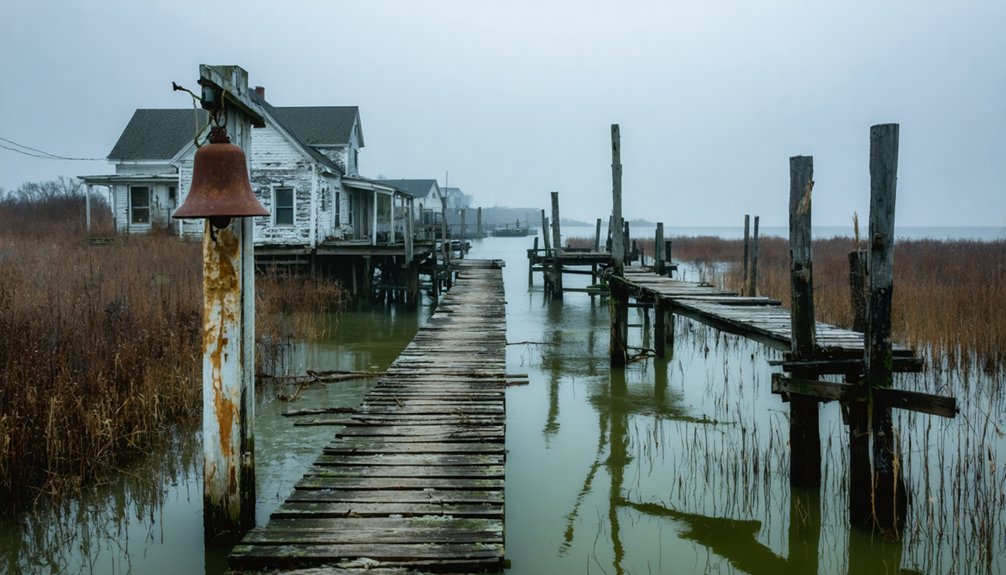
In 1832, the Neptune Mill rose along the banks north of Salmon River Cove, its machinery humming with the production of twine and yarn that would supply America’s burgeoning fishing industry. You’ll find this 62-acre ghost town in East Haddam’s Moodus section, where twelve mills once thrived along the Moodus and Salmon Rivers.
The town of Johnsonville grew around these operations, housing workers who produced fishing nets and carpet warp through both World Wars. Lightning struck Neptune Mill in 1972, reducing it to ashes. Raymond Schmitt’s Victorian tourist attraction dreams collapsed amid zoning disputes in 1994. Today, visitor safety concerns keep the site closed, though a Philippine church group purchased the property in 2017 for future town redevelopment as a religious center.
Gay City State Park: From Religious Settlement to Mysterious Ruins
You’ll find Gay City State Park conceals one of Connecticut’s most enigmatic ghost towns, established in 1796 when Elijah Andrus led devout Methodists from Hartford to found a religious settlement along the Blackledge River.
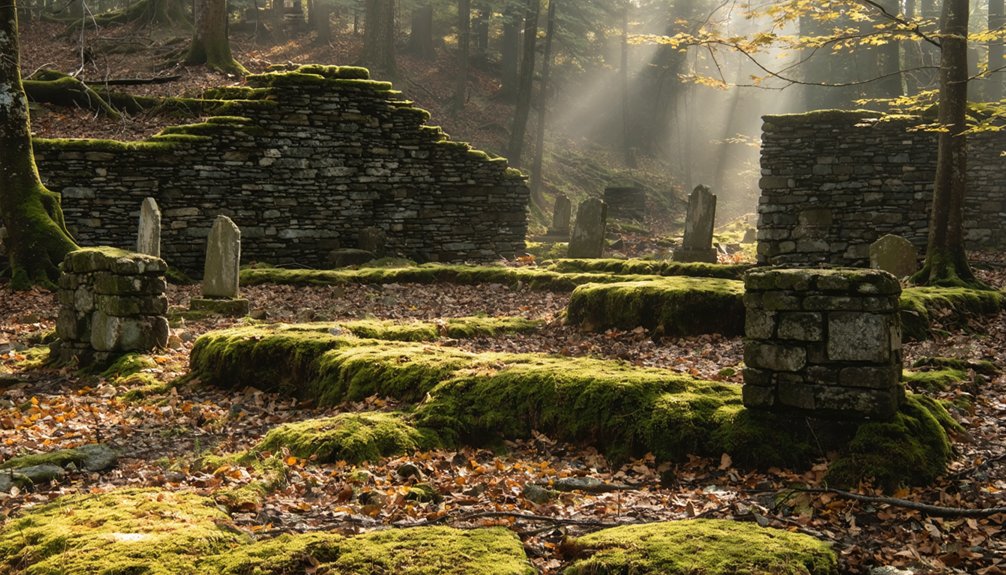
What began as a spiritual refuge named for founding member John Gay transformed into Factory Hollow, a thriving mill village that suffered three devastating fires before complete abandonment in the 1880s. The site’s metamorphosis from prosperous community to forgotten ruins carries whispers of violent deaths and unexplained occurrences that persist among the remaining foundations and weathered gravestones.
Methodist Founders Flee Hartford
The religious settlement at Hope Valley, later known as Hopevale in Hebron, emerged from a formal 1849 land deed when David Chapman transferred property to trustees of the Wesleyan Methodist Society. This early Methodist expansion established Connecticut’s foothold for religious autonomy outside established denominational control. Services continued until deaths and relocations depleted membership, forcing denominational abandonment.
A mysterious revival led by Brother Kathan in 1881 transformed the landscape, bringing conversions and establishing the Methodist Episcopal Church. On October 10, 1881, David Johnson and Mrs. Sarah Thompson joined others in formal membership.
Key elements of this transformation:
- Property re-deeded to Methodist Episcopal trustees February 3, 1882
- Members admitted through letters, probation, and baptism ceremonies
- Original Wesleyan society dissolved completely before Episcopal revival
- Ruins now preserved in Gay City State Park as record of religious independence
Mills, Murder, and Mystery
As economic ambitions transformed Hopevale’s religious character, textile mills rose along the river channels, their waterwheels driving looms that promised prosperity to the settlement. Yet fire consumed these structures thrice before century’s end, followed by a post-Civil War paper mill that met identical fate. Only stone canals and foundations remain as legacy.
Darker currents ran beneath industrial failure. A blacksmith decapitated his apprentice for tardiness. A traveling salesman’s skeleton emerged from a charcoal pit, his merchant-killer having attempted burning away evidence. Both murders remain unsolved.
Today, rumors persist of strange religious rituals involving alcohol, while ghostly sightings in ruins continue. You’ll find drunken voices echo through moonlit nights, and spectral figures flit between trees where cellars and chimney stacks mark vanished homes.
Abandoned Ruins Become Park
Despite decades of tragedy and abandonment, Gay City’s story found redemption through preservation. In 1943, Emma Foster, the last descendant of the Gay family, donated the land to Connecticut with one clear stipulation: name it Gay City State Park and protect its ruins and graveyard. By 1944, this historic settlement transformed into a public sanctuary where you’re free to explore its mysterious past.
Today, you’ll discover the thrice-burned paper mill’s foundations, stone canals, and towering chimney stack standing as monuments to resilience. House foundations and cellars emerge from woodland trails, while the small cemetery near the entrance holds weathered gravestones that fuel supernatural stories.
- Stone ruins mark where ambitious pioneers once thrived
- Mill foundations reveal three catastrophic fires that shaped destiny
- Unmarked cellar holes reward those who venture off-trail
- The preserved graveyard connects you to forgotten lives
Bara-Hack: The Vanished Welsh Community
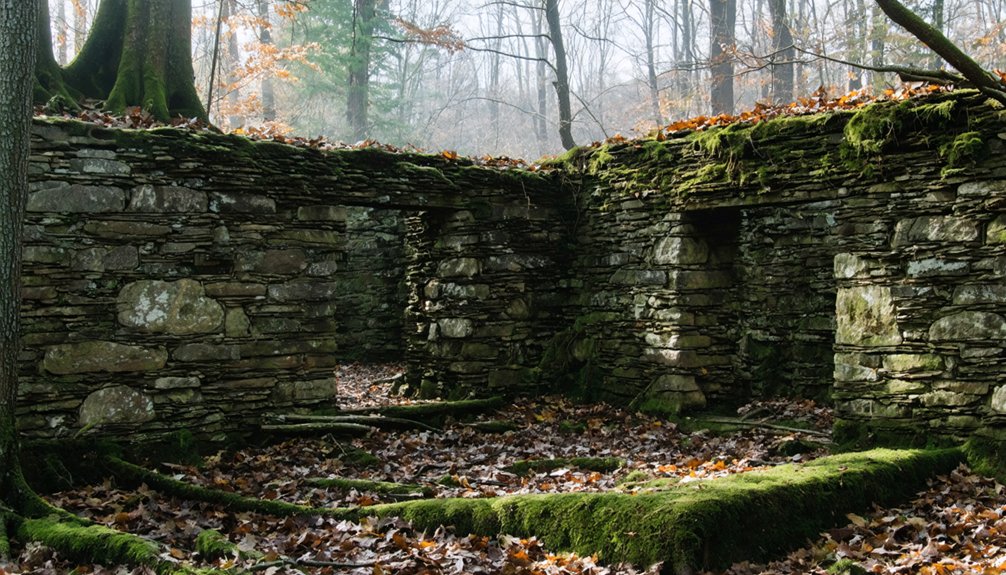
When British forces advanced during the Battle of Rhode Island in 1778, Jonathan Randall and Obadiah Higginbotham—both of Welsh descent—fled their Cranston, Rhode Island homes for land Randall had purchased two years earlier in Pomfret, Connecticut’s Ragged Hills. They established Bara-Hack—meaning “breaking of bread” in Welsh, though disputed origins suggest this name may be a 20th-century invention.
The settlement featured homes, farms, and Higginbotham’s linen wheel business along Nightingale Brook. Both families and their slaves shared a burial ground where nine interments were recorded. By 1890, economic hardship forced complete abandonment.
Today, you’ll find haunting phenomena throughout the ruins: children’s laughter, mill sounds, wagon wheels. Some attribute these occurrences to a Nipmuc curse for displacing indigenous peoples from their ancestral territory.
Dudleytown: Cursed Farmland in Dark Entry Forest
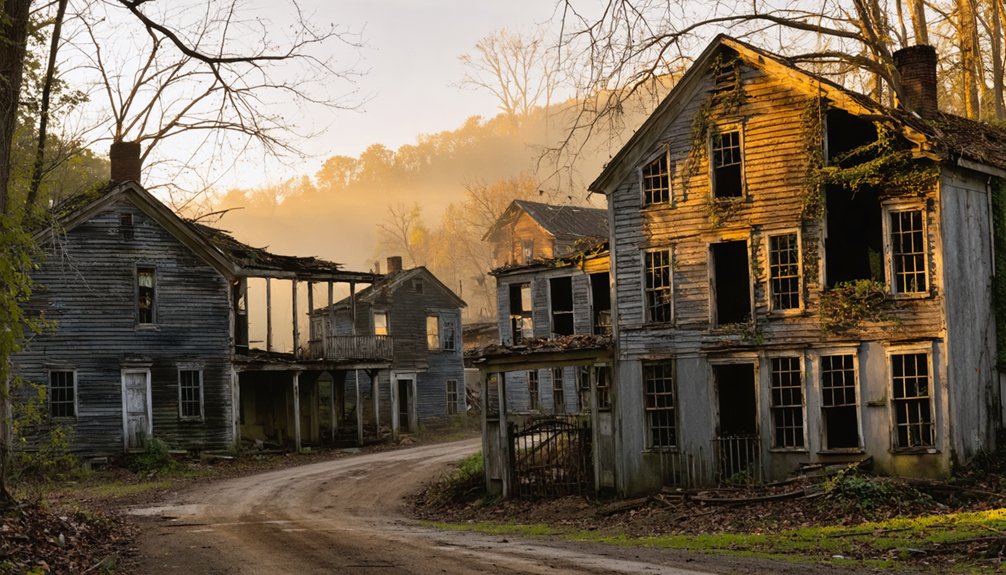
Between three towering hills in Cornwall, Connecticut’s Dark Entry Forest, settlers established Dudleytown in the mid-1740s—a valley so deeply shadowed that darkness fell at noon even on cloudless days. Descendants of England’s Dudley family carved homes from this unforgiving landscape, allegedly fleeing a curse originating from Edmund Dudley’s 1510 beheading.
Despite historians debunking genealogical connections to the executed nobleman, tragedy persisted. Brutal winters and unsuitable soil destroyed agricultural prospects, forcing residents toward timber income. By 1854, only twenty-six families remained. The settlement stood completely abandoned by the early 1900s, marked by eerie family disappearances and unexplained deaths.
Evidence of Dudleytown’s Dark Legacy:
- Ed and Lorraine Warren’s 1970s paranormal investigations documented unexplained phenomena
- Visitors report physical encounters: touches, pushes, scratches from invisible forces
- Forest reclaimed all structures within decades
- 1980s vandalism forced permanent closure to seekers
Valley Forge: Sacrificed for the Saugatuck Reservoir
Welsh immigrants carved Valley Forge from Connecticut’s Saugatuck River Valley in the eighteenth century, transforming the settlement into a manufacturing powerhouse that forged iron and steel for America’s defining conflicts—the War of 1812, the Civil War, and the railroad expansion that stitched the nation together. Charles H.D. Adelbert Whitlock’s pre dam photographs captured the town’s industrial significance during the 1860s, preserving images of a community that wouldn’t survive progress’s demands.
The Bridgeport Hydraulic Company seized Valley Forge through eminent domain in the late 1930s, offering residents pennies for their properties. Depression-era desperation crushed resistance. Authorities relocated cemetery bodies, demolished buildings, and burned what remained.
Other Forgotten Connecticut Settlements Worth Exploring
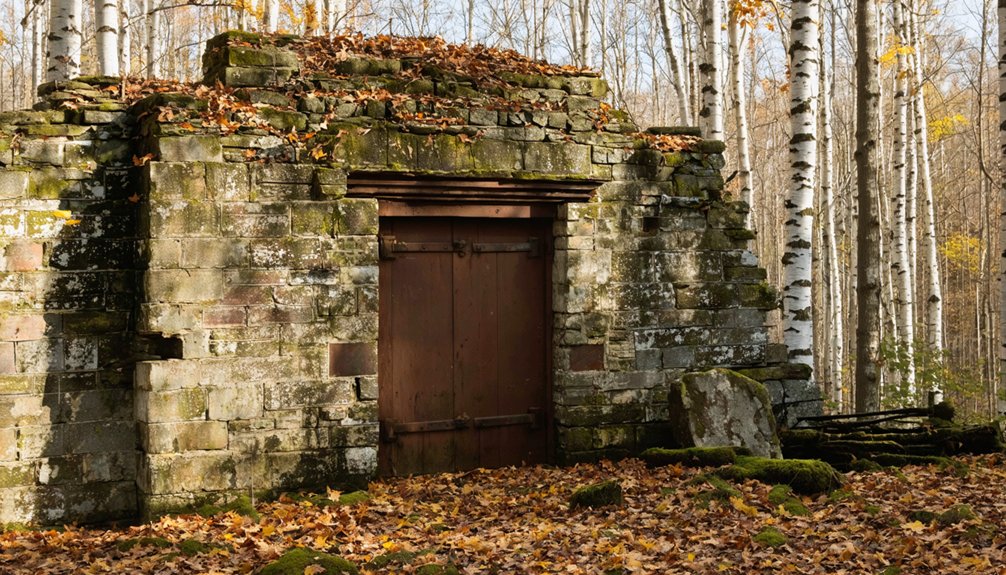
Beyond Valley Forge’s submerged streets, Connecticut conceals dozens of settlements that met equally dramatic fates—communities erased by fire, economic collapse, and the relentless march of modernization.
You’ll discover Gay City’s 1796 Methodist refuge, where alcohol-loving dissenters built mills and homes before flames consumed their textile industry twice. Johnsonville Village showcases five generations of industrial decay along the Salmon River, its colonial era homes surrounding burned mill foundations.
Bara-Hack’s Welsh stone foundations rest in Pomfret’s woods, abandoned before the Civil War. Dudleytown remains Connecticut’s most secretive ghost town, while Stamford’s miniature settlement vanished beneath urban roadways.
These settlements reveal Connecticut’s hidden narrative:
- Economic vulnerability: Single-industry dependence guaranteed community extinction
- Fire’s destructive power: Repeated blazes sealed multiple towns’ fates
- Modernization’s cost: Infrastructure development erased historical landscapes
- Access restrictions: Private ownership now guards abandoned sites
Frequently Asked Questions
Can You Legally Visit Any of Connecticut’s Ghost Towns Today?
You’ll find several Connecticut ghost towns legally accessible today, though property ownership restrictions and public access regulations vary considerably. Gay City State Park welcomes visitors freely, while Dudleytown remains strictly off-limits on private land requiring special permission.
Are the Paranormal Stories About These Abandoned Towns Actually True?
You’ll find paranormal sightings reported at these locations remain unverified despite numerous local legends investigated over decades. No scientific evidence confirms supernatural claims, though eyewitness accounts persist. You’re free to explore and form your own conclusions.
What Happened to the Original Residents When These Towns Were Abandoned?
Like leaves scattered by autumn winds, you’ll find residents dispersed by varied reasons for abandonment—economic collapse, forced displacement, or mysterious tragedies—leaving lingering effects on former inhabitants who carried memories of loss, injustice, and unresolved questions throughout their remaining days.
How Do Connecticut’s Ghost Towns Compare to Abandoned Settlements in Other States?
You’ll find Connecticut’s ghost towns smaller-scaled than Western sites, yet they’re better integrated into historical preservation efforts. Unlike regional population trends driving mass Western abandonments, Connecticut’s settlements declined through localized tragedies and curse-driven fear.
Are There Guided Tours Available for Any of These Historic Sites?
You won’t find guided tours offered at Connecticut’s ghost towns due to preservation efforts underway and access restrictions. Gay City State Park provides self-guided exploration with interpretive markers, while Dudleytown remains completely closed, protecting your freedom to discover accessible alternatives.