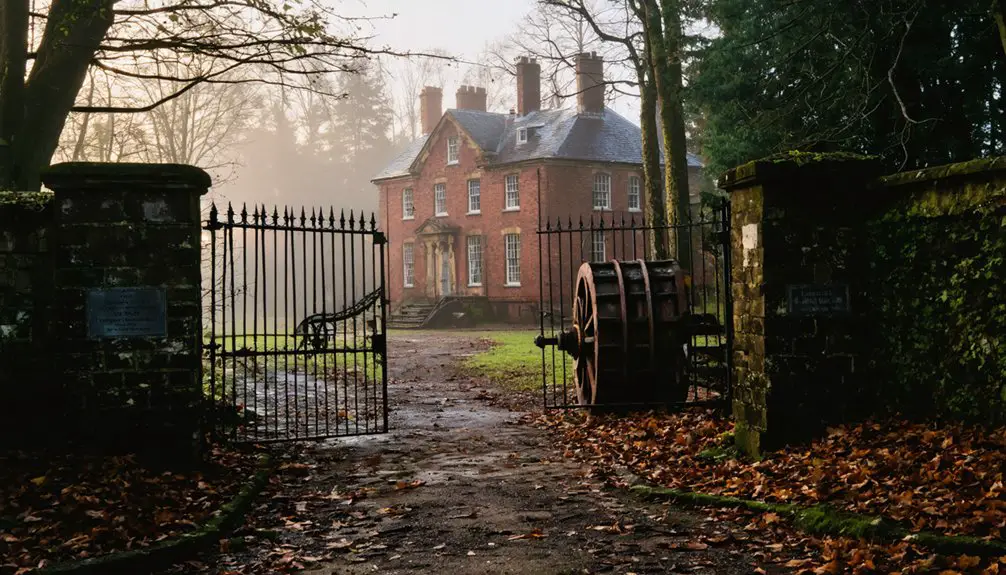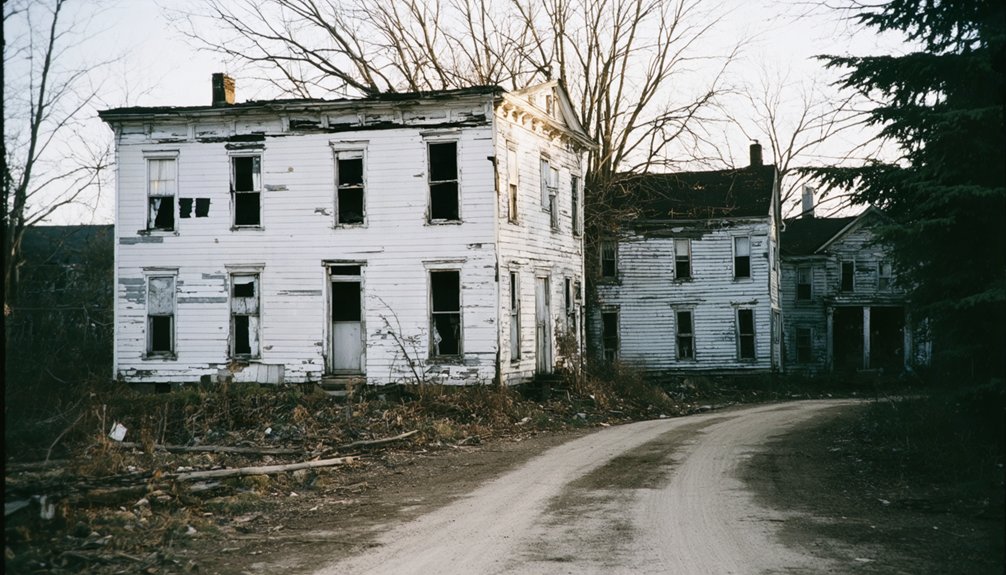
You’ll find New Jersey’s ghost towns scattered across the Pinelands and northern highlands, where nineteenth-century industry once flourished. Batsto Village forged Revolutionary War munitions from 1766, while Waterloo Village served Morris Canal travelers at the waterway’s midpoint. Harrisville’s paper mill ruins mark a settlement destroyed by fire in 1914, and Feltville stands twice-abandoned after David Felt’s 1845 factory dream collapsed. Allaire Village’s massive iron furnace supported 500 residents before failing in 1846. Each preserved site reveals the stories of America’s early industrial communities and the workers who built them.
Key Takeaways
- Batsto Village, established in 1766, supplied Revolutionary War munitions and is now preserved as a New Jersey Historic Site.
- Waterloo Village thrived at the Morris Canal’s midpoint but was abandoned by 1900 after railroads replaced canal transport.
- Harrisville Ruins began as an 1795 sawmill, became a papermaking town, then was destroyed by a 1914 forest fire.
- Feltville was twice abandoned, first after the 1857 Panic and again in 1916 following its failed resort revival.
- Allaire Village housed 400-500 residents around America’s largest furnace until its 1846 collapse; 13 structures remain today.
Batsto Village: Revolutionary War Iron Works in the Pine Barrens
Deep in New Jersey’s Pine Barrens, where streams yielded bog ore and forests stood thick with timber, Charles Read recognized the perfect conditions for industry. In 1766, he established Batsto Iron Works along the Batsto River, harnessing natural resources that’d fuel a revolutionary enterprise. You’ll find this wasn’t merely commerce—during the Revolutionary War, Batsto supplied the Continental Army with cannons and munitions while British spies prowled nearby Chestnut Neck.
The Richards family sustained this community for 92 years, creating a self-sufficient village where charcoal production and ironmaking thrived. Though the furnace was dismantled in 1855, Batsto’s legacy endures. New Jersey acquired the site in the 1950s, preserving these grounds as a Historic Site where you can trace America’s industrial independence.
Waterloo Village: Morris Canal’s Historic Halfway Point
Where the Musconetcong River carved its path between Schooleys Mountain and Allamuchy Mountain, engineers identified the ideal midpoint for their ambitious waterway. You’ll find Waterloo Village nestled within what’s now Allamuchy Mountain State Park, where the 102-mile Morris Canal reached its halfway mark in 1829.
At the Musconetcong River’s natural gap, 19th-century engineers discovered the perfect location for their canal’s crucial midpoint.
This settlement thrived as boatmen navigated mule towing paths, their vessels climbing 1,674 feet through ingenious locks and inclined planes.
During overnight canal boat trips, travelers found respite at the inn while blacksmiths tended their mules. The 1820s gristmill ground grain as anthracite coal flowed toward Northern New Jersey’s factories, peaking during the Civil War.
Though railroads claimed dominance by 1900 and abandonment followed in 1924, you can still explore this restored canal town—testament to American ingenuity.
Harrisville Ruins: The Pinelands Paper Mill Ghost Town
Six miles northwest of New Gretna, the New Jersey Pine Barrens conceal the brick remnants of what once thrived as a nearly 400-person papermaking settlement. You’ll discover Harrisville’s story begins in 1795, when Isaac Potts named it after his wife Martha.
By 1834, McCarty’s $10,000 paper mill transformed this sawmill community into an industrial hub powered by the Wading River‘s paper production processes.
The Harris family modernized operations in the 1850s, installing underground gas lighting and worker housing. Their ambition couldn’t prevent financial collapse, though. Joseph Wharton acquired the foreclosed property in 1896, and a 1914 forest fire delivered the final blow.
Today you’re free to explore hand dug canal remnants, cellar holes, and that still-flowing artisan well—tangible connections to Pinelands heritage worth preserving.
Feltville (Deserted Village): From Factory to Forgotten Resort
While Harrisville’s ruins speak to the Pine Barrens’ industrial past, the Watchung Mountains harbor a different kind of abandonment—one that witnessed two complete cycles of settlement and desertion.
You’ll find Feltville’s origins in David Felt’s 1845 vision: a water-powered industry built on Blue Brook’s flow. He constructed worker housing, a church-store, and schoolhouse, creating a self-contained mill town of 175 residents by 1850. “King David” enforced mandatory church attendance and education—community control that defined daily existence.
The 1857 Panic destroyed his empire. Felt abandoned the village after just fifteen years. Successive enterprises failed. By the 1870s, silence claimed the settlement.
Warren Ackerman’s 1882 resort conversion brought temporary revival, but Glenside Park closed in 1916. The village stood empty again—twice deserted, twice forgotten.
Allaire Village: The Rise and Fall of a Bog Iron Community
- Built America’s largest furnace, supporting 400-500 residents in a self-contained village
- Produced pig iron, castings, hollowware, and stoves shipped to New York foundries
- Issued private currency enabling workers to purchase goods during economic downturns
- Championed Jacksonian reforms: temperance, anti-slavery movements, free education
The furnace collapsed in 1846. Today, thirteen original structures survive as evidence to pioneering industrial independence.
Frequently Asked Questions
What Happened to Walpack Center After the Dam Project Was Cancelled?
After cancellation, you’ll find Walpack Center’s abandoned buildings preserved as historic landmarks under National Park Service stewardship. Walpack Center’s repurposed structures now serve educational purposes, while the Inn continued operating, creating a living museum celebrating freedom from development’s destructive march.
Are Any of These Ghost Towns Considered Haunted or Have Paranormal Activity?
Ghosts whisper through New Jersey’s abandoned corridors. You’ll find reported paranormal sightings at Feltville’s deserted houses and Ong’s Hat’s dimensional gateway legends. Abandoned structures’ preservation maintains these eerie sites where you’re free to explore Jersey Devil territory and Hampton’s haunted bogs.
Can Visitors Explore the Buildings or Only View Them From Outside?
You’ll find building access restrictions vary by site. At Batsto and Allaire, you can visitors enter abandoned buildings freely during tours. Feltville offers self-guided exploration of eight structures. Walpack’s buildings remain largely exterior viewing only, preserving their historic integrity.
What Caused the Decline of Bog Iron Production in New Jersey?
You’ll find bog iron production declined when cheaper Scottish imports arrived around 1840, creating decreasing industry demand. Transportation challenges couldn’t overcome competition from Pennsylvania’s anthracite coal and richer ore deposits, which proved far more efficient than charcoal-fueled operations.
Are There Guided Tours Available at These Historic Ghost Town Sites?
You’ll find the lay of the land varies—guided tours offered at Allaire and Waterloo Villages through seasonal programs, while Batsto and Feltville emphasize self-guided exploration. Tourist accessibility remains excellent, honoring your independence to discover these preserved communities freely.