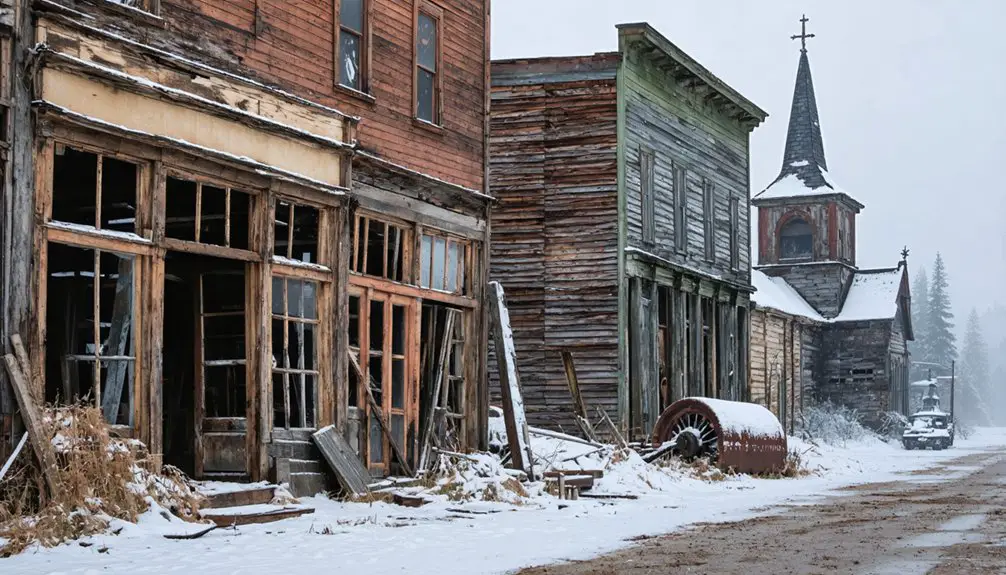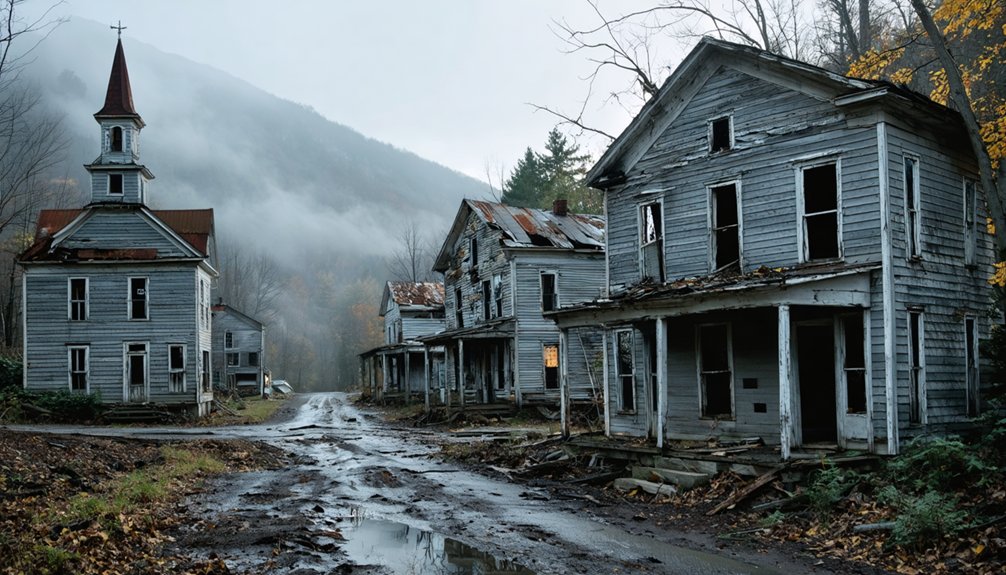
You’ll find West Virginia’s most compelling ghost towns clustered along a 12-mile stretch of the New River Gorge, where over 60 abandoned coal communities tell Appalachia’s industrial story. Thurmond once processed 95,000 passengers annually but now shelters just five residents, while Kaymoor’s 821 stairs descend to mine portals 560 feet above the river. Nuttallburg’s 1873 operation and Stotesbury’s nine-decade mining legacy left tangible remnants—rusted tipples, coke ovens, and company town foundations—that reveal how coal culture shaped these mountains and the communities who called them home.
Key Takeaways
- Over 60 abandoned mining towns span a 12-mile stretch of the New River Gorge, remnants of Appalachian coal industry heritage.
- Thurmond declined from servicing 95,000 annual travelers with fifteen daily trains to just five residents today.
- Kaymoor’s 821 stairs lead to abandoned lower camp ruins, including 200 coke ovens and sealed mine entrances.
- Nuttallburg features rusted equipment once leased by Henry Ford, now preserved as part of the National Park Service.
- Stotesbury’s 90-year mining history ended with White Mountain LLC’s 2002 bankruptcy after dangerous roof conditions forced closure.
The New River Gorge: A 12-Mile Corridor of Abandoned Mining Towns
The Chesapeake & Ohio Railroad‘s arrival in 1873 transformed the New River Gorge from a remote wilderness into West Virginia’s most productive coal-mining corridor. You’ll find remnants of over 60 abandoned mining towns scattered across this 12-mile stretch, each telling stories of boom and bust.
The gorge’s smokeless coal attracted steel mills nationwide, sparking operations like Kaymoor—one of the region’s largest producers with sophisticated coal washing infrastructure and mountain haulage systems that transported miners between upper and lower sections. Towns like Nuttallburg, Beechwood, and Whipple emerged along the rail line, thriving until the 1940s-1950s.
Today, you can explore rusted tipples, sealed mine portals, and crumbling foundations via hiking trails—tangible evidence of an industry that shaped Appalachian culture.
Thurmond: From 95,000 Daily Passengers to 5 Residents
Perched on the southern bank of the New River, Thurmond transformed from West Virginia’s most prosperous railroad town into one of America’s most dramatic ghost towns. When the Chesapeake and Ohio Railway arrived in 1873, you’d have witnessed fifteen passenger trains daily servicing 95,000 travelers annually. Two banks—West Virginia’s richest—anchored a thriving commercial district with hotels, saloons, and theaters.
But diesel locomotives, automobile culture, and declining coal production hollowed out this once-bustling depot town. Natural disaster impacts compounded the decline: devastating fires in 1922 and 1930 destroyed critical infrastructure, including the DunGlen Hotel.
Today, you’ll find infrastructure remnants like the 1904 Mankin-Cox Building and the historic depot, now serving Amtrak’s occasional passengers. With just five residents, Thurmond stands as testimony to the railroad era’s impermanence.
Kaymoor: The 821-Stair Journey to Underground Ruins
While Thurmond’s railroad prosperity faded with changing transportation, deep within the New River Gorge another ghost town tells a different story—one of coal, sweat, and the 821 stairs that still connect its scattered ruins.
Kaymoor defied typical coal mining culture expectations. While most company towns lasted 25 years, this operation survived 62—from 1900 to 1962. Over 800 workers extracted nearly 17 million tons of coal from rooms carved into the gorge wall, 560 feet above the New River.
You’ll find two distinct settlements: Kaymoor Top at the rim and Kaymoor Bottom below, connected by inclines that once hauled miners down and coal up. The town’s decline began in 1952 when residents abandoned the lower camp. Today, 200 coke ovens and mine entrances remain, accessible only to those willing to descend those relentless stairs.
Nuttallburg: John Nuttall’s 1873 Coal Legacy
Before Kaymoor’s 821 stairs became legendary, John Nuttall was already reshaping the New River Gorge’s economic future. This English immigrant gambled on 1,500 acres at Keeney Creek in 1870, betting the coming railroad would transform his investment. He was right—by 1873, Nuttallburg’s coal mining infrastructure became the gorge’s second rail-shipping operation.
Nuttall’s vision created a complete industrial community:
- 98 dwellings housing 300 residents by 1893
- 80 coke ovens and three progressive tipples maximizing production
- Suspension bridge connecting workers across the New River
Yet prosperity came with stark divisions. Racial segregation within company town boundaries placed white miners west of Short Creek while Black workers occupied the eastern hillsides. When Henry Ford purchased the operation in 1919, he modernized everything—except those entrenched social barriers that defined Appalachian coal communities.
Stotesbury: Nine Decades of Mining Ends in 2002
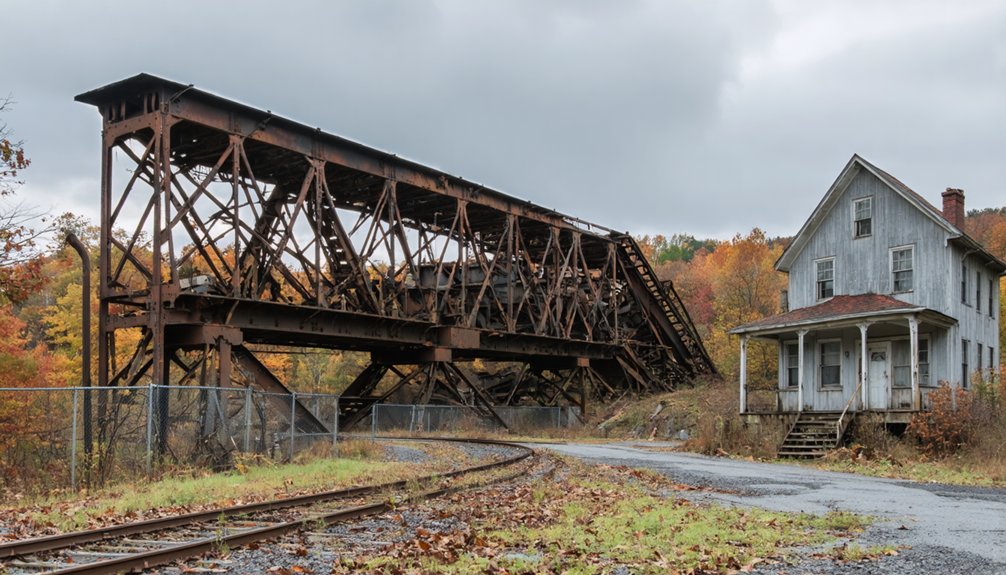
Deep in Raleigh County’s Winding Gulf Coalfield, Stotesbury’s 90-year mining saga tells the story of Appalachian coal’s boom-and-bust cycle in miniature.
You’ll find coal town remnants where E.E. White Coal Company first dug into the Beckley seam around 1912. The community thrived through the 1930s, survived ownership changes from Koppers to Eastern Associated Coal, and witnessed technological shifts like the area’s pioneering longwall operations.
When White Mountain LLC reopened the mine in 2001—chasing $55-per-ton prices from California’s energy crisis—optimism briefly returned. New equipment and a rebuilt infrastructure suggested renewal. Yet dangerous roof conditions forced closure within a year, bankrupting the company by November 2002.
Today, winding gulf coalfield restoration efforts have reclaimed refuse dumps from the 1920s, while Stotesbury Community Church anchors what remains.
Exploring Fayette County’s Forgotten Communities
You’ll find Fayette County’s ghost towns clustered along a twelve-mile stretch of the New River Gorge, where coal veins and railroad access created over sixty now-abandoned communities.
Thurmond stands out as the former railroad hub where the Dunglen Hotel and Ballyhack district drew miners and train crews for drinking and gambling until a 1922 fire changed everything.
To reach Kaymoor’s preserved mining site, you’ll descend 821 steps into the gorge, while Nuttallburg’s rusted equipment—once leased by Henry Ford for his steel operations—now sits reclaimed by forest as part of the National Park Service.
Thurmond’s Bustling Railroad Past
When Captain William D. Thurmond accepted 73 acres as surveyor’s payment in 1873, he couldn’t have imagined the empire that would rise alongside the newly completed Chesapeake & Ohio Railway mainline. This remote gorge location, accessible only by train for 35 years, transformed into the railroad’s premier revenue generator by 1910—surpassing Cincinnati and Richmond combined.
Thurmond’s pivotal role in coal transportation drove unprecedented prosperity:
- 15 passenger trains daily served 75,000 travelers yearly at peak operations
- 150-200 railroad workers kept locomotives and freight cars moving around the clock
- Millions of tons of smokeless coal flowed from surrounding mines through consolidation yards
This historical impact on regional economy built a thriving town of 500 residents, complete with banks, hotels, and telegraph offices—all without a single road connection.
Kaymoor’s Treacherous Stair Descent
Eight hundred twenty-one wooden steps plunge down the mountainside at Kaymoor, marking one of West Virginia’s most dramatic descents into coal mining history. You’ll drop over 1,000 feet through multiple operational levels where miners once extracted coal from horizontal drifts cut 560 feet above the New River.
The mining infrastructure stretched across rugged terrain, connecting two separate villages through an ingenious steam-powered incline system. This vertical transportation network—dubbed “the haulage” by workers—moved men upward and coal downward until operations ceased in 1962.
Today, you’re free to explore the preserved ruins, though safety grates now block mine entrances. The National Park Service maintains access to this registered historic site, where scattered coal fragments still mark West Virginia’s industrial heritage beneath your boots.
Nuttallburg’s Industrial Mining Remnants
Along Keeney Creek’s wooded banks, Nuttallburg preserves the most complete coal-mining complex in West Virginia—a rare monument to the industrial ambitions that transformed Fayette County’s wilderness into a production powerhouse. You’ll discover foundations where 110 old company housing structures once sheltered 342 residents who extracted high-carbon bituminous coal from 1873 until economic challenges forced closure in 1958.
The National Park Service now protects:
- 46 beehive coke ovens standing sentinel along the former railroad siding
- Steel conveyor structures spanning 500+ feet from Henry Ford’s 1920s modernization
- Weathered headhouse foundations marking three generations of tipple construction
Walk among these industrial remnants and you’ll understand why vertical integration failed—even Ford’s resources couldn’t overcome transportation monopolies. Nuttallburg stands as tangible proof that corporate control has limits.
Southern West Virginia’s Hidden Ghost Town Treasures
Southern West Virginia’s ghost towns tell the story of coal’s boom and devastating bust across McDowell and Mingo counties, where company towns like Algoma and Glen Alum once thrived before economic collapse left them to the elements.
You’ll find these remote mountain ruins challenging to access—many require serious hiking through overgrown hollows and abandoned rail grades—but the National Park Service’s stewardship of sites like Nuttallburg has transformed preservation efforts, protecting structural remnants like coke ovens and coal tipples for future generations.
These cultural landscapes reveal how extractive industry shaped Appalachian communities, then abandoned them when profits dried up.
Coal Mining Legacy Sites
Deep within the rugged hollows and steep river gorges of southern West Virginia, a constellation of abandoned coal towns stands frozen in time, their weathered structures bearing witness to the region’s explosive industrial rise and eventual economic collapse. These sites reveal the harsh realities of coal labor conditions and profound socioeconomic impacts that shaped Appalachian communities.
These ghost towns offer unfiltered access to America’s industrial heritage, free from sanitized narratives.
You’ll discover compelling remnants across the New River Gorge:
- Nuttallburg’s restored tipple dramatically extends from hillside to river, showcasing complete coal processing infrastructure
- Kaymoor’s 821 stairs lead to preserved safety warnings that miners once heeded daily
- Gary’s former glory as a 1923 model town scoring 90/100 for cleanliness contrasts sharply with today’s population of 700
Accessing Remote Mountain Ruins
Beyond the maintained trails and visitor centers of New River Gorge National Park and Preserve, West Virginia’s most evocative coal town ruins demand genuine expedition skills. You’ll need 4×4 capability for Sewell’s off-grid location—rangers at Babcock State Park provide essential directions through unmarked backcountry.
Kaymoor’s abandoned mining equipment requires descending 821 stairs with no vehicular alternative. Nuttallburg’s remote site access follows a precarious dirt road hugging the New River, where cell reception vanishes and mountain walls press close.
General coordinates exist, but expect aimless exploration through dense forest canopy. The National Park Service manages these locations, eliminating trespassing concerns while preserving authentic desolation.
Winona and Red Ash cluster within a 12-mile stretch, rewarding persistent navigators with coke ovens, foundation remnants, and structures reclaimed by Appalachian wilderness.
Preservation Through National Parks
The National Park Service transformed what could have been West Virginia’s greatest heritage loss into its most accessible open-air museum. Through national park conservation efforts beginning in the 1980s, more than 60 ghost towns along the New River Gorge now stand protected from developers and vandals.
Historic site stabilization programs launched in 2003 brought new life to crumbling structures—metal roofs, drainage systems, and careful repairs preserve authentic 1900s appearances without Disney-fying these coal camps.
You’ll find remarkable results at key sites:
- Nuttallburg’s industrial towers remain graffiti-free after 85 years of abandonment
- Thurmond’s restored depot serves visitors while twenty structures maintain their vintage character
- Kaymoor and Dun Glen became publicly accessible through strategic trail development
When advocates challenged 2023 demolition proposals, the Service compromised—proving citizen involvement still shapes preservation outcomes.
Historic Features That Still Stand Today
While most ghost towns vanish into memory, West Virginia’s abandoned coal communities have left behind tangible remnants that tell their stories. You’ll find Thurmond’s 1922 Fairbanks and Morse coal tower standing alongside its restored commercial row—endangered architectural landmarks saved through historic building conservation efforts.
At Nuttallburg, coal tipples and conveyor systems remain visible among overgrown structures documenting both mining operations and African American community life.
Dun Glen’s ruins sit 700 feet above the New River, accessible only via former tramway routes. Stotesbury preserves separate churches that reflect the era’s racial segregation, while Quinnimont’s iron furnace remnants mark the boom period.
These sites offer you authentic glimpses into Appalachian coal culture without sanitized interpretations—raw history you’re free to explore and interpret yourself.
Accessing Ghost Towns Through National Park Trails
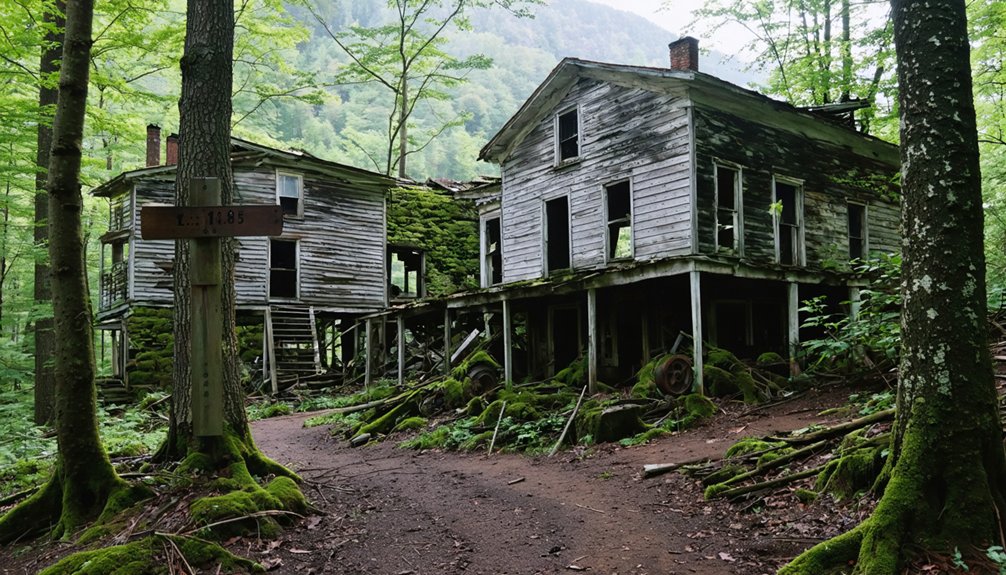
New River Gorge National Park protects over 60 ghost towns along a dozen-mile stretch of river valley, creating one of America’s most concentrated networks of abandoned coal communities. You’ll find established trails connecting you to several sites, eliminating exploring private property challenges that once restricted access.
Key Trail Access Points:
- Kaymoor Trail follows an old road with wayside exhibits before reaching 821 stairs descending to the townsite
- Thurmond requires crossing an 827-foot one-way bridge built in the early 1900s, with seasonal visitor center tours available
- Dun Glen sits 700 feet above the river, currently reachable only via primitive wagon roads until the Park Service completes construction
Accessing off the beaten path ruins like Sewell near Babcock State Park may require ranger directions and 4×4 vehicles for scattered coke oven remains.
Frequently Asked Questions
Are Ghost Town Visits Safe for Families With Young Children?
Ghost town visits aren’t recommended for young children due to unstable structures and remote locations lacking emergency services. You’ll find minimal child safety protocols or family-friendly activities. Instead, explore West Virginia’s documented historic sites with proper facilities and supervision.
What Caused West Virginia’s Coal Mining Towns to Become Abandoned?
You’ll find these towns died from economic decline when diesel replaced steam locomotives and coal seams ran dry. Poor investment returns, environmental degradation, and resource depletion forced miners to abandon their communities by the 1980s.
Can Visitors Explore Inside Abandoned Buildings in These Ghost Towns?
You’ll find varying access across sites. While some structures remain open for exploration, you should respect restricted areas and trespass concerns. Tour-based locations like Trans-Allegheny require guides, while Nuttallburg’s ruins offer freer wandering through coal-era remnants.
What’s the Best Time of Year to Visit West Virginia Ghost Towns?
Fall offers the best season for photography with vibrant foliage framing historic structures, while spring provides ideal weather conditions—moderate temperatures and fewer crowds let you explore these mountain settlements at your own pace.
Do Any Ghost Towns Offer Guided Tours or Visitor Centers?
While most abandoned settlements favor self-guided tours through their weathered ruins, you’ll find Thurmond Depot’s ranger-staffed visitor center offers context before exploration. Group walking tours aren’t formalized—these freedom-seeking sites let you discover coal country’s stories independently.