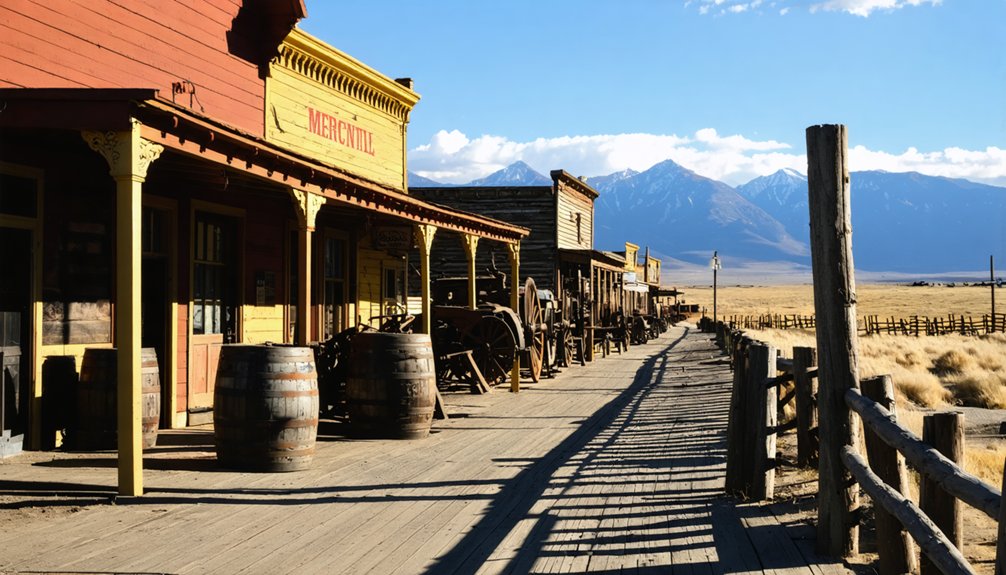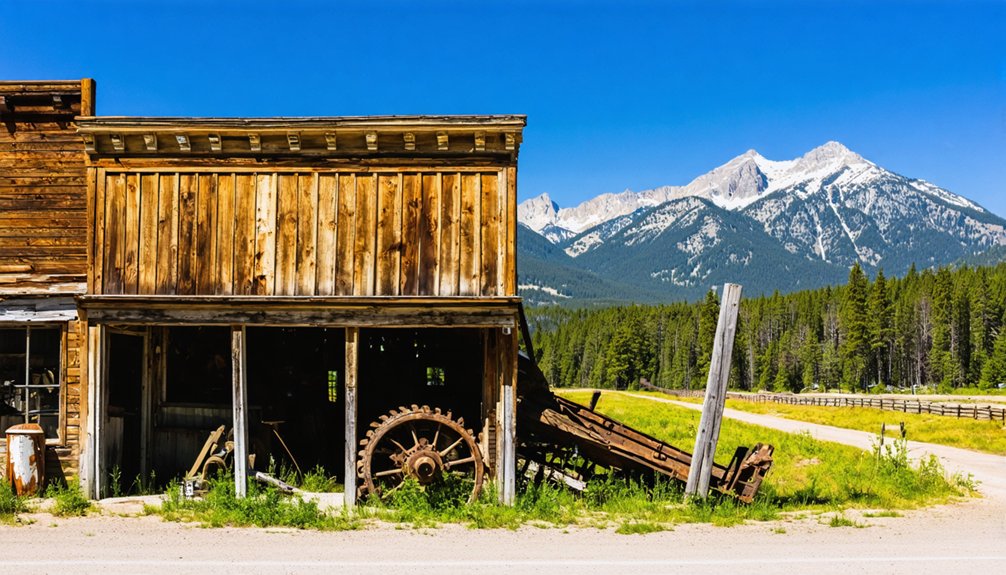
Petersburg, California emerged from the 1851 Kern River gold rush, established by Peter Gardett around 1855. This Greenhorn Mountains settlement thrived with placer mining evolving into lode mining, extracting approximately 3.4 million gold ounces during its operational years. You’ll find minimal remains today—just weathered structures and scattered foundations at coordinates 35.60250°N 118.60361°W in Kern County. The site’s remote desert setting offers a glimpse into California’s boom-and-bust mining legacy for those willing to explore further.
Key Takeaways
- Petersburg was established around 1855 by Peter Gardett during the Kern River gold rush after gold discovery in 1851.
- The town flourished through gold mining, extracting approximately 3.4 million ounces throughout its operational lifetime.
- Miners faced harsh 10-12 hour workdays in dangerous conditions while living in tents or rudimentary, overcrowded cabins.
- The settlement declined before 1890 due to depleted gold deposits and lack of economic diversity.
- Today, only scattered foundations and weathered structures remain at coordinates 35.60250°N 118.60361°W in Kern County.
The Founding of Petersburg Along Greenhorn Creek
When gold was first discovered in 1851 near the mouth of Greenhorn Gulch at Kern River by a member of General John C. Fremont’s expedition, it triggered a rush that would establish the foundations of Petersburg’s heritage.
This discovery, occurring at elevations between 2,000 and 6,500 feet in the Greenhorn Mountains north of Bakersfield, marked the first significant gold find in Kern County.
Petersburg was later established by Peter Gardett around 1855 during the first Kern River gold rush, becoming one of the earliest mining settlements in the region.
The area continued to provide opportunities through the Gold Cliff vein, which supported mining operations from the 1850s through the 1930s.
Gold Mining Operations and Economic Prosperity
When you examine Petersburg’s economic prosperity, you’ll find a clear shift from early placer mining yielding $50 per pan to more sophisticated lode mining operations after 1855.
The installation of quartz mills fundamentally transformed the local economy, with processing fees ranging from $80 to $135 per ton indicating the lucrative nature of these operations.
Kern County’s impressive production of approximately 1,777,000 ounces of gold between 1880 and 1959 reflects the region’s significant contribution to California’s mining heritage, despite operational challenges that would eventually lead to decline. The Kern River gold rush that began in 1851 led to significant developments in Petersburgh and Keyesville, establishing the foundation for the area’s mining prominence. Gold-bearing deposits in the area typically occurred in narrow quartz veins similar to those found in the Green Mountain District, often containing small but rich gold shoots.
Mining Methods Used
Gold mining operations in Petersburg evolved through four distinct methodological phases, each representing significant technological advancement and increased extraction efficiency.
You’d initially find miners using basic placer techniques—panning stream beds, operating cradles and long toms, and constructing sluice boxes that maximized gold particle capture behind riffle bars.
As operations expanded, Petersburg’s miners implemented intermediate water systems, diverting entire rivers to expose gold-bearing sediments. These early methods extracted an impressive portion of the 12 million ounces of gold recovered in California during the first five years of the rush.
The watershed transformation came with hydraulic methods around 1853, when high-pressure water cannons blasted hillsides, processing unprecedented volumes despite environmental consequences. The environmental impact was severe, eroding 1.2 billion cubic yards of sediment that clogged waterways throughout the region.
These operations ceased after the 1884 Sawyer Decision curtailed such destructive practices.
Finally, Petersburg’s mature operations employed hard-rock mining, with shafts penetrating up to 40 feet deep and steam-powered Cornish pumps combating flooding as miners pursued gold-laden quartz veins deep within the earth.
Gold Production Values
Petersburg’s economic prosperity rested upon the extraction of approximately 3.4 million ounces of gold during its operational lifetime, representing a considerable portion of California’s immense 118 million ounce historical yield.
The town’s production value would equate to billions in today’s market, considering modern gold price fluctuations typically range between $1,500-$2,000 per ounce. With current market conditions, those values would be substantially higher as gold has reached approximately US$3,364 per ounce in July 2025.
You’ll appreciate how Petersburg exemplified California’s rich mining heritage with:
- Peak annual yields exceeding 150,000 ounces during the 1880s
- Return on mining investment opportunities averaging 32% during productive years
- Economic multipliers generating $4.6 million annually for surrounding communities
This substantial contribution to California’s position as the 6th-ranked gold-producing state demonstrates how single operations considerably impacted both local prosperity and the broader minerals sector’s multi-billion-dollar valuation. The town’s success aligned with California having the highest number of gold-bearing locations in the United States.
Daily Life in a Sierra Nevada Mining Settlement
The harsh realities of Sierra Nevada mining settlements revealed themselves in the daily routines of miners who labored under grueling conditions to extract gold from the region’s rich deposits.
You’d find yourself working 10-12 hour days in dangerous conditions, risking injury with limited medical care available. The introduction of hydraulic mining techniques dramatically changed both productivity and environmental impact throughout Nevada County. Mining claims that were initially small, typically 30×30 feet, eventually expanded as rules relaxed to accommodate the increased capital needs of more efficient operations. Your living quarters would typically be a basic tent or rudimentary cabin, shared with others in overcrowded conditions that bred disease.
The social dynamics of these settlements reflected remarkable cultural diversity, with fellow miners hailing from Europe, Mexico, Asia, and across America.
You’d pay inflated prices for basic supplies at local merchants while seeking evening entertainment in the camp’s saloons.
As settlements matured, you’d witness the gradual establishment of law enforcement and community institutions replacing the earlier lawlessness.
Notable Structures and Landmarks
Unlike its more extensively documented counterparts in the Sierra Nevada region, Petersburg’s notable structures and landmarks remain shrouded in historical obscurity, presenting challenges for contemporary researchers attempting to reconstruct its physical landscape.
The architectural features that once defined this settlement have largely disappeared from both physical existence and historical record.
- The absence of documented structures paradoxically heightens Petersburg’s mystique, inviting explorers to imagine the vernacular architecture that once defined this frontier outpost.
- This historical significance lies not in preserved buildings but in the intellectual freedom to reconstruct its narrative through archaeological investigation.
- Petersburg stands as a symbol of California’s impermanent landscape, where human endeavors can vanish completely, leaving only questions about what structures once stood.
The Gradual Decline Into Ghost Town Status

While notable structures may have vanished from physical existence, it’s in Petersburg’s economic trajectory that we can trace the complete story of its abandonment. The town’s fortunes plummeted as gold mining activity declined before 1890, exposing its lack of economic diversity and vulnerability to market fluctuations.
You can observe how community resilience faltered without alternative industries to sustain population. The closure of transportation routes created economic isolation, while miners departed for more promising opportunities elsewhere.
Visiting Petersburg Today: What Remains
When you visit Petersburg today, you’ll encounter only partial remnants of the once-thriving settlement, with scattered foundations and weathered structures marking where buildings once stood.
Access to the site remains possible via Kern County roads, though you should note the absence of visitor facilities, established hours, or on-site services.
The ghost town’s remaining physical elements offer valuable photographic and educational opportunities despite the lack of systematic restoration or preservation efforts.
Remnants and Ruins
Whispers of the past echo through the weathered structures of Petersburg, a forgotten California settlement now reclaimed by nature and time. Despite limited documentation, this ghost town invites scholarly exploration of its historical artifacts and challenges site preservation efforts.
The history of petro ghost town reveals a narrative of ambition and decline, highlighting the impact of the oil boom in the early 20th century. As researchers delve into forgotten accounts and remnants of daily life, they uncover stories of resilience amid adversity. Each discovery adds a layer to our understanding of the town’s rapid rise and eventual abandonment, further illuminating the rich tapestry of California’s past.
When visiting Petersburg’s ruins, you’ll encounter:
- Foundations of brick and stone structures, partially obscured by vegetation yet revealing architectural patterns consistent with late 19th-century mining settlements.
- Scattered fragments of daily life—rusted metal implements, glass bottle remains, and weathered wooden beams—each artifact telling a story of economic aspirations and subsequent abandonment.
- Evidence of erosion and natural reclamation processes that threaten remaining structures, creating an urgent imperative for documentation before these physical connections to California’s frontier past disappear entirely.
Petersburg stands as both warning and monument to civilization’s impermanence.
Accessing the Site
Located at 35.60250°N 118.60361°W in Kern County, Petersburg’s remote desert setting presents a challenging yet rewarding destination for ghost town enthusiasts.
You’ll find the site accessible via established road networks, though preparation is crucial given its isolation from major population centers.
Several access routes connect to this forgotten settlement, with most visitors approaching from the main Kern County highways.
While reaching Petersburg requires deliberate planning, the established transportation infrastructure guarantees you won’t face insurmountable barriers.
For the best experiences, consult local historical societies before your journey—they maintain valuable visitor tips regarding seasonal conditions and site navigation.
Geographic databases and regional guides provide additional resources for planning your expedition.
Despite its abandoned status, Petersburg remains open to those seeking to experience California’s boom-and-bust settlement legacy firsthand.
Frequently Asked Questions
What Indigenous Peoples Inhabited the Area Before Petersburg’s Establishment?
The Wiyot people, part of the Algonquian-speaking Native Tribes, inhabited Petersburg’s area before settlement. You’ll find their rich Cultural Heritage reflected in fishing practices, basketry, and matrilineal social structures.
Did Any Famous Historical Figures Visit or Mine in Petersburg?
No famous visitors or mining legends are documented at Petersburg. Records show only Peter Gardett and local miners, with no evidence that nationally recognized historical figures ever visited or worked there.
Were There Any Major Crimes or Violence in Petersburg?
You won’t find evidence of high crime rates or significant violent incidents in historical records of Petersburg. Unlike larger boomtowns, this smaller mining settlement demonstrates a notable absence of documented lawlessness.
How Did the Civil War Affect Petersburg and Its Mining Operations?
Like gold veins exhausted by time, Petersburg’s mining operations weren’t directly affected by the Civil War. You’ll find California’s remoteness shielded it from the conflict ravaging eastern mining communities.
What Natural Disasters or Epidemics Impacted Petersburg’s Development?
You won’t find records of earthquake impact or flood damage affecting Petersburg. Historical documents reveal no major epidemics or natural disasters specifically impacting this settlement’s development in the Greenhorn Mountains region.
References
- https://www.geocaching.com/geocache/GC8WTVF
- https://www.camp-california.com/california-ghost-towns/
- https://kids.kiddle.co/Petersburg
- https://en.wikipedia.org/wiki/List_of_ghost_towns_in_California
- https://www.geotab.com/ghost-towns/
- http://www.genealogytrails.com/ill/menard/hist/misc/petehistory.html
- https://www.wvhistoryonview.org/?f[wvcp_subjects_sim][]=Counties–Grant.
- https://www.greenhorncreek.com/history
- https://www.plumasmuseum.org/pdf/nletter05.11.pdf
- http://explore.museumca.org/goldrush/dist-greenhornmountain.html