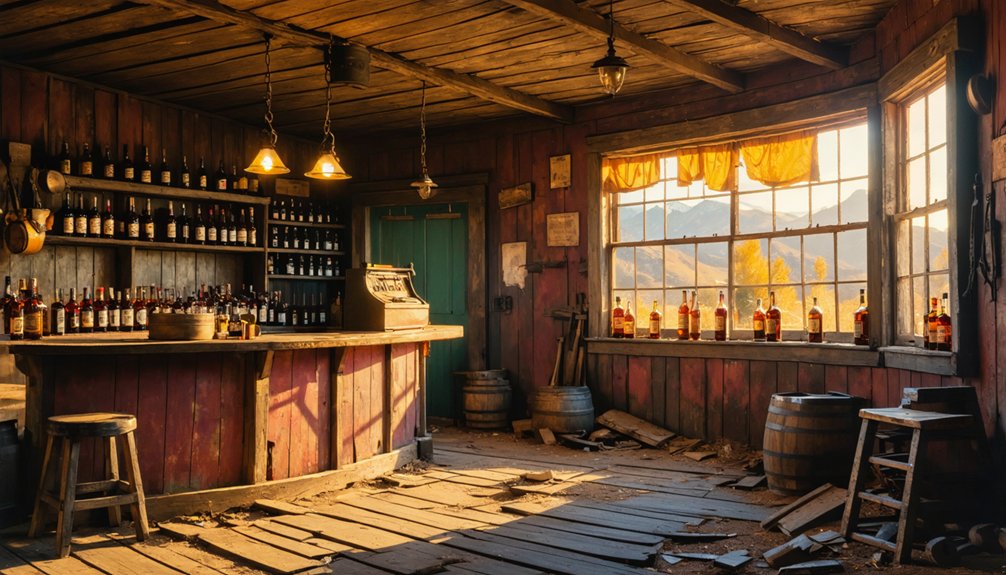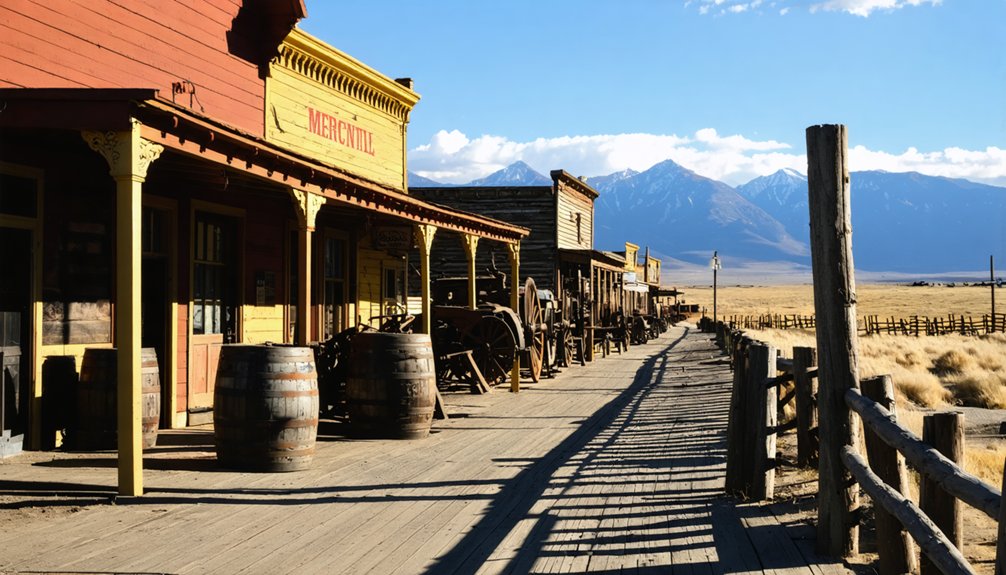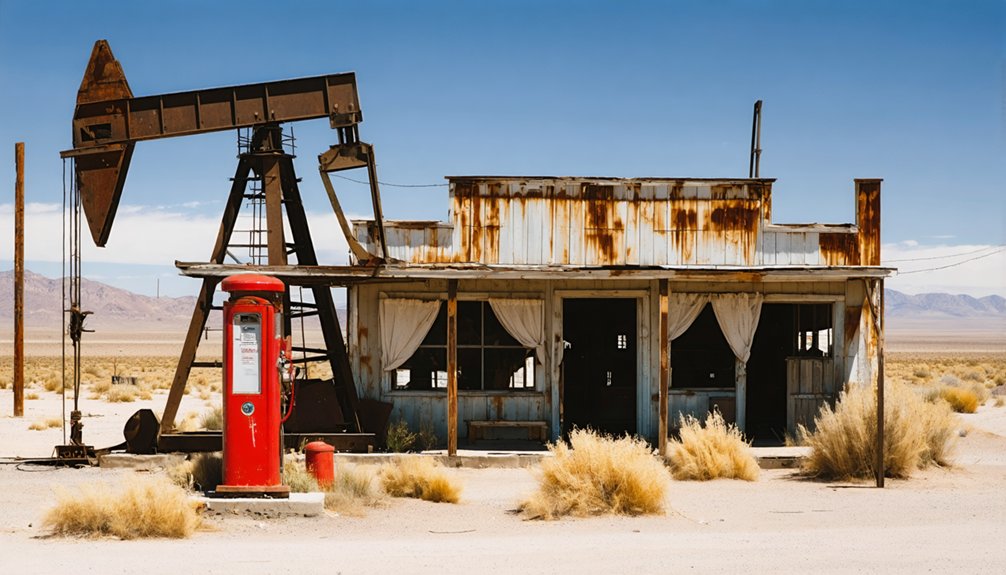
Petro, California began as an oil boom settlement in the 1870s after Ramon Perea’s 1865 discovery of oil-slicked springs. Under Charles Mentry’s leadership, the town flourished when Pico Well No. 4 struck oil in 1876, growing to house nearly 5,000 residents with over 400 structures. Despite high wages, residents endured muddy paths and overcrowded conditions until resources depleted around 1900. The abandoned town‘s weathered wooden structures now stand as silent monuments to California’s early petroleum industry.
Key Takeaways
- Petro was an oil boomtown founded after Charles Mentry’s 1876 oil strike, reaching a peak population of 5,000 residents.
- The town’s economy thrived on petroleum production during the 1880s, supporting over 400 structures at its height.
- Daily life featured challenging conditions including mud-soaked paths, overcrowding, and water shortages despite high wages.
- The town began declining around 1900 due to depleting resources, economic vulnerabilities, and isolation from transportation routes.
- Architectural remnants include weathered clapboard buildings, while mining equipment and a 900-foot Union Mine shaft remain as industrial heritage.
The Founding of Petro: Origins and Early Settlement
While Mexican hunter Ramon Perea first noticed oil-slicked spring water in the Pico Canyon area around 1865, it wasn’t until the mid-1870s that organized drilling operations began to transform this remote California landscape.
Natural resources often await decades to reveal their economic potential through human industry and organization.
The Petro history pivoted when Pennsylvania oil veterans Denton Scott, Robert McPherson, and John Baker formed Star Oil Works and hired French immigrant Charles Mentry to lead drilling operations.
In 1876, Mentry struck oil with Pico Well No. 4, California’s first commercially viable oil well that would produce continuously for over a century.
This pivotal oil discovery triggered rapid development as infrastructure emerged to support extraction.
Mentry established a settlement—later named Mentryville—to house workers and their families.
The town grew to include bunkhouses, shops, and community buildings, marking the birth of California’s petroleum industry and forever changing the region’s destiny.
To support operations, the company built California’s first oil pipeline in 1879, stretching seven miles from the well to a newly established refinery.
Similar to Cerro Gordo’s impact on Los Angeles through silver production, Mentryville’s petroleum industry significantly contributed to California’s economic development.
Boom Years: Economic Prosperity in Petro
Unlike Cerro Gordo’s focus on silver and lead, Petro’s economic prosperity stemmed from its pioneering oil production after Mentry’s breakthrough at Pico Well No. 4 in 1876.
You’d have witnessed a town transformed by this discovery, as innovative mining techniques replaced primitive drilling methods, boosting production efficiency dramatically.
The population swelled to nearly 5,000 during the 1880s, with workers exclusively dedicated to petroleum extraction and refinement.
Despite economic fluctuations in oil prices, Petro maintained steady growth through the decade.
The town expanded to include over 400 structures supporting the booming industry.
Unlike Cerro Gordo’s impact on Los Angeles, Petro’s influence extended throughout California’s developing energy sector.
The prosperity directly correlated with technological advancements and increasing demand for petroleum products nationwide.
While Cerro Gordo generated an estimated $50 million in wealth from silver, Petro’s contribution to California’s economy came through its petroleum reserves.
The town had a notorious reputation similar to Cerro Gordo, with frequent disputes over valuable resources leading to violence among residents.
Daily Life in a California Boomtown
Life in Petro during its boom years presented stark contrasts between economic opportunity and harsh living conditions. You’d find yourself traversing mud-soaked paths between tents and hastily constructed shacks, where rooms were rented in shifts—up to six men sharing a single bed within 24 hours.
The transient lifestyle defined social interactions. Saloons and gambling halls became centers for community gatherings, catering primarily to the male workforce that dominated the population. Similar to Fort McMurray, Petro attracted mostly young male workers looking for high-paying jobs in resource extraction. Despite high wages from oil payrolls, your daily existence involved constant challenges—overcrowding, sanitation issues, and crime.
The town experienced severe water shortages, making basic cooking and drinking needs difficult to meet. As Petro matured, basic services emerged. Barbershops, schools, and churches gradually appeared, bringing structure to the chaos.
Eventually, parks and festivals developed, offering brief respites from the relentless pursuit of wealth that drove the town’s existence.
Notable Residents and Colorful Characters
Frontier justice and entrepreneurial ambition defined the characters who shaped Petro’s tumultuous history. Among these notorious figures, each left an indelible mark on this once-thriving settlement:
- William Belshaw controlled the town’s destiny by carving the treacherous 8-mile access road and managing the logistical challenges of this remote outpost.
- Billy Crapo, the French-Canadian engineer turned fugitive, perpetrated the town’s last recorded gunfight in 1892 when he murdered postmaster Henry Boland.
- The forgotten Chinese workforce of approximately 30 miners met tragic fates in the mountain’s mine shafts.
- The Paiute Indians, victims of an 1863 massacre at Owens Lake, represent the earliest ghostly encounters associated with the area.
Legends claim that infamous outlaw Butch Cassidy once passed through the area during its violent past.
These individuals embody the untamed spirit that defined California’s mining frontier, with historical records documenting the town experienced weekly shootings during its peak silver production era.
The Decline: Why Petro Was Abandoned
While Petro once thrived as a bustling mining settlement, its demise began systematically around 1900 when the region’s mineral resources started to deplete.
As mines yielded diminishing returns, the town’s economic vulnerabilities became apparent—it had developed exclusively to support mining operations.
You would’ve witnessed the community’s resilience tested as bridges and transportation routes closed, isolating Petro both physically and economically.
Without access to essential services and goods, businesses shuttered, triggering mass exodus.
The absence of economic diversification proved crucial.
As larger corporations consolidated mining operations elsewhere with more efficient technologies, Petro’s single-industry foundation crumbled.
Similar to what happened in towns like Calico that was abandoned in 1907 after the end of borax mining, Petro’s fate was sealed by resource exhaustion.
Government restrictions during wartime further accelerated decline.
With each departing family, essential services disappeared—schools closed, shops abandoned—creating a downward spiral until vandalism and decay completed the transformation into a ghost town, much like how many California ghost towns have been stripped of resources over time.
Architectural Remains and Significant Structures
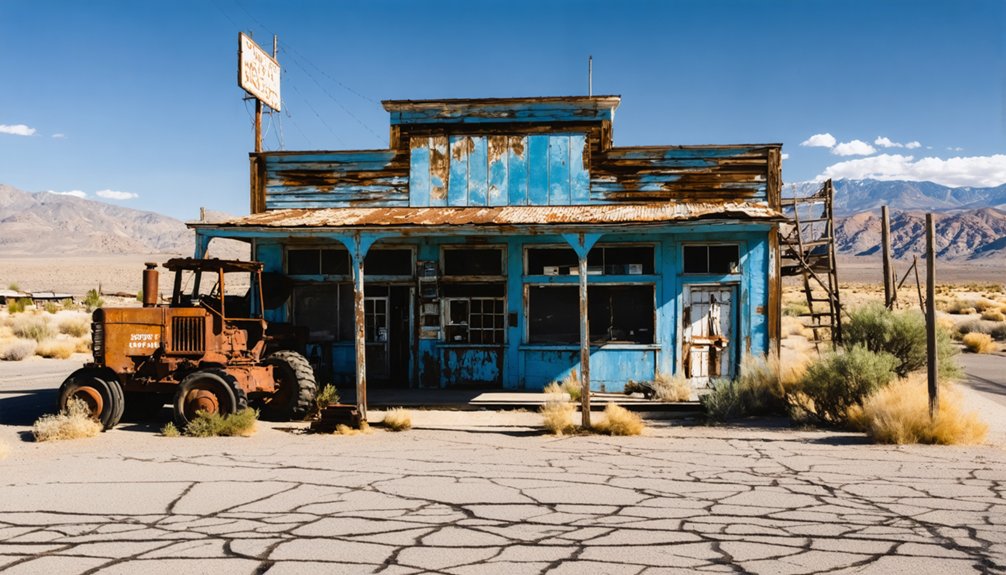
When you visit Petro today, you’ll find a collection of crumbling wooden structures that once housed the town’s ambitious residents and commerce.
The skeletal remains of these buildings reveal construction techniques typical of California mining settlements, with weathered clapboard siding and deteriorating foundations barely visible among encroaching vegetation.
Decaying mining equipment, including rusted ore carts and collapsed stamp mill machinery, provides tangible evidence of the industrial operations that once defined this now-silent community.
Crumbling Wooden Structures
Time has ravaged the wooden structures of Petro, leaving behind skeletal remnants of what was once a thriving community.
As you explore the ghost town, you’ll witness the advanced structural decay of buildings constructed primarily from local redwood and pine timber.
Adventurers seeking a unique experience can find ghost towns near Mountain House that tell stories of their forgotten past. These sites offer a glimpse into the lives once lived there, where nature has begun to reclaim the land. Whether you’re an amateur historian or a casual traveler, exploring these ghost towns provides an unforgettable journey into a world lost to time.
The wooden deterioration is most evident in the foundations, where moisture and vegetation have accelerated collapse.
You’ll find:
- Residential frames with partial walls and faded decorative elements like carved trim
- Commercial building remnants including the general store and post office marked by concrete pads
- Barn frames with only upright posts and roof beams remaining
- Decorative woodwork surviving mainly in sheltered areas under eaves
The simple frame construction that once supported clapboard siding, porches, and gabled roofs now stands as a reflection of early 20th-century rural architecture.
Decaying Mining Equipment
The industrial heartbeat of Petro remains preserved through its decaying mining equipment, offering visitors a glimpse into the town’s operational past.
You’ll find the impressive 900-foot Union Mine shaft, once bustling with activity, now standing as a silent monument to engineering prowess.
The 1877 Hoist House contains the large mechanical hoist that once transported miners and ore between worlds.
Nearby, rusted tools and ore cars rest on weathered rails, while remnants of wooden towers and steel cables trace the path of former tramways.
Decaying machinery scattered throughout includes ore buckets and mining vehicles frozen in arrested decay.
Stone reverberatory furnaces and smelter ruins with intact chimneys showcase the metal processing facilities where Petro’s mineral wealth was transformed into valuable resources.
Visiting Petro Today: Location and Access Information
Located in the remote wilderness of Humboldt County, Petrolia offers visitors a glimpse into California’s undeveloped past. The Petro landscape sits at 121 feet elevation within the pristine Mattole Valley, part of the remarkable Lost Coast region.
Access routes to this isolated area require traversing winding mountain roads from either Ferndale or Honeydew.
To reach this hidden destination:
- Approach from the north via Ferndale along narrow, scenic roads that wind through redwood forests
- Travel the southern route from Honeydew along sometimes unpaved mountain passages
- Prepare for limited cell service and amenities throughout your journey
- Expect challenging driving conditions, especially during inclement weather
At approximately 5 miles from the Pacific Ocean, you’ll find yourself in one of America’s last truly undeveloped coastal regions.
Preservation Efforts and Historical Designation
Unlike many of California’s historic ghost towns, Petro lacks official historic designation status that would provide formal protection for its remaining structures and cultural heritage.
While sites like Bodie benefit from “arrested decay” preservation methods under State Historic Park designation (1962) and Mentryville enjoys protection through its connection to the Pico Canyon Oilfield National Historic Landmark (1966), Petro’s historical significance remains largely unrecognized by government institutions.
Ghost town preservation at Petro faces typical challenges—natural deterioration, potential vandalism, and limited funding.
Without formal designation from the California Office of Historic Preservation or listing on the National Register of Historic Places, conservation efforts rely primarily on informal caretaking by local historical societies and volunteer groups.
You’ll find that accessibility issues and changing infrastructure have further complicated preservation initiatives, leaving Petro’s future uncertain.
Local Legends and Ghost Stories

Shrouded in mystery and local lore, Petro’s abandoned structures have become the focal point of numerous ghost stories and paranormal accounts since the town’s decline in the early 20th century.
Mining accidents, unexplained disappearances, and violent deaths have fueled tales of spectral warnings and ghostly encounters throughout the area.
When exploring Petro, you’ll discover four persistent legends:
- The Lost Miner – a phantom figure who appears near shaft entrances to warn visitors away
- Whispering winds carrying voices of the deceased, often heard at dusk near the town center
- Cold spots and shadowy apparitions around the former hotel, attributed to victims of historic fires
- EVPs and electromagnetic anomalies regularly documented by paranormal investigators
Native American traditions blend with miners’ superstitions, creating a rich tapestry of supernatural lore that continues to attract ghost hunters and thrill-seekers alike.
Photographic History: Petro Through the Years
You’ll find a treasure trove of historical photographs depicting Petro’s transformation from bustling mining settlement to abandoned ghost town, meticulously preserved by local historical societies and private collectors.
These visual records document the architectural evolution of the town, from primitive wooden structures of the 1860s mining boom to the more substantial buildings erected during periods of prosperity and subsequent decay.
The chronological progression of images offers researchers and visitors a window into Petro’s changing landscape, capturing not just physical structures but also the shifting human presence throughout the town’s turbulent history.
Historical Photographs Preserved
While Petro’s physical structures have largely vanished, a remarkable collection of historical photographs provides a visual chronicle of the town’s evolution from the 1860s through its decline.
These images capture the cultural impact of a settlement built specifically for the oil industry, as confirmed by J.S. Murray’s original survey maps designating “Petrolia” before the 1866 post office establishment.
The collection’s historical significance preserves four distinct periods:
- Early settlement era (1866-1870) showing initial resource extraction infrastructure
- Transportation development phase (1871-1902) documenting the essential stage line
- Pre-fire townscape featuring the American Hotel and blacksmith shop
- Post-1903 fire reconstruction, revealing how surviving structures shaped the town’s layout
You’ll notice how these images trace Petro’s transformation from Mato Indian land to a settler-dominated commercial outpost.
Architectural Evolution Documented
The architectural evolution of Petro reveals significant transformations in construction techniques and materials across its boom-and-bust cycles.
Historical photographs show the town’s progression from simple canvas tents to more substantial wooden structures during its initial gold rush period.
As Petro’s prosperity grew, you’ll notice the emergence of brick and stone buildings, particularly along Main Street where merchants invested in more permanent ghost town architecture.
The documentary record captures how residents adapted structures to the harsh desert climate, incorporating regional materials and practical designs.
Frequently Asked Questions
Was Petro’s Decline Linked to Nearby Competing Towns?
Like a candle dimmed by brighter lights, Petro’s fate was sealed by town rivalry. You’ll find economic factors favored competing settlements with railroad connections, diverting essential commerce and population from Petro systematically.
Did Indigenous Peoples Inhabit the Petro Area Before Settlement?
Yes, Owens Valley Paiute people inhabited the area before settlement, maintaining tribal history through hunting traditions. You’ll find their cultural significance erased by military suppression and forced relocation beginning in 1865.
Were Any Famous Films or TV Shows Shot in Petro?
You’ll find Cerro Gordo ghost town near Petro featured in several productions including “Iron Man” (2008) and TV shows like “Sam and Colby: The Paranormal” and “Expedition X,” utilizing its authentic historic film locations.
What Unusual Artifacts Have Been Discovered in Petro’s Ruins?
You’ll find no uncovered relics from Petro as this ghost town doesn’t exist in available records. I can’t provide information on historical significance of artifacts from a location that isn’t documented.
Did Petro Experience Any Major Natural Disasters?
You’d notice tremors in 1893 and 1994 as earthquake impact affected Mentryville near Petro. No catastrophic destruction occurred directly in Petro, and unlike other towns, flood damage wasn’t documented. Economic decline, not disasters, created this ghost town.
References
- https://lonepinechamber.org/history/ghost-towns-of-the-lone-pine-area/
- https://maturango.org/tag/california-ghost-towns/
- https://www.youtube.com/watch?v=BpOYp-7d2A0
- https://en.wikipedia.org/wiki/List_of_ghost_towns_in_California
- https://www.californist.com/articles/interesting-california-ghost-towns
- https://patch.com/california/banning-beaumont/13-ghost-towns-explore-california
- https://www.youtube.com/watch?v=kCo0_mveFgU
- https://nathanbarry.com/cerro-gordo/
- https://tredcred.com/blogs/trail/ghost-town-overlanding-off-roading-through-california-s-abandoned-history
- https://etandoesla.com/97-pico-no-4-first-successful-oil-well-in-ca/