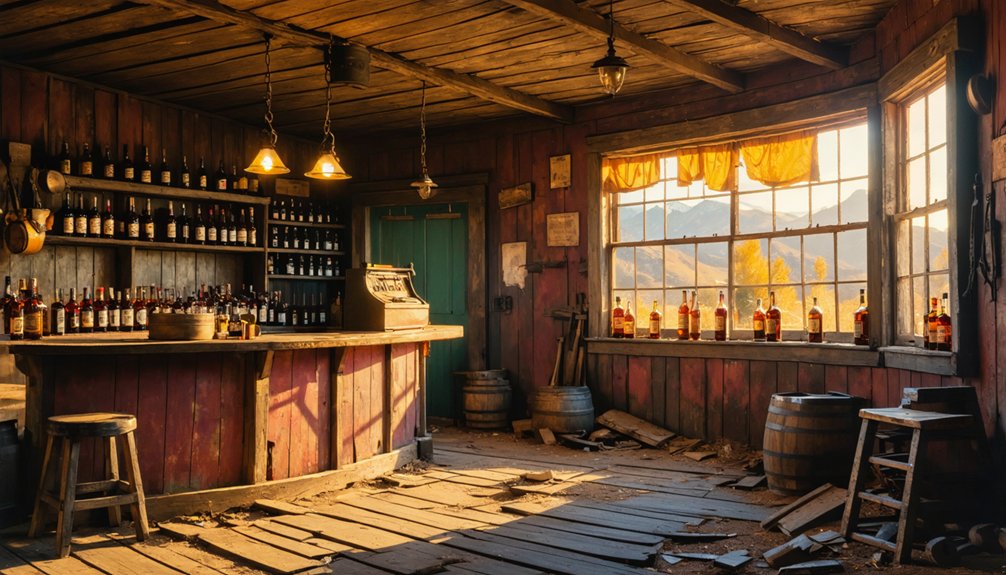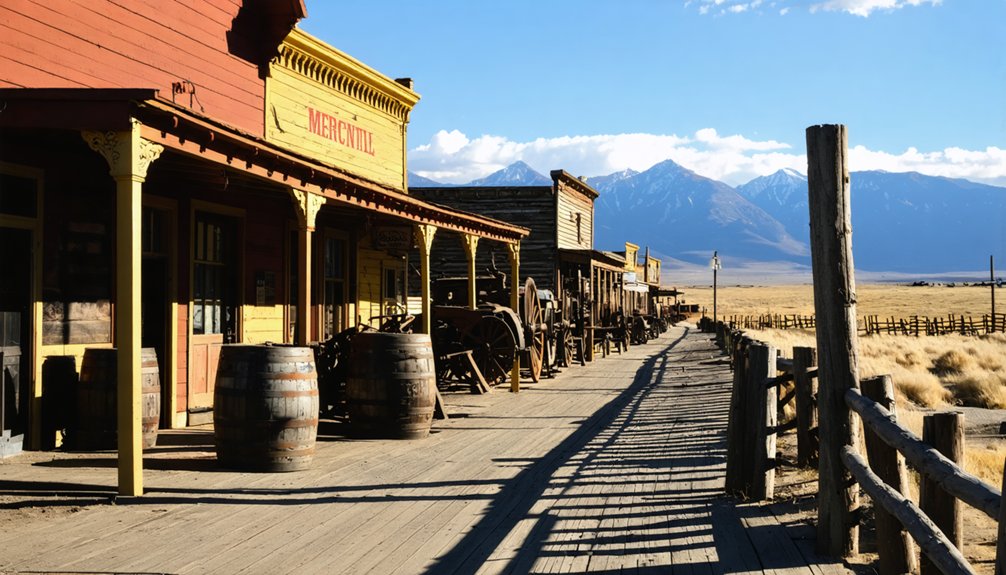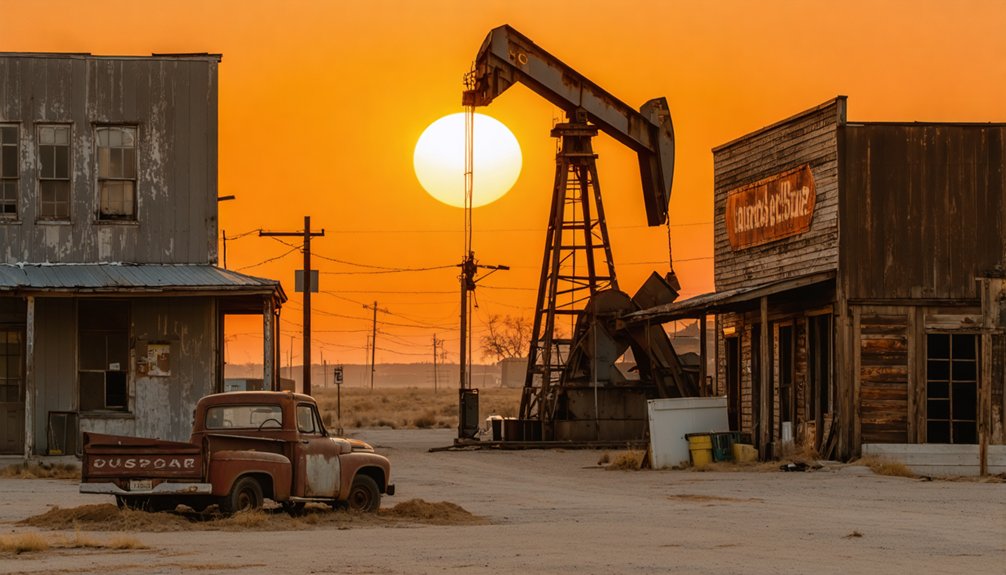
Petroleopolis emerged after California’s 1910 oil discovery, quickly developing into a company-controlled settlement with distinctive housing and scrip currency. Workers endured harsh conditions at wells reaching 560 feet deep, producing up to 500 barrels daily. As petroleum yields diminished, residents departed in phases, leaving behind adobe structures and rusty equipment. Today, over 2,400 unplugged wells leak toxic compounds throughout California, offering silent testimony to the environmental cost of resource-dependent communities.
Key Takeaways
- Petroleopolis was an oil boom town in southern California that flourished after petroleum discovery in 1910 before declining as resources depleted.
- The town featured company-controlled housing, scrip-based payment systems, and infrastructure supporting 30 wells producing 500 barrels daily.
- Abandoned structures reflect distinct phases of community exodus as petroleum yields diminished, with workers leaving first followed by service businesses.
- Notable figures like Edward L. Doheny shaped the town’s development, while local folklore includes stories of Charles Mentry as a spectral guardian.
- Environmental impacts persist with contaminated soil, skeletal extraction equipment, and preserved adobe structures now accessible only with careful preparation.
The Birth of an Oil Boom Town (1910-1920)
When oil was first discovered in the remote hills of southern California in 1910, few could have predicted the explosive development that would follow.
Within months, drilling rigs dotted the landscape as investors rushed to capitalize on Petroleopolis’s rich reserves. You’d have witnessed the hasty construction of roads and pipelines connecting this newfound wealth to hungry markets beyond. The town’s rapid development mirrored earlier successes like those of the Pico Canyon Oilfield which had become California’s first commercially successful oil field in 1876.
The oil discovery triggered unprecedented community migration, transforming a barren outpost into a bustling settlement of thousands within five years. Workers from across America flocked to the region, establishing tent cities that eventually gave way to more permanent structures. The population growth mirrored the wider trend seen in Los Angeles, which tripled by 1910 as the oil industry expanded throughout Southern California.
Daily Life in a Company-Controlled Community
Once the oil industry established its foothold in Petroleopolis, the company quickly assumed control over nearly every aspect of residents’ lives.
You’d live in company-owned housing with a uniform architectural style, creating visual community cohesion while reinforcing corporate identity. Your paycheck would come with strings attached—company scrip forcing you to shop at inflated company stores. Similar to Copperopolis residents who experienced economic fluctuations due to ore price changes, your financial stability depended entirely on industry conditions.
Your workdays stretched long under minimal safety regulations, surrounded by the ever-present hazards of oil extraction. During precious off-hours, you’d participate in company-sponsored recreation designed to foster loyalty. Many residents would gather in saloon bars that served as important social centers, similar to the gold rush era establishments.
Even your children’s education aligned with corporate values.
The company’s pervasive influence created a suffocating paradox—the security of provided services against the restriction of personal freedom.
This paternalistic relationship meant your economic mobility, housing security, and even social standing depended entirely on remaining in the company’s good graces.
Oil Production Infrastructure and Operations
Deep beneath the surface of Petroleopolis, a complex network of oil extraction technology fueled the town’s existence and economic purpose. You’d find wells reaching depths of 370 to 560 feet, with production increasing dramatically as drilling extended deeper—Well No. 4 jumped from 25 to 150 barrels daily after deepening.
The town’s infrastructure included California’s first oil pipeline, built in 1877, connecting the Pico Canyon oilfield to Newhall’s Pioneer Refinery. This pipeline technology revolutionized distribution, eventually extending 50 miles to Ventura port facilities. The operations were pioneered by Charles A. Mentry, who drilled California’s first commercial oil well in 1876 using improvised tools. Early drilling utilized cable tool technology which repeatedly dropped heavy chisels to pulverize rock formations below.
At its peak, the operation achieved 500 barrels daily across 30 wells.
Workers endured brutal conditions, with shifts limited to 20 minutes due to extreme temperatures and gas fumes. The nearby Pioneer Refinery processed this crude into kerosene and lubricants, establishing new standards for western markets.
Notable Characters and Families of Petroleopolis
Petroleopolis’ social tapestry was woven by distinctive families and individuals who shaped the town’s character beyond its industrial facade.
You’ll discover how the Oil Baron’s Dynasty established economic control while Workers’ Family Legacies created the backbone of community resilience amid harsh conditions. Charles Alexander Metri, for whom the town was named, served as the superintendent foreman overseeing early operations. Similar to many California settlements, Petroleopolis experienced a rapid decline when its primary resources were completely depleted.
The town’s Local Folklore Heroes, emerging from both fact and fiction, continue to animate the ghost town’s narrative even after its physical structures have crumbled.
The Oil Baron’s Dynasty
At the center of Petroleopolis’s storied history stands Edward L. Doheny, the visionary who ignited Southern California’s oil boom with his landmark 1892 well.
You’ll find his influence extending far beyond city limits—his Mexican Petroleum Company controlled 85% of Mexico’s oil by 1902, establishing a dynasty that shaped two nations’ industrial destinies.
The Doheny legacy was both magnificent and tragic. His son Ned’s opulent Greystone Mansion symbolized the family’s extraordinary wealth before his mysterious 1929 shooting death.
Edward’s partnerships with Charles Canfield and political connections with Albert Fall proved instrumental in building his empire, though the latter relationship embroiled him in the infamous Teapot Dome scandal. Born to Irish immigrants in Wisconsin, Doheny embodied the American Dream, rising from humble beginnings as a mule driver to become one of the nation’s wealthiest oil barons. His innovative drilling system utilizing eucalyptus tree trunks revolutionized the extraction process in the early days of oil exploration.
When Doheny died in 1935, his $85 million estate (equivalent to $1.4 billion today) cemented his status as one of oil’s greatest pioneers.
Workers’ Family Legacies
Beyond the opulence of oil barons like Doheny, the true character of Petroleopolis emerged through its working-class families who formed the backbone of this once-thriving industrial community.
Historical records about these families remain limited in conventional archives. You’ll find their legacy stories inscribed not in official documents, but in the archaeological remains of modest worker cottages that once lined the western ridge.
Family traditions persisted despite harsh conditions—many households maintained small garden plots where children learned cultivation skills passed through generations.
The Rodriguez and Sullivan families, representing Mexican and Irish immigrant populations respectively, established multigenerational employment patterns at the refineries.
Their descendants occasionally return for informal gatherings at the old town site, sharing oral histories that scholars have only recently begun documenting—preserving narratives of resilience that counterbalance the dominant focus on industrial magnates.
Local Folklore Heroes
While conventional histories of California ghost towns often focus on economic factors and industrial developments, the folklore of Petroleopolis reveals a more nuanced tapestry of characters whose legacies transcend mere historical documentation.
Among these tales are the ghost stories of Phillip’s Flat, where whispers of lost miners and spectral residents paint a vivid picture of the town’s storied past. Each encounter hints at the vibrant lives once lived there, drawing visitors into a deeper understanding of the community’s cultural heritage. As night falls, the air thickens with the weight of these histories, beckoning the brave to explore the remnants of forgotten dreams.
You’ll encounter Charles Mentry both as historical founder and spectral guardian—his ghost reportedly guided descendants during the 1994 earthquake.
Hughes, directed to oil by spiritual mediums, became a local legend when he died with tools stuck in his well.
The red barn and Mentry mansion host ghostly encounters that attract paranormal enthusiasts.
These stories, supervised by rangers during tours, intertwine with preservation efforts by Mentry descendants and Standard Oil families who maintained the town’s historical significance.
Unseen “helpers” in the refinery—manifesting through mysterious footsteps and handprints—complete the supernatural dimension of Petroleopolis’s industrial legacy.
The Slow Decline: When the Wells Ran Dry
When examining Petroleopolis’s collapse, you’ll observe distinctive patterns of community exodus that occurred in phases rather than a sudden mass departure.
You can identify these migration waves through abandoned structures dating from different periods, reflecting the gradually diminishing petroleum yields that initially sustained the town.
The environmental legacy remains visible today, with oil-contaminated soil and the skeletal infrastructure of extraction equipment standing as stark reminders of the industry that both created and ultimately destroyed this once-thriving community.
Community Exodus Patterns
As the oil wells of Petroleopolis gradually ceased production in the early 20th century, the once-thriving settlement began its inexorable transformation into a ghost town.
You’d have noticed the migration trends followed a predictable pattern: workers and their families departed first as extraction jobs evaporated, followed by service businesses that could no longer sustain operations.
Despite brief moments of community resilience, where long-established families clung to hope for economic revival, the exodus accelerated after formal announcements of well closures.
Residents packed their belongings onto mules and wagons, typically relocating to emerging boomtowns or urban centers offering employment alternatives.
The last to leave were often second-generation inhabitants, their departure marking the final dissolution of social bonds that had once defined Petroleopolis—a microcosm of the boom-and-bust cycle characterizing California’s resource-dependent settlements.
Environmental Scars Remain
The human exodus from Petroleopolis left behind more than empty buildings and abandoned dreams—it created an environmental legacy that persists to this day.
You’ll find over 2,425 unplugged wells across California, with half concentrated in Los Angeles County, leaking toxic compounds into air and soil.
Walk through certain neighborhoods between Dodger Stadium and Koreatown, and you’re breathing petroleum vapors, sulfur compounds, and benzene.
The environmental contamination isn’t merely aesthetic—it’s poisoning communities. Residents report respiratory problems and chronic illnesses from long-term exposure, while explosive gases accumulate beneath structures.
The regulatory response has been anemic. Health risks multiply as developers build atop contaminated land, while bankrupt drilling companies evade cleanup responsibilities.
Groundwater contamination will persist for generations, an invisible monument to regulatory failure and corporate abandonment.
What Remains Today: A Photographic Tour
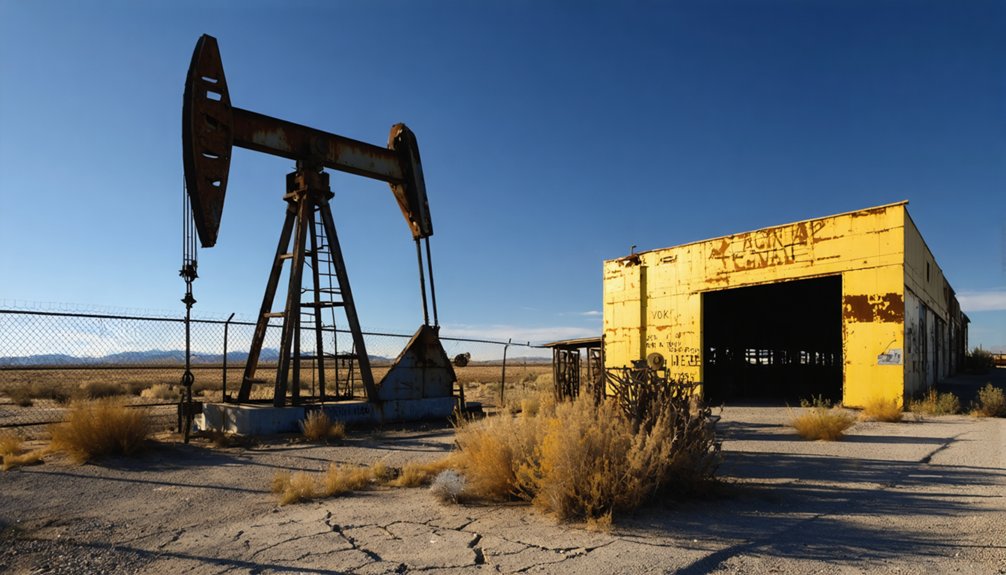
Standing amid the windswept remnants of Petroleopolis, visitors today encounter a hauntingly preserved tableau of California’s mining past.
You’ll find ghostly remnants of adobe and wooden structures, their facades peeling away like pages of history. Desert vegetation slowly reclaims these architectural skeletons while extreme temperature cycles continue their relentless deconstruction.
Time sculpts these forgotten walls into monuments of memory, each crumbling brick a chapter of California’s vanished dreams.
As you explore, timeworn artifacts emerge from the sand—rusty pocket watches, shattered whiskey bottles, and ceramic fragments tell silent stories of those who once called this place home.
Mining infrastructure reveals itself through oxidized equipment and dangerous shaft entrances dotting the hillsides. Foundation stones persist despite decades of abandonment, while archival photographs provide glimpses of what once was.
These physical remnants, compared with historical documentation, create a tangible connection to California’s industrial heritage.
How to Visit: Access and Safety Information
Visiting Petroleopolis requires careful preparation due to its remote location in the California desert.
Unfortunately, specific access information for this particular ghost town isn’t currently available in reliable sources, making advance research essential before planning your expedition.
When exploring any California ghost town like Petroleopolis, you’ll need a high-clearance vehicle, ample water supplies, and navigation tools beyond cell service.
Remember that desert temperatures fluctuate dramatically; plan morning visits during summer months to avoid dangerous heat. Always inform someone of your itinerary and expected return time.
Respect Petroleopolis history by leaving artifacts undisturbed—take only photographs.
Ghost town exploration enthusiasts should check local land management offices for current conditions and access restrictions, as these sites may reside on private property requiring permission or have seasonal closures due to safety concerns.
Petroleopolis in Context: California’s Forgotten Oil Towns
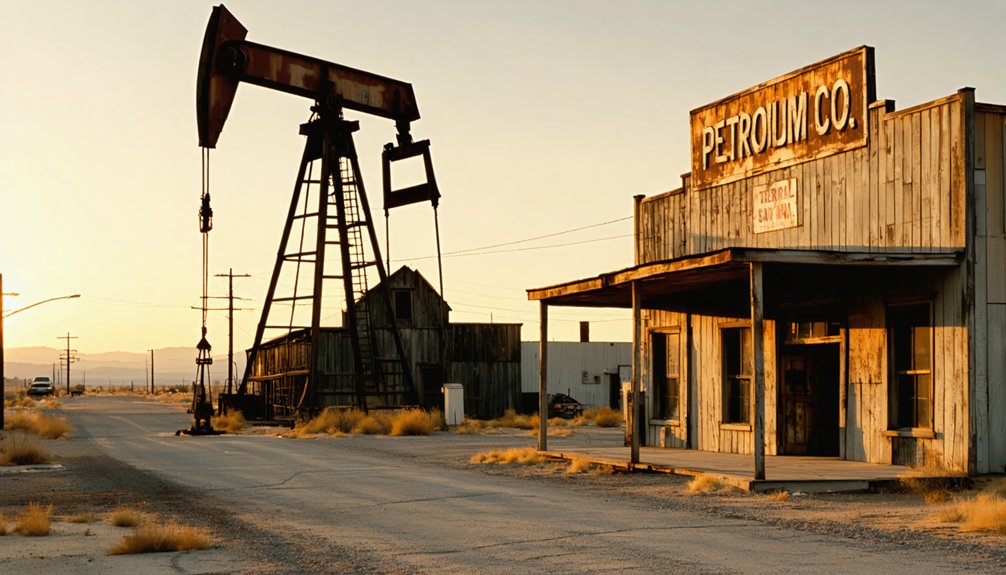
California’s earliest oil boom began not in the familiar fields of Bakersfield or Long Beach, but in the remote regions that gave birth to settlements like Petroleopolis.
Before fields at Bakersfield or Long Beach, California’s first oil boom birthed remote settlements like Petroleopolis.
While Petroleopolis operated only from 1867 to 1871, it represents just one of many forgotten towns that rose and fell with economic cycles of petroleum extraction.
You’ll find similar patterns in places like Mentryville near Pico Canyon, named for Charles Alexander Mentry, which flourished from the 1870s until production declined.
Petrolia in Humboldt County, site of California’s first drilled wells in 1865, experienced similar boom-bust dynamics.
These settlements shared common features: rapid growth during prosperous periods, rudimentary infrastructure including post offices and schools, and eventual abandonment when wells ran dry—leaving ghost towns as silent testimony to California’s pioneering oil industry.
Frequently Asked Questions
Did Any Major Fires or Industrial Accidents Occur in Petroleopolis?
Research doesn’t indicate major fires or industrial accidents in Petroleopolis. You’ll need to investigate local archives for specific industrial safety incidents or fire hazards that may have contributed to its abandonment.
Were There Any Indigenous Settlements Displaced by Petroleopolis’s Development?
Scattered arrowheads and weathered relics tell a forgotten story. You’ll find no verified records of indigenous settlement patterns displaced by development, though regional indigenous history suggests Chumash or Yokuts may have inhabited nearby lands.
What Environmental Impact Remains From the Oil Extraction Activities?
You’ll find persistent oil contamination in soil and groundwater, alongside extensive habitat destruction that eliminated native ecosystems. These legacies continue affecting wildlife corridors and watershed health decades after operations ceased.
Did Petroleopolis Play Any Role in California’s Labor Movement?
You’d think this tiny oil town sparked labor strikes and championed worker rights! Historical evidence reveals Petroleopolis had virtually no documented role in California’s broader labor movement or organizing efforts. No significant activism emerged there.
Are There Any Local Legends or Ghost Stories Associated With Petroleopolis?
You won’t find documented spectral sightings or haunted history associated with Petroleopolis. Unlike other California ghost towns, it lacks supernatural legends, focusing instead on industrial development rather than paranormal occurrences.
References
- https://www.youtube.com/watch?v=OD9M6MP6RRU
- https://wheregalswander.com/mentryville-oil-ghost-town-rich-in-history/
- https://www.ghosttowns.com/states/ca/copperopolis.html
- https://www.youtube.com/watch?v=bz6XtozCSMg
- https://dornsife.usc.edu/magazine/echoes-in-the-dust/
- https://www.californist.com/articles/interesting-california-ghost-towns
- https://www.visitcalifornia.com/road-trips/ghost-towns/
- https://en.wikipedia.org/wiki/List_of_ghost_towns_in_California
- https://noehill.com/calaveras/poi_copperopolis.asp
- https://www.shhs90755.org/early-oil-history/story-of-oil-in-ca