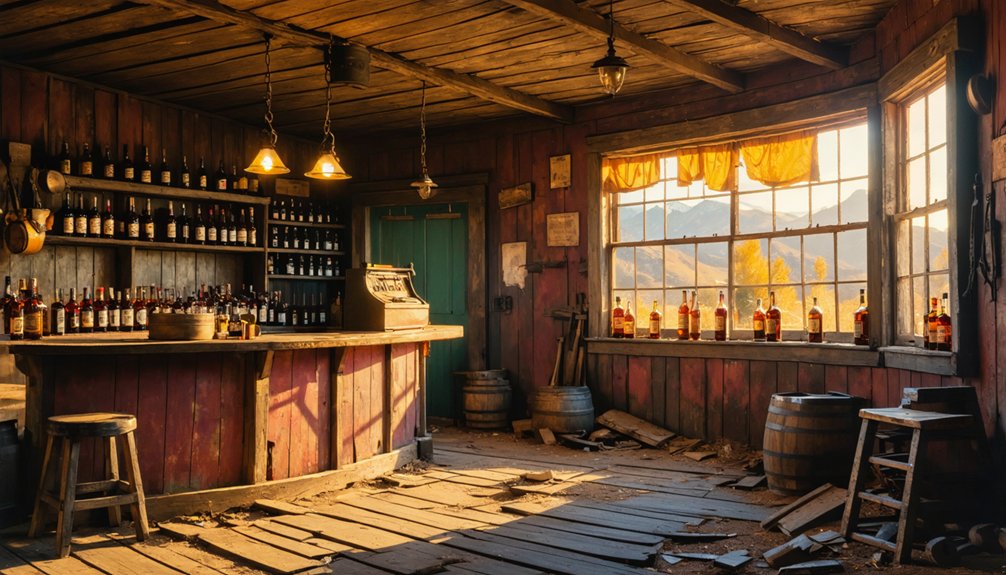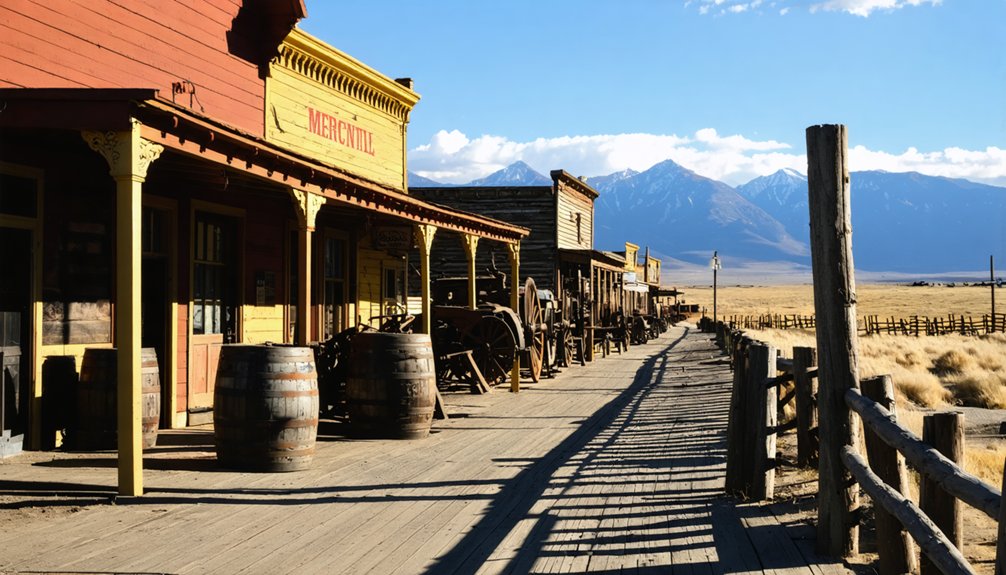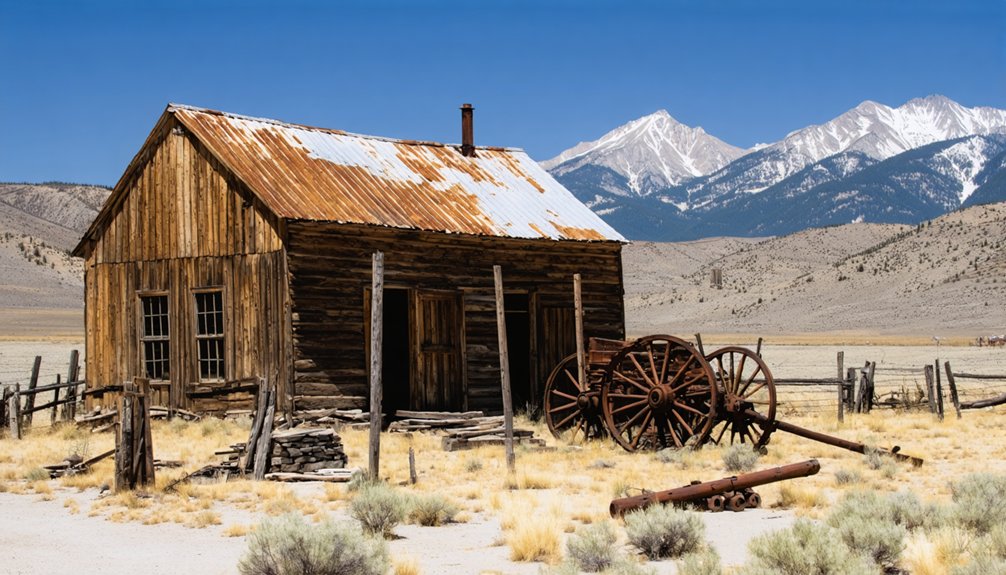
Phillip’s Flat (later Spadra) emerged as an essential stagecoach stop in the 1860s when Louis Phillips acquired the former Rancho San Jose lands. You’ll find this ghost town tucked in eastern Los Angeles County, where Phillips built his mansion and amassed wealth through farming and urban investments. The settlement declined after railroads bypassed it and Phillips sold key portions to Pomona investors in 1875. The remnants offer a glimpse into California’s changing frontier period.
Key Takeaways
- Phillip’s Flat was a crucial stagecoach stop in mid-19th century California before becoming a ghost town.
- Named after Louis Phillips who acquired Rancho San Jose in 1866 and became Los Angeles County’s wealthiest man.
- The settlement declined after being bypassed by railroad routes and losing residents to nearby Pomona.
- Following Phillips’ death in 1900, leadership deteriorated until the land was designated for Pacific Colony in 1919.
- Today, visitors can find scattered remnants including foundation stones, remnants of the mercantile store, and a small cemetery.
From Rancho San Jose to Spadra: The Birth of a Settlement
The expansive 22,000-acre Rancho San Jose emerged in 1837 when Governor Juan B. Alvarado awarded the land grant to Ricardo Vejar and Ygnacio Palomares. They divided the property, with Vejar controlling the southern 12,000-acre section known as San Jose de Abajo—encompassing present-day Glendora, San Dimas, La Verne, and Claremont.
This thriving cattle ranch became known for its “agreeable people fond of festivities” by 1846.
After devastating floods, drought, and economic collapse of the 1860s, Louis Phillips (born Galefsky) purchased Vejar’s foreclosed portion in 1866. As judge of the plains, Phillips managed the rancho from Vejar’s adobe house near Pedregosa Creek, selling parcels to encourage settlement.
When financial ruin struck in the 1860s, Phillips acquired Vejar’s lands and governed from the historic adobe, gradually parceling out the territory.
William W. Rubottom became a prominent local settler after Phillips sold him land, establishing what would become the community of Spadra.
The Southern Pacific Railroad‘s 1874 arrival along the Butterfield Stage route catalyzed the area’s transformation into the Pomona Tract.
Phillips later built a magnificent Second Empire style mansion in 1875, which became one of the area’s most distinctive landmarks.
The Rise and Fall of Louis Phillips’ Frontier Empire
After acquiring 12,000 acres of Rancho San Jose through foreclosure in 1864, Louis Phillips methodically built one of Southern California’s most formidable land empires.
His strategic land acquisition continued with purchases of Rancho San Antonio, amassing 20,000 acres by 1874. Phillips’s economic ventures diversified beyond cattle and sheep ranching into wool, honey, and grain production. His business acumen was evident in the way he managed these lands, especially after relocating to Spadra in 1862.
By the 1890s, he’d become Los Angeles County’s wealthiest man, worth $3 million. His investments expanded into urban development with downtown properties and the Phillips Block skyscraper.
His architectural legacy centered on the 1875 Phillips Mansion, now a historical landmark that served as both home and ranch headquarters. The mansion, built for over $20,000, showcased luxurious features including 16-foot ceilings and six elegant fireplaces.
The ranching decline began gradually as Phillips sold land for Pomona’s development following the railroad’s arrival in 1874, though he maintained a 2,241-acre core until his death in 1900.
Daily Life in a 19th Century Stagecoach Town
While railroad construction was still decades away from transforming the Western frontier, stagecoach lines became the lifeblood of isolated communities throughout California’s expanding territory in the mid-nineteenth century.
Phillip’s Flat thrived as a critical stopping point where stagecoach culture shaped residents’ daily routines. You’d witness the town’s rhythms dictated by arrival schedules – merchants preparing for passenger influxes, coaching inns readying meals and beds.
Skilled drivers commanded respect as they expertly handled six-horse teams, maneuvering treacherous terrain while protecting valuable cargo. Drivers like Charley Parkhurst earned reputations as expert whips, navigating dangerous routes with remarkable skill. Locals developed economies around these transit needs, with blacksmiths, hostlers, and innkeepers forming the backbone of community commerce.
Stagecoach drivers navigated California’s wild frontier with masterful precision, while local tradesmen built communities serving the essential transit lifeline.
The stagecoach stop transformed Phillip’s Flat from settlement to economic hub, with residents constantly vigilant against highwaymen who stalked nearby roads, hiding in brush waiting to ambush passing coaches. A one-way journey often cost passengers sixteen dollars for the complete Los Angeles to San Diego route in the 1870s.
Why Phillip’s Flat Became a Ghost Town
Paradoxically, the very stagecoach connections that brought Phillip’s Flat to life ultimately set the stage for its demise when transportation networks evolved beyond the town’s capabilities to adapt.
The economic decline began when railroad routes bypassed the settlement, eliminating its strategic advantage at the Butterfield Stage Route intersection.
You would’ve witnessed the rapid transformation after 1875 when Phillips sold 2,500 acres to investors who developed Pomona instead.
The emerging town drew settlers away with better infrastructure while Phillip’s Flat struggled with transportation shifts that devastated its commerce.
After Phillips died in 1900, leadership vanished and property management deteriorated.
The final blow came in 1919 when the state legislature designated the land for Pacific Colony mental hospital, effectively ending any chance for the civilian settlement’s revival.
Local residents once proudly referred to the growing Pomona as monkey town, revealing their disdain for what would eventually become their replacement.
The Phillips Mansion, built in 1875 with distinctive fired red bricks, stood as one of the last remaining landmarks of the once-thriving Spadra community.
Visiting the Haunting Remains of Spadra Today
Today’s visitors to the former Phillip’s Flat settlement, now known as Spadra, will find only scattered remnants of what once constituted a thriving stagecoach stop.
Ghost town exploration here requires careful observation, as time has reclaimed much of the site. You’ll need to navigate private property boundaries, as some historical landmarks remain on restricted land.
the haunted history of moore’s flat adds an eerie layer to your journey, with tales of its former residents echoing through the abandoned structures. Exploring the remnants of their lives can feel both thrilling and unsettling, as legends of ghostly encounters linger in the air. As you delve deeper, be prepared to uncover the stories that have shaped this forgotten corner of history.
The most notable surviving structures include the deteriorating foundation stones of the original hotel and fragments of the old mercantile store. Unlike George Air Force Base, these structures haven’t been preserved by desert climate conditions.
A small cemetery with weather-worn headstones dates back to the 1870s, offering glimpses into the lives of early settlers. The cemetery reveals the harsh realities of frontier life with its numerous graves of women and children who faced high mortality rates due to limited medical care.
For the best experience, visit during spring when vegetation is less dense and historical features are more visible.
Remember to document rather than disturb these fragile connections to California’s past.
Frequently Asked Questions
Are There Documented Paranormal Experiences at Phillips Mansion?
While Phillips Mansion has a haunted history, no officially documented paranormal experiences exist—only anecdotal reports of ghost sightings, unexplained noises, and shadowy figures that you’ll find in local folklore and visitor accounts.
What Happened to Louis Phillips’ Descendants After His Death?
After Louis’s death, you’ll find his widow Esther managed the estate until 1916. The Phillips legacy continued as their children operated the incorporated Phillips Estate, with family migration away from the mansion occurring by 1931.
Did Any Famous Historical Figures Visit Spadra During Its Heyday?
Like a forgotten whisper in history’s pages, you’ll find no famous visitors graced Spadra during its heyday. Historical significance remained local, with Louis Phillips overshadowing any national notables in this frontier settlement.
Were There Significant Conflicts Between Early Settlers and Native Americans?
Yes, you’d find significant settler conflicts throughout the region, with native resistance occurring as tribes defended their lands against mining encroachment and territorial expansion during the 1850s-1860s.
What Original Artifacts From Spadra Can Visitors See Today?
Proudly preserved original artifacts from Spadra you’ll discover include Phillips Mansion’s red bricks and gas fixtures, historical family antiques at Palomares Adobe, and gravesites of prominent settlers at Spadra Cemetery—all maintaining their historical significance.
References
- https://www.youtube.com/watch?v=sad1wCDdvBE
- https://www.avoidingregret.com/2012/11/the-forbidden-haunted-mansion-of-spadra.html
- https://www.californist.com/articles/interesting-california-ghost-towns
- https://www.youtube.com/watch?v=o6gnjvp5kzk
- https://en.wikipedia.org/wiki/Phillips_Mansion
- https://www.pomonahistorical.org/phillips-mansion
- https://en.wikipedia.org/wiki/List_of_ghost_towns_in_California
- https://www.youtube.com/watch?v=XrVKjfFpx4M
- https://www.youtube.com/watch?v=pWbzbZ-F72k
- https://homesteadmuseum.blog/2019/06/29/sharing-history-at-the-phillips-mansion-in-pomona/