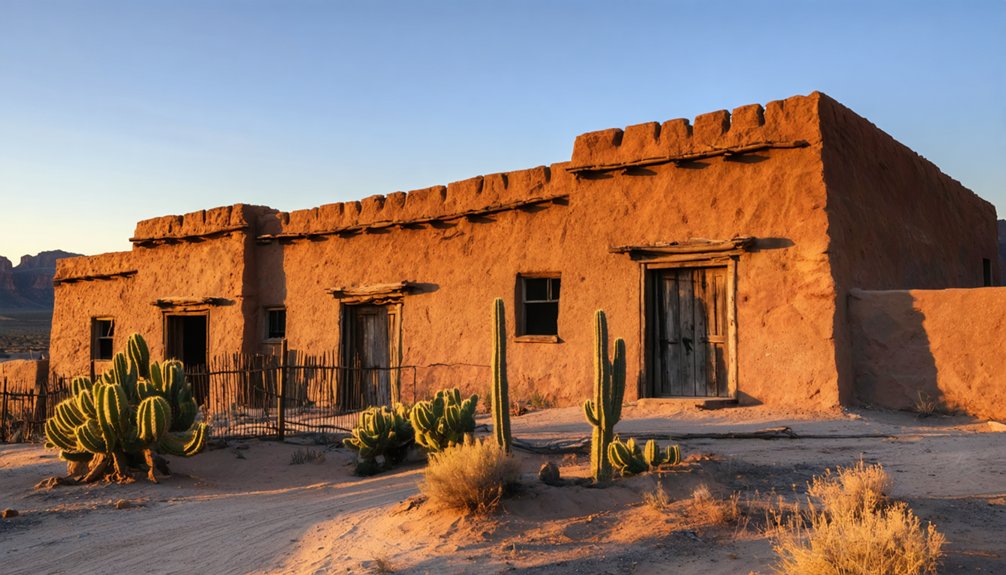
You’ll find Pipe Spring National Monument preserved as a frontier fortification rather than a true ghost town—it’s a remarkably intact 1870s Mormon cattle ranch headquarters where stone walls still enclose the desert spring that has sustained human life for over 12,000 years. Anson P. Winsor constructed the protective fort between 1870-1872 to safeguard water rights and manage tithing cattle operations in Arizona’s harsh landscape. Today, the Kaibab Paiute tribe operates the visitor center jointly with the National Park Service, revealing the complex layers of this contested oasis.
Key Takeaways
- Pipe Spring is not a ghost town but a preserved national monument featuring Winsor Castle Fort, built 1870-1872 over natural springs.
- The fort served as a Mormon tithing ranch headquarters managing cattle operations and protecting travelers on the Arizona frontier.
- Federal government acquired the property in 1923, transforming the working ranch into a national monument preserving frontier history.
- Kaibab Paiute tribe jointly operates the visitor center with National Park Service, sharing their ancestral connection to the springs.
- The site sustained human life for 12,000 years due to reliable water supply in Arizona’s harsh desert landscape.
A Desert Oasis With Ancient Roots
For more than 12,000 years, Pipe Spring has sustained human life in Arizona’s harsh desert landscape. This desert oasis emerges where underground water breaks through sandstone layers at four distinct points, creating seasonal water flow that attracted nomadic big game hunters who used it as a travel corridor.
By 300 BC, Ancestral Puebloans established settlements here, gathering grass seeds and cultivating crops for a millennium. The springs’ consistent water supply enabled remarkable wildlife diversity, with vegetation growing so thick that grass reached horses’ bellies when Mormons arrived in the 1850s.
Semi-nomadic hunters exploited this abundance, ambushing game drawn to the waterhole. The Kaibab Paiute recognized Pipe Spring’s sacred significance, cultivating beans, squash, and corn by the 1700s—a tradition their descendants maintain today.
Mormon Settlement and Winsor Castle Fort
When Jacob Hamblin led a Latter-day Saint expedition to the Hopi mesas in 1858, his party gave Pipe Spring its enduring name, marking the beginning of sustained Mormon interest in this strategic desert oasis. James Whitmore established the area’s first cattle operation in the 1860s, but a January 1866 Navajo raid claimed his life and Robert McIntyre’s, prompting Brigham Young to order fortification during his 1870 visit.
Construction challenges didn’t deter Anson P. Winsor from building a protective rock fort over the spring between 1870-1872, incorporating an existing 1868 guard house. After Brigham Young purchased the property in 1873, it functioned as a tithing ranch operations center, managing donated cattle while serving travelers crossing the isolated Arizona Strip and couples journeying along the Honeymoon Trail.
Conflicts and Displacement on the Arizona Strip
You’ll find that Mormon settlement around Pipe Spring intensified water competition with Paiutes, who’d relied on these springs for centuries before cattle ranching monopolized access.
The fort’s construction in 1870-72 physically secured water rights for church herds while effectively excluding native populations from their traditional resources.
These local tensions coincided with the broader Black Hawk War (1865-72), when Ute and Paiute bands conducted retaliatory raids across southern Utah and northern Arizona in response to displacement and resource appropriation.
Mormon-Paiute Water Disputes
The Kaibab band of Paiutes had relied on Pipe Spring’s life-sustaining waters for centuries, cultivating beans, squash, and corn in the surrounding lands where they hunted and gathered across the high desert. When Mormon ranchers arrived in the late 1850s, they systematically gained control over Arizona Strip water sources.
The disputes escalated through three critical developments:
- 1866: Whitmore’s killing was incorrectly blamed on Paiutes, though Navajos were responsible
- 1870: Brigham Young’s stone fortress physically blocked Paiute water access rights
- 1933: Federal authorities finally mandated equal water distribution
Cultural misunderstandings fueled violence while overgrazing decimated native food sources. Without federal assistance until 1907’s reservation formation, displaced Paiutes faced starvation as Mormon settlements expanded, transforming shared resources into contested territorial claims.
Black Hawk War Raids
Between 1865 and 1872, Black Hawk’s coalition transformed the Arizona Strip into a contested war zone where Mormon settlements faced systematic raids that ultimately forced frontier abandonment. You’ll find that tribal alliances between Utes, Paiutes, Navajos, and Apaches created devastating effectiveness across Utah territory.
The Pipe Spring raid exemplifies this pattern—Mormon retaliation killed four unarmed Paiutes uninvolved in earlier murders, driving more fighters to Black Hawk’s cause.
Livestock depredations reached staggering proportions: over 2,000 cattle and horses disappeared during initial strikes, funneled to markets in Santa Fe and Los Angeles. Settlements like Mount Carmel, Glendale, Panguitch, and Circleville couldn’t withstand the pressure.
From Working Ranch to National Monument
In the early 1870s, Brigham Young purchased the Pipe Spring land to establish a tithing ranch that would support the Mormon Church’s growing population in the region. Between 1871 and 1876, you’d have witnessed a sophisticated operation producing beef and dairy products for temple laborers in St. George, Utah.
The remote water infrastructure centered on Winsor Castle, a fortified sandstone headquarters built to protect against raids while securing the precious spring.
This model of cattle economies thrived until federal enforcement changed everything:
- The Edmunds-Tucker Act of 1887 stripped church property through legal penalties
- Private ownership followed, maintaining ranching operations into the 20th century
- Federal acquisition in 1923 transformed the working ranch into a national monument
Today, you’ll find 50,000 annual visitors exploring this preserved frontier outpost.
Kaibab Paiute Heritage and Partnership
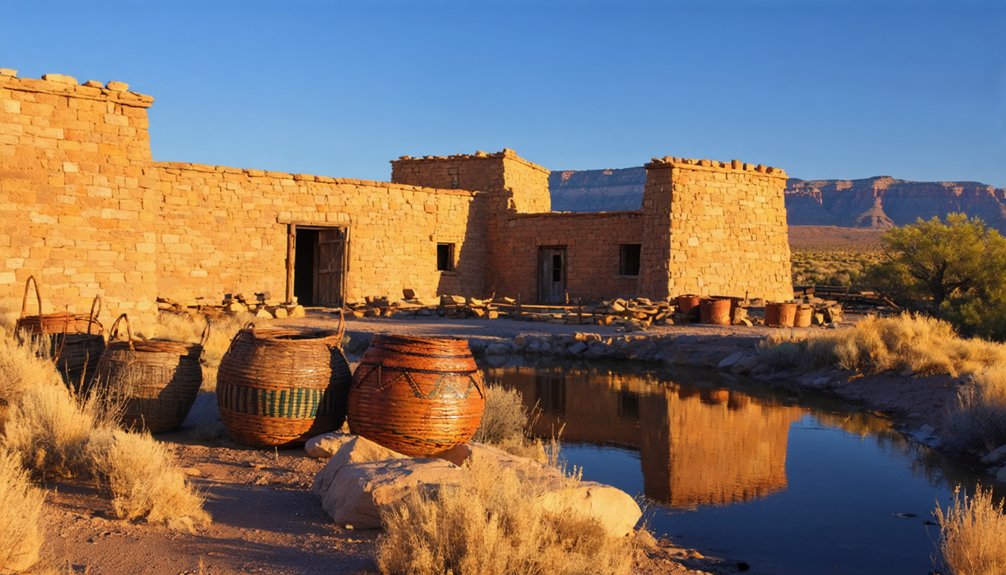
Long before Winsor Castle rose from the desert floor, the Kaibab Paiute sustained themselves through intimate knowledge of this arid landscape’s seasonal rhythms. As one of ten Southern Paiute bands spanning the southern Great Basin, they’ve protected these sacred cultural lands for generations. Thunder Mountain dominates their homeland’s horizon and anchors traditional folklore.
Today you’ll find the tribe operating Pipe Spring’s visitor center jointly with the National Park Service, bridging past and present. Their sovereignty earned recognition through the world’s first International Dark Sky designation—”Thunder Mountain Pootsee Nightsky”—honoring centuries of reverence for these pristine night skies.
Through the Kaibab Vermilion Cliffs Heritage Alliance, they’ve documented 370 archaeological sites, demonstrating their ongoing commitment to preserving ancestral resources across 121,000 reservation acres.
Exploring the Historic Site Today
When you visit Pipe Spring today, you’ll access Winsor Castle only through guided ranger tours departing every half hour, where period furnishings and defensive architecture illustrate Mormon frontier life circa the 1870s.
The visitor center provides essential context through exhibits documenting both Kaibab Paiute culture and settler history, complemented by living history demonstrations across the 40-acre grounds.
Beyond the fort, you can explore short hiking trails to historic cabins, observe ranch animals near the spring-fed ponds, and walk through reconstructed orchards and corrals that sustained this remote cattle operation.
Guided Tours and Exhibits
Ranger-led tours through Winsor Castle provide the only access inside the fortified stone ranch house, offering visitors detailed interpretations of late 19th-century Mormon settler life at this remote Arizona outpost. These guided experiences depart at half-hour intervals throughout the day, with seasonal programming running during both summer and winter months.
The visitor center enriches your understanding through extensive exhibits:
- Cultural Museum – Kaibab Paiute artifacts and stories alongside Ancestral Puebloan history
- Video Presentation – 23-25 minute documentary examining cultures and water management
- Cowboy Displays – Historical exhibits housed in East and West Cabins
These family-friendly experiences operate year-round (closed Thanksgiving, Christmas, New Year’s Day), with summer hours from 7am-5pm and 8am-5pm otherwise. Check the visitor center upon arrival for current tour schedules.
Living History Demonstrations
Throughout the day, rangers and volunteers bring 19th-century frontier life to vivid reality through hands-on demonstrations that explore both Kaibab Paiute and Mormon settler traditions. You’ll witness living history reenactments at Winsor Castle, where interpreters recreate 1870s cattle operations and fortified ranch life. Traditional craftsmanship demonstrations showcase Paiute basketry, clothing construction, and tool-making alongside pioneer gardening and livestock management techniques.
These programs run daily from 8:00 a.m. to 5:00 p.m. MST, with ranger-guided presentations every half hour at key sites. The museum—operated cooperatively with the Kaibab Band of Paiute Indians—provides context through exhibits highlighting both cultures’ ingenuity and land relationships. You’ll experience authentic portrayals of daily routines, from water-use practices to survival adaptations, all set against historic fort buildings and corrals where longhorn cattle graze.
Trails and Ranch Activities
Beyond the scheduled demonstrations, you’ll discover Pipe Spring’s landscape through self-guided exploration of trails and preserved ranch grounds. The half-mile Ridge Trail climbs 130 feet via switchbacks, offering panoramic views of the Arizona Strip from 5,000-foot elevations. Rangers reveal locations of significant finds:
- Faint petroglyphs along the route showcase Native American history and cultural significance
- Dinosaur track discoveries from Eubrontes species, preserved for 220 million years
- Historic outbuildings, including corrals housing oxen and horses, orchards, and spring-fed ponds
You’ll need water and sun protection for this exposed red-dirt path. The trail connects to ranch areas where preserved cabins, gardens, and corrals demonstrate 1870s Mormon pioneer life. Check with rangers for specific petroglyph and dinosaur track locations before hiking.
Life at a Remote Frontier Outpost
When James Whitmore claimed 160 acres at Pipe Spring in 1863, he established the first permanent Euro-American settlement at what had served as a life-sustaining oasis for 12,000 years. You’ll find his original dugout, corrals, orchard, and vineyard formed the foundation of ranch operations that produced butter and cheese sent to St. George as church tithe.
The 1870 construction of Winsor Castle transformed the outpost into a fortified headquarters with an enclosed courtyard, though its defensive design against Navajo raids was never tested. That same year, Arizona’s first Deseret Telegraph relay station connected this remote location to Salt Lake City.
Today’s demonstration gardens showcase cultural sustainability through parallel displays: half cultivated using pioneer methods, half employing Native practices for historical preservation.
Frequently Asked Questions
Is Pipe Spring National Monument Actually a Ghost Town?
No, you’ll find it’s an active national monument, not a ghost town. It showcases pre-settlement history through Kaibab Paiute heritage and Mormon settlement via preserved structures like Winsor Castle, with continuous operation since 1923.
What Are the Visitor Center Hours and Admission Fees?
The visitor center’s open daily 8:30 am to 4:30 pm Arizona Time. You’ll pay $10 admission if you’re 17 or older; kids enter free. Monument accessibility includes visitor center facilities and grounds, with America the Beautiful passes accepted.
Are Pets Allowed on the Trails and Grounds?
You’ll love exploring the paved grounds with your furry companion! Pet policies welcome leashed dogs on sidewalks and walkways, though leash requirements keep them off the Ridge Trail and out of historic buildings for preservation purposes.
Can Visitors Access the Spring Water Directly Today?
You can’t access the spring water directly due to preservation requirements and visitor guidelines protecting this cultural resource. However, you’ll find drinking water at visitor facilities that meets water quality standards for public consumption during your visit.
What Lodging and Dining Options Exist Near the Monument?
Your adventure base awaits nearby! Nearby hotels range from Zion Glamping Adventures to Fredonia’s motels fifteen miles east. You’ll find local dining establishments in Fredonia or Kanab, since the monument itself offers no on-site restaurants.