Smoky Hill City sits 12 miles southwest of Hays, Kansas, where con artists once sold gold-rush dreams on land that never yielded a single recoverable ounce. You’ll find shallow depressions, prairie grasses, and limestone formations where a townsite once buzzed with false promises. Pair the ghost town with nearby chalk bluffs, fossil beds, and frontier landmarks for a full day of forgotten history — and there’s far more to this story than meets the eye.
Key Takeaways
- Smoky Hill City sits 12 miles southwest of Hays, Kansas, on the Smoky Hill River’s north bank in Ellis County.
- The townsite was platted in 1899 following a gold rush boom built on fraudulent mining claims that lasted from 1895 to 1903.
- High-clearance vehicles are recommended for reaching the site, as road conditions can deteriorate significantly after rainfall.
- Nearby attractions include the Cathedral of the Plains, Threshing Machine Canyon, and fossil-rich Niobrara Chalk Bluffs.
- A full-day itinerary can include dawn photography, townsite exploration, fossil hunting, and sunset views at Threshing Machine Canyon.
Where Exactly Is Smoky Hill City, Kansas?
Where exactly do you go to find a town that time swallowed whole? Head to Ellis County, Kansas, and drive 12 miles southwest of Hays.
You’ll find Smoky Hill City‘s location details pinned to the north bank of the Smoky Hill River, deep in Kansas’s Smoky Hills region, close to the Trego County border.
The historical significance here runs deeper than the quiet landscape suggests. This wasn’t random settlement. Someone deliberately platted this townsite in 1899, drew people away from neighboring Chetolah, and built something real on a dream that wasn’t.
Someone platted this townsite in 1899, pulled people from Chetolah, and built something real on a dream that wasn’t.
The Smoky Hills stretch around you in sandstone and chalk, indifferent to ambition. You’re standing in a place where geography, geology, and human desperation collided — and geography won.
The Gold Rush Swindle That Built Smoky Hill City
The swindle that built Smoky Hill City didn’t begin in 1899 — it began decades earlier, when mid-19th century con men first whispered about tin mines hiding along the Smoky Hill River.
That historical deception evolved through the 1890s, when fresh swindlers convinced enthusiastic prospectors that local shale concealed zinc, then gold. Unscrupulous assayers promoted bogus extraction processes, and gold mining myths spread like prairie fire across Ellis County.
The boom ran from 1895 to 1903, pulling dreamers westward before Kansas geologist Erasmus Haworth publicly warned the region held nothing recoverable.
You can almost feel the desperation baked into those shale formations today — ordinary men betting everything on whispered promises. The gold was never there. It never had been.
How to Get to Smoky Hill City From Hays
From Hays, you’ll head southwest roughly 12 miles to reach the ghost town site of Smoky Hill City, tracing a route that shadows the old Smoky Hill River corridor through Ellis County’s wide-open terrain.
You’ll want to check road conditions before you go, since rural Kansas backroads near the Trego County border can turn unforgiving after rain, leaving unpaved stretches rutted and soft.
Keep your eye on the north bank of the Smoky Hill River once you’re close — that’s where Charles Holliday platted his ill-fated townsite back in 1899, and the land still carries the quiet weight of that forgotten ambition.
Route From Hays
Twelve miles southwest of Hays, the ghost town of Smoky Hill City waits along the north bank of the Smoky Hill River, and reaching it means following the same general corridor that prospectors, homesteaders, and soldiers once traveled during the trail’s heyday between 1859 and 1865.
From Hays, head southwest toward the Trego County border, tracking the Smoky Hill River’s path through open Kansas plains. This road trip rewards those who pay attention — the landscape shifts subtly, sandstone and limestone formations rising where shale once fooled desperate men into believing gold lay beneath their boots.
You’re not just driving toward one of Kansas’s forgotten ghost towns; you’re retracing a route that carried whole communities toward dreams that the earth simply refused to deliver.
Road Conditions Ahead
Getting to Smoky Hill City from Hays is straightforward, though the roads thin out quickly once you leave town. Head southwest on US-183, then cut toward the Smoky Hill River valley along rural county roads.
Paved surfaces give way to gravel, then dirt — the kind of road that reminds you why you packed extra water.
This ghost town sits roughly 12 miles out, and the final stretch demands a high-clearance vehicle, especially after rain. The Smoky Hills terrain isn’t forgiving: limestone outcroppings, soft shoulders, and creek crossings can catch unprepared road trip travelers off guard.
Check Ellis County road conditions before leaving Hays. What feels passable in dry July turns treacherous by October.
Reaching this ghost town requires patience — but that’s part of the freedom you came for.
What’s Actually Left at Smoky Hill City Today?
When you arrive at the site of Smoky Hill City, you’ll find almost nothing standing — the land has swallowed the failed dream whole, leaving only subtle ground-level traces like shallow depressions and scattered debris where structures once stood.
Nature’s reclaimed this stretch of the Smoky Hill River’s north bank with stubborn prairie grasses and wind-carved silence, erasing the brief, desperate scramble for gold that never existed.
Yet the surrounding region rewards your curiosity, with the Cathedral of the Plains, Smoky Valley Scenic Byway markers, and Cretaceous chalk bluffs all within reach, grounding Smoky Hill City’s ghost story in a richer landscape of history.
Traces On The Ground
Though Smoky Hill City vanished from official maps after 1905, the land still holds faint whispers of what once stood here. You’ll find ghostly remnants scattered across the north bank of the Smoky Hill River — subtle depressions where foundations once anchored hopeful buildings, eroded pathways that residents wore into the Kansas earth.
These historical echoes speak quietly if you know how to listen.
Walk the terrain carefully. The shale formations that once sparked a gold rush delusion still outcrop visibly, unchanged and indifferent to human ambition.
No markers guide you here, no interpretive signs explain the folly. Just windswept grassland, river sounds, and the raw honesty of land that outlasted every dream projected onto it.
Bring your curiosity and respect the silence.
Nature Reclaims The Site
Nature has quietly erased Smoky Hill City with the same indifference that swallowed the gold rush delusion itself. You’ll find no standing structures, no crumbling foundations demanding your attention. Instead, ghost town ecology takes over completely here — native grasses reclaim platted lots, cottonwoods crowd the Smoky Hill riverbank, and prairie winds carry no whispers of 1899 ambitions.
Nature’s resilience writes the most honest history of this place. Walk the north bank carefully, and you’ll notice subtle ground depressions where buildings once stood, soil compacted differently beneath your boots.
The shale formations that promised imaginary gold now simply weather under Kansas sun. This land doesn’t mourn its failed town. It simply continues, indifferent and magnificent, offering you the rarest ghost town experience — pure, unfiltered silence.
Nearby Historical Landmarks
While Smoky Hill City itself offers only soil memory and silence, the surrounding region rewards curious travelers with tangible history.
Drive the Smoky Valley Scenic Byway and you’ll encounter historic sites marking the old Smoky Hill Trail — that 1859 corridor where prospectors, homesteaders, and soldiers carved westward ambitions into Kansas prairie.
Nearby attractions include the Cathedral of the Plains near Victoria, built with fossil-embedded limestone pulled from this same ancient landscape.
Head toward Cedar Bluff and find Threshing Machine Canyon, where frontier violence left permanent marks on the historical record.
The Niobrara Chalk bluffs rise dramatically, holding plesiosaur and mosasaur fossils within their pale formations.
This region doesn’t just surround Smoky Hill City — it contextualizes it, reminding you why people chased impossible dreams here.
What to See Near Smoky Hill City on the Smoky Valley Byway
Once you’ve wandered the ghost town site of Smoky Hill City, the Smoky Valley Scenic Byway unfolds a remarkable corridor of deep time and violent history.
These ghost town attractions anchor scenic views that reward curious travelers willing to roam freely:
These scattered ghost town relics frame breathtaking vistas, quietly beckoning adventurous souls eager to explore history’s forgotten corners.
- Niobrara Chalk Bluffs — Scan ancient seabeds where plesiosaur and mosasaur fossils emerge from Cretaceous formations.
- Threshing Machine Canyon — Stand where Cheyenne warriors ambushed settlers near Cedar Bluff, forever marking the plains.
- Cathedral of the Plains — Touch limestone walls embedded with actual marine fossils quarried locally.
- Smoky Hills Formations — Trace sandstone, limestone, and chalk layers recording millions of years of geological transformation.
Each stop deepens your understanding of why people came here chasing dreams — and sometimes never left.
Where to Find Fossils and Chalk Bluffs Near Smoky Hill City
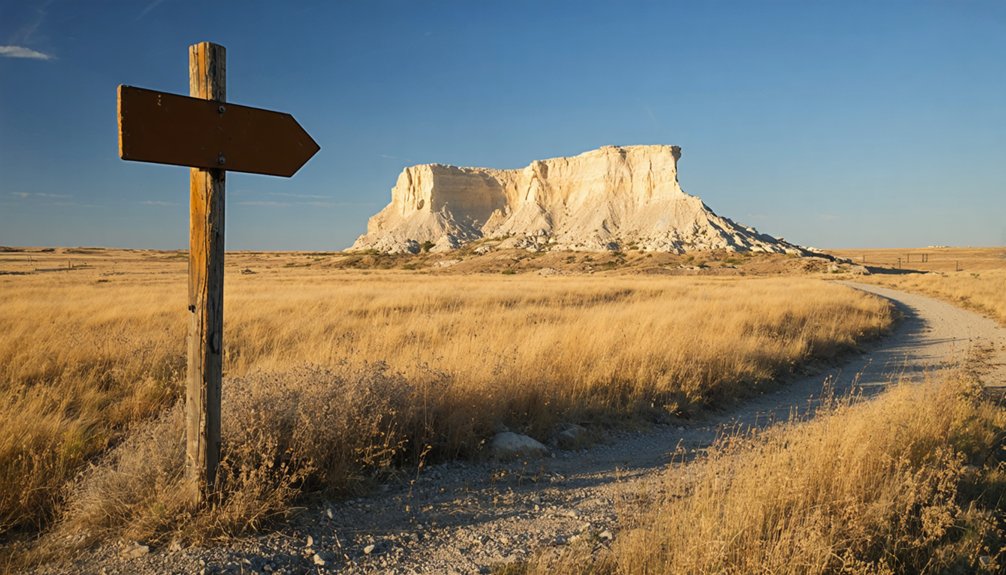
The Niobrara Chalk bluffs rising along the Smoky Hill River aren’t just scenic backdrops — they’re open fossil archives from the Western Interior Seaway, the shallow Cretaceous sea that once swallowed this entire region.
When you explore these chalk formations, you’re walking terrain where plesiosaurs and mosasaurs once ruled. Fossil hunting here feels genuinely different from curated museum experiences — the land itself hands you discoveries.
Follow the Smoky Valley Scenic Byway southwest toward the Trego County border, where exposed Cretaceous layers reveal bones that predate every human story connected to this stretch of Kansas.
You don’t need specialized equipment, just sharp eyes and patience. These bluffs remind you why the Great Plains rewards the traveler who slows down and actually looks.
How to Make a Full Day Out of Smoky Hill City
Squeezing a full day out of Smoky Hill City means treating the ghost town as an anchor, not a destination — start at dawn when the Smoky Hill River catches early light and the chalk bluffs glow pale gold before the heat sets in.
Structure your day around its historical significance and ghost town legends:
- Morning: Walk the former townsite and photograph the river’s north bank.
- Midday: Drive the Smoky Valley Scenic Byway toward Cathedral of the Plains.
- Afternoon: Hunt fossils in Niobrara Chalk formations nearby.
- Evening: Visit Threshing Machine Canyon before sunset.
You’re chasing something real here — failed dreams baked into Kansas shale, a gold rush built on lies, and landscapes that don’t apologize for any of it.
Frequently Asked Questions
Is There an Entrance Fee to Visit Smoky Hill City Ghost Town?
There’s no entrance fee to explore Smoky Hill City’s ghost town history. You’ll roam freely through local legends of failed gold rushes, feeling the nostalgic pull of abandoned dreams scattered across Kansas’ windswept, open plains.
Are Pets Allowed When Exploring the Smoky Hill City Area?
Saddle up your furry companions! Pet-friendly activities are welcomed in Smoky Hill City’s open plains. You’ll want to practice good ghost town etiquette—keep pets leashed, respecting the haunting, untamed freedom this abandoned Kansas landscape still breathes.
What Is the Best Time of Year to Visit Smoky Hill City?
Spring and fall are the best seasons to explore Smoky Hill City’s haunted plains. You’ll find mild weather conditions perfect for roaming free across history’s forgotten trails, chasing gold rush echoes under wide-open Kansas skies.
Is Smoky Hill City Accessible by Public Transportation From Hays?
“You’re on your own out here!” Public transport won’t reach Smoky Hill City — you’ll need your own wheels. Travel tips: drive 12 miles southwest from Hays, embracing the freedom of open Kansas roads.
Are There Camping Facilities Near the Smoky Hill City Ghost Town?
No official camping facilities exist near Smoky Hill City, but you’ll find rugged freedom along the Smoky Hill River’s banks. Follow camping tips, respect local wildlife, and embrace the nostalgic echoes of gold rush dreamers who once roamed here.
References
- https://en.wikipedia.org/wiki/Smoky_Hill_City
- https://kids.kiddle.co/Smoky_Hill_City
- https://www.legendsofamerica.com/carneiro-kansas/
- https://legendsofkansas.com/trego-county-kansas-extinct-towns/
- https://www.youtube.com/watch?v=TpaN1zGpiL0
- https://www.legendsofamerica.com/ks-smokyhillstrail/
- https://geokansas.ku.edu/smoky-hills
- https://www.travelks.com/things-to-do/byways-and-highways/byways/smoky-valley/history-heritage/