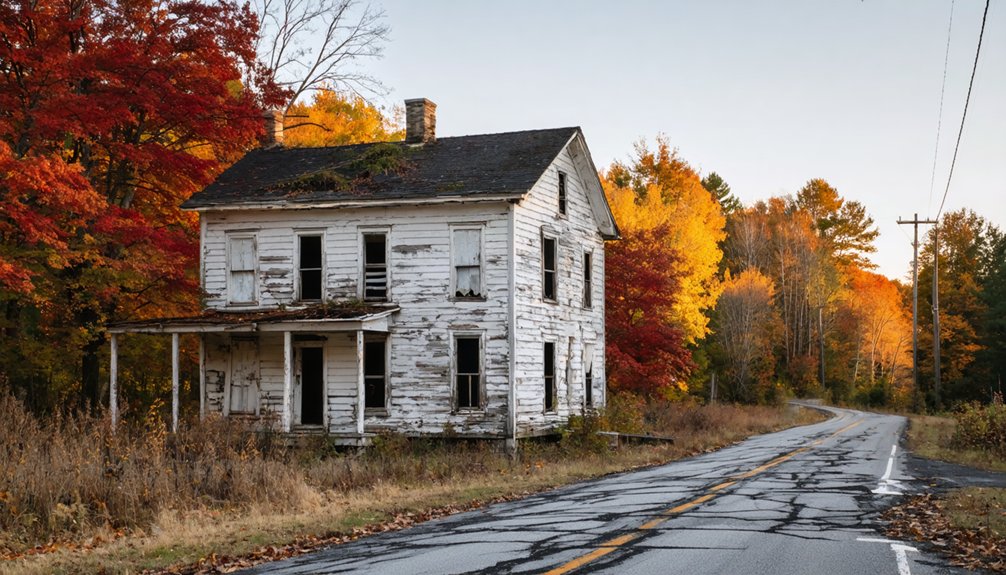
Start your ghost town road trip at Glastenbury’s eerie Bennington Triangle, where unexplained disappearances and paranormal legends set the mood. Then follow Rt. 30 for roughly 40 miles through rolling farmland and river valleys toward South Poultney. Along the way, you’ll discover forgotten settlements, 19th-century cemeteries, and haunted histories that reveal Vermont’s layered past. From the Hosford Tomb to West Castleton’s abandoned ruins, every stop tells a story worth uncovering.
Key Takeaways
- Start your road trip at Glastenbury, Vermont’s eeriest ghost town, located roughly 40 miles from South Poultney via scenic Route 30.
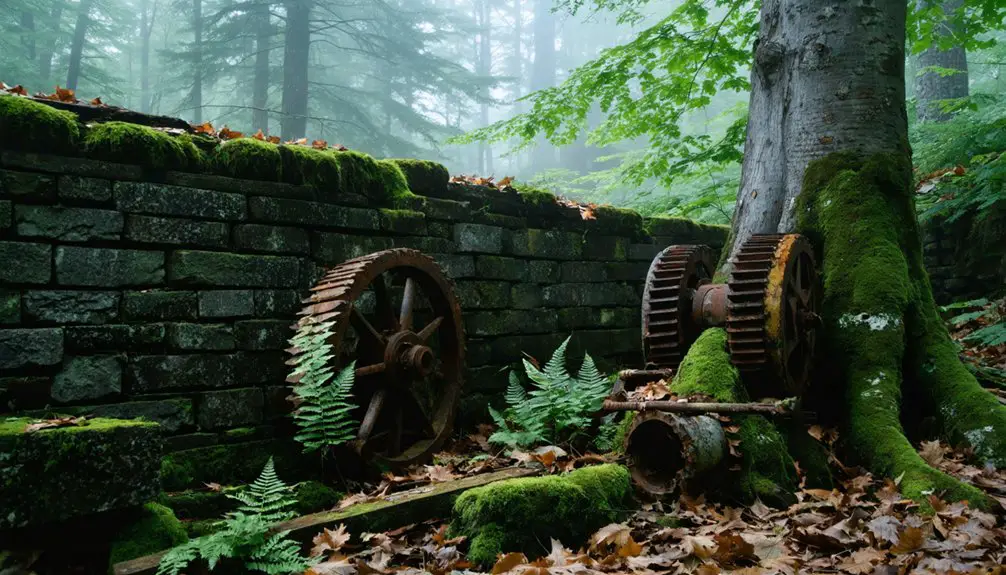
- Stop at West Castleton, a forgotten settlement within Bomoseen State Park, offering a glimpse into Vermont’s abandoned industrial past.
- Visit the Hosford Tomb, an 1844 vault holding family and railroad worker remains, located 3.3 miles north of Poultney.
- Explore South Poultney’s historic cemeteries, including East Poultney Cemetery featuring pre-1815 stones carved by local artisan Enos Clark.
- Break up the drive in Castleton, where local eateries provide a rest stop before reaching your South Poultney destination.
Why South Poultney’s Ghost Town History Starts in Glastenbury
When you think of Vermont ghost towns, Glastenbury in Bennington County is where the story begins. Its Glastenbury origins trace back to a charcoal-making and logging boom that pushed its population to 241 residents by 1880.
Then murders struck nearby Fayville in 1892 and Bickford Hollow in 1897, triggering a rapid decline that emptied the town entirely.
The historical significance of Glastenbury extends beyond simple abandonment. It’s earned the nickname “Bennington Triangle” for its string of unexplained disappearances, paranormal legends, and Abenaki stories describing the mountain as a dangerous meeting place of the Four Winds.
Glastenbury’s story goes deeper than desertion — it’s a place where disappearances, legends, and ancient warnings converge.
Legends of cursed boulders, UFOs, and energy vortexes still circulate today.
Understanding Glastenbury sets the stage for exploring South Poultney’s own layered, haunting past.
Ghost Towns and Eerie Stops Near South Poultney
From Glastenbury’s haunted hollows, your road trip north along Rt. 30 leads to a cluster of eerie stops that flesh out Vermont’s ghost town landscape. Each destination carries its own abandoned structures and local folklore worth exploring:
- West Castleton — tucked inside Bomoseen State Park in Rutland County, this forgotten settlement rewards curious wanderers.
- Hosford Tomb — just 3.3 miles north of Poultney’s stoplight on Rt. 30, this 1844 vault holds family remains alongside railroad workers.
- St. John’s Episcopal Cemetery — reached via a three-mile dirt road off Rt. 30, it features beautifully carved stones with seraphs and angels.
Together, these stops connect Vermont’s layered past, from indigenous hunting grounds to 19th-century industrial decline, painting a vivid picture of lives left behind.
Glastenbury’s Paranormal Legends and Bennington Triangle Overlap
Beyond the tombstones and abandoned settlements, Glastenbury pulls you deeper into Vermont’s strangeness through a web of paranormal legends that have shadowed the region for over a century.
Glastenbury hauntings draw curious travelers into the so-called Bennington Triangle, where multiple unexplained disappearances centered on Glastenbury Mountain remain unsolved.
The Abenaki described the mountain as a meeting place of the Four Winds, warning of strange noises and supernatural forces lurking within the forest.
The Abenaki called this mountain cursed ground — a crossroads of winds, whispers, and forces that defy explanation.
Paranormal encounters here range from UFO sightings and energy vortex theories to legends of a man-eating stone and cursed boulder.
Somerset, Sunderland, Woodford, and Glastenbury all fall within this eerie zone.
The uninhabited territory amplifies every local legend, making this stretch of southern Vermont feel genuinely untamed and unresolved.
The South Poultney Cemeteries That Double as History Stops
Leaving the Bennington Triangle’s unsettled air behind, you trade paranormal fog for carved stone and documented history as the road north on Rt. 30 carries you toward South Poultney’s quiet cemetery stops.
Each site carries real cemetery significance, connecting you directly to Vermont’s earliest settlers and historical figures who shaped the region.
Three stops worth your time:
- East Poultney Cemetery — Features pre-1815 stones carved by Enos Clark, sitting just 0.2 miles east of the green.
- Poultney Town Cemetery — One of the town’s largest, positioned along Rt. 30’s east side.
- Hosford Tomb — Dated 1844, holding family and railroad worker remains 3.3 miles north of Poultney’s stoplight.
You’re not just visiting graves; you’re reading Vermont’s actual story.
Your Driving Route From Glastenbury to South Poultney via Rt. 30
The route north from Glastenbury to South Poultney covers roughly 40 miles, and Rt. 30 does most of the heavy lifting.
You’ll leave the Bennington Triangle‘s eerie Green Mountain forest behind and gain elevation before the landscape opens into rolling farmland and river valleys. The scenic views along this corridor reward anyone willing to drive slowly and look around.
Keep Rt. 30 north through Castleton, where you can fuel up at local eateries before pushing the final stretch toward Poultney.
Once you hit the Poultney stoplight, you’re close. The Hosford Tomb sits 3.3 miles north on Rt. 30’s west side, and East Poultney’s historic green is just beyond.
You’ve connected two haunted corners of Vermont on one clean, uninterrupted drive.
Frequently Asked Questions
Is South Poultney Safe to Visit Alone at Night?
Like a lone pioneer, you’re venturing into the unknown! South Poultney’s nighttime safety isn’t guaranteed for solo travel — its isolated roads, dense forests, and paranormal legends make after-dark exploration risky; always trust your instincts.
What Should I Pack for a Vermont Ghost Town Road Trip?
Pack your packing essentials: sturdy boots, layers, flashlight, and a camera. Fuel your adventure with Vermont’s local cuisine—grab maple syrup treats and artisan cheeses before exploring haunted trails and abandoned ghost towns.
Are There Any Guided Ghost Town Tours Available Near Poultney?
Guided tours aren’t widely available, but you’ll uncover ghost town history through self-guided exploration. Local legends whisper through Poultney’s eerie landscapes—connect with local historical societies; they’ll point you toward hidden stories waiting to be discovered.
What Is the Best Time of Year to Visit South Poultney?
Fall’s your best season to visit South Poultney! You’ll experience vibrant foliage framing historic cemeteries and ghost town trails. Local events celebrating Vermont’s harvest culture make autumn visits uniquely atmospheric, blending spooky legends with breathtaking, freedom-inspiring landscapes.
Are Vermont Ghost Town Sites Accessible for Visitors With Disabilities?
Uneven cobblestones and rugged trails challenge wheelchair users, but you’ll find some accessible pathways and historical signage at select Vermont ghost town sites. Always call ahead to confirm each location’s current accessibility accommodations before visiting.
References
- https://happyvermont.com/2014/10/23/glastenbury-ghost-town/
- https://www.youtube.com/watch?v=ScW-H7A8yL8
- https://www.poultneyhistoricalsociety.org/visitor-information/prehistoric-poultney-8500-bc-1761-ad
- https://www.poultneyhistoricalsociety.org/timeline/cemeteries
- https://en.wikipedia.org/wiki/List_of_ghost_towns_in_Vermont
- https://archive.org/stream/historyoftownofp1875josl/historyoftownofp1875josl_djvu.txt