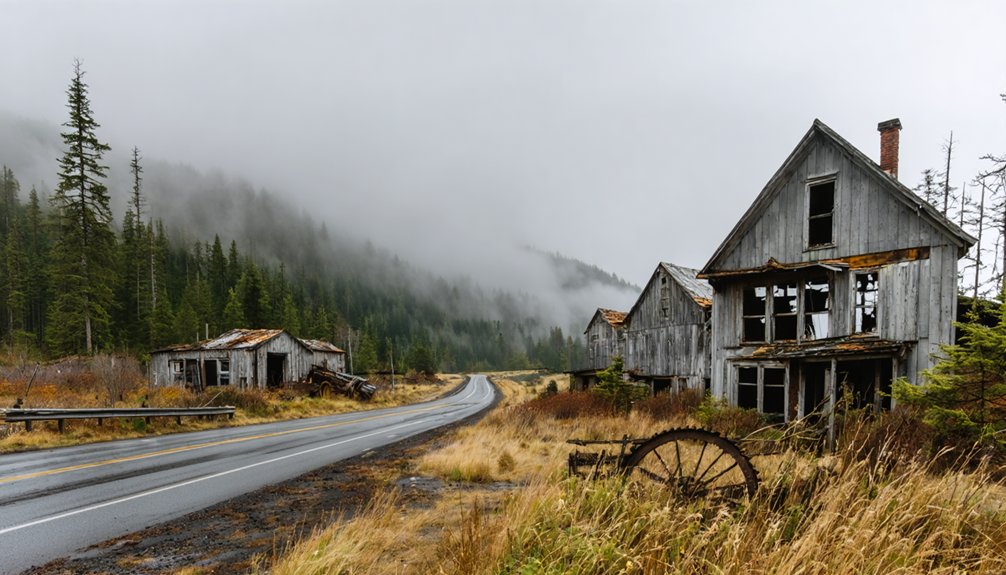
Planning a ghost town road trip to Southport, Oregon means venturing into Coos County’s forgotten past, where a once-thriving 1875 coastal mining settlement vanished entirely by the 1890s. You’ll find crumbling foundations, overgrown paths, and weathered graves instead of preserved buildings. Access the area through Coos Bay, arriving by late spring through early fall for the best conditions. Pack layers, paper maps, and plenty of water — and there’s much more to uncover about making this journey unforgettable.
Key Takeaways
- Southport, Oregon, is a fully abandoned Type A ghost town in Coos County, established around 1875 and deserted by the 1890s.
- Access Southport via Coos Bay, traveling from Portland on I-5 south, then Highway 38 west, before heading south on Highway 101.
- Visit between late spring and early fall for optimal exploration conditions, clearer coastal views, and extended daylight hours.
- Pack water, snacks, a spare tire, paper maps, layered clothing, and comfortable walking shoes for remote coastal terrain.
- Combine your trip with nearby ghost towns like Sparta, Hardman, and Lonerock for a fuller Oregon frontier experience.
What Makes Southport Oregon Worth a Ghost Town Road Trip?
Why does Southport, Oregon pull ghost town enthusiasts off the beaten path and into its forgotten silence? Established around 1875 in Coos County, this coastal mining settlement thrived briefly before disappearing entirely by the 1890s. That rapid rise and fall gives Southport its raw historical significance.
You’ll find yourself standing where a real community once hustled, imagining the lives that gold rush ambitions built and abandoned. The abandoned buildings that remain tell stories no museum can replicate.
Southport earns its Type A classification — fully surrendered to time, untouched by modern interference.
For road trippers craving genuine freedom and discovery, Southport delivers exactly that. It’s Oregon’s boom-and-bust frontier spirit preserved in eerie silence, waiting for curious travelers willing to seek it out.
When to Visit Southport and What You’ll Actually Find There
Timing your visit to Southport shapes everything about the experience. Late spring through early fall offers the best seasons for exploration, when coastal fog lifts long enough to reveal the landscape clearly.
Summer keeps daylight extended, giving you more hours to wander what remains of this abandoned mining settlement.
Don’t expect preserved buildings or tourist infrastructure. Southport’s Type A classification means full abandonment — you’ll find crumbling foundations, overgrown paths, and an eerie silence that speaks louder than any museum exhibit.
Crumbling foundations, overgrown paths, eerie silence — Southport offers raw abandonment, not polished preservation.
Weathered wooden crosses mark forgotten graves, connecting you directly to the people who once built lives here.
Locals carry fragments of stories and local legends about Southport’s gold rush days. Talk to them before you arrive. Their knowledge transforms scattered ruins into something genuinely meaningful.
How to Reach Southport in Coos County
Once you’ve decided when to make the trip, getting yourself to Southport requires traversing southwest Oregon’s coastal highway system. Your primary directions access comes through Coos Bay, the region’s main hub.
From there, you’ll navigate southwest toward the coast using local connecting roads into Coos County’s quieter corridors.
Your travel routes depend on your starting point. Coming from Portland, take I-5 south to Eugene, then head west on Highway 38 toward Reedsport before dropping south on Highway 101 into Coos Bay.
From California, drive north on 101 straight through the Oregon coast. Pack a paper map since cell service gets spotty fast out here.
Remote coastal terrain rewards prepared travelers who embrace the unpredictability of chasing forgotten places on their own terms.
What to Pack for Remote Oregon Ghost Town Roads
Packing smart separates a memorable ghost town adventure from a miserable one. Remote Oregon roads near Southport don’t forgive poor preparation, so load your vehicle with packing essentials before leaving civilization behind. Toss in extra snacks, plenty of water, and a spare tire because coastal southwest Oregon stretches far from the nearest service station.
Your navigation tools matter just as much as your supplies. Cell service disappears fast on these backroads, so grab a paper map and consider a dedicated GPS device.
You’ll also want comfortable walking shoes for exploring abandoned structures, a flashlight for dim interiors, and a basic first-aid kit. Dress in layers since coastal Oregon weather shifts quickly.
Pack these items right, and you’ll explore Southport’s forgotten streets completely on your own terms.
Southwest Oregon Ghost Towns Worth Adding to Your Drive
With your gear loaded and your map unfolded, you’re ready to think beyond Southport itself.
Southwest Oregon rewards curious drivers with several ghost towns worth folding into your route.
Sparta, established in 1872 in Baker County, carries serious mining heritage and abandoned structures that speak volumes about Oregon’s gold rush era.
Its historical significance alone justifies the detour.
Hardman, accessible via State Highway 207, once thrived before automobiles quietly drained its population.
Walking its remnants feels like stepping through a forgotten chapter.
Lonerock, a former ranch hub turned ghost town, covers just over a square mile but packs considerable atmosphere into every corner.
Each stop deepens your understanding of Oregon’s boom-and-bust past, transforming a simple drive into something genuinely worth remembering.
How to Build a Multi-Stop Road Trip Around Southport
Building a multi-stop road trip around Southport starts with treating southwest Oregon as your anchor point and expanding outward.
Begin your itinerary planning near the Coos Bay area, where Southport’s historical significance as an 1875 mining settlement sets the tone for everything ahead.
From there, push east toward Baker County to explore Sparta, another mining-era relic founded in 1872.
Loop north to catch Hardman along SH 207, then swing toward Lonerock before finishing near Harney County’s Sodhouse.
Each stop layers a distinct chapter of Oregon’s frontier story onto your drive.
Keep your route flexible, pack a paper map, and fuel up before entering remote stretches.
You’re not just driving between coordinates — you’re connecting forgotten communities that once shaped the state’s identity.
Frequently Asked Questions
What Classification System Categorizes Southport as a Type a Ghost Town?
You’ll find that the Gary Speck system categorizes Southport as a Type A ghost town, recognizing its ghost town characteristics, historical significance, and fully abandoned status — you’re exploring a site that’s completely deserted and historically compelling.
How Many Total Ghost Towns Has Historian Stephen Arndt Counted in Oregon?
You’ll be amazed that historian Stephen Arndt’s counted 256 Ghost Towns across Oregon! His dedicated Historic Preservation research reveals a stunning collection of forgotten frontier communities, inviting you to freely explore Oregon’s remarkably rich, abandoned heritage.
Was Southport Primarily a Mining or Lumber Camp Community?
Swipe right on Mining History — Southport’s primarily a mining community! You’ll find it tied to Oregon’s gold rush era, not the Lumber Industry. It’s a Type A ghost town that’ll fuel your freedom-seeking adventurous spirit!
Which County in Oregon Is Southport Officially Located Within?
You’ll find Southport nestled within Coos County, Oregon. It’s a fascinating coastal history gem that beckons ghost town tourism enthusiasts like you to explore its abandoned, mysterious past along southwest Oregon’s rugged, freedom-filled shoreline.
Approximately What Year Was Southport Originally Established as a Settlement?
You’ll find Southport’s historical significance dates back to approximately 1875, when early settlers first established this coastal mining community. It’s a fascinating piece of Oregon’s rugged, freedom-filled frontier history worth exploring on your adventure!
References
- https://thatoregonlife.com/2016/04/road-trip-ghost-towns-eastern-oregon/
- https://myfamilytravels.com/this-oregon-road-trip-through-ghost-towns-is-packed-with-creepy-history
- https://usghostadventures.com/americas-most-haunted-trending/ghost-towns-to-visit-on-your-summer-road-trip-along-route-66/
- https://en.wikipedia.org/wiki/List_of_ghost_towns_in_Oregon
- https://traveloregon.com/things-to-do/culture-history/ghost-towns/
- https://www.gowildusa.com/ghosttowns