You’ll find America City’s ghost town site in rural Nemaha County, where this 1858 settlement succumbed to railroad bypasses and Depression-era collapse in 1932. Before departing, verify road conditions through the county’s Road & Bridge department—unmarked rural routes challenge GPS reliability. From major highways like U.S. 36 and Highway 75, navigate carefully toward Parallel Road, the original overland trail corridor. The twenty-minute journey rewards prepared explorers with a relocated Union Church, an abandoned schoolhouse, and a 460-grave cemetery documenting vanished frontier lives—treasures that reveal deeper stories beneath Kansas prairie skies.
Key Takeaways
- Access America City via U.S. Highway 36 and Highway 75, following Parallel Road which marks the original overland trail route.
- Visit the relocated Union Church, abandoned schoolhouse, and cemetery with 460 graves documenting the former community.
- Verify road conditions through Nemaha County Road & Bridge department’s seasonal reports and 911 Roads map before departure.
- Plan for twenty to twenty-five minutes travel time and use GPS coordinates to locate the precise ghost town site.
- Monitor weather patterns and confirm EMS coverage, as remote township response times extend considerably in this rural area.
The Rise and Fall of America City: A Brief Timeline
On Valentine’s Day 1857, the Kansas Territorial Legislature carved out 380 acres of prairie for a settlement that would bear one of the most audacious names in frontier history. Joseph G. McKay and Newcomb Ireland laid out America City in 1858, establishing a post office, general store, school, and church along the southern boundary’s Parallel Street.
The factors enabling settlement growth centered on trail traffic along Parallel Road and robust farming operations. You’ll find the town thrived until the Central Branch of the Union Pacific Railroad bypassed it for Corning, six miles distant, before 1870. That railroad became among the primary catalysts contributing to decline.
Competition from nearby Corning and Havensville drained population and businesses until America City’s final collapse in 1932.
What Caused This Thriving Settlement to Disappear
When the Central Branch of the Union Pacific Railroad laid its tracks through Corning in the late 1860s, it sealed America City’s fate with surgical precision. You’ll find the reasons for economic isolation weren’t mysterious—bypassed towns simply ceased to exist in Kansas’s new transportation economy.
The Parallel Road trail that once funneled westbound freight through town became obsolete overnight. Business owners packed up for rail-connected Havensville and Corning, chasing customers who’d abandoned stagecoaches for faster trains. The carrying trade collapsed entirely by the 1870s, leaving farmers to work increasingly marginal land.
When the Great Depression struck in the 1930s, the impact of commodity agriculture crushed what remained. The post office shuttered in 1932, and residents scattered, selling off homesteads that once promised prosperity.
Historic Structures You Can Still Visit Today
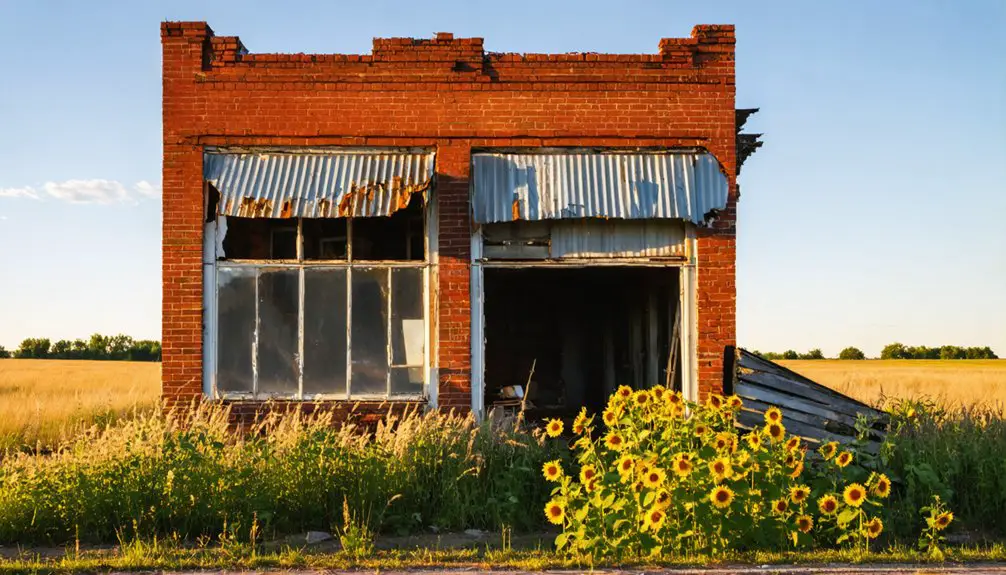
You’ll find three tangible remnants of America City’s past scattered across the original town site in Nemaha County. The relocated church structure stands beside the abandoned schoolhouse, both showing decades of weathering yet preserving identifiable features from their educational and spiritual purposes.
Northeast of these buildings, the hilly cemetery holds 460 graves—a sobering memorial to the community that once thrived here before vanishing from Kansas’s landscape.
The Standing Stone Church
Standing at the southern edge of America City on Parallel Street, the remnants of what locals called the Union Church tell a complex story of frontier faith and communal determination. Built between 1864 and 1865 as the town prospered, this structure served multiple denominations—United Brethren members held services here starting in 1858, while meeting minutes from 1884 document its formal establishment with founders H.B. Channell, John Mills, and Isaac McKee.
You’ll find the weathered building relocated north beside the abandoned schoolhouse, its steeple removed and large doors added for storage purposes. This historic architecture represents the religious significance pioneers placed on communal worship alongside education. The dilapidated church stands today as legacy to those who prioritized spirit and learning while carving civilization from prairie wilderness.
Abandoned Schoolhouse Remains
Adjacent to the relocated Union Church, America City’s abandoned schoolhouse stands as a monument to frontier educational ambition—funded by $1,100 in bonds voted by residents who sourced doors and windows from Leavenworth while using native lumber for its walnut-sided walls. Built by Charles Grover and Orrin Foote, this native timber construction served students until the town’s 1932 abandonment.
You’ll find the main entrance on the south side, where a long coat rack still greets phantom pupils. Inside, convertible folding doors divide the classroom space, while two intact chalkboards preserve lessons from Kansas’s territorial past. Though someone attempted converting it into a residence, weathered furnishings now sit abandoned beneath a tin roof installed for preservation, creating an accessible time capsule you can explore freely.
Cemetery With 460 Graves
A few miles west of Highway 63 on a gravel road in southern Nemaha County, America City Cemetery preserves the most complete record of this lost town’s existence—460 graves carved into stone, documenting every soul who bet their future on this Kansas frontier community between 1857 and 1932.
You’ll discover burial trends and patterns that reveal concentrated child mortality during disease outbreaks and the remarriages of widowers across generations. Grave marker symbolism varies dramatically, from intricate carvings of prosperous families to simple stones marking pioneer struggles.
Navigate using the directional highway sign to access:
- 625 memorial records searchable through Find a Grave database
- Scanned cemetery records via Kansas State Historical Society on Ancestry.com
- Veterans burial documentation through Kansas transcription databases
- Genealogical connections accessible on FamilySearch
How to Find America City in Nemaha County

You’ll find America City’s remnants by following the network of rural roads that crisscross Nemaha County’s northeastern Kansas farmland, where GPS coordinates prove more reliable than outdated township maps.
Historical records from the Lost Kansas digital archive pinpoint the settlement’s location, though seasonal weather patterns can transform dirt county roads into impassable mud tracks during spring thaw and heavy rainfall.
Look for section line intersections and surviving property markers that once delineated the town’s original plat, as these geographical anchors remain constant even as the structures themselves have vanished into prairie grass.
Finding America City requires careful navigation of Nemaha County’s rural road network, where modern highways intersect with historic trails that once promised prosperity to frontier settlements. You’ll traverse territory where off grid infrastructure meets forgotten pathways, demanding both historical knowledge and practical routing skills.
Essential navigation resources include:
- U.S. Highway 36 and Highway 75 provide primary access corridors through Nemaha County’s expansive terrain
- Parallel Road marks the county border—the original overland trail from Atchison to Denver that America City’s settlers fatefully chose over railroad access
- Historic roadmaps from 1887 Meacham’s atlas reveal sectional details and original landowner layouts
- Kansas Rural Water Association’s downloadable county maps offer current rural road systems in high-resolution PDF format
These archivally sourced tools guide you toward America City’s vanished streets.
Key Landmarks and Coordinates
Located six miles southwest of Corning, Kansas, the former America City town site occupies coordinates accessible through triangulation from three regional anchors: 50 miles west of Atchison, 20 miles south of the Nemaha County seat in Seneca, and directly along “The Parallel” road that marks the settlement’s original southern boundary.
You’ll find the cemetery alongside Highway markers pointing toward the tree-lined lot where approximately 460 individuals rest. Early settler headstones provide documentary evidence of the 380-acre townsite approved February 14, 1857, though land ownership transfers gradually dissolved the community by 1932. The stone carvings reveal families who staked claims in this Glaciated Region’s fertile soil.
Navigate by these reference points rather than GPS coordinates—America City exists now only through cemetery records and rural memory.
Seasonal Access Considerations
Rural gravel roads define your journey to America City’s remnants, particularly the historic Parallel Road that once channeled westbound pioneers along what settlers called Parallel Street. Winter weather patterns transform these routes into impassable corridors, demanding advance planning before you venture into Red Vermillion Township’s isolated terrain.
Pre-Trip Assessment Protocol:
- Verify road status through Nemaha County Road & Bridge department’s seasonal maintenance reports and 911 Roads map
- Monitor weather patterns affecting the county’s 10,273-resident area where isolation risks multiply rapidly
- Check Commissioners’ meeting minutes detailing closure updates and infrastructure limitations
- Confirm EMS district coverage in remote townships where response times extend considerably
The county’s Noxious Weed and Road conditions webpage provides real-time access information for independent travelers seeking authentic frontier exploration.
Recommended Driving Route From Atchison
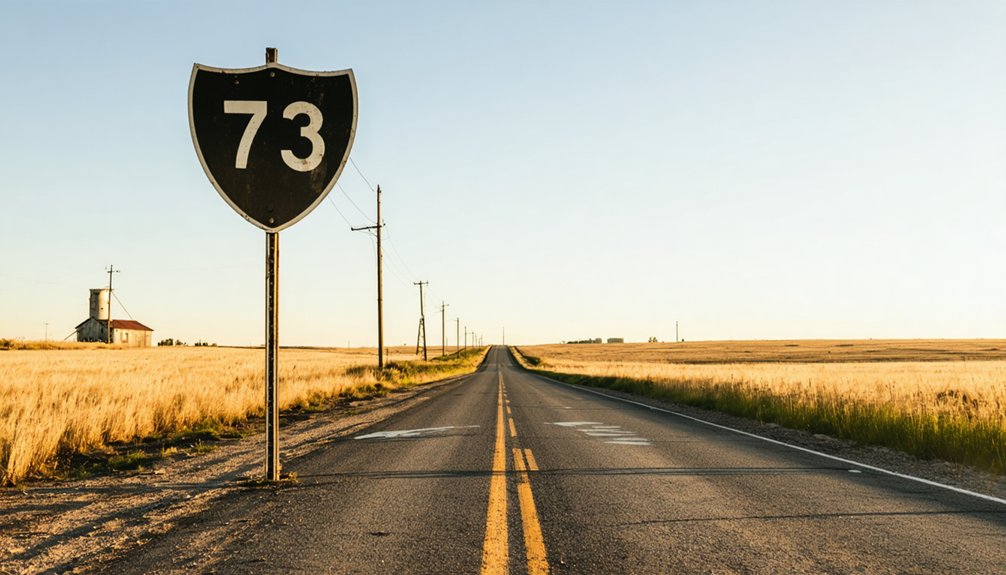
Because America City sits just seventeen miles northwest of Atchison, you’ll find the journey remarkably straightforward along U.S. Highway 73. This direct, paved two-lane road cuts through open Atchison County landscapes, delivering you to the ghost town site in twenty to twenty-five minutes. The highway accommodates all vehicle types—sedans, trucks, RVs—without tolls or restrictions hindering your exploration.
While alternate route options exist via county roads, they’ll extend your distance beyond twenty miles without offering practical advantages. Rural road conditions on U.S. 73 remain consistently maintained year-round, though light traffic guarantees you’ll rarely encounter delays. GPS coordinates pinpoint the precise location, and highway signs mark relevant intersections. This unobstructed corridor grants you autonomous access to Kansas’s vanished communities, free from bureaucratic impediments or gatekeepers controlling your historical investigations.
Must-See Features at the Ghost Town Site
When you arrive at America City’s scattered remains, the expansive hilltop cemetery commands your attention first—a windswept memorial ground where approximately 460 headstones document the settlement’s demographic tragedy.
Four hundred sixty weathered stones stand sentinel on the windswept hilltop, silent witnesses to America City’s vanished dreams and frontier sorrows.
Essential features to explore include:
- Gravesite symbolism carved into weathered stones, revealing widowers’ remarriages and frontier hardships through inscribed dates and symbols
- The original church structure, now repurposed as a garage but standing defiantly against decades of abandonment
- Disease outbreak patterns visible across headstone clusters, particularly affecting children during epidemics
- Agricultural way of life framed beyond tree-lined cemetery borders, where rolling farmland continues the settlers’ legacy
The deserted schoolhouse nearby—partially converted into a residence—completes your glimpse into this 1857-1932 settlement’s brief existence, six miles southwest of Corning.
Other Abandoned Kansas Towns to Add to Your Journey
Kansas preserves dozens of abandoned settlements within day-trip distance of America City, each offering distinct architectural remnants and historical narratives that complement your ghost town exploration. You’ll find Aulne’s railroad remnants six miles south of Marion, where the Chicago, Rock Island & Pacific once stopped.
Castleton in Reno County showcases typical prairie decay, featuring scattered ruins and the claim to fame as Sevillinois’ 1952 filming location. Croft’s vacant grain elevators stand as monuments to agricultural foundations in Pratt County.
Riley County’s Bala reveals a deteriorating Presbyterian Church among hardscrabble houses, though Fort Riley’s expansion consumed most structures. Quindaro offers profoundly different significance—founded by abolitionists in 1856, this Underground Railroad stop near Kansas City metro preserves freedom’s tangible architecture.
Frequently Asked Questions
What Is the Best Time of Year to Visit America City?
Visit America City during fall’s comfortable 50-70°F days when you’ll find ideal road conditions, fewer crowds at local attractions, and preserved ruins. Spring offers wildflowers and seasonal events, though muddy roads may limit your exploration freedom.
Are There Any Entrance Fees or Permits Required to Access the Site?
You’ll find no entrance fees or permits block your path to America City’s ruins. Available parking options exist along rural roadsides, though nearby amenities and facilities vanish into Kansas prairie—bring supplies for this solitary, unrestricted exploration.
Is the Cemetery Maintained or Open to the Public?
No dedicated cemetery exists at America City’s ghost town site. Public accessibility remains unrestricted across the abandoned townscape, though cemetery conditions elsewhere in Republic County vary. You’ll find maintained burial grounds in neighboring communities requiring proper respect during visits.
Can You Camp Overnight Near the America City Ghost Town Area?
Like tumbleweed finding rest, you’ll discover overnight camping nearby through northwest Kansas’s primitive sites and state parks. Availability of designated camping areas exists regionally, though America City’s remaining structures offer no facilities—you’ll need established campgrounds for your basecamp.
Are Guided Tours Available for Exploring the Historic Structures?
Unfortunately, guided tours aren’t offered at America City’s abandoned structures due to safety concerns and private ownership. However, you’ll find self-guided tours are your best option—explore freely at your own pace while respecting property boundaries and historical integrity.