You’ll find Ames 12 miles east of Concordia along K-9 highway, where grain elevators tower above a dwindling population of 33. Plan your visit during spring or fall when Kansas weather cooperates, and bring navigation tools, camera gear, and emergency supplies for the remote prairie journey. Budget $18-$43 for gas depending on your vehicle, and remember to respect the privately owned farmland surrounding the abandoned buildings. The route’s worth plotting carefully to maximize your ghost town exploration experience.
Key Takeaways
- Ames is located 12 miles east of Concordia along K-9 highway, with grain silos visible 3 miles southwest of Clyde.
- Visit during fall or spring for mild temperatures and scenic landscapes while avoiding summer heat and winter cold.
- Budget $18-$43 for the journey depending on your vehicle type and fuel efficiency.
- Bring GPS backup, camera gear, layered clothing, emergency supplies, and basic vehicle maintenance tools for the trip.
- Respect private property boundaries as most buildings and farmland in Ames are privately owned.
The Rise and Fall of Ames: A Brief History
When George Clark accepted his appointment as Ames’s first postmaster on May 28, 1878, he couldn’t have known his modest store would anchor a thriving prairie settlement.
You’ll discover how former business pioneers like O.B. Thompson, William Frederick, and Chester Thomas built a community from scratch, establishing key commercial institutions that made Ames matter. Eastern capitalist W.P. Rice constructed two large stores and a spacious hall, drawing every business line imaginable.
By the 1880s, E.B. Purcell’s massive elevator—14,000 bushel capacity—stood as one of the Mississippi’s largest. But devastating fires in 1886 and 1902 consumed lumber yards and mercantile houses.
The population dwindled by the 20th century, leaving only S.H. Hooper’s general store serving scattered farmers who still remembered better days.
What Remains of Ames Today
The ghost of prosperity lingers in Ames today, though just 33 souls called this census-designated place home in 2020—a fraction of the 120 residents who populated the town in 1910. You’ll find several homes still standing south of the Republican River, three miles southwest of Clyde along Highway K-9.
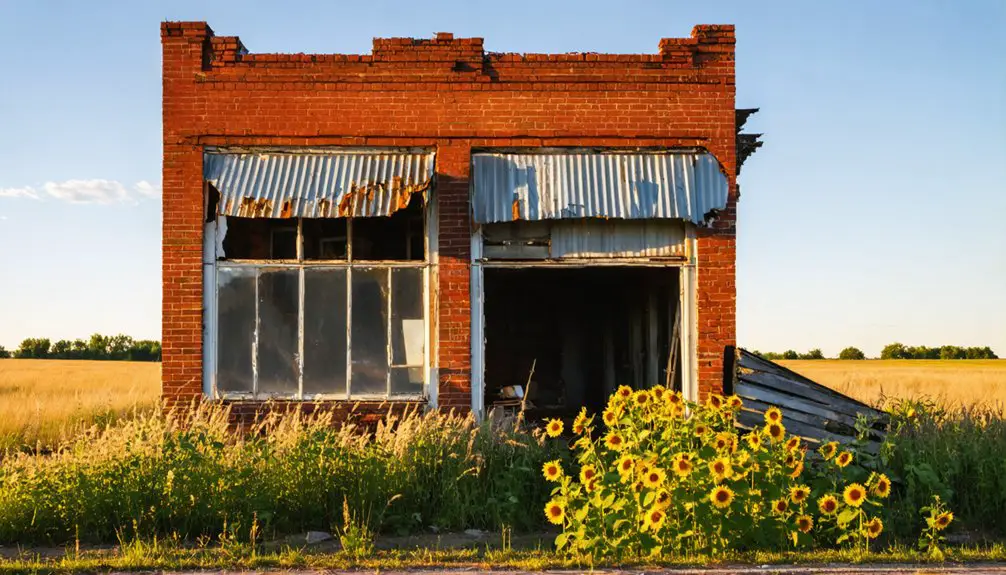
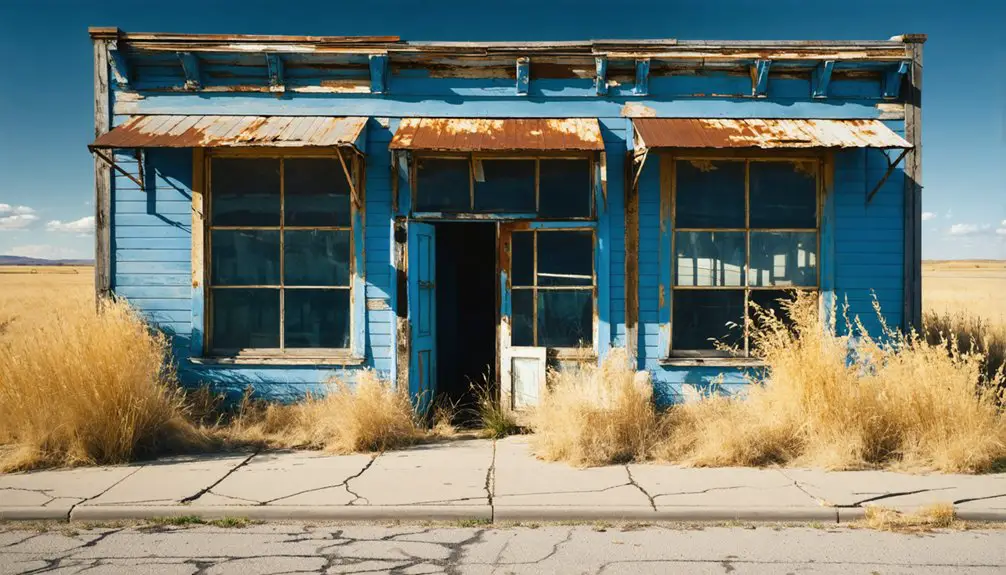
The grain elevators remain Ames’s most striking feature—towering silos that once held 14,000 bushels still pierce the prairie sky. An operating grain business keeps commerce alive, while abandoned buildings whisper stories of mercantile houses and the Roach Brothers elevator. The old schoolhouse endures, though students now attend Clifton-Clyde USD 224. The post office shuttered in 1993, marking another chapter’s end in this quiet riverside settlement.
Getting to Ames: Directions and Route Planning
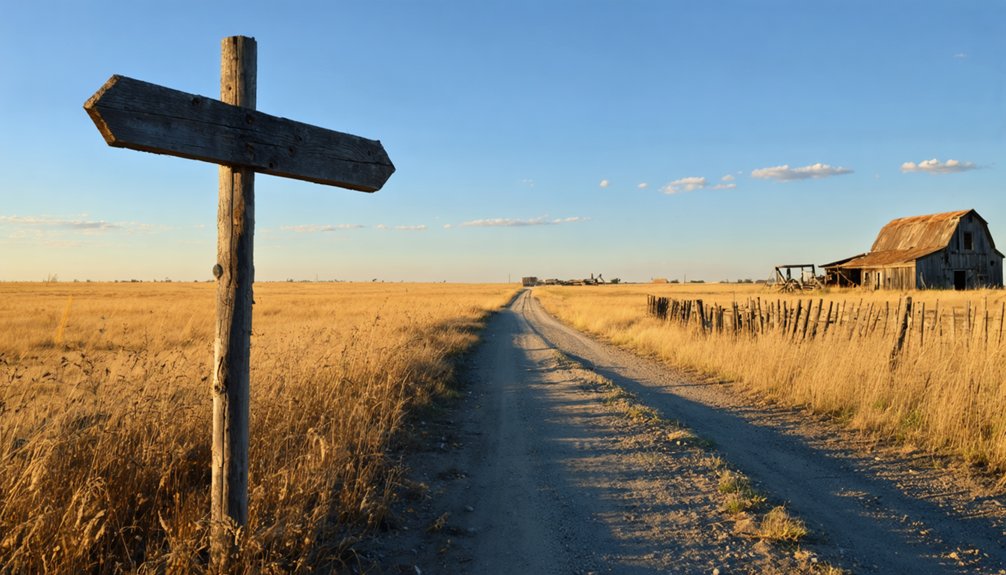
Reaching this riverside remnant requires traversing Kansas’s rural heartland, where county highways cut through endless wheat fields and the Republican River charts its meandering course. You’ll find Ames twelve miles east of Concordia along K-9 highway, with alternative road routes connecting through K-28 and County Road 777. From Concordia’s county seat, head east—watching for the grain silos that mark your destination three miles southwest of Clyde.
Planning fuel efficient travel matters here, where gas stations grow scarce between towns. Budget $18-$43 for the journey, depending on your vehicle. The surrounding privately owned farmland means respecting boundaries while exploring what remains. You’re venturing beyond cellular coverage and convenience stores—pack water, charge your phone, and embrace the isolation that defines authentic ghost town exploration.
Best Time to Visit Kansas Ghost Towns
Timing your Kansas ghost town expedition makes the difference between dusty discomfort and discovering these abandoned settlements at their most photogenic. Fall delivers temperatures in the 50s-70s, painting crumbling facades against brilliant foliage while smaller crowds let you explore freely.
Spring’s March-through-May window offers blooming landscapes that contrast beautifully with Amy’s weathered structures of unique historical significance. You’ll dodge summer’s oppressive 80s-90s heat that’ll drain your enthusiasm before reaching your third stop, and winter’s 30s-40s temperatures that’ll cut your outdoor exploration short.
Kansas’s big-sky sunsets amplify the atmospheric appeal during shoulder seasons, while year-round seasonal amenities guarantee comfortable lodging regardless of when you venture out. Pack accordingly, plan strategically, and let autumn or spring guide your journey through these forgotten prairie settlements.
What to Bring on Your Ghost Town Adventure
You’ll want to pack strategically for your Amy ghost town expedition, balancing exploration essentials with practical safeguards for remote Kansas terrain. Your gear list should include reliable navigation tools and safety equipment, camera gear to capture weathered structures and prairie landscapes, and clothing layers that’ll protect you from the region’s unpredictable elements.
Think beyond typical road trip basics—ghost town adventures demand preparation for areas where cell service fades and the nearest assistance might be miles away.
Discover hidden gems like ghost town attractions in Calista, Kansas, where history whispers through abandoned buildings. Each site tells a story of a bygone era, inviting visitors to ponder the lives once lived there. Prepare for a journey into the past that promises both thrill and nostalgia.
Before you venture down the crumbling roads that lead to Amy, Kansas, you’ll need to pack more than just a sense of adventure—your survival might depend on the gear stashed in your vehicle. Cell phones with portable batteries and solar chargers form your lifeline when establishing emergency communication protocols with the outside world.
Pack road atlases as GPS backup—satellites fail in desolate stretches. Your vehicle toolkit becomes critical for fuel spill response procedures, alongside WD-40 and zip ties for improvised repairs. High-powered flashlights illuminate abandoned structures after sunset, while reflective triangles mark your position if darkness catches you mid-repair. Cut-resistant gloves protect hands exploring jagged ruins.
Include emergency blankets, drinking water, and nonperishable food—ghost towns don’t offer conveniences, only isolation and self-reliance.
Photography and Documentation Equipment
Capturing Amy’s weathered facades and wind-scattered debris demands equipment that’ll survive dust, temperature swings, and the relentless Kansas sun. Pack a versatile digital SLR like the Canon 5D or Nikon Z7ii with a 24-70mm f/2.8 lens for general shooting, plus a wide-angle 16-35mm for cramped interiors and expansive main street compositions. A sturdy carbon fiber tripod stabilizes long exposures inside collapsed structures where light barely penetrates.
Bring multiple SD cards and organize them religiously—losing Amy’s documentation to card failure stings. Your digital asset management starts in the field: label cards, back up to portable drives nightly. Spare batteries are non-negotiable; cold Kansas mornings drain power fast. Add a Rode VideoMic for atmospheric audio, neutral density filters for midday sun control, and cleaning supplies for persistent prairie dust infiltrating every seal.
Weather-Appropriate Clothing and Supplies
Kansas weather ambushes the unprepared—morning frost gives way to afternoon heat, clear skies collapse into wall clouds, and spring winds strong enough to lean against arrive without warning. Dressing for changing conditions means thinking in layers: insulated bases for winter lows near 20°F, breathable fabrics for July’s 93°F peaks, and wind-resistant shells year-round.
Planning for extreme weather requires waterproof boots with aggressive tread, wide-brimmed hats for relentless sun, and compact rain gear that won’t weigh you down while exploring crumbling structures. Pack light-colored clothing for summer’s four-month heat siege, but throw in a jacket even then—evenings cool to 66°F. The continental climate respects no schedule, so flexibility beats fashion every time.
Nearby Ghost Towns Worth Exploring
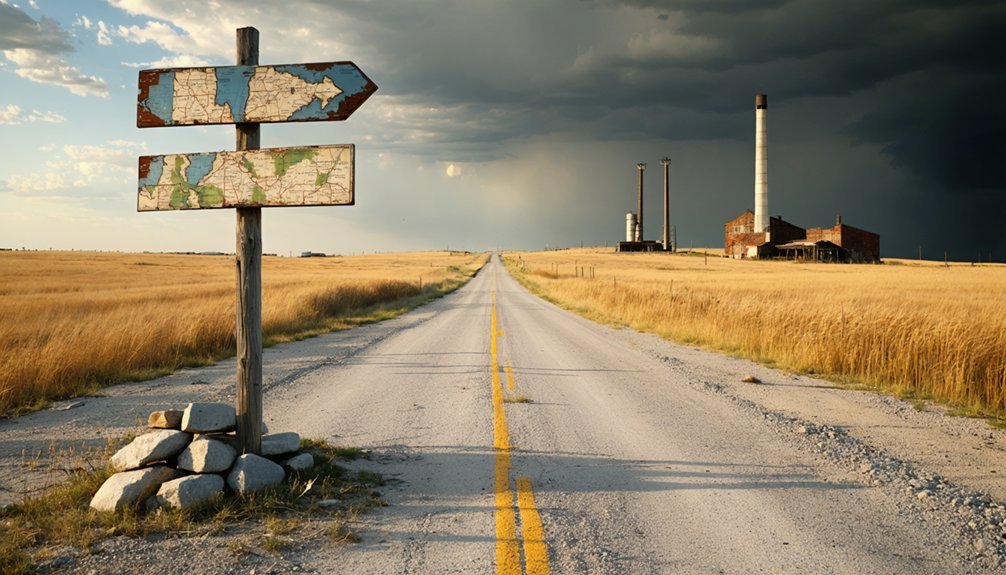
Your exploration of Amy opens doors to other vanished communities scattered across western Kansas’s windswept plains. Within a short drive, you’ll discover Eminence’s relocated buildings, Ulysses’s remarkable transformation from ghost town to thriving county seat, and Ravana’s limestone ruins—witness to one of the region’s most audacious courthouse heists.
Each site tells a distinct story of survival, failure, and the occasional outlaw escapade that shaped Lane County and its neighbors.
Eminence: Relocated and Repurposed
Today’s current preservation efforts remain minimal. You can visit the cemetery half-mile north, where a 1998 stone marker stands sentinel over lost wooden graves.
Catherine Doll’s ranch occupies the hotel site, while crumbling brick pillars dot the prairie where Ravanna’s “Great White Elephant” courthouse once stood. No roads lead here—just freedom and emptiness.
Ulysses: A Town Reborn
Unlike most Kansas ghost towns that stayed dead, Ulysses clawed its way back to life. Founded in 1885 and named after Ulysses S. Grant, the original settlement couldn’t survive crushing debt and Dust Bowl devastation.
But instead of accepting defeat, residents staged one of Kansas’s boldest relocation triumphs.
You’ll find two versions of Ulysses today:
- Old Ulysses – buried remnants of the ghost town, swallowed by prairie winds and time
- New Ulysses – rebuilt three miles east with 6,000 residents thriving on those same unforgiving plains
- The Legacy – a rare story of pioneers who refused to let environmental catastrophe write their final chapter
The reborn town stands as record/proof/documentation to high plains grit, transforming failure into resilience while haunted Red Rock Elementary School keeps darker memories alive.
Ravana: Courthouse Raid Drama
Just fifteen miles southwest of reborn Ulysses, Ravanna’s story took a darker turn—one involving midnight raids, stolen court records, and legendary lawman Bat Masterson riding in to prevent bloodshed.
After Ravanna won the 1887 county seat election, political corruption surfaced when Kansas Supreme Court discovered 60 votes cast by deceased voters, awarding Eminence the prize. Ravanna refused to surrender. Eminence citizens responded by breaking into the courthouse at night and stealing official records.
The state adjutant general intervened in 1891 as tensions reached breaking point. Ravanna organized armed resistance to retrieve their documents, but ultimately lost. Today, you’ll find low stone walls and a weathered archway—remnants of the $10,000 courthouse built from Pawnee quarry rock—slowly dissolving into rattlesnake-infested prairie.
Photography Tips for Capturing Abandoned Sites
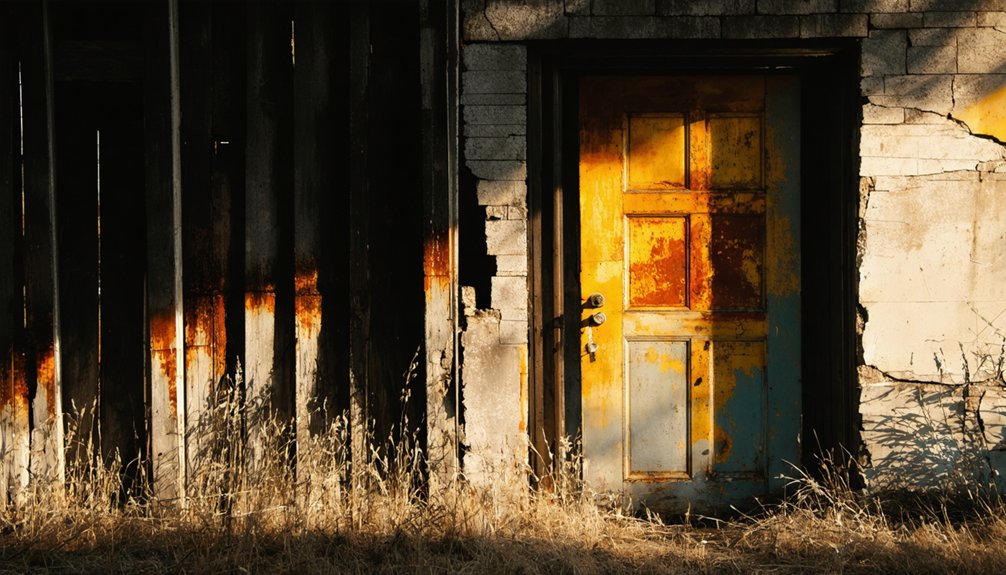
When you step into an abandoned building in Amy, Kansas, your camera becomes a time machine capable of preserving decades of forgotten stories. Respect the historical context while documenting these spaces, keeping ethical considerations paramount—never damage property or remove artifacts.
Master these essential techniques:
- Frame your shots using doorways and windows as natural borders, creating depth that draws viewers into the scene’s narrative layers.
- Embrace long exposures by setting your ISO above 800 and employing flashlights to paint light across weathered textures, revealing ghostly atmospheres without harsh flashes.
- Capture intimate details like peeling paint, rust patterns, and abandoned letters that whisper forgotten lives.
Shoot from low angles and deep corners, transforming ordinary decay into extraordinary visual poetry that celebrates liberation from time’s constraints.
Respecting Private Property and Historical Sites
The crumbling structures of Amy, Kansas, may appear abandoned to the world, but they’re not legally yours to explore without permission. Respecting historical site boundaries keeps you free from trespassing charges and potential eviction notices. Stay on public access areas and verify legal rights before venturing onto private roads or through gated easements.
Avoiding legal disputes over property ownership means recognizing that many ghost town parcels remain privately held, despite their desolate appearance. Boundary disputes are common near rural abandoned sites, so don’t assume that weathered fence lines mark accurate property limits. Regular owner inspections still occur, even at seemingly forgotten locations.
Touch nothing, photograph from public vantage points, and leave only footprints on verified public land. True freedom comes from exploring responsibly within legal boundaries.
Where to Stay Near Ames
Since Amy, Kansas sits in remote countryside, you’ll find your closest accommodations in Ames, Iowa—about 200 miles northeast.
The small towns surrounding Ames offer practical lodging bases, from Gilbert and Nevada motels to Story City’s cozy B&Bs, all within easy driving distance of Iowa’s cultural attractions.
If you’re traveling by RV, you’ll discover campgrounds scattered throughout Central Iowa’s rolling farmland, giving you flexibility to explore the region at your own pace.
Nearby Towns With Lodging
Finding a comfortable bed after exploring Amy’s abandoned streets means heading to one of several small towns within a 30-minute drive. These prairie communities offer authentic Kansas hospitality without the corporate chains.
Your best options include:
- Grenola – The closest town with charming bed and breakfasts housed in restored Victorian homes, where hosts share ghost town lore over breakfast.
- Howard – A slightly larger hub featuring family-owned motels and local dining experiences at Main Street cafés serving genuine home cooking.
- Moline – Known for its welcoming guesthouses and proximity to multiple ghost town sites, making it perfect for multi-day explorations.
Each town maintains that small-town independence you’re craving, with proprietors who’ll gladly direct you to hidden ruins and forgotten cemeteries locals know best.
Camping and RV Options
Waking up to prairie sunrises becomes effortless when you park your RV or pitch your tent near Amy’s weathered ruins. Mill Creek Campground delivers year-round freedom with 47 full-hookup sites and camping amenities like WIFI, laundry, and propane—perfect for extended explorations.
Calvin’s RV Camping offers seven pull-through sites and four tent spots with storm shelter access when Kansas skies turn temperamental. For budget-conscious wanderers, Riverside Estates provides weekly ($100) and monthly ($300) rates that let you settle into ghost town detective work without rushing.
The camping season never closes at Tuttle Creek State Park, where 900 primitive sites await those who prefer solitude over full hookups. Curtis Creek and Rock Creek campgrounds add variety around Milford and Perry Lakes, ensuring you’ll find your perfect basecamp.
Making a Day of It: Other Attractions in the Area
While Amy itself may be little more than a memory on the prairie, the surrounding region rewards curious travelers with an unexpected wealth of destinations.
Natural landscapes beckon within easy reach:
- St. Jacob’s Well — A spring-fed pool 60 feet deep, surrounded by cottonwood trees and limestone formations. This hidden oasis served Native Americans and Texas cattle drovers, accessible via a serene 1.7-mile path from the highway.
- Clark State Fishing Lake — Nestled in Bluff Creek canyon, offering rugged western Kansas vistas. The Jay R. Wood Memorial Nature Trail loops through cottonwood bottomlands where native wildlife thrives, including red-headed woodpeckers and white-breasted nuthatches.
- Kansas’ Largest Barn Quilt — Located on Venture Foods’ north wall at 803 Main Street in nearby Ashland, this roadside marvel celebrates rural artistry.
Frequently Asked Questions
Are There Any Documented Paranormal Activities or Ghost Sightings in Ames?
No documented paranormal activities exist for Amy, Kansas. However, you’ll find plenty of verified hauntings elsewhere in Kansas—from unexplained noises heard at Garnett House to shadowy figures seen at Atchison’s Molly’s Hollow, waiting for your exploration.
Can I Legally Explore Inside the Remaining Limestone Schoolhouse Structure?
You’ll need landowner permission before stepping inside—trespassing laws don’t vanish with ghost towns. The structural stability of schoolhouse ruins makes unauthorized exploration dangerous anyway. Obtaining permission to access the site protects you legally and physically from crumbling limestone hazards.
What Happened to the Records Stolen From Ravana Courthouse?
No evidence exists of stolen records from Ravanna’s courthouse. Historical documents suggest courthouse records storage transferred to Eminence in 1889 when the county seat moved. Missing historical documents likely burned when the abandoned courthouse caught fire around 1900.
How Do I Locate the Ames Cemetery With Crumbled Markers?
You’ll find Ames Cemetery by driving south from Howard on Highway 99, then searching local history archives about Ames Cemetery for map coordinates. The crumbling markers sit 7 miles SSE of Moline, where freedom-seeking pioneers once rested.
Were Any Artifacts From the 1886 or 1902 Fires Preserved?
No preserved artifacts from those fires survived. Historical documentation mentions the 1886 and 1902 blazes destroyed Ames’ buildings and lumber yards, but you won’t find physical remnants—only written records confirm what flames consumed.