You’ll find Arthur 15 miles east of Duncan in Stephens County, accessible via a 2-hour drive north from Dallas on I-35. This freedmen settlement, established when former slaves carved out autonomous communities across Oklahoma, now offers crumbling structures like the auction house where Black ranchers once traded cattle independently. Spring and fall heritage festivals throughout the region bring these ghost town stories alive through demonstrations and firsthand accounts. Connecting Arthur with nearby Boley, Taft, and Rentiesville creates a powerful multi-day journey through Oklahoma’s extraordinary network of over 50 all-black towns that thrived before the Depression scattered their determined populations.
Key Takeaways
- Arthur is located 15 miles east of Duncan in Stephens County, accessible via highways with final navigation on county roads.
- Visit abandoned structures like the auction house, but avoid unstable platforms, toxic tailings, and sharp metal debris hazards.
- Combine Arthur with nearby all-black settlements like Boley, Taft, and Langston for a comprehensive historical road trip experience.
- Spring and fall offer heritage festivals featuring living history demonstrations and community storytelling at Oklahoma’s all-black towns.
- Arthur declined after the Great Depression forced population migration, closing its post office in 1934 after opening in 1890.
Understanding Arthur’s Place in Oklahoma’s All-Black Towns Movement
While Arthur never grew as large as Boley or Langston, this small settlement embodied the same fierce hope that drove former slaves and their descendants to carve out autonomous communities across Indian Territory. You’ll find Arthur’s story woven into the broader tapestry of over 50 all-black towns established between 1865 and 1920, each representing a deliberate choice for self-determination.
The early town development followed patterns you’d recognize from other settlements—freedmen deliberately claimed adjacent parcels during land allotments, creating cohesive neighborhoods. Though Arthur remained modest in size, its residents built essential social institutions: churches anchored spiritual life, schools educated children, and local businesses sustained the economy. These structures weren’t merely functional; they represented freedom from white oversight and the power to shape their own destinies.
Getting to Arthur: Routes and Distances From Major Cities
Your journey to Arthur begins where Oklahoma’s major arteries—I-35, I-44, and US-81—converge toward the windswept plains of Stephens County.
From Oklahoma City, you’ll clock roughly two hours southeast through cattle country and oil derricks, while Tulsa travelers face a longer haul of three-and-a-half hours cutting southwest across the state’s midsection.
Dallas visitors actually have the smoothest run, riding I-35 North straight through red dirt hills and across the Red River into Duncan territory, where rural backroads will lead you the final fifteen miles east to where Arthur once stood.
Major Highway Access Points
The ghost town of Arthur sits tucked away in the rolling prairie landscape about 15 miles east of Duncan, making this your primary navigation anchor for the journey. While specific highway designations aren’t documented in historical records, you’ll find Duncan accessible via US Highway 81, which cuts through central Oklahoma’s heartland.
From there, navigable roads branch eastward into Stephens County’s rural terrain where Arthur once thrived.
Your adventure requires some flexibility—these backroads don’t appear on every GPS system, and seasonal accessibility can shift with Oklahoma’s temperamental weather. Spring rains transform dirt paths into muddy challenges, while summer and fall offer clearer passage.
You’re venturing beyond marked tourist routes here, following traces of forgotten communities through countryside that rewards the persistent explorer seeking authentic historical remnants.
Estimated Drive Times
Planning your ghost town expedition means understanding the commitment required from your starting point. From Oklahoma City, you’ll invest just 1 hour 45 minutes traversing I-35 S and rural backroads—perfect for a spontaneous Saturday adventure.
Tulsa travelers face a longer 3 hours 45 minutes through rolling Oklahoma landscape.
Dallas explorers cross the Red River for a 2-hour northbound journey on I-35 N, while Wichita adventurers commit to 4 hours 30 minutes down US-81 S through prairie country.
Amarillo’s remoteness demands 4 hours via I-40 E. Driving conditions remain straightforward on these well-maintained highways, though Arthur’s final 15-mile stretch requires attention on narrower county roads.
Travel logistics favor spontaneity from Oklahoma City, while distant cities demand proper fuel planning and daylight arrival timing.
What Remains: Exploring the Physical Remnants of Arthur Today
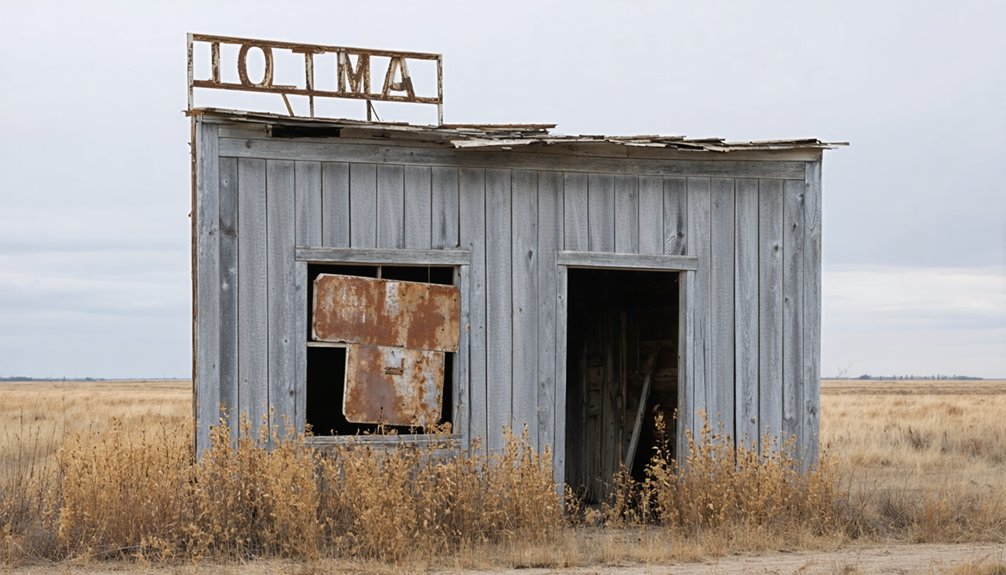
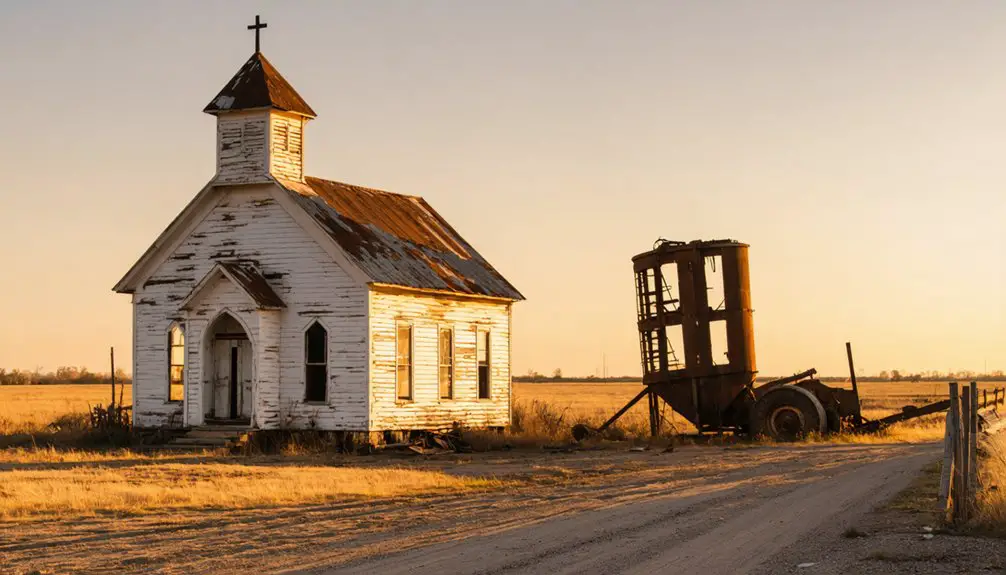
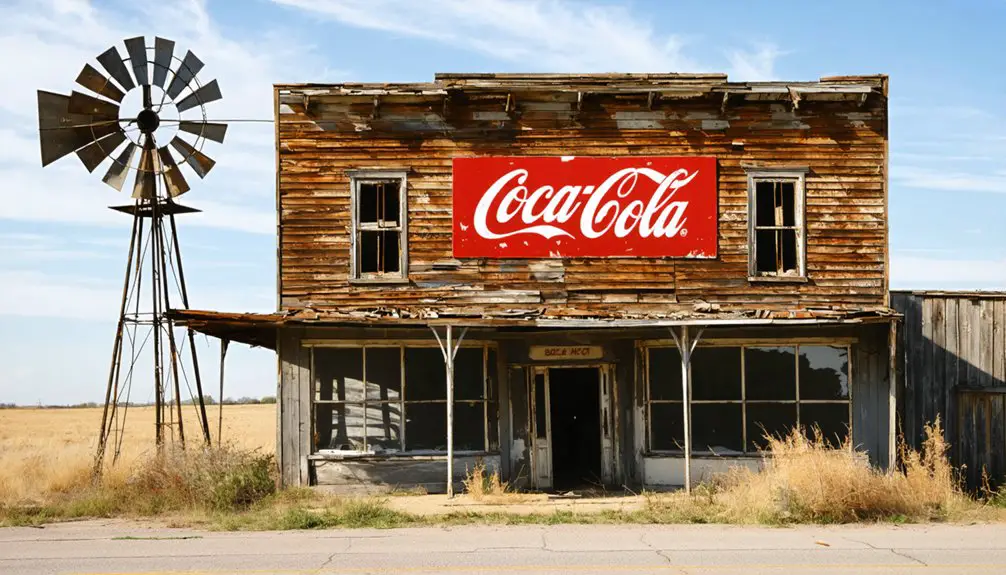
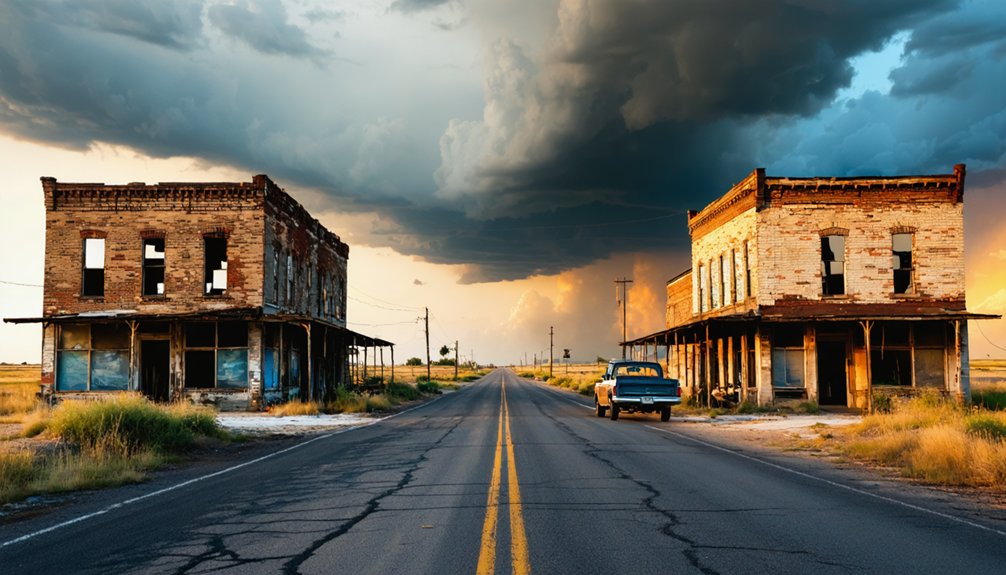
Where does a town go when its people vanish? At Arthur, you’ll find eerie answers scattered across contaminated ground. The auction house on Connell Street now serves as event parking, while the community building stands silent—once buzzing with utility meetings, now empty. These abandoned structures tell stories through peeling paint and warped boards.
Peeling paint and warped boards whisper the stories of a vanished community, leaving only eerie silence where life once thrived.
Your exploration demands caution around three critical dangers:
- Unstable platforms in industrial zones threaten sudden collapse
- Toxic tailings and waste—70 million tons—concentrate heavy metals where children might play
- Underground caverns from room-and-pillar mining create hollow ground beneath your feet
Don’t enter closed buildings. Their loose boards and sharp metal edges pose immediate threats, while 36 million tons of mill sand release windblown dust you shouldn’t breathe. Stay alert, stay visible, stay free.
The Rise and Fall: Economic Forces That Shaped Arthur’s Destiny
When Arthur’s post office opened its doors on May 14, 1890, nobody imagined the building would outlast the community it served. You’re standing where agricultural economy shifts first whispered warnings of decline.
By 1959, sorghum replaced corn across Stephens County—a symptom of deeper economic troubles. New roads carved paths around Arthur, not through it, while railroads blessed neighboring settlements with prosperity you’ll never find commemorated here.
The Great Depression delivered the killing blow. When the post office shuttered on September 29, 1934, population migration patterns accelerated toward cities promising jobs Arthur couldn’t provide. You’ll recognize this story—it’s written across Oklahoma’s landscape in abandoned foundations and reclaimed farmland. Resource exhaustion, market collapse, infrastructure neglect: the classic American ghost town trifecta that turned Arthur from functioning settlement into historical footnote.
Combining Your Visit: Other All-Black Towns and Ghost Towns in the Region
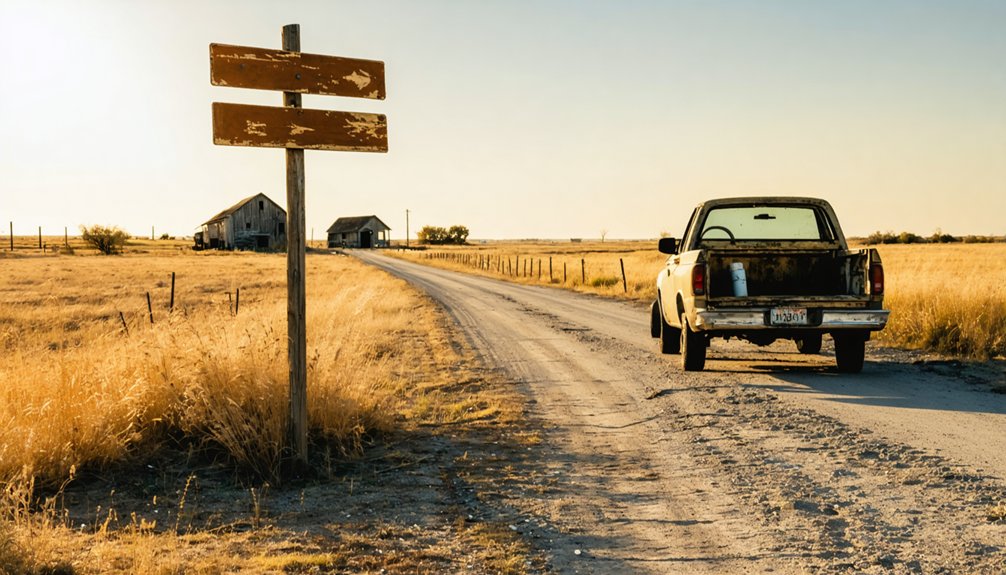
Arthur’s story isn’t solitary—it’s one thread in Oklahoma’s extraordinary tapestry of all-black settlements. You’ll find remnants of over 50 communities where freedmen built autonomous futures beyond Jim Crow’s reach.
Transportation infrastructure shaped these towns’ fates—Boley thrived along the Ft. Smith and Western Railway with 5,000 citizens, while isolated settlements faded when local economy factors shifted agricultural to industrial.
Plan your southeastern Oklahoma route:
- Rentiesville (McIntosh County)—post-Civil War freedmen community still supporting businesses and churches
- Boley (Okfuskee County)—once boasted black-owned banks, telephone companies, electric plants
- Red Bird (Muskogee County)—promoted as “excellent townsite” in 1905, now a whisper
Connect Arthur with Taft and Langston via highways. Each stop reveals how determination couldn’t always overcome Depression hardships, white intimidation, and forced migrations that emptied thriving streets into ghost-town silence.
Best Times to Visit Southeastern Oklahoma’s Historical Sites
You’ll find southeastern Oklahoma’s historical sites most comfortable from October through April, when temperatures hover between 50-70°F and you can explore without battling the region’s oppressive summer heat.
Summer visits mean facing brutal, unfiltered sunlight at abandoned townsite locations like Arthur, where shade is nonexistent and heat advisories are common.
Planning your trip around local heritage festivals—often held in spring and fall—adds living history demonstrations and community storytelling that bring these ghost towns’ past into sharper focus.
Seasonal Weather and Conditions
Before packing your camera and setting off to explore Arthur’s weathered remnants, you’ll want to understand southeastern Oklahoma’s dramatic seasonal swings. Summer brings punishing heat—highs reaching 91°F with 65% humidity that’ll leave you drained by noon. Winter crashes hard with ice storms coating roads and temperatures plummeting to 12°F.
Spring’s beauty carries tornado warnings that can materialize from those innocent-looking clouds.
Your best exploration windows:
- Early fall (September-October): comfortable 70-80°F days, minimal rainfall, reduced humidity
- Late spring (May): moderate temperatures before peak storm season hits
- Avoid late winter through early spring when ice and severe weather trap you indoors
Daily temperature swings of 20-30°F mean layering clothes strategically. Seasonal precipitation patterns shift from spring thunderstorms to summer droughts, shaping your ghost town experience considerably.
Local Events and Festivals
Few things enhance a ghost town exploration like stumbling upon a nearby festival that breathes temporary life into quiet rural roads. While Arthur itself remains frozen in time, you’ll find local tourism opportunities scattered throughout southeastern Oklahoma’s living communities.
Check community event calendars for small-town celebrations—harvest festivals in September, rodeos during summer months, and historical reenactments at preserved sites. These gatherings offer authentic glimpses into rural Oklahoma culture that ghost towns once embodied.
You’ll meet locals who share stories passed down through generations, often revealing unmarked historical locations worth exploring. Time your visit around these events to experience both the silence of abandoned places and the spirited gatherings that remind you why people settled here. It’s this contrast that makes your journey memorable.
Essential Research and Preparation Before Your Trip
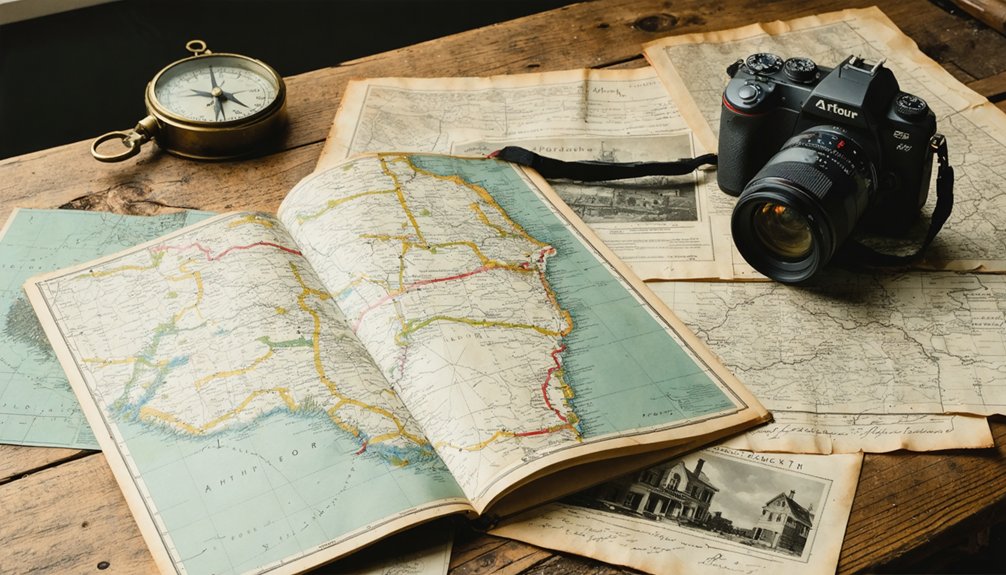
Your pre-trip checklist should include:
- Download offline maps since cell service disappears in rural stretches
- Pack water, first aid supplies, and emergency equipment for isolated terrain
- Research seasonal weather patterns affecting Oklahoma’s unpaved county roads
Study archival photographs and plat maps to identify what remains worth discovering. This homework transforms random wandering into purposeful exploration, helping you locate foundations, cemetery markers, and traces of Arthur’s vanished community without trespassing or endangering yourself.
Nearby Historical Attractions and Points of Interest
The solitude of Arthur’s abandoned streets extends across a region dotted with forgotten communities and historical landmarks that’ll enrich your ghost town expedition. While specific attractions near Arthur remain undocumented in readily available sources, you’ll need to chart your own course through this corner of Oklahoma.
Research the exact location of Arthur first, then map out surrounding towns where cultural heritage still whispers through weathered structures. Look for local historical societies dedicated to community preservation—they’re goldmines of information about nearby forgotten settlements.
Connect with fellow ghost town enthusiasts who’ve explored this territory. Your freedom to discover lies in thorough preparation, transforming uncertainty into adventure as you uncover the hidden stories that conventional travel guides overlook.
Frequently Asked Questions
Are There Restrooms or Facilities Available at the Arthur Ghost Town Site?
No facilities exist at Arthur’s abandoned site—you’ll find no public restroom availability among the crumbling structures. Plan ahead by using nearby lodging options in Duncan, fifteen miles west, where you’ll discover modern amenities before your exploration.
Is Camping Permitted Near Arthur or in the Surrounding Area?
Camping isn’t available at Arthur itself, but you’ll find camping sites nearby at local campgrounds within Wildlife Management Areas and state parks. These designated spots offer hunter camping during open seasons, giving you freedom to explore Oklahoma’s backcountry.
Do I Need Permission From Private Landowners to Access Arthur?
Yes, you’ll need to obtain landowner permission before exploring Arthur’s remains. The site sits on private property with no public access. Respect private property boundaries—trespassing laws apply strictly here, and there’s honestly little left to see anyway.
Are Guided Tours of Arthur Available Through Local Historical Societies?
No guided tours exist—you’ll find only wide-open silence waiting. Instead, you’re free to explore self-guided tours through apps like Pocketsights, though Arthur lacks dedicated audio walking tours. Pure independence defines your ghost town adventure here.
What Safety Precautions Should I Take When Exploring Abandoned Structures?
Avoid entering unstable structures with crumbling roofs or weakened floors. You’ll need proper safety equipment: sturdy boots, gloves, flashlight, and dust mask. Stay alert for hazards like asbestos, sharp debris, and wildlife. When doubt creeps in, admire from outside instead.