You’ll find Arvonia twenty-three miles from Emporia, accessible via S. Arvonia Road’s winding gravel—where five limestone sentinels mark Welsh pioneers’ dreams. Navigate by intuition past Melvern Lake’s overlook to discover the 1883 Calvinistic Methodist Church and John G. Haskell’s stone schoolhouse, monuments to immigrants who chose dairy farming over railroad speculation. Spring wildflowers and fall foliage transform these weathered structures into photographer’s paradise, though sturdy boots and old-fashioned wayfinding skills prove essential. Beyond these prairie ruins, there’s more to uncover about Kansas’s forgotten settlements.
Key Takeaways
- Navigate using S. Arvonia Road and W. 323rd Street; bring MapQuest or TopoZone as GPS may be unreliable on gravel roads.
- Visit five historic buildings including the 1883 Calvinistic Methodist Church and 1872 stone schoolhouse on self-guided tours.
- Plan trips for spring (April-May) or fall (September-October) when weather is comfortable and scenery is most photogenic.
- Wear sturdy hiking boots for dirt roads and bring photography equipment to capture the weathered stone structures.
- Explore Welsh settlement history: founded in 1869, prioritized churches over commerce, survived after railroad dreams failed.
The Welsh Settlement That Time Forgot
When John Mather Jones first surveyed the rolling prairie along the Marais des Cygnes River in 1869, he envisioned more than just another frontier settlement—he dreamed of a New Wales rising from the Kansas grasslands. You’ll find the remnants of this bold experiment twelve miles southwest of Lyndon, where twenty-three Welsh natives had arrived by 1870, drawn by Jones’s pamphlet promising opportunity in Osage County.
Today, you’re exploring a landscape where cultural heritage influences still whisper through abandoned foundations. The 1883 Calvinistic Methodist Church stands as evidence to their forgotten Welsh identity—a congregation that disbanded in 1968 after nearly a century. These pioneers emphasized sobriety, banned alcohol sales, and built two churches before three stores. Their railroad dreams failed, but Welsh families stubbornly remained for generations, cultivating dairy farms along this quiet river valley.
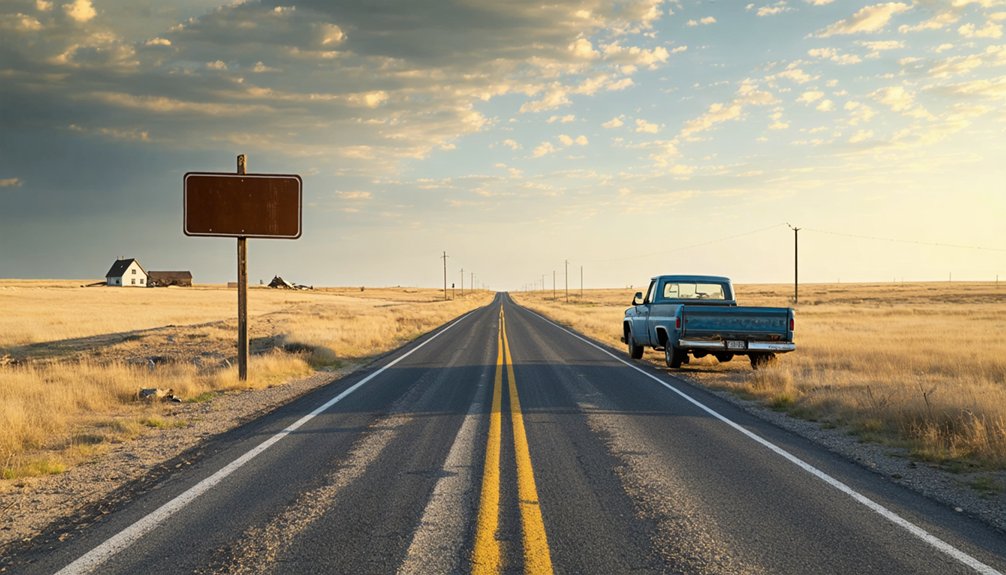
Though modern GPS may confidently guide you to Arvonia’s coordinates in southwest Osage County, reaching this ghost town demands old-fashioned navigation skills and a tolerance for gravel roads that ribbon through prairie farmland. Your primary route follows S. Arvonia Road, where the historic church stands at 32413, while W. 323rd Street leads to the Main House.
MapQuest and TopoZone provide essential interactive layers showing trails winding past Melvern Lake’s overlook. These aren’t scenic byways marked by tourism bureaus—they’re working agricultural roads where you’ll navigate by landmark rather than signage.
The preservation society maintains self-guided tours of exterior sites, including the one-room schoolhouse at 32465 S. Arvonia Road. Pack offline maps; cellular signals fade where Welsh settlers once carved their community from Kansas grassland.
What Remains: Historic Buildings Worth Visiting
Five weathered sentinels mark Arvonia’s footprint across the Kansas prairie, each stone and timber structure whispering stories of Welsh determination that refused to fade with the town itself.
You’ll find the 1883 Calvinistic Methodist Church standing defiant against time’s erosion, its preservation methods funded through Heritage Trust grants. The 1872 Arvonia Schoolhouse—architect John G. Haskell’s stone masterpiece—draws photographers to Kansas’s most iconic one-room classroom, accessible for exterior wandering anytime.
Humphrey’s House, privately owned since the 1860s, reveals restoration challenges through its three renovations. The Arvonia Cabin now shelters modern adventurers at 8103 Arvonia Rd, while the Main House and Township Hall anchor preservation efforts. Each building refuses confinement to history books, inviting you to walk freely among remnants of immigrant dreams.
The Story Behind the Railroad That Never Came
While Welsh pioneers hammered stakes into Kansas prairie soil in 1869, John Mather Jones dreamed bigger than stone churches and tidy farmsteads—he envisioned steam locomotives thundering through the Marais des Cygnes Valley, transforming his speculative townsite into a commercial hub.
Jones’s railroad dreams promised industrial thunder—what arrived instead was silence, and in that quiet failure, a different community took root.
Those railroad expectations never materialized. When tracks bypassed Arvonia entirely, Jones and fellow speculators abandoned their investments. The steam sawmill fell silent. The post office shuttered in 1901.
The railroad’s ghost shaped everything that followed:
- Property values plummeted as speculators fled
- Welsh families stayed, pivoting to cheese factories and dairy farming
- Reading’s station, twelve miles distant, became their lifeline
- Economic shifts preserved agricultural community where boom-town ambitions died
You’ll find Arvonia survived precisely because it failed Jones’s grand vision.
Best Time to Visit and What to Bring
You’ll find Arvonia’s stone schoolhouse most photogenic when spring wildflowers blanket the prairie or fall foliage frames its weathered limestone walls. Pack your camera with extra batteries—the golden hour light transforms these 1880s structures into haunting silhouettes against endless Kansas sky.
Sturdy hiking boots are essential for traversing the dirt roads that lead past the Calvinistic Methodist Church, especially after spring rains soften the clay-packed paths.
Seasonal Weather Considerations
The windswept prairie surrounding Arvonia transforms dramatically with each passing season, and timing your ghost town expedition can mean the difference between a sun-drenched exploration and a shivering retreat to your vehicle. Understanding average precipitation patterns helps you avoid the 82 days of rain or snow that could obscure crumbling foundations.
The seasonal temperature range swings wildly—from January’s bone-chilling 19°F lows to July’s sweltering 94°F peaks—demanding strategic planning for comfort.
Your seasonal survival guide:
- Spring (April-May): Catch 68-77°F perfection before summer’s humid assault arrives
- Fall (September-October): Experience prime 71-85°F exploring weather with fewer storms
- Summer: Battle 89-94°F heat and thunderstorms with early-morning photography sessions
- Winter: Brace for sub-freezing temperatures and 20+ mph winds across exposed terrain
Essential Photography Gear
Weathered wooden frames and crumbling stone foundations demand specialized equipment to capture Arvonia’s haunting beauty before time erases what remains. You’ll need a full-frame camera body with exceptional high ISO performance—those dusty interiors won’t photograph themselves.
Weather sealing importance can’t be overstated when prairie winds kick up Kansas dust around your gear during golden hour shoots.
Pack a wide-angle 14-24mm lens for sprawling main street scenes and a versatile 24-70mm for the schoolhouse and church details. Low light photography techniques become essential inside abandoned structures, so bring that carbon fiber tripod and LED panel.
Don’t forget extra batteries—Arvonia’s remoteness means no quick replacement runs. A polarizing filter cuts window glare while ND filters smooth those dramatic prairie skies into timeless exposures.
Nearby Ghost Towns to Add to Your Route
While Arvonia anchors your ghost town adventure, several forgotten settlements dot the surrounding prairie within an hour’s drive, each offering its own glimpse into Kansas’s vanished railroad era.
Start at Silkville, where ambitious silk production dreams dissolved into history beside Arvonia’s Welsh settlement. Then venture to Peterton, a mile down dusty roads where early settler structures barely whisper their stories near active tracks.
Miller delivers crumbling buildings along the converted Flint Hills Trail, showcasing rural transportation impacts that transformed bustling depots into silent ruins. Finally, explore Padonia in northeast Kansas, where Civil War-era headstones from the 1700s mark one of the region’s oldest settlements.
- Each site reveals different chapters of Kansas’s speculative ventures and railroad dependencies
- Abandoned routes now serve recreational trails connecting ghost town clusters
- Minimal visitor restrictions let you explore at your own pace
- Combined itinerary creates full-day backroad adventure
Photography Opportunities in This Prairie Relic
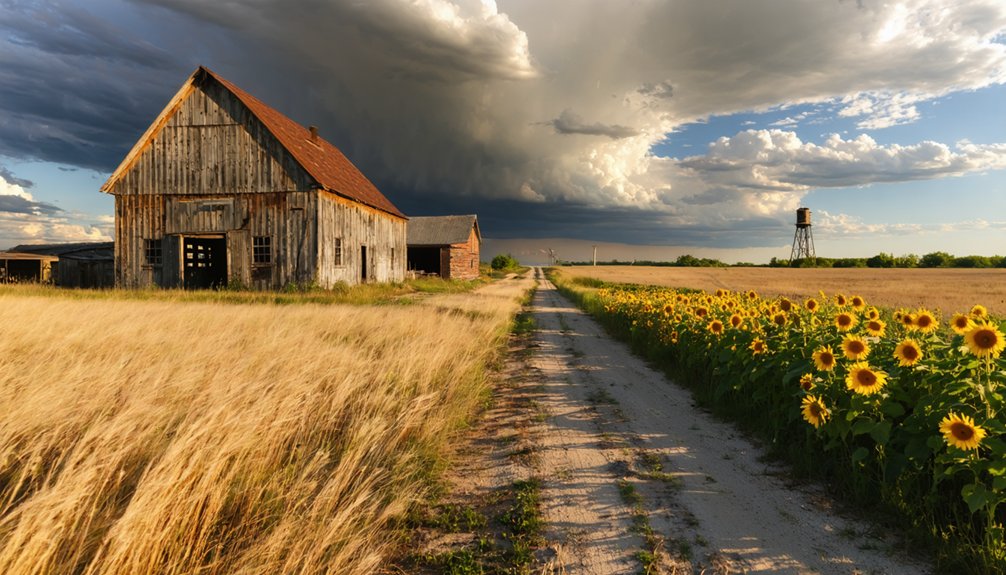
You’ll find Arvonia’s white clapboard church standing like a sentinel against endless sky, its weathered steeple and peeling paint telling stories your camera will hunger to capture.
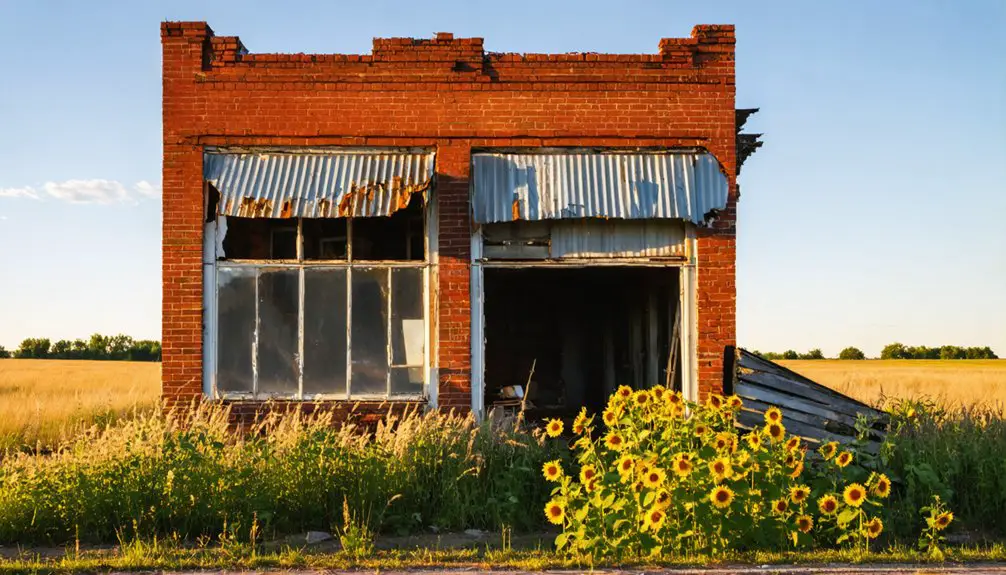
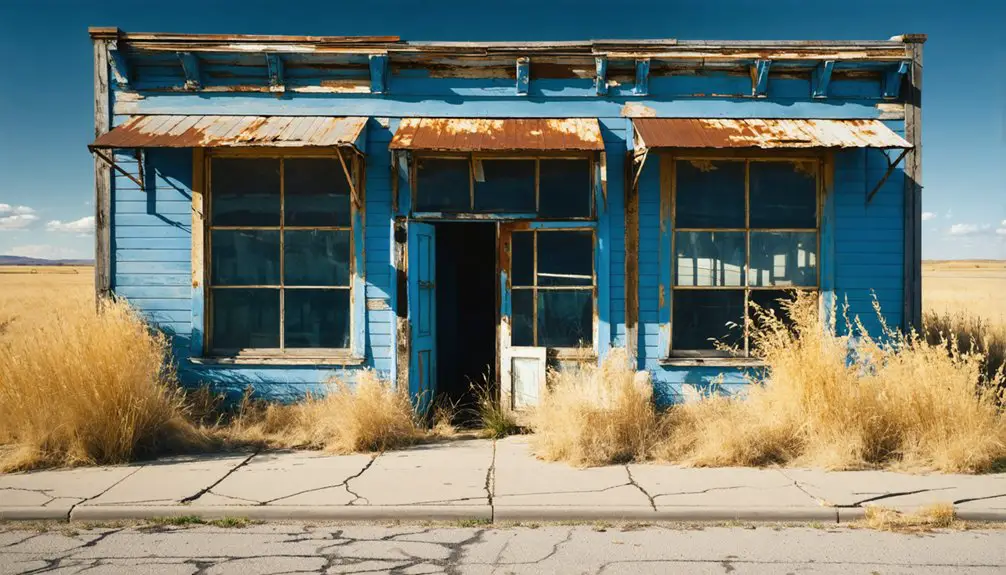
Step through sagging doorframes of abandoned homes where morning light streams through empty windows, illuminating decades of prairie decay in golden dust motes.
Beyond the structures, the Marais des Cygnes valley stretches in waves of tallgrass, offering you sweeping landscape shots that frame this forgotten Welsh settlement against Kansas’s vast, indifferent horizons.
Historic Church Architecture Shots
Rising from the Kansas prairie since 1883, the Calvinistic Methodist Church presents photographers with a compelling study in Welsh-American vernacular architecture. You’ll find cut limestone construction that catches dramatic prairie light, particularly during morning hours when the east-facing structure glows against the surrounding landscape.
The church interior details reveal craftsmanship from devoted settlers who built this worship space to endure—and it did, serving continuously until 1965.
Your architectural material analysis opportunities include:
- Stone texture contrasts between weathered exterior limestone and preserved interior surfaces
- Geometric window patterns that frame prairie vistas and create natural light studies
- Structural elements showing 19th-century construction techniques unique to Welsh settlement communities
- Seasonal documentation during December’s Candlelight Service when ambient lighting transforms the space
Tours are available anytime by appointment.
Abandoned Building Interiors
The Quonset Building behind 323rd Street provides striking contrast—this post-WWII metal arch structure functions as modern community gathering space for festivals and receptions.
Each interior tells Arvonia’s evolution from bustling Welsh enclave to quietly preserved heritage site you’re free to explore.
Rural Prairie Landscapes
Endless wheat fields ripple golden-bronze across Osage County’s flatlands, transforming Arvonia into a photographer’s dream where abandoned structures punctuate horizons of pure agricultural geometry. You’ll capture the schoolhouse against dreamy open skies that stretch uninterrupted to every compass point.
Dirt roads kick up atmospheric dust trails, especially magical during golden hour when dramatic light changes paint the prairie in amber tones. Storm fronts roll across these plains with cinematic intensity, creating moody backdrops for your compositions.
Photography opportunities you’ll discover:
- Black-and-white prairie portraits emphasizing isolation and ramshackle farmhouses against endless horizons
- Sunset sessions at the one-room schoolhouse, Osage County’s prettiest prairie relic
- Storm-chasing frames where incoming weather systems meet extinct town structures
- Native Stone Byway exploration revealing rural stone architecture scattered across northeast Kansas flatlands
Connecting With the Arvonia Historic Preservation Society
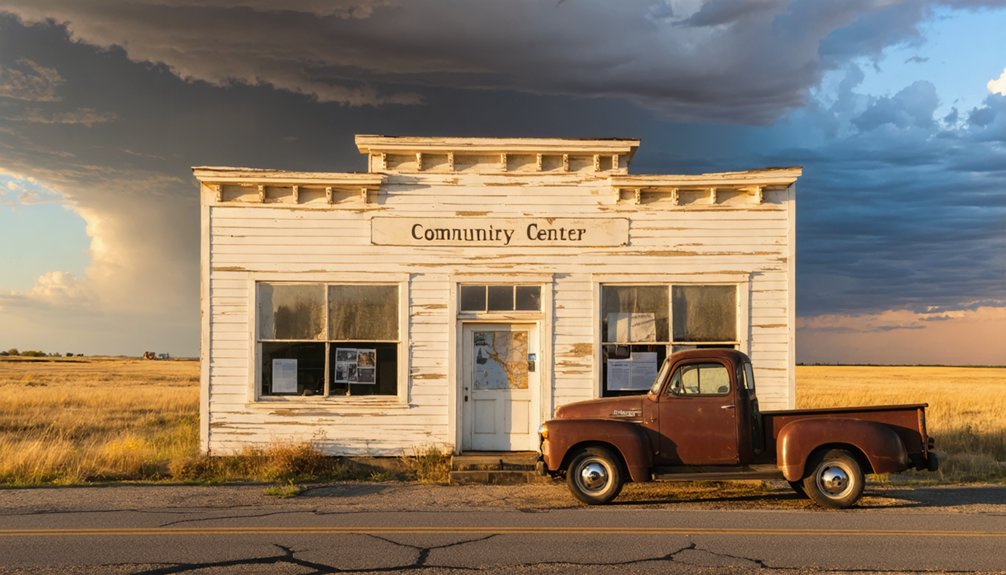
Since its founding in 2014, the Arvonia Historic Preservation Society has stood as the guardian of this Welsh settlement’s fading legacy, breathing life into weathered limestone walls and hand-hewn timber frames that once echoed with the voices of 700 residents.
You’ll witness their ongoing preservation efforts firsthand at the 1872 Main House schoolhouse, where interior tours reveal Kansas’s most photographed one-room classroom. Local community support flows through grants from the Humphreys and Jones trusts, while the Heritage Trust Fund keeps roofs tight and foundations solid.
Ring the bell yourself, photograph century-old stonework, or schedule a visit to explore the Calvinistic Methodist Church. The society welcomes your wandering spirit—exterior access runs sunrise to sunset, appointments grant access to the rest.
Frequently Asked Questions
Are There Any Restaurants or Gas Stations Near Arvonia?
No restaurants or gas stations exist in Arvonia itself—you’ll need to fuel up beforehand. Check nearby accommodations’ availability in Osage City, where local amenities’ open hours vary. This remote freedom comes with planning your provisions wisely.
Can I Camp Overnight Near the Historic Buildings in Arvonia?
You can’t camp overnight at Arvonia’s historic buildings due to camping regulations and historical preservation concerns. Instead, you’ll find freedom exploring nearby Melvern Lake’s shoreline or driving southwest to Argonia River Park’s full-service sites.
Is Arvonia Safe to Visit Alone or at Night?
Arvonia’s isolation means you’ll want personal safety precautions—it’s generally safe, though nearby emergency services are distant. Daytime visits offer better visibility for exploring. At night, you’re truly alone with crumbling structures and endless prairie darkness.
Are There Guided Tours Available for Arvonia Ghost Town?
Yes, you’ll find guided tours availability through the Arvonia Historic Preservation Society at (620) 794-3917. Tour scheduling logistics require appointments for the 1872 schoolhouse interior, though you’re free to explore exteriors independently anytime.
Do I Need Permission to Enter the Historic Buildings?
You’ll need permission for interior access to most buildings. The schoolhouse requires appointments, while the church welcomes visitors during hours. Always obtain property owner’s consent and respect private property boundaries—especially at residential structures like Humphrey’s House.