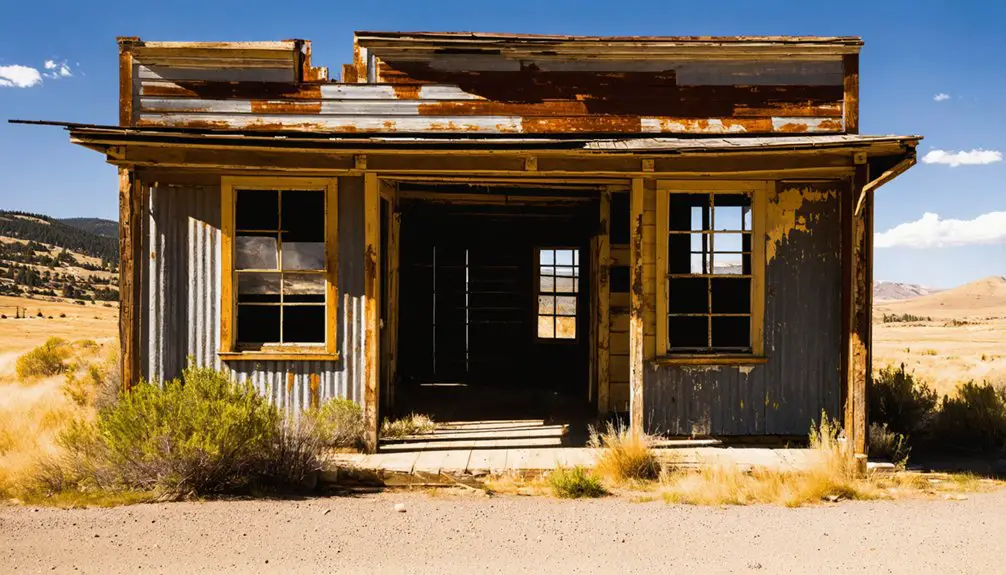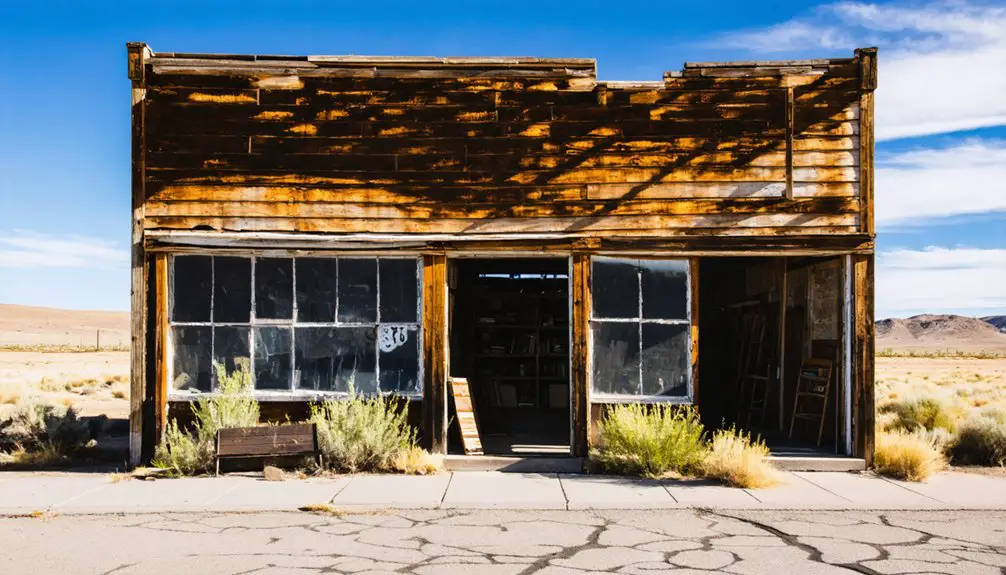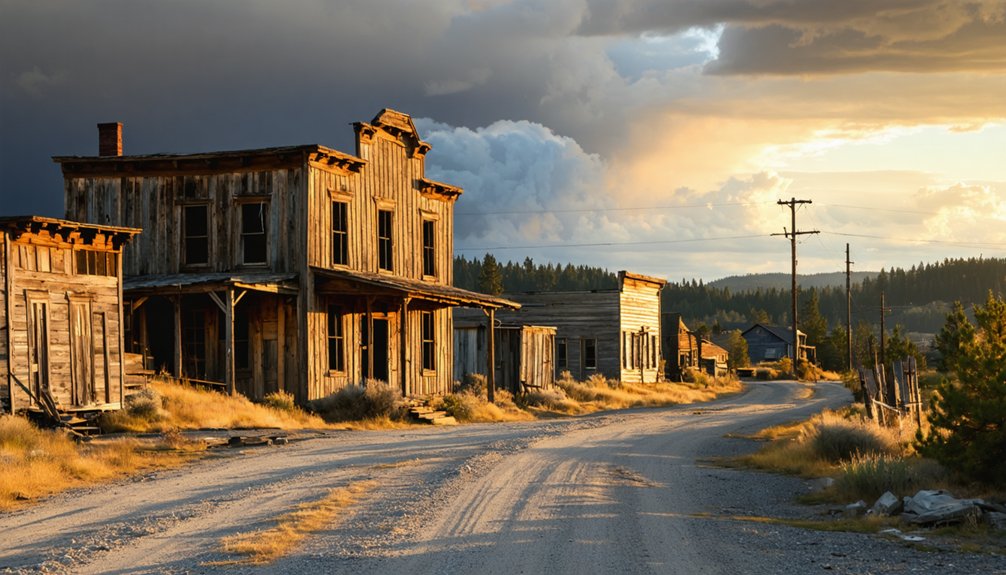
You’ll find Auburn ghost town just 8 miles southwest of Baker City along Oregon Route 7—a 20-minute drive climbing to 4,213 feet through forested Blue Mountain terrain. Park near the 1941 commemorative marker, where empty meadows now blanket what was once eastern Oregon’s largest settlement of 6,000 gold-crazed miners. Bring water and sturdy shoes, as no services exist at this vanished boomtown where weathered cemetery stones whisper stories of boom, bust, and frontier justice that shaped Baker County’s turbulent beginning.
Key Takeaways
- Auburn lies 8 miles southwest of Baker City via Oregon Route 7, a 20-minute scenic drive through Blue Mountains.
- Park near the 1941 commemorative sign; no services exist, only empty meadows and historical markers remain today.
- The site sits at 4,213 feet elevation where 6,000 miners once lived during the 1862-1863 gold boom.
- Visit the weathered cemetery with gravestones from frontier days, offering glimpses into Auburn’s lawless past and diverse population.
- Expect stark emptiness with zero standing structures from this former Baker County seat that vanished after 1903.
Getting to Auburn Ghost Town From Baker City

Nestled eight miles southwest of Baker City in Oregon’s rugged Blue Mountains, Auburn ghost town awaits along a route that’s deceptively simple for modern travelers yet echoes a far more arduous past. You’ll take Oregon Route 7 southwest from Baker City, watching for historical markers off the highway near McEwen.
The twenty-minute drive climbs into forested terrain at 4,213 feet elevation, where abandoned buildings whisper tales of the 1860s gold rush that once drew thousands through these mountains. Back then, supplies traveled 300 brutal miles from The Dalles; today’s paved road follows those original transport corridors that ultimately favored Baker City’s growth.
Fuel up before departing—Auburn offers no services, just raw local history preserved in mountain silence. Park responsibly near the 1941 commemorative sign marking this vanished boomtown.
What Remains at the Historic Site Today
After your twenty-minute journey through the Blue Mountains, you’ll arrive at Auburn to discover something profoundly unsettling: absolutely nothing remains. The landscape that once supported Oregon’s second-largest city—5,000 souls mining fortune from placer deposits—has been reclaimed entirely by nature. Over 150 years of abandonment erased every trace of civilization.
What you’ll find at this historically significant site:
- Empty meadows where thousands once crowded streets seeking gold
- No mining infrastructure, despite Auburn minting the first Pacific Coast gold
- Zero standing structures from the 1862 founding to 1903 post office closure
While archaeology surveys and historical records research confirm Auburn’s existence, you’re left confronting stark absence. This void speaks powerfully about impermanence—a vanished civilization leaving only coordinates and memories.
Auburn’s Rise as Baker County’s First Seat
Within six months of D. Littlefield’s 1862 discovery, Auburn transformed from wilderness into Baker County’s first administrative center. You’ll find it remarkable how county seat politics moved swiftly—the Oregon legislature created Baker County that fall specifically to govern this booming district. Auburn’s designation as county seat formalized its dominance over the region.
The town’s early administrative functions launched with northeastern Oregon’s first post office in November 1862. By then, 6,000 residents demanded real governance, not frontier chaos. You can imagine the challenges: managing disputes among prospectors, recording claims, maintaining order in a settlement built practically overnight.
This wasn’t just about gold—it was about establishing civilization where none existed. Auburn became the political and commercial hub, its infrastructure supporting everything from legal proceedings to mail delivery across 300 miles of rugged territory.
The Gold Rush Boom and Rapid Decline
Auburn’s transformation from boomtown to ghost town happened at breathtaking speed—the population exploded to 6,000 miners by 1863, making it eastern Oregon’s largest settlement.
But within just two summers, prospectors had exhausted the rich placer deposits that drew them here, and the exodus began as quickly as the rush arrived. By December 1864, only 150 souls remained in what had been a thriving city, and the 1870s saw Auburn fade into near-complete abandonment.
Peak Population in 1863
The discovery of gold in early spring 1862 transformed a remote confluence of creeks into one of Oregon’s most populous settlements almost overnight. Early population growth exploded as word spread of Auburn’s rich placer deposits, drawing approximately 5,000 to 6,000 fortune-seekers by 1863. You’d have encountered a bustling frontier metropolis where mining industry impacts shaped every aspect of daily life.
This remarkable concentration of humanity included:
- Men from across the continent converging on 100-foot-square claims, working at least one day in six to maintain ownership
- Women capitalizing on scarcity by operating boardinghouses, laundries, and hotels in a male-dominated landscape
- Chinese miners explicitly barred from purchasing claims under discriminatory district laws
The Oregon Steam Navigation Company’s passenger numbers tell the story—from 10,500 in 1861 to 36,000 by 1864.
Ghost Town by 1870s
Just four years after Auburn’s founding, the glittering promise that drew thousands to these windswept gulches had already begun to fade. By December 1864, former population figures had plummeted to just 150 souls—a ghost of the bustling camp that once hummed with gold fever. When the county seat shifted to Baker City in 1868, Auburn’s fate was sealed.
The nature reclamation process moved swiftly through these abandoned streets. Chinese miners worked the tailings through the 1870s, gleaning what others left behind, but even they eventually departed. By 1903, the post office shuttered its doors for good. Where merchants once hawked supplies hauled 300 miles from The Dalles, silence settled over empty foundations. By the 1940s, not a single building remained standing.
Dark Tales and Frontier Justice
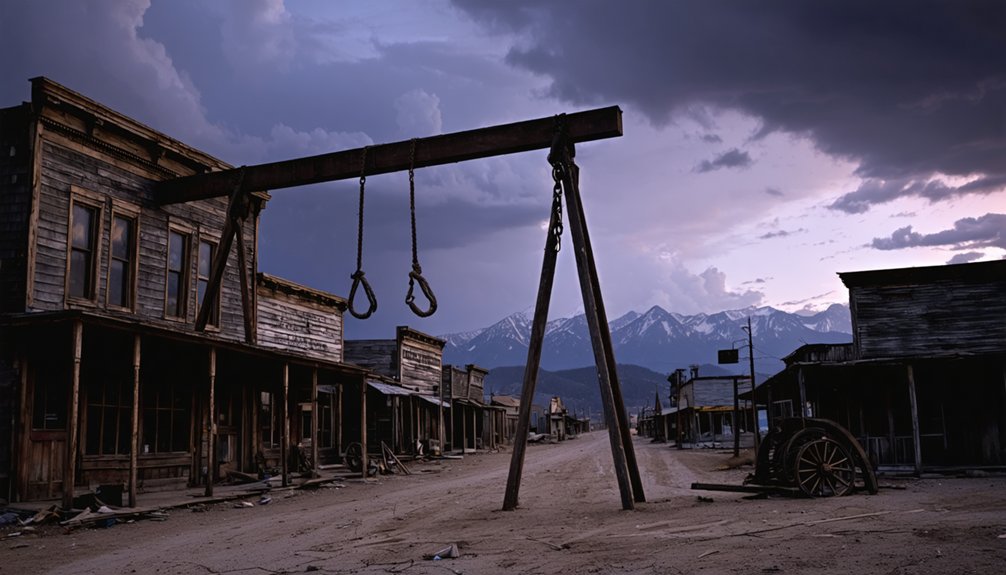
Gold fever attracted fortune-seekers by the thousands, but Auburn’s remote location—300 miles from the nearest county seat at The Dalles—created a lawless vacuum where justice bent to expedience.
You’ll discover tales of improvised vigilante justice that kept murder rates surprisingly low through harsh sentencing—though ferociousness fell disproportionately on foreigners, including Frenchmen, Mexicans, and Chileans.
One infamous case reveals the era’s moral flexibility: a miner arrested for killing his tent partner claimed self-defense. Townspeople hired two escorts for $50 to transport him to The Dalles for trial. All three vanished, later spotted prospecting together in Idaho with brand-new tools.
Community enforcement reflected mining camp realities:
- Swift retribution replaced formal legal proceedings
- Rough tribunals dispensed immediate sentences
- Distance from official authority enabled extrajudicial measures
Exploring the Cemetery and Grave Markers
Beyond the scattered foundations of Auburn’s vanished streets, a windswept mile separates you from the town’s most enduring memorial—its cemetery. Here lie the notable gravesites of Henry Griffin, whose fraudulent gold claims sparked the 1861 rush, and the markers of Henry Labaree and Jack Desmond—Spanish Tom’s 1862 murder victims. The historical significance extends beyond these named stones; ground dips reveal anonymous graves where coffins have collapsed beneath decades of mountain winters.
Originally three cemeteries stood here—one for whites, two for Chinese miners. The Chinese remains were exhumed and repatriated by the early 1900s, one cemetery literally washed away during subsequent gold dredging. What remains offers stark testimony: weathered markers amid sagebrush, silent witnesses to Auburn’s violent, vanished glory.
Best Time to Visit and What to Bring

Planning your Auburn expedition requires careful consideration of Oregon’s mountain climate and the challenges of reaching this isolated site. Seasonal weather conditions shift dramatically—fall moisture brings hillsides alive with color, while winter’s overcast skies enhance the ghost town’s eerie atmosphere. Early spring offers cooler temperatures and solitude before summer’s heat arrives.
Auburn’s dramatic seasonal shifts create distinct experiences—from fall’s vibrant colors to winter’s haunting atmosphere and spring’s peaceful solitude.
Remote trail accessibility demands preparation. Pack these essentials:
- Sturdy boots and layered clothing for traversing rugged miner-established routes and adapting to mountain temperature swings
- Camera and flashlight for capturing weathered structures and safely exploring dark building interiors
- Water, snacks, and detailed maps for long drives through isolated terrain where services don’t exist
September delivers ideal conditions—lingering warmth, clear trails, and freedom from crowds. Always check weather before departing, as snowfall transforms paths into treacherous passages.
Frequently Asked Questions
Are There Any Nearby Ghost Towns to Visit in the Same Trip?
You’ll find Cornucopia’s decommissioned mining camps in the nearby Wallowa Mountains, once Oregon’s richest gold mine. Galena’s nearby abandoned homesteads hide deep in the Blue Mountains, rewarding your freedom-seeking spirit with authentic remnants of Eastern Oregon’s untamed mining past.
Is Camping Allowed Near the Auburn Ghost Town Site?
Ironically, you’ll find freedom in nature’s rules here. Camping regulations near Auburn’s ghost town remain unclear due to site accessibility challenges and limited official information. You should contact local Oregon land management offices before planning your overnight adventure there.
Were Any Famous Historical Figures Associated With Auburn’s Gold Rush?
Auburn’s gold rush attracted notable prospectors who struck it rich, like Henry Griffin and D. Littlefield, though none achieved lasting fame. The Oregon Trail’s influence on the town’s growth brought thousands of fortune-seekers to these wild, lawless diggings.
What Happened to Auburn’s Buildings and Building Materials?
Weathered wooden structures succumbed to nature’s relentless assault. Abandoned buildings’ materials deteriorated through decades of exposure, collapsing into rubble by the 1940s. Today, you’ll find only deterioration of structures—gravestones and scattered debris marking Auburn’s forgotten freedom-seeking spirit.
Are There Guided Tours Available for the Auburn Ghost Town?
No guided walking tours of the town exist at Auburn’s remote location. You’ll explore independently, though self-guided historical signage around the site is minimal. This wild, untamed ghost town rewards adventurous spirits who crave unscripted discovery.