You’ll find Aura at coordinates 32°57′17″N 110°11′44″W in Graham County, where crumbling saloon walls and scattered foundation stones mark what was once a 150-resident supply hub from 1906. Since it’s privately owned with no public transport access, you’ll need permission to traverse the terrain, sturdy hiking boots for gravel trails, and sun protection for those 300+ sunny days. Winter and spring offer ideal visiting conditions with 0.70-inch April precipitation, and the nearby Safford area provides your supply hub before exploring what made this middleman town survive when neighboring extraction camps couldn’t.
Key Takeaways
- Aura is located at coordinates 32°57′17″N 110°11′44″W in Graham County, near the old Geronimo railroad station site.
- The privately owned ghost town requires permission to access, with Safford providing the nearest supply hub for provisions.
- Visit during winter or spring for ideal conditions, with April offering 0.70-inch precipitation and 10-mile visibility.
- Bring sturdy hiking boots, sun protection gear, and photography equipment for exploring crumbling saloon walls and scattered foundations.
- Combine your trip with nearby ghost towns including Fortuna, Swansea, and Gila City for a comprehensive exploration experience.
Location and How to Get There
Aura’s remote location sits at coordinates 32°57′17″N 110°11′44″W in Graham County, Arizona, perched at 3,840 feet above sea level where the desert floor begins its gradual climb toward surrounding mountain ranges. You’ll find this ghost town near the old Geronimo railroad station site, though stagecoach service vanished decades ago and limited public transport won’t get you anywhere close today.
Privately owned access means you’re traversing terrain where permission matters—this working ranch doesn’t welcome trespassers. Plot your route using GPS coordinates on topographic maps, pack your 4WD, and verify property boundaries before venturing off-trail.
The Safford micropolitan area provides your nearest supply hub, but expect isolation once you head toward Aura’s weathered remains among Arizona’s scattered ghost town cluster.
The History of Aura’s Rise and Fall
When prospectors staked out a new townsite in March 1906, they weren’t chasing fresh ore—they’d watched the Bull Run district’s first boom fizzle decades earlier between the 1860s and 1880s. Instead, they built Aura two miles below old Columbia as a supply center, betting on the district’s 1905 revival.
You’d have found 150 residents by 1907, their economic diversity stretching beyond pickaxes: two stores, boarding houses, a saloon, and stage line connections linking Tuscarora to Mountain City. The social structures of school and post office proved civilization had arrived—however briefly.
What Made Aura Different From Other Mining Towns
Unlike the dozens of pickaxe-and-prayer camps scattered across Nevada’s ranges, Aura carved its niche as the district’s middleman. While prospectors chased silver veins elsewhere, you’d have found Aura thriving on what miners needed most: supplies, connections, and a reliable stage stop. Its 150 residents understood something fundamental about frontier survival—sometimes the real money wasn’t underground.
The town’s relative economic activities centered on logistics rather than extraction. You could’ve stocked provisions, caught the next stage, or brokered deals here around 1907. This focus on regional transportation dynamics meant Aura’s fortunes weren’t chained to ore prices alone. When mines went bust elsewhere, the supply chain kept rolling. That independence made Aura different: it lived by the road, not by the claim.
Peak Years: Life in Early 1900s Aura
By March 1906, wooden storefronts lined Aura’s main thoroughfare—two general stores competing for miners’ coin, a pair of boarding houses with creaky beds and questionable stew, and a saloon where gossip traveled faster than the stage to Tuscarora.
You’d find a social composition unlike typical extraction camps: schoolteachers boarding alongside prospectors, postal clerks sharing whiskey with merchants. This commercial diversity created economic resilience when neighboring mines faltered.
The Decline of Mining Operations
As you stand among Aura’s weathered foundations, you’ll notice the silence that settled over this camp when mining operations ceased by 1920. The technological breakthroughs transforming nearby Ajo—with its railroad and massive leaching plants processing millions of pounds of copper—never reached this small prospector’s settlement, where inadequate ore processing and water scarcity sealed its fate.
When the post office closed its doors, it severed Aura’s last lifeline to the outside world, leaving miners’ families no choice but to pack their belongings and abandon their desert dreams.
Operations Ceased by 1920
The once-bustling operations at Aura couldn’t sustain themselves beyond the close of World War I. By 1920, mining had dwindled to scattered leasing arrangements, and within a year, every business had shuttered its doors. The reasons behind operational cessation were straightforward—limited high-value ore output simply couldn’t justify continued investment in the district’s infrastructure.
The impact on local community was swift and definitive. Families who’d built lives around the mines packed up and moved on, chasing opportunities elsewhere. The school held out until 1927, serving the last handful of stubborn homesteaders who hadn’t yet admitted defeat. Today, you’ll find only stone walls from the old saloon standing sentinel over what was once a community of 150 souls pursuing their fortunes in Nevada’s unforgiving terrain.
Post Office Closure Impact
Mail service ended in 1921, severing Aura’s final administrative thread to the outside world. You’ll find this closure marked the definitive end for operations that were already gasping their last breath.
The post office’s disappearance created cascading effects:
- Mining labor impacts intensified as workers couldn’t receive correspondence or wages reliably, pushing them toward towns with functioning infrastructure
- Supply chain disruptions made ordering equipment and materials nearly impossible without postal coordination
- Communication with investors and buyers vanished, isolating operators from capital markets
- Legal documents, mining claims, and business transactions required postal verification that no longer existed
Without this connection, you’re looking at a settlement that lost its reason to persist—remote, abandoned, and forgotten within months.
What Remains at the Site Today
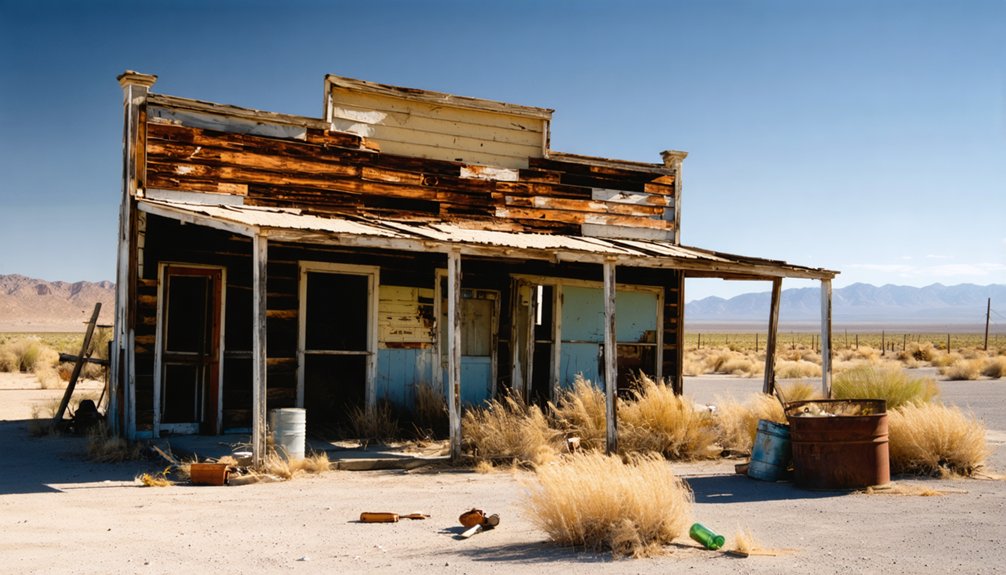
You’ll find disappointingly little when you arrive at Aura—a few crumbling saloon walls poking through desert brush and scattered foundation stones that hint at where buildings once stood. Unlike the well-preserved structures at nearby Vulture City with its intact assay office and blacksmith shop, Aura’s remains are skeletal at best, more suggested than seen.
The harsh Arizona sun and decades of neglect have reduced this once-bustling copper camp to archaeological whispers rather than the dramatic ghost town facades you might expect.
Standing Saloon Wall Fragments
Crumbling adobe walls rise up from the desert floor at Aura’s old saloon site, their sun-bleached surfaces telling stories of rowdy miners who once bellied up to the bar. These weathered fragments showcase architectural features of saloons from Arizona’s territorial era, standing as a memorial to the town’s brief but vibrant past.
When you visit, you’ll notice:
- Partial doorway frames revealing the saloon’s original entrance
- Window openings positioned to catch cross-breezes in the desert heat
- Interior wall segments showing attachment points for the wooden bar
- Foundation stones marking the building’s full footprint
The challenges in preserving ruins like these are evident—erosion, vandalism, and harsh weather constantly threaten what remains. Touch nothing; photograph everything. These fragile walls won’t stand forever.
Minimal Structural Evidence Remains
Beyond the saloon’s crumbling adobe, Aura offers little else to modern explorers. You’ll find minimal evidence of the bustling mining camp that once thrived here—just scattered foundation stones and weathered wood fragments half-buried in desert sand. The limited remains tell a stark story of abandonment and nature’s reclamation.
I’ve walked these grounds twice, searching for something more substantial, but time’s erased most traces. A few rusty tin cans, broken glass catching sunlight, and depressions where structures once stood—that’s your reality here. Don’t expect Instagram-worthy ruins. What you’ll discover is profound solitude and the raw truth that nothing permanent exists in Arizona’s unforgiving landscape. Bring water, wear sturdy boots, and embrace the emptiness. That’s Aura’s real gift.
Best Time to Visit and What to Bring
When temperatures plummet to 15°F on January mornings in The Ghost area, the cold air sharpens every detail—gravel crunches louder underfoot, shadows stretch longer across weathered timber, and the patina on abandoned structures reveals itself without summer’s blinding glare.
Winter and spring offer ideal conditions for self guided tours, letting you explore historical perspectives at your own pace without battling 105°F summer heat.
Pack strategically for your adventure:
- Layered clothing for temperature swings from 15°F to 62°F
- Sturdy hiking boots for traversing gravel trails and uneven terrain
- Sun protection gear including hats and sunscreen for 300+ sunny days
- Wind-resistant jacket for spring gusts reaching 12 mph
April’s 0.70-inch precipitation and 10-mile visibility create perfect conditions for discovering Aura’s remnants.
Nearby Ghost Towns and Attractions
Your exploration of Aura doesn’t end at its own scattered foundations. The surrounding area landscape reveals Fortuna just miles away, where you’ll walk interpretive trails past a century-old general store and reservoir ruins.
Swansea’s eerie industrial skeleton stands preserved thirty miles east of Parker, its machinery frozen in time against desert backdrops where local wildlife species—roadrunners and coyotes—reclaim territory.
Gila City offers stark contemplation of nature’s power, wiped clean by the 1862 flood. You’re free to roam between these forgotten outposts, each telling different chapters of boom-and-bust cycles.
The Marines maintain Fortuna’s trails, but most sites require your self-reliance and navigation skills. Pack water, respect boundaries, and let curiosity guide your route through Yuma County’s vanished dreams.
Photography Tips and Safety Considerations
Capturing Aura’s haunting beauty demands equipment that balances capability with portability—a truth I learned after lugging a heavy DSLR kit across a scorching mile of desert rubble only to find the best shots required scrambling up unstable hillsides. Pack light but smart: a mirrorless camera with wide-angle lens, tripod for those golden hour exposures, and powerful headlamps for interior exploration.
Heavy gear promised perfect shots until desert reality hit—now I chase ghost towns with half the weight and twice the creative freedom.
Essential preparation checklist:
- Verify site accessibility and weather conditions beforehand—spring and fall offer ideal temperatures
- Bring high-clearance vehicle for rough terrain approaches
- Watch for rattlesnakes and wild horses while composing shots
- Allocate minimum two hours at sunrise or sunset for vibrant lighting
Long exposures reveal cloud movement across crumbling facades, while strategic flashlight work illuminates forgotten details inside abandoned structures.
Frequently Asked Questions
Are There Any Guided Tours Available for Visiting Aura?
No guided tours exist for Aura since it’s not a documented Arizona ghost town. Check your nearest visitor information center for authentic alternatives like Vulture City’s flashlight tours or Jerome’s guided walking tours, where you’ll experience real abandoned mining history.
Can I Camp Overnight Near the Aura Ghost Town Site?
Sleep under Arizona’s starlit canvas! You’ll find overnight accommodation options on nearby BLM land following camping regulations: 14 days maximum within 28 days. Pack everything in and out—your freedom demands responsibility in this untamed desert landscape.
What Permits or Permissions Are Needed to Explore Aura?
You’ll need to check access restrictions with local BLM offices before exploring Aura, as ghost towns often sit on public or private land requiring local authority approval. Always verify current regulations to ascertain you’re exploring legally and responsibly.
Are There Any Restaurants or Gas Stations Close to Aura?
Aura’s remote desert location means you’ll find no nearby dining options or local fuel sources. Stock up in Sedona before heading out—pack plenty of water, snacks, and fill your tank. You’re venturing into true wilderness territory here.
Is Metal Detecting Allowed at the Aura Ghost Town Location?
Metal detector regulations aren’t specifically documented for Aura, but you’ll need landowner permission on private property. Historical artifact preservation laws generally prohibit removing items from ghost towns, protecting Nevada’s 1906-era heritage for future adventurers like yourself.