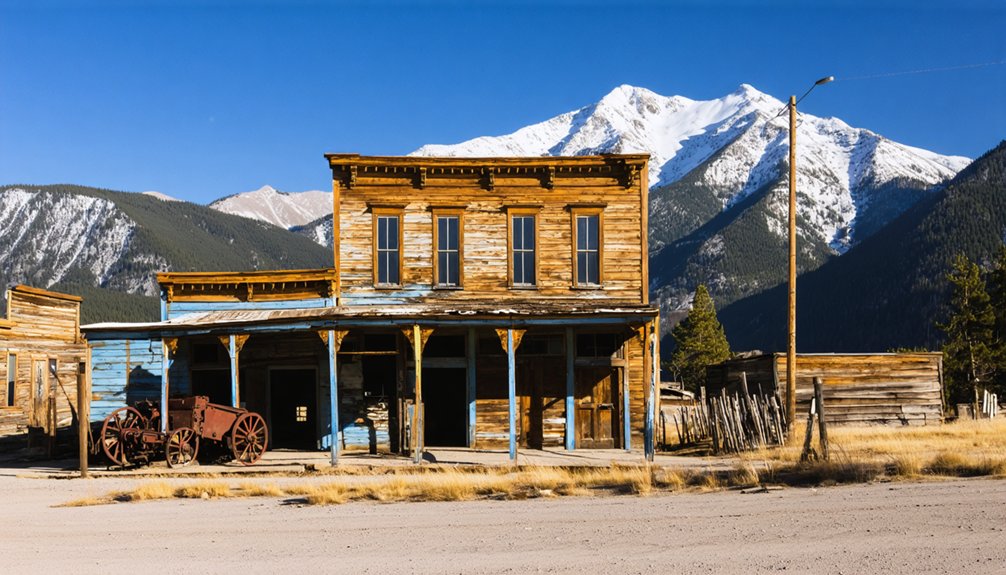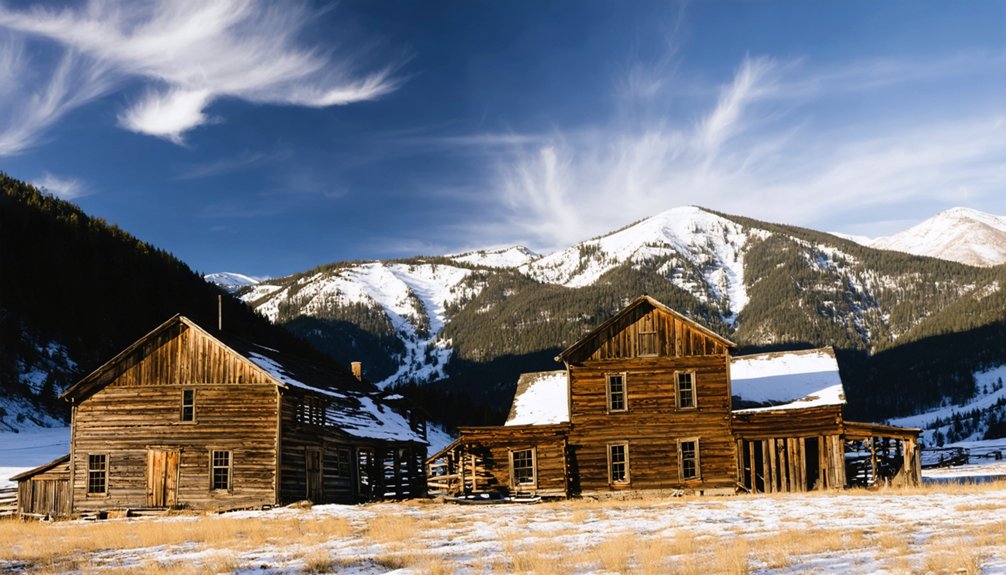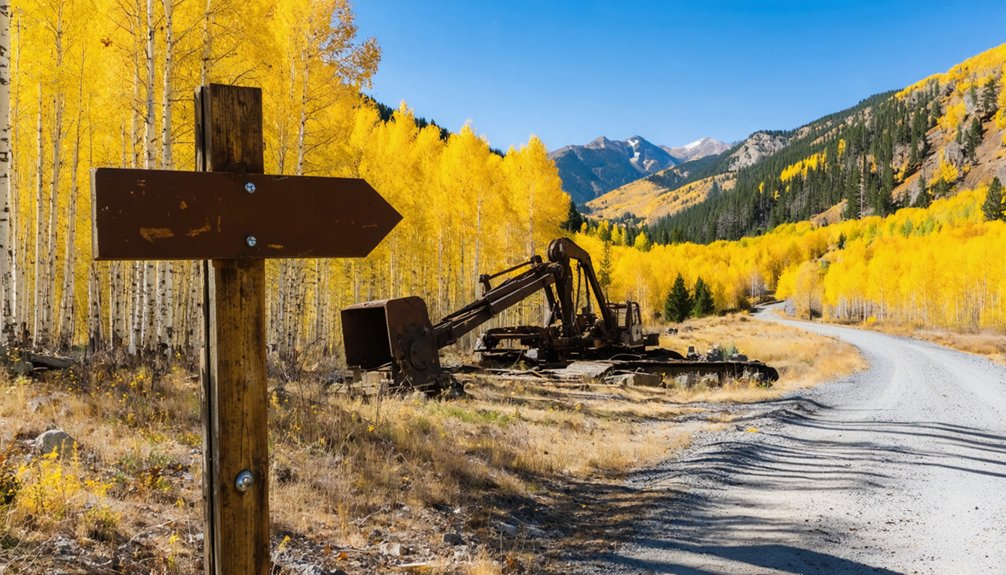
Your Bailey ghost town adventure starts an hour west of Denver, where Highway 285 opens into rugged mountain country dotted with mining ruins. Base yourself in Bailey—a former ranching outpost turned railroad hub—then tackle the washboard road to Crossons Ghost Town, where weathered cabins and a sealed mine tell stories of gold theft and abandonment. Hall Valley’s silver-era remnants lie nearby, offering crumbling foundations and century-old artifacts scattered across sweeping valleys that’ll transport you straight into Colorado’s boom-and-bust past.
Key Takeaways
- Access Crossons Ghost Town via Highway 285, 14 miles west of Bailey, then 1.5 miles on CR 60 Hall Valley Road.
- Plan a 5-mile roundtrip hike with 2.5-mile descent through forested terrain to reach the townsite from the trailhead.
- Explore weathered structures, mining equipment, historic artifacts, and the sealed Crossons Mine at the valley site.
- Visit Hall Valley area to see Colonel Hall’s 1872 silver discovery site and remnants of failed smelter operations.
- Bring a 2WD vehicle for access road; high-clearance recommended but not required for the smooth hiking trail.
Bailey’s Transformation From Ranch to Transportation Hub
The Denver & South Park Railroad‘s arrival in 1878 transformed Bailey from scattered ranching outposts into a genuine transportation hub, though you’d hardly recognize it as the sleepy mountain town it’s today. Before steel rails, you’d have bounced along stagecoach routes serving gold-crazed miners heading to their claims. The post office opened that November, marking Bailey’s official arrival on Colorado’s map.
Service sector development followed the rails—first dude ranches, then practical businesses like Bell Oil’s 1953 station, which replaced a struggling resort operation. Municipal infrastructure growth came later, with the Bailey Water and Sanitation District finally delivering reliable wells and sewer lines.
Crossons Ghost Town Trail Access and Hiking Details
You’ll drive roughly 14 miles west from Bailey on Highway 285 until you reach the CR 60 Hall Valley Road area, where a washboard road leads 1.5 miles to a parking gate—manageable in any 2WD vehicle despite the bumpy approach.
From there, the real work begins: a steep 2.5 to 4-mile descent through forested terrain into the valley where Crossons sits, offering spectacular mountain vistas that’ll make you forget about the challenging uphill return.
The trail follows an old mining road that cuts through private land generously open to the public, so respectful behavior keeps this hidden gem accessible for future ghost town hunters.
Getting to the Trailhead
Nestled within the Buffalo Creek Recreation Area, Crossons Ghost Town sits roughly an hour’s drive from Denver—close enough for a day trip yet worlds away from urban sprawl. You’ll navigate an old mining road through thick forest, covering 1.5 miles to reach the gate.
The trail conditions start rough—washboard sections that’ll rattle your fillings—but once you’re on Crossons Trail proper, it’s surprisingly smooth sailing. Vehicle requirements favor high-clearance rigs, though the trail itself poses no real obstacles. This seclusion keeps crowds thin.
From the gate, you’ll hike another 2.5 miles down into the valley where the ghost town awaits. The views? Spectacular mountain vistas that make every jarring bump worthwhile. It’s your ticket to untamed Colorado backcountry.
As you explore the history of Ula, Colorado ghost town, you’ll uncover remnants of a once-thriving mining community. Each step reveals intriguing artifacts and stories of the past, inviting you to imagine the lives once lived in this remote setting. Make sure to have your camera ready; the juxtaposition of decaying buildings against stunning natural backdrops creates a striking visual narrative.
Valley Hike Requirements
Once you’ve conquered that bumpy access road and reached the gate, your real adventure begins on foot. The trail length requirements aren’t demanding—just 2.5 miles one way into the valley where Crossons Ghost Town awaits. I found the path surprisingly smooth compared to that brutal drive in, with no technical challenges to slow you down.
Gate access protocols are straightforward: respect the land, and it’ll remain open for all who crave this secluded escape.
The roundtrip totals about 5 miles of pure freedom, winding through forests with expansive mountain vistas. This valley descent delivers fantastic views throughout, and the minimal elevation change makes it accessible for most hikers.
Just remember—this private property stays public thanks to respectful visitors like you.
What to Expect at the Crossons Townsite Ruins
When you reach the townsite, you’ll find weathered house frames and crumbling foundations scattered across the valley floor, half-reclaimed by wildflowers and scrub pine.
The trash piles near the old railroad base might seem unpromising at first, but I’ve watched visitors uncover rusted piano parts and century-old bottles after just a few minutes of careful searching.
Stand at the damaged bridge and look back toward the trail—the sweeping valley views that drew settlers here still take your breath away, though now they frame only silence and ruins.
Historical Remnants and Artifacts
The Crossons townsite greets you with weathered structures that tell stories of Colorado’s mining past through their decay. You’ll discover preserved mining equipment scattered near the cabin behind the main structures, where serious prospecting once took place. The historic cabin artifacts include remnants from daily life—trash piles reveal surprising treasures like piano parts, evidence of settlers who brought civilization to this remote valley.
Near the railroad base toward Bailey, you’ll find collections of artifacts left accessible for exploration. The blasted-shut Crossons Mine stands as a dramatic reminder of the gold theft that ended operations here. These tangible pieces of the 1880s settlement remain protected on private land, allowing you to walk freely among genuine frontier history without museum barriers.
Valley Views and Landscape
Beyond these historical treasures, your journey to Crossons rewards you with stunning natural scenery that rivals the artifacts themselves. You’ll wind through dense montane forest dynamics initially, where towering pines create a tranquil canopy overhead.
The landscape then dramatically shifts to burn-scarred terrain, showcasing post fire landscape evolution in its rawest form. These open expanses reveal nature’s resilience while offering unobstructed views of Pike’s Peak and distant summits.
Just before reaching the gate, breathtaking vistas unfold across the undulating valley below. Your 2.5-mile descent reveals sweeping panoramas that make every step worthwhile.
The townsite itself nestles deep within this secluded basin, where forested edges meet open meadows. This remote setting amplifies your escape from civilization—exactly what freedom-seekers crave when exploring Colorado’s forgotten corners.
As you approach the Crossons trail access road, your vehicle will immediately encounter the notorious washboard surface that has tested the patience of countless ghost town seekers before you. This corrugated terrain demands respect—slow your speed to protect both your sanity and suspension.
After enduring 1.5 miles of bone-rattling ridges, you’ll reach the gate where the real journey begins.
Gate Parking Essentials:
- Park at the gate for fantastic valley views and secure vehicle access
- Prepare for a 2.5-mile descent into the ghost town valley on foot
- Check road grading recommendations and local trail conditions via CDOT’s COtrip.org before departure
The gate marks your shift from motorized travel to boot leather, opening access to Crossons’ hidden remnants below.
Hall Valley and Other Historic Ghost Towns Near Bailey
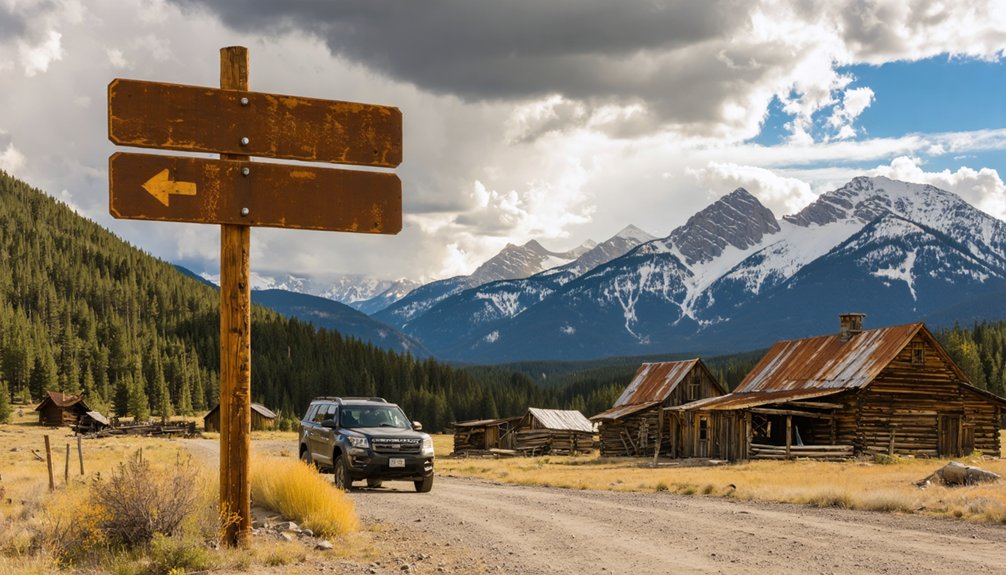
Silver fever gripped these mountains in 1872 when Colonel Jairus W. Hall discovered silver near Whale Peak. The New York Brigadier General partnered with British investors, building an ambitious tramway and smelter that peaked at 13,000 ounces in 1883.
You’ll find the campground occupying where Hall’s family home once stood, with boarding houses and saloons scattered westward from the center. Local ore composition challenges ultimately doomed the operation—smelter failure details reveal design flaws that couldn’t process the region’s specific silver deposits.
Big Jake Bayard’s fatal shooting of Amos Brazille in Campbell’s saloon marked 1883’s violent end. Down the valley road, you’ll discover Crossons Ghost Town beyond a gate, where trash piles yield piano parts from another abandoned saloon. Freedom-seekers find authentic Western decay here.
Best Practices for Visiting Private Land Ghost Town Sites
The crumbling walls and weathered timber of Hall Valley’s abandoned structures sit behind locked gates and barbed wire fences—a reality that stops many ghost town enthusiasts in their tracks. Understanding private property protocols isn’t just courtesy—it’s essential to avoid visitor trespassing risks that could land you with criminal charges or worse.
Legal Access Methods:
- Contact landowners directly through county records to request permission weeks before your visit
- Join guided tours that’ve secured access rights to otherwise off-limits locations
- Explore public alternatives like Webster Ghost Town, where you’re welcome without restrictions
Colorado takes property rights seriously. That “No Trespassing” sign means bodily harm charges or prosecution await those who ignore it. Respect boundaries, and you’ll discover legitimate adventures without risking your freedom.
Artifact Hunting Opportunities and Historical Remnants
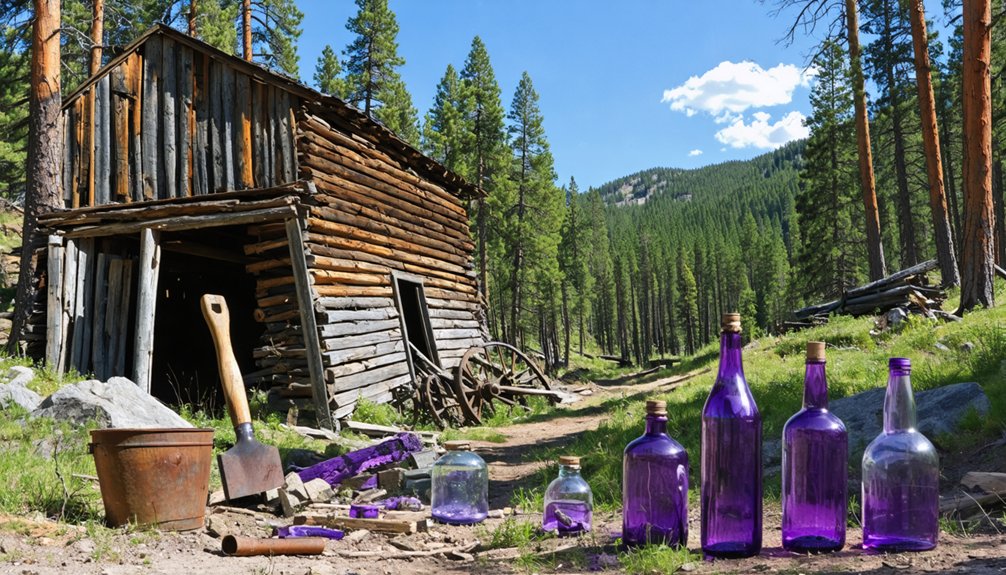
You’ll spot weathered railroad ties and rusted metal debris scattered near the Estabrook Historic District‘s last remaining Denver, South Park & Pacific bridge—tangible pieces of the 1880s rail boom that once powered Bailey’s growth.
Former saloon foundations emerge along Main Street’s edges, their stone footings and bottle glass fragments whispering stories of miners who’d cash their pay and lose it by midnight.
I’ve traced my fingers along hand-hewn timber at the 1864 Way Station site, where stage passengers once warmed themselves between the rough-cut walls that still stand in McGraw Memorial Park.
Railroad Base and Debris
Along the weathered traces of the Denver South Park & Pacific Railway, you’ll discover tangible remnants of Bailey’s industrial past scattered through the Estabrook Historic District. The original roadbed winds along Old Stagecoach Road and Highway 285, where interpretation access reveals stories from 1873-1937 operations.
Key sites for exploration:
- Last surviving railroad bridge – This small structure represents remnant preservation at its finest, part of the National Register site bounded by Estabrook and Platte Canyon
- Caboose 10600 – A standard gauge exhibit donated in 1973, displayed on the original route by Park County Historical Society
- Stone and wood outbuildings – Ice houses and barns linked directly to railway operations dot the landscape
McGraw Memorial Park’s relocated cabin offers interpreted glimpses into homestead life alongside these iron pathways that once carried lumber, livestock, and adventure-seekers through the canyon.
Former Saloon Site Exploration
When you venture roughly 14 miles west from Bailey on Highway 285 before turning right onto County Road 60, you’ll find Hall Valley’s scattered saloon remnants beckoning history enthusiasts and artifact hunters alike.
You’ll discover wooden storefronts still standing against mountain winds, their weathered planks marking where miners once drank away silver fortunes. Search trash piles near old railroad bases—I’ve found original glassware and square-cut nails marking foundation sites where violence erupted during boom times.
You might spot piano components or nineteenth-century bar stools, though material condition deteriorates rapidly. Preservation challenges mount as weather and foot traffic take their toll. Remember: private property restrictions apply here, so respect boundaries while exploring these authentic fragments of frontier saloon culture where Big Jake Bayard’s 1883 shooting once shattered George Campbell’s establishment.
Scenic Valley Views Along the Crossons Route
As the trail winds deeper into the valley, Pike’s Peak commands the horizon with an authority that makes you pause mid-step. The burn-scarred terrain creates dramatic landscapes where charred tree skeletons frame pristine mountain panoramas—nature’s raw beauty unfiltered.
You’ll witness forest regeneration firsthand as new growth pushes through blackened soil, transforming devastation into rebirth.
Three perspectives you’ll encounter on your 2.5-mile descent:
- Pre-gate viewpoint – Where the forested trail opens to reveal your first sweeping mountain vista
- Mid-valley expanse – Burn-scarred slopes creating unobstructed 360-degree views of Pike National Forest
- Ghost town approach – Surrounding peaks form a natural amphitheater around the abandoned settlement
Every turn offers fresh perspectives, proving that sometimes the journey surpasses the destination itself.
Camping and Overnight Options Near the Trailhead
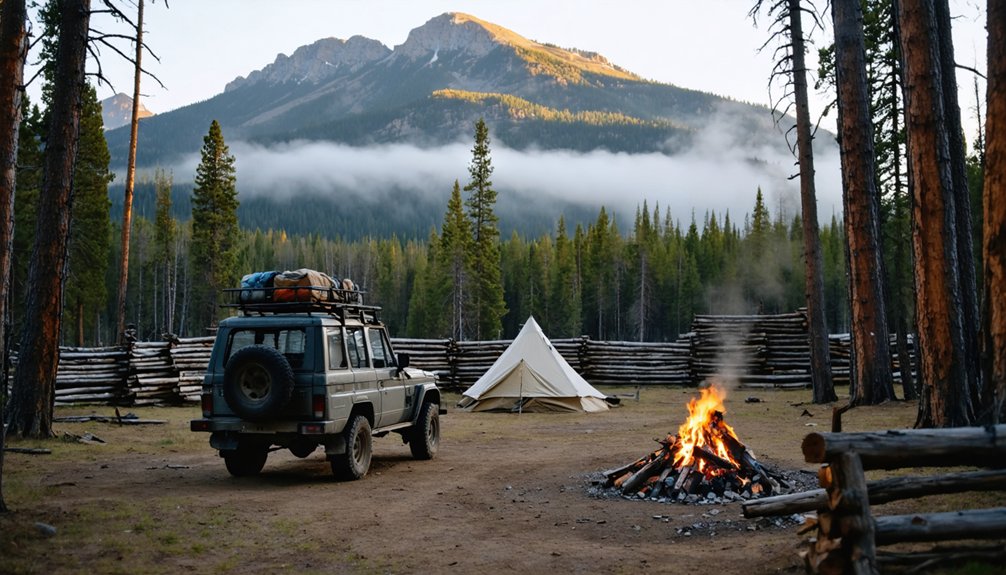
The Crossons Trail delivers an embarrassment of riches for overnight adventurers—more than 30 designated campsites dot the route, though you’ll need strategy and timing to claim your piece of wilderness. Weekend warriors fill every spot by Saturday morning, with prime locations concentrated along the first four miles before the trail narrows and options thin out.
There’s no campsite reservation policies here—it’s pure first-come, first-served freedom. Pack your own water since pit toilets are your only amenity, though a creek crossing at 4.75 miles offers refill opportunities near a scenic waterfall.
Seasonal trail conditions matter: blowdown debris and snow can complicate access. The washboard approach road requires decent clearance, but most vehicles handle it fine. Arrive early Friday for weekend camping success.
Planning a Multi-Site Bailey Area Ghost Town Itinerary
Bailey’s concentrated cluster of ghost towns transforms your weekend into a time-traveling bonanza—you can realistically hit three sites in two days without the marathon drives that plague other Colorado mining regions.
Your two-day freedom route:
- Day One: Hall Valley’s smelter remnants (5-mile drive from campground base)—explore the reverberatory furnace ruins where flawed smelting process details doomed silver operations, then investigate Big Jake’s infamous 1883 saloon shooting site
- Day One afternoon: Crossons’ beginner-friendly terrain offers smooth hiking after Hall Valley’s elevation gains
- Day Two: Puma City’s 13-mile stagecoach trace from Lake George connects regional mining history through that brutal two-hour journey prospectors endured
The Estabrook railroad bridge makes an excellent sunrise photography stop between sites, linking these isolated camps through Denver, South Park & Pacific’s transportation network.
Frequently Asked Questions
What Permits or Fees Are Required to Visit Crossons Ghost Town?
You won’t need permits or fees to explore Crossons Ghost Town, despite private land ownership. The site remains open with permitted tour access through respectful conduct. Just bring proper gear and maintain the freedom future adventurers deserve to experience this historic place.
Are Dogs Allowed on the Crossons Trail and Townsite Area?
You’ll absolutely love that dogs can join your adventure! While dog friendly policies aren’t explicitly posted, the trail welcomes leashed pups. Remember to pack out pet waste disposal bags—leave no trace in this wild, historic landscape.
What Is the Best Season to Visit Bailey Area Ghost Towns?
Summer offers you ideal viewing conditions with clear roads and warm weather, but fall’s your perfect spot—fewer crowds, comfortable temperatures, and stunning fall foliage displays transform ghost towns into photographers’ paradise while maintaining excellent accessibility.
Are There Restroom Facilities Available Near the Crossons Trailhead?
No restroom facilities exist at Crossons trailhead itself—you’ll find parking availability at the trail gate, but trailhead accessibility means planning ahead. Bailey’s town facilities, just minutes away, offer your nearest reliable restrooms before venturing into wilderness freedom.
Can I Use a Standard Sedan to Reach the Gate?
Yes, you’ll conquer this “treacherous” beginner trail in your sedan—parking options exist at the trailhead gate where pavement meets adventure. Road conditions favor standard vehicles through forested sections, though checking current photos guarantees your low-clearance chariot survives unscathed.