You’ll find Bairdstown’s remnants near Blairsville, accessible via the Riverfront Trail with parking at West Market Street or Wyotech Park. This abandoned coal mining settlement offers scattered foundation stones and structural depressions that haven’t received formal archaeological documentation. You can extend your journey along the 32-mile Ghost Town Trail, which connects multiple abandoned mining communities through Indiana County. Consider including nearby sites like Rausch Gap, Scotia, or Yellow Dog Village in your itinerary. The following sections detail preservation efforts, trail conditions, and historical context that’ll enhance your documentation expedition.
Key Takeaways
- Start at Blairsville Riverfront Trail with parking at West Market Street or Wyotech Park for easiest site access.
- Explore the 32-mile Ghost Town Trail connecting multiple abandoned coal mining settlements from Saylor Park to Ebensburg.
- Check water conditions before visiting as the trail location is prone to seasonal flooding near Bairdstown.
- Combine your trip with nearby ghost towns like Concrete City, Yellow Dog Village, Rausch Gap, or Scotia.
- Expect minimal physical remains at Bairdstown—scattered foundation stones and depressions mark the former mining settlement.
The Tragic History Behind Bairdstown’s Abandonment
Nestled in the coal-rich hills of Westmoreland County, Bairdstown emerged as one of western Pennsylvania’s many mining settlements that would eventually fade into historical record. You’ll find its story lacks the dramatic catastrophes that marked other abandoned towns—no underground fires like Centralia, no reservoir submersion like Social Hall.
Instead, Bairdstown’s decline followed a quieter pattern common throughout Derry Township. Coal seam exhaustion drove residents away as mining operations became economically unviable. The regional economic shift from extraction industries left small communities without purpose. Like neighboring Snydertown and Millwood Shaft, Bairdstown couldn’t adapt when the coal ran out.
Unlike Centralia where ground became unstable with roads buckling and sinkholes appearing from underground fires, Bairdstown’s landscape remained intact even as its population departed. The coal seam fire that devastated Centralia started in 1962 and transformed that Columbia County community into Pennsylvania’s most famous ghost town.
Today, you’re free to explore what remains: the replacement bridge marking where an iron crossing once stood, and trails preserving access to Pennsylvania’s industrial past.
What Remains at the Bairdstown Ghost Town Site Today
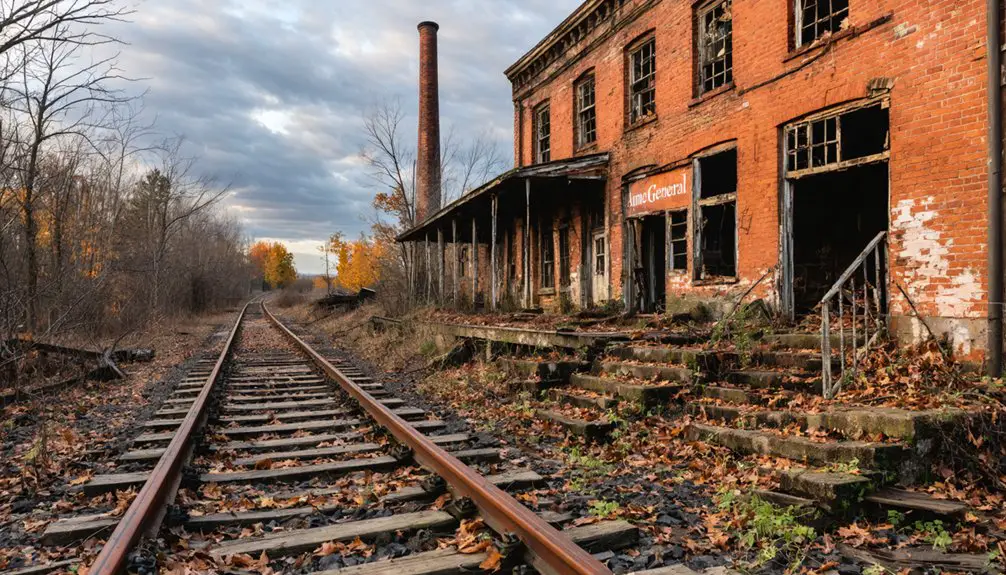
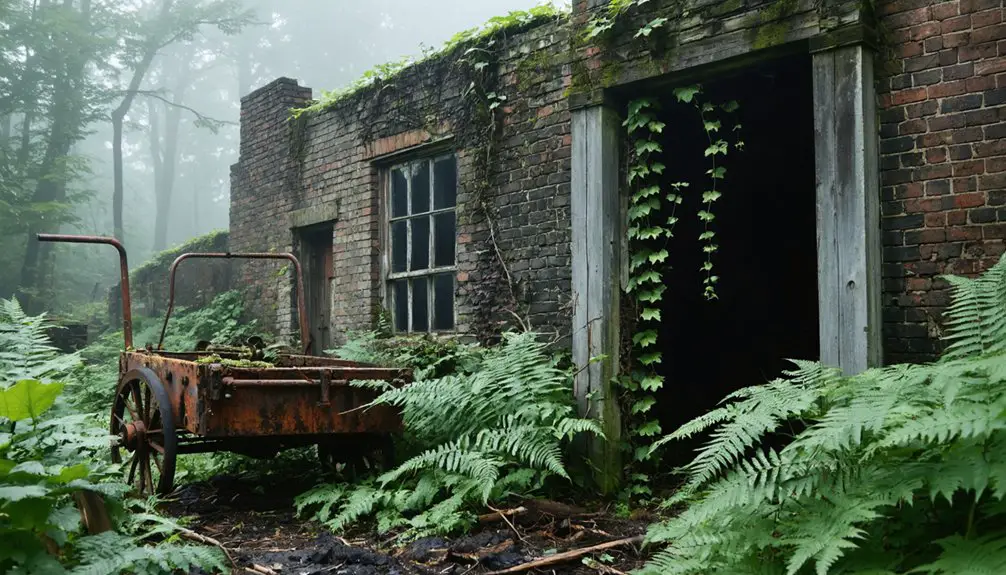
Today, minimal physical evidence marks Bairdstown’s former location along what locals still call Ghost Town Road. You’ll find scattered foundation stones and depressions where structures once stood, though nature has reclaimed most of the settlement.
No thorough archaeological excavations have documented the site, leaving much of Bairdstown’s material culture unrecorded. Local preservation efforts remain largely informal—residents share oral histories and maintain knowledge of boundary markers, but no official historical designation protects the area. The site shares characteristics with neglected ghost towns that contain more ruins than completely barren locations, with remnants slowly disappearing over time.
You’re free to explore accessible portions of the site, though private property restrictions apply to some sections. The absence of interpretive signage or maintained trails means you’ll need to rely on your own research and navigation skills to identify what limited remnants persist in this forgotten Pennsylvania landscape. Like nearby Centralia, this area demonstrates the rewilding process where native vegetation returns after human settlement disappears.
Getting to Bairdstown via the Blairsville Riverfront Trail
While the Blairsville Riverfront Trail doesn’t directly reach Bairdstown’s ghost town site, it serves as the nearest established trailhead for accessing the area. You’ll find parking at West Market Street or Wyotech Park along this 1.7-mile route following the Conemaugh River. The trail’s flat, tar-and-chip surface makes navigation straightforward, though you’ll need to continue beyond its endpoints to reach Bairdstown’s remains.
Before setting out, check water conditions with Indiana County Parks & Trails at (724) 463-8636, since flooding closes the path. The trail is situated on flood plain property owned by the U.S. Army Corps of Engineers, with a flood-control dam located 7 miles downstream. Downtown Blairsville offers trail amenities including restaurants and shops within walking distance. The borough’s community revitalization efforts have preserved historic buildings you’ll pass en route. As part of the West Penn Trail system, the Riverfront Trail connects to over 50 miles of additional routes for extended exploration. From the trailhead, you’re positioned to explore Bairdstown’s documented location independently.
Exploring the Ghost Town Trail and Regional Trail Network
The Ghost Town Trail extends 32 miles along its main stem from Saylor Park in Black Lick to Ebensburg, with additional extensions bringing the total system to over 46 miles of documented pathways.
You’ll traverse the former Ebensburg and Black Lick Railroad right-of-way, established in 1991 as a National Recreation Trail. The crushed limestone surface provides reliable off road biking opportunities year-round, climbing the Allegheny Front’s western slope at grades under 3%.
Historical coal mining relics mark your route through abandoned settlements along Blacklick Creek. At Vintondale, the trail divides and follows two branches of Blacklick Creek. The trail connects to the Hoodlebug Trail at Saylor Park, forming part of the Trans Allegheny Trails network.
Notable extensions include the 17-mile C&I Extension and 8-mile Stritty’s Way, documented with detailed maps available for independent exploration. The system offers a 32-mile continuous loop for cyclists seeking an uninterrupted touring experience.
Other Abandoned Towns and Attractions Near Bairdstown
Pennsylvania’s landscape contains dozens of documented ghost towns within day-trip distance of Bairdstown, each preserving distinct narratives of industrial decline and demographic shift. You’ll find derelict buildings and secretive locations scattered throughout the region, offering unregulated exploration opportunities:
Among these fascinating sites are several ghost towns near French Azilum, each telling its own story of abandonment and mystery. Visitors can delve into their history, uncovering remnants of a bygone era that echo the vibrant life these places once held. Exploring these forgotten locations can evoke a sense of curiosity and nostalgia, reminding us of the transient nature of communities.
These abandoned settlements provide unrestricted access to Pennsylvania’s forgotten industrial heritage, inviting documentation of architectural decay and demographic transformation.
- Concrete City (Luzerne County): Built as worker housing for DL&W Railroad employees, these experimental concrete structures stand on city-owned land open to documentation and photography.
- Yellow Dog Village (Armstrong County): This early 1900s mining settlement in Gilpin Township functions as an accessible time capsule, preserving coal-era architecture without restrictive barriers.
- Rausch Gap (Lebanon County): Established in 1828 near the Appalachian Trail, this site features building foundations and cemetery remains within St. Anthony’s Wilderness, reachable via rail trail. The Ghost Town Trail in Indiana County also provides access to several abandoned coal mining towns from the region’s industrial peak.
- Scotia (Centre County): This 19th century iron furnace site near State College draws hikers and mountain bikers to explore remnants of foundry operations and home foundations now overgrown with vegetation.
Each location permits independent investigation while respecting historical preservation principles.
Frequently Asked Questions
Is There an Admission Fee to Visit the Bairdstown Ghost Town Site?
No admission fee’s required—you’ll access Bairdstown freely along Ghost Town Trail. However, verify parking availability and follow signage for directions, as historical documentation shows fees may apply at related attractions. Always confirm current conditions through Indiana County’s Tourist Bureau.
What’s the Best Time of Year to Explore Bairdstown and Nearby Trails?
You’ll dodge summer’s selfie-stick crowds best during fall foliage season (September-October), when 45-65°F temperatures complement your independent exploration. Local history events often align with this period, letting you document Bairdstown’s preserved remnants without bureaucratic interference or admission fees.
Are Guided Tours Available for the Bairdstown Area and Ghost Town Trail?
You’ll find self-guided tours with interpretive signage documenting Bairdstown’s heritage. The Ghost Town Trail offers independent exploration freedom, preserving historical narratives through markers and brochures. Contact local visitor bureaus for archival resources and trail documentation materials.
Can You Camp Overnight Near Bairdstown or Along the Trail System?
You’ll find primitive camping spots along the Kiski-Conemaugh Water Trail near Bairdstown Bridge, plus designated campgrounds at nearby state facilities. These preserved riverfront areas let you explore independently while documenting your backcountry experience through Pennsylvania’s historic corridor.
Is the Bairdstown Site Safe to Visit During Flood Season?
You’ll face significant flood risks during wet seasons, so check weather conditions before visiting. The Bairdstown Bridge trail section closes during floods, but dam protections now safeguard the area better than in 1936’s devastating event.
References
- https://en.wikipedia.org/wiki/List_of_ghost_towns_in_Pennsylvania
- https://kids.kiddle.co/List_of_ghost_towns_in_Pennsylvania
- https://en.wikipedia.org/wiki/Livermore
- https://mainlinecanalgreenway.org/wp-content/uploads/2015/06/Your-Town-Six-Years-Later.pdf
- https://indianacountyparks.org/our-trails/blairsville-rivefront-trail/blairsville-riverfront-trail-photo-gallery/
- https://www.youtube.com/watch?v=bAJTde-tq5U
- https://www.visitindianacountypa.org/explore/expedition/
- https://www.youtube.com/watch?v=BlioLNgiKCk
- https://uncoveringpa.com/ghost-towns-in-pa
- https://www.islands.com/1824527/america-burning-ghost-town-once-thriving-quintessential-mining-destination-pennsylvania-centralia-fire/