You’ll find Beach Valley only in Pleasant Valley Cemetery’s weathered headstones now, where century-old trees shade the dreams of Black homesteaders who sought freedom on Kansas’s unforgiving prairie. Start here, then expand your route to include Nicodemus (the state’s enduring all-Black settlement), Freeport’s 1889 hotel ruins, and Hunnewell’s cattle-shipping remnants. Pack cross-country navigation tools since many sites lack paved access, and secure landowner permissions beforehand. The full story reveals why timing, preparation, and respect make all the difference.
Key Takeaways
- Pleasant Valley Cemetery, with its 1926 chapel and 150-year-old trees, offers Beach Valley’s most accessible historical site.
- Obtain landowner permission before exploring, as many ghost town sites sit on private property with restricted access.
- Plan for unpaved roads and cross-country navigation; standard road trip routes won’t reach most abandoned Kansas settlements.
- Combine Beach Valley with nearby ghost towns like Nicodemus, Freeport, and Hunnewell for a comprehensive prairie exploration itinerary.
- Visit soon, as sites continue deteriorating from natural decay, fires, and environmental damage, making preservation time-sensitive.
The Rise and Fall of Beach Valley: A Black Settlement Pioneer Story
When the Civil War’s smoke finally cleared, thousands of newly freed Black Americans looked westward to Kansas, drawn by the twin promises of the Homestead Act of 1862 and Lincoln’s Emancipation Proclamation. You’ll discover that settlements like Nicodemus emerged from this exodus—Black entrepreneurs staking claims where self-governance wasn’t just a dream but reality.
By 1887, Nicodemus had transformed into a thriving economic center with banks, hotels, and professional offices, all Black-owned. The spirit of self determination pulsed through every storefront and homestead. Yet harsh prairie conditions and broken promises challenged even the most resilient pioneers. While over half-dozen Kansas settlements vanished, Nicodemus endured.
Today, you can walk its preserved streets and feel that revolutionary courage echoing across 140 years of continuous celebration.
What Remains: Exploring Beach Valley’s Cemetery and Historical Footprints
Although the bustling shops and homesteads have vanished, Pleasant Valley Cemetery stands as Beach Valley’s most tangible connection to its pioneer past. You’ll find this sacred ground on land donated from an 1854 Shawnee Indian tract, where the first burial occurred in 1880’s harsh winter.
Walk among forgotten pioneer structures like the 1926 chapel, built for weather shelter and funerals. The cemetery reveals diverse religious practices through its varied burial traditions—some early North Central Kansas mounds even contained bundled bones from scaffold burials and incinerary rites dating to 500 BC.
Trees planted 150 years ago still shade weathered headstones. You can explore the 2005 Veterans Military Monument and 2013 Columbarium Memorial Plaza, tangible reminders that freedom’s price spans generations.
Nearby Ghost Towns Worth Adding to Your Itinerary
You’ll find Kansas’s most compelling ghost town stories within a two-hour drive of Beach Valley, where cattle empires clashed with railroad barons and Black homesteaders carved out freedom on the prairie.
I’ve mapped three distinct circuits that’ll take you through the skeletal remains of once-thriving cattle shipping towns, the haunting sites of all-Black settlements like Nicodemus, and bitter railroad rivalry towns where competing rail lines left behind double depots and abandoned warehouses.
Pack your camera and a detailed county map—many of these sites exist only as foundation stones in wheat fields, accessible through unmarked farm roads that require permission from local landowners.
Historic Cattle Towns Circuit
If you’re making the journey to Beach Valley, consider extending your adventure into a multi-day ghost town circuit through Kansas’s forgotten cattle country. These historic cattle town settlements reveal raw early settler frontier experiences—from Diamond Springs’ post-Civil War resurrection by seven Illinois families to Ravena’s dugout pioneers who carved homes from earth itself.
You’ll find Shep completely vanished since 1905, while Avilla’s two competing newspapers once spun tales of prosperity that never materialized. Don’t miss the Freeport-Midlotheian feud site, where rivals literally built a fence down Main Street before merging in 1886.
Pack camping gear and topographic maps—cell service is spotty. These ruins lie scattered across remote ranch roads where you’ll drive miles between ghost towns, breathing the same independence that drew settlers westward.
Black Settler Colony Sites
The ghost towns surrounding Beach Valley tell a powerful story of Black pioneers and abolitionists who carved out freedom on the Kansas frontier. These settlements represent black entrepreneurial ventures that flourished despite overwhelming odds.
Your itinerary should include:
- Dunlap Colony – Benjamin “Pap” Singleton’s 1878 settlement where 200 Black families built a thriving economy with banks, mills, and shops
- Quindaro – An 1856 abolitionist haven and Underground Railroad stop, now marked by historic remnants near Kansas City
- Bloomington – An 1854 abolitionist community in Wakarusa River Valley, commemorated at Bloomington Beach
These sites embodied early civil rights movements long before the term existed. You’ll find historic markers, preserved buildings, and museums documenting how these communities defied segregation through economic independence and self-governance—a chronicle to autonomous living.
Railroad Rivalry Communities
Kansas railroads didn’t just connect towns—they created cutthroat competitions that birthed entire communities overnight and abandoned them just as quickly.
You’ll witness this boom-bust cycle at Hunnewell, where railroad community growth exploded after 1880. Buildings materialized within weeks, and that stockyard shipped 500 cattle loads by 1889. Nine saloons served the 170 residents—railroad town demographics that screamed “opportunity.”
Rome tells a grimmer story. Gunfights punctuated daily life as this cow town thrived on railroad access. Then competing lines pushed into Oklahoma and Texas, draining Rome’s lifeblood overnight.
Perth peaked at 240 souls in 1910, complete with bank and mill, all dependent on the Atchison, Topeka, and Santa Fe line. When Highway 81 diverted traffic in 1912, Perth’s fate was sealed. You’re exploring capitalism’s rawest edge here.
Understanding Why Kansas Prairie Towns Vanished
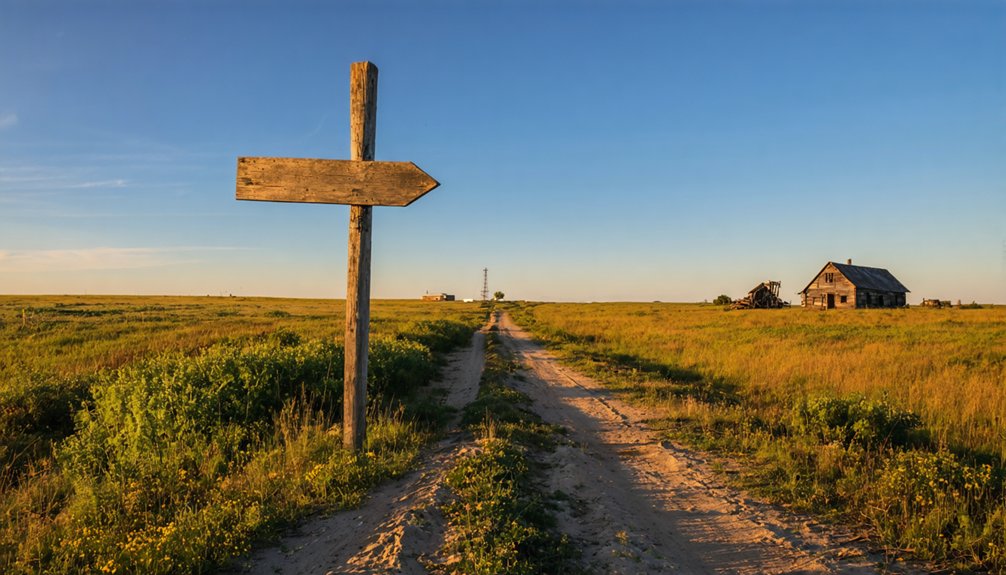
Throughout the Great Plains, dozens of once-thriving Kansas communities transformed into empty shells of weathered buildings and crumbling foundations. You’ll discover that town depopulation wasn’t random—specific forces systematically erased these settlements from maps.
The primary drivers of abandonment included:
- Railroad bypass or abandonment – When steel rails avoided or later abandoned towns, farmers lost market access and communities lost their economic lifeline
- Agricultural mechanization – Modern machinery allowed single operators to manage land that once required entire communities of workers
- Natural disasters – Tornadoes, floods, and Dust Bowl devastation during economic hardships pushed residents beyond their breaking point
You’re witnessing the intersection of technology, nature, and economics. Each ghost town tells a story of people who built dreams on the prairie, only to watch progress—or disaster—render their settlements obsolete.
Best Routes for a Multi-Day Ghost Town Adventure
Planning a multi-day ghost town adventure across Kansas requires strategic routing to maximize your discoveries while minimizing backtracking through endless prairie miles. Start with Northeast Kansas—Arrington and Arvonia offer intact one-room schools and historic cemeteries accessible via Highway 119’s 26-mile stretch.
Your second day should follow the Smoky Hill River valley, where Bridgeport and Kipp provide riverfront ruins and scenic trail conditions along converted railroad lines.
Ghost town mapping becomes essential for Route 3’s western loop through Barton County, where Boyd’s abandoned buildings and Galatia’s 36 remaining residents tell prairie decline stories. Finish at Johnson County’s Sunflower remnants or Bloomington’s submerged foundations near Clinton Lake.
Pack camping gear—you’ll find freedom camping near Valley Brook’s 1880s headstones between official stops.
Photography and Preservation: What to Expect at Abandoned Sites
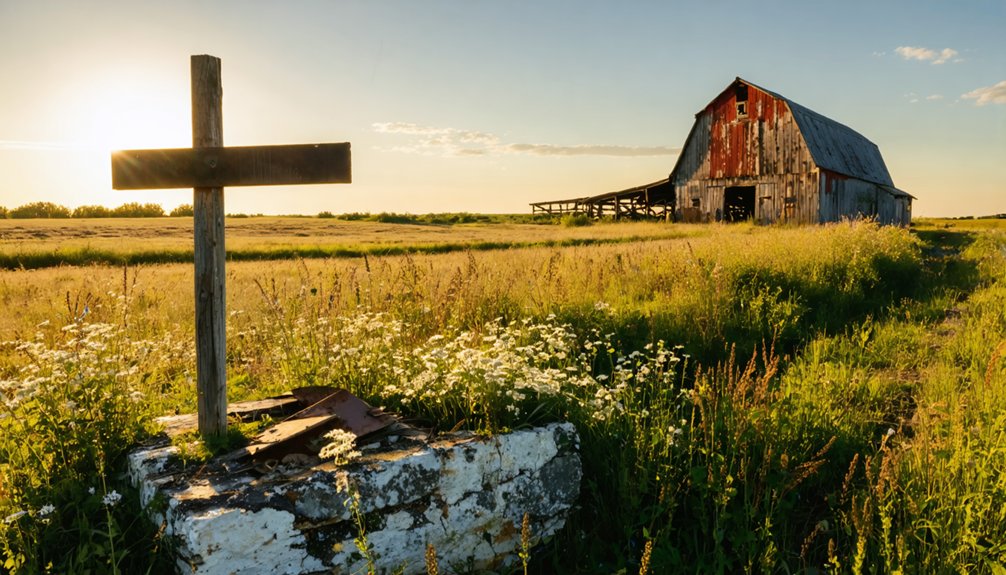
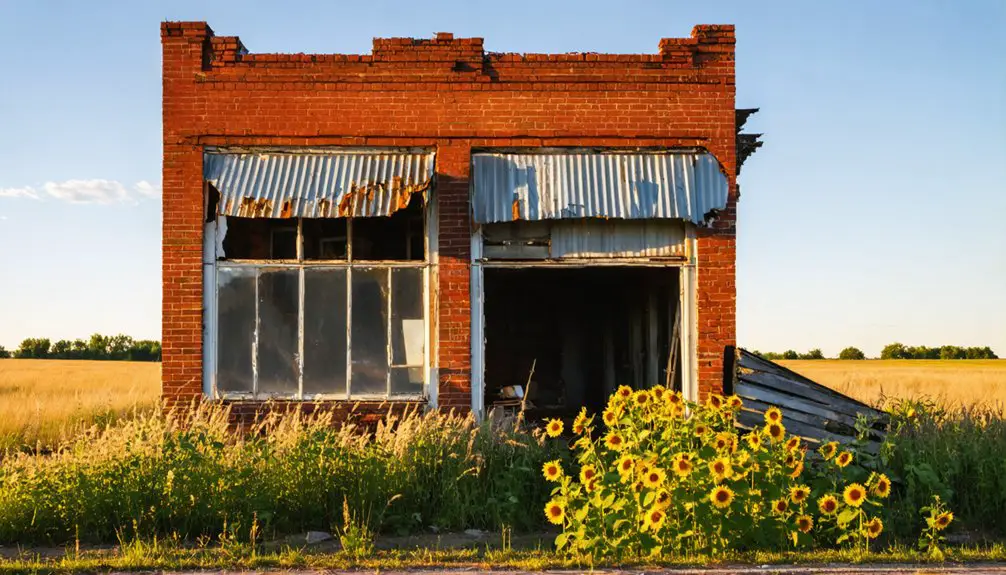
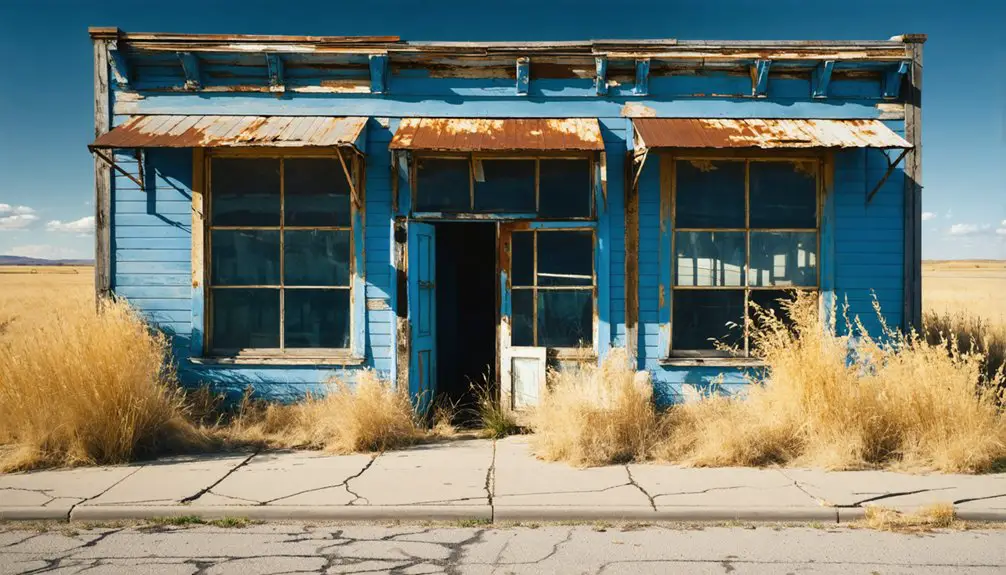
Your camera will capture a Kansas landscape where stone walls from the 1880s stand defiant against prairie winds, their limestone blocks still mortared tight while wooden neighbors collapsed decades ago. Renee’s relocated structures showcase architectural decay at its most photogenic, while Freeport’s 1889 event center hotel presents stunning early-era architecture against vast prairie backdrops.
Stone sentinels from the 1880s outlast their wooden contemporaries, offering photographers architectural resilience frozen against endless Kansas prairie horizons.
Expect these photogenic landscapes at abandoned sites:
- Hunnewell’s business district remnants – dance halls, saloon foundations, and stockyard traces from cattle-shipping glory days
- Jury’s three-story Jewelry Hotel – 46-room structure displaying post-1912 highway-era deterioration
- Quindaro’s Underground Railroad markers – historic foundations where freedom-seekers once gathered
You’ll find self-guided exploration possible at most locations, though recent challenges like Harlem Baptist Church’s 2021 fire remind you these sites won’t wait forever.
Planning Your Visit: Travel Tips and Historical Resources
Before you load your car with camera gear and hiking boots, understand that reaching Kansas’s ghost towns requires different strategies than your typical road trip. Seasonal timing considerations matter—spring and fall offer ideal conditions for traversing unpaved rural routes, while avoiding the flooding that submerged towns like Bloomington under Clinton Lake. Summer provides maximum daylight for exploring remnants, though winter works near Kansas City metro sites.
The accessibility challenges overview is stark: many locations lack paved access, requiring cross-country navigation reminiscent of 1880s settlers. Some sites rest beneath eminent domain floods; others hide behind overgrown paths and private fencing. The Kansas Historical Society’s Dead Towns list and Andreas’ 1883 History of Kansas provide essential pre-trip research. Pack emergency supplies—these isolated spots mirror the harsh conditions that created ghost towns originally.
Frequently Asked Questions
Are There Any Dining or Lodging Options Near Beach Valley Today?
You’ll find limited local restaurants in this remote ghost town area, but nearby accommodations like Clover Cliff Ranch B&B offer cozy stays. Pack snacks for your adventure, and you’ll discover authentic Kansas hospitality along your journey.
Can Visitors Access Private Property When Exploring Ghost Town Sites?
No, you absolutely can’t access private property without permission—that’d be trespassing concerns squared. Always contact private landowner permission first. Respect boundaries like your freedom depends on it, because legally, your exploration privileges actually do.
What Is the Best Season to Visit Kansas Ghost Towns?
Fall’s your prime window—ideal weather conditions create perfect exploration temperatures while vibrant foliage frames crumbling structures beautifully. You’ll find fewer crowds disrupting your discovery, and historical preservation efforts remain visible without summer’s harsh heat obscuring architectural details.
Are There Guided Tours Available for Beach Valley or Nearby Towns?
Beach Valley offers no guided tours—you’ll explore freely using self guided tours and historical markers. However, nearby Ellinwood provides underground tours for $15, while Atchison’s haunted experiences await at $49.95 if you’re craving structured adventure.
How Much Time Should I Budget for Visiting Beach Valley?
Budget 4-5 hours total from Wichita, including drives. You’ll spend 1.5-2 hours exploring remnants of the Jersey Hotel and foundations. Consider transportation needs—no public transit exists, so you’ll need your own vehicle for this adventure.