Start your adventure at 13333 Black Star Canyon Road in Silverado, where you’ll tackle an eight-mile trail climbing to 2,820 feet elevation. You’ll discover Joe Beek’s crumbling 1929 river-rock homestead, a towering 103-foot concrete cross, and scattered mining ruins from the 1890s coal operations. The route passes Black Star Falls before reaching the ghost town’s foundations and eerie steel structures. Bring plenty of water and avoid visiting after rain when the lower trail becomes treacherously muddy—there’s much more to know before you set out.
Key Takeaways
- Start at 13333 Black Star Canyon Rd in Silverado, turning left after the bridge on Santiago Canyon Road.
- The eight-mile trail climbs to 2,820 feet elevation, passing Black Star Falls before reaching the ghost town ruins.
- Avoid visiting after rain, as the lower two miles become muddy and difficult to navigate.
- Explore Joe Beek’s 1929 river-rock foundations, a 103-foot concrete cross, and abandoned mining equipment scattered throughout.
- A shorter six-mile route from Skyline Drive trailhead in Corona offers an alternative approach on fire roads.
The Mysterious History of Beeks Place Ghost Town
Tucked away in the rugged folds of Black Star Canyon, Beeks Place emerged during California’s restless 19th century as part of the sprawling 800-acre Hidden Ranch—a settlement that would later transform into the Mariposa Reserve. Anglo-American and Mexican homesteaders carved out lives here alongside the Black Star Coal Mine and Santa Clara Mine operations, their fortunes tied to the earth’s dark seams.
The canyon’s haunted folklore runs deep, rooted in genuine violence. In 1899, a shooting at Hidden Ranch left a man named Gregg dead and Henry Hungerford convicted—an event that rippled through Orange County politics and shaped local elections.
Today, visitors report unexplained disappearances of personal belongings and persistent supernatural encounters. The site’s archaeological remnants whisper of boom-and-bust cycles that defined California’s mining frontier.
Getting to Black Star Canyon: Route Planning and Access Points
Two primary routes lead adventurers to Beeks Place, each offering distinct challenges and rewards.
The Black Star Canyon approach starts at 13333 Black Star Canyon Rd in Silverado—access it via Santiago Canyon Road, turning left after the bridge. You’ll park roadside before the locked gate, and here’s the catch: there’s zero local amenities availability, so pack everything you need.
No water, no restrooms, no services—just you, the canyon, and whatever you’re smart enough to carry in.
Trail conditions after rain transform the lower two miles into muddy terrain, thanks to farm and camp traffic. The eight-mile route climbs steadily past Black Star Falls, through old Indian potrero, reaching the ghost town at 2,820 feet elevation.
Alternatively, Corona’s Skyline Drive trailhead offers a shorter six-mile approach on wide fire roads, delivering sweeping canyon views with less elevation punishment.
What Remains: Exploring the Abandoned Ruins
As you reach the homestead site, you’ll spot the foundations of what was once a sole resident’s mountain sanctuary—Joe Beek’s 1929 river-rock retreat now reduced to scattered stone walls and crumbling remnants.
The most striking feature that’ll catch your eye is the giant metallic steel structure rising near the ruins, a monolithic tower that once anchored the property’s innovative wind power system.
Among the rubble, you can still make out pieces of the swimming pool, cistern infrastructure, and various artifacts that hint at the self-sufficient lifestyle Beek carved out in this isolated canyon.
Sole Resident’s Former Home
Standing before the weathered skeleton of the Beeks homestead, you’ll immediately notice the distinctive L-shaped footprint that tells the story of two distinct construction phases. The 1848 timber-framed core, confirmed by hand-wrought nails, forms the western wing—a humble two-room beginning for pioneer Silas J.N. Beeks.
The renovated homestead features showcase the ca. 1860 Carpenter Gothic addition that transformed this frontier dwelling:
- Original timber framing with hand-wrought nails intact
- Non-modern glass windows dating to 1860 renovation
- Rectangular 1.5-story Gothic farmhouse section
- One-story wing projecting westward
- Historic racing track remnants where Beeks bred champion horses
Though recently renovated before its 1976 sale to Gary Senko and renamed Beacon’s Pines, you can still trace the evolution from pioneer cabin to prosperous farmstead.
Scattered Artifacts and Remnants
Beyond the crumbling walls of the Beeks homestead, a haunting collection of abandoned objects dots the landscape—silent witnesses to lives once lived here. You’ll stumble upon scattered animal remains bleached white by the desert sun, their origins lost to time. Unidentified metal objects—rusted machinery parts, mysterious three-legged chairs, and corroded plumbing chutes—lie exactly where they were last used decades ago.
Each artifact tells a story you’ll never fully know. Once you remove them, their historical context vanishes forever. That’s why rangers discourage pocketing souvenirs, though returned items arrive regularly at nearby parks. People blame stolen rocks for flat tires and broken relationships, shipping back their cursed treasures with apologetic notes.
Leave everything untouched. These orphaned remnants belong to the ghost town’s narrative, not your shelf.
Mysterious Giant Cross Structure
Deep in the high desert, a towering concrete cross rises 103 feet above the abandoned settlement—an architectural giant that shouldn’t exist in this forgotten corner of California. You’ll marvel at its religious significance and unexpected architectural style, crafted with 750 cubic yards of concrete and 30 tons of reinforced steel anchored 16 feet into bedrock.
The structure’s scale reveals ambitious intentions:
- Designed by architect George Kelham and engineer Henry J. Brunnier
- Originally designated as the world’s largest cross in 1934
- Built after vandals destroyed two previous wooden crosses
- Required massive concrete block foundation for stability
- Illuminated with electrical lamps during Easter week services
Standing before this weathered monument, you’ll sense the determination of those who built something permanent in this desolate landscape—a memento of faith that outlasted the community itself.
Black Star Canyon’s Mining Heritage and Historic Sites
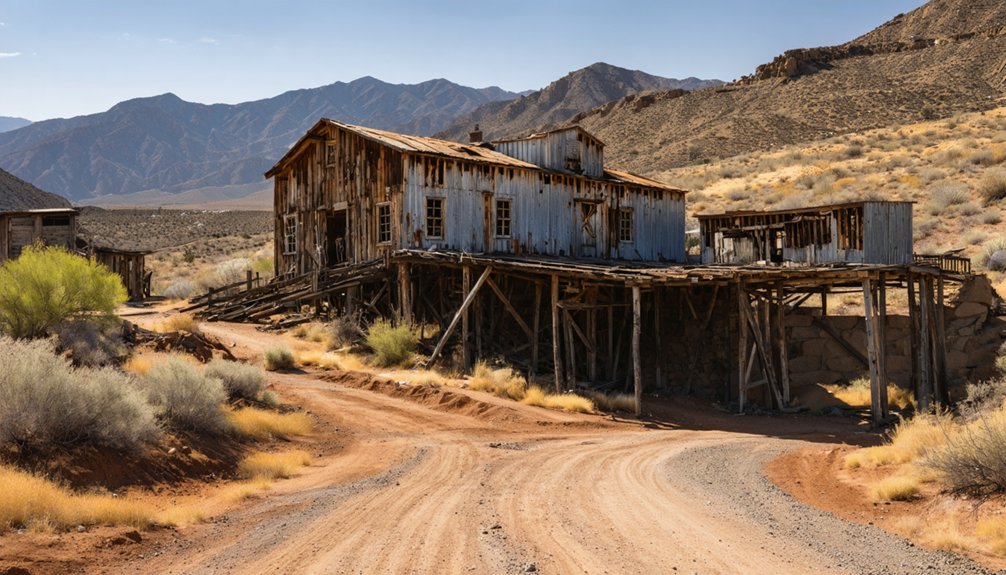
You’ll find Black Star Canyon‘s coal mining legacy carved into the mountainside, where August Witte’s operation extracted black ore intermittently from 1877 until the early 1900s. The abandoned mine shafts still punctuate the canyon walls near the mouth, their weathered timbers and collapsed entries standing as monuments to the Santa Ana Mountains’ industrial past.
As you hike toward these skeletal remains, watch for rusted equipment and ore cart tracks disappearing into the chaparral—tangible reminders of when this remote canyon fueled Southern California’s growth.
Historic Mining Operations Timeline
While concrete records of Black Star Canyon’s mining timeline remain elusive in historical archives, the canyon’s rugged terrain and proximity to Southern California’s lesser-known mining districts suggest it played a role in the region’s 19th-century mineral exploration.
You’ll find that historic mining processes in these remote canyons followed patterns similar to California’s documented operations:
- 1860s-1870s: Initial prospecting and claim staking during regional mineral rushes
- 1880s: Small-scale operations extracting silver, coal, and base metals
- 1890s-1900s: Peak activity with tunnel development and ore processing
- 1910s-1920s: Declining yields and abandoned infrastructure
- 1930s: Depression-era reworking of old claims
This mining operations overview reveals why you’ll encounter scattered remnants—rusted equipment, collapsed adits, and foundations—marking where determined prospectors sought fortune in California’s untamed backcountry.
Exploring Abandoned Mine Sites
Beyond the well-worn paths of California’s famous Gold Country, Black Star Canyon conceals a quieter chapter of mining history where coal—not gold—drew ambitious prospectors to Orange County’s rugged backcountry. August Witte’s 1877 discovery launched the Black Star Coal Mining Company, though operations sputtered intermittently until the early 1900s when inconsistent yields forced closure.
You’ll find the remains near the canyon mouth, now protected within wilderness park boundaries where cultural preservation efforts maintain these fragile remnants. The trails threading past crumbling structures reveal minimal ecological impacts—native sage scrub and chaparral have reclaimed most scarred ground.
Stone cabin ruins from Joseph Peak’s 1930s summer retreat mark the canyon road’s end, offering sweeping vistas toward Irvine Lake and the Pacific beyond, where freedom-seeking explorers still wander unencumbered.
The Lone Resident: Five Decades of Solitude
Deep in Black Star Canyon, where the Santa Ana Mountains cast long shadows across abandoned homesteads, one determined soul defied the exodus that emptied Beeks Place. This solitary occupation lasted an astounding five decades—a chronicle to self-reliance you’ll rarely encounter in California’s ghost town lore.
The lone resident’s preserved isolation created a unique chapter in Orange County history:
- No neighbors for fifty consecutive years in the remote canyon
- Single inhabitant maintained the settlement from before 1940
- Complete abandonment followed immediately after their death
- Mining decline had already scattered earlier homesteaders
- Giant cross at ranch entrance marks their enduring presence
You’ll find this story compelling because it represents ultimate freedom—choosing profound solitude over society’s conveniences, persisting where others couldn’t imagine remaining.
Supernatural Encounters and Haunted Legends
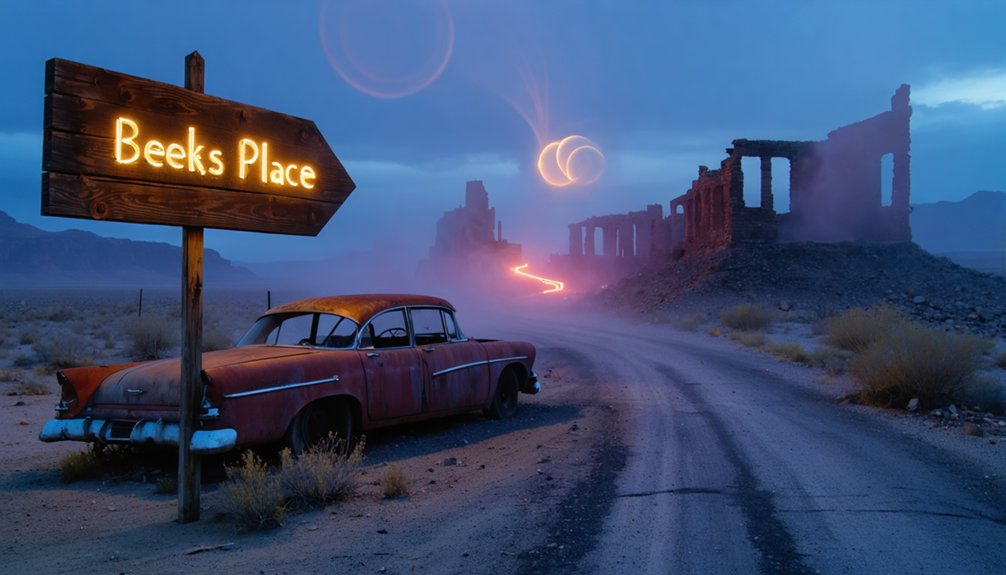
Something unsettling lingers in Black Star Canyon that transforms skeptics into believers. You’ll feel it immediately—that oppressive energy hikers describe at the trailhead. This ranks among Southern California’s most haunted locations, where paranormal investigations document everything from ghostly apparitions to cryptid encounters with Bigfoot and UFO activity.
The violence runs deep here. An 1831 battle between trappers and Native Americans saturated this ground with blood, while the 1899 Hidden Ranch shooting added Henry Hungerford’s victim to the canyon’s restless spirits. At nearby Forest City’s jail, you’ll experience phantom touches—hair pulling, poking, brushing against your skin.
Watch for abandoned bikes with missing riders. Listen to unnatural silence. That giant cross at the ranch entrance? It’s there for a reason. Stay alert. You’re not alone on these trails.
How do you navigate 10.5 miles of fire road without losing your way—or your energy? I learned that elevation profile challenges demand respect—2,227 feet feels like climbing two Empire State Buildings. The switchbacks through Hagador Canyon test your thighs, but each turn reveals San Gabriel and San Bernardino ranges stretching endlessly.
Essential navigation markers:
- Stay straight at the 4.7-mile fork over the ridgeline for coastline views
- Spot the metallic vulture structure signaling Beek’s Place proximity
- Pack 180 oz minimum water—seasonal trail conditions turn this exposed route brutal
- Scout shaded east-facing spots as afternoon sun retreats behind peaks
- Follow main fire road at forks, avoiding blocked private routes
The cabin foundations emerge just past the ridgeline crossing. Your reward? Three-hundred-sixty-degree panoramas stretching from inland empire to Pacific coastline.
The Giant Cross and Other Eerie Landmarks
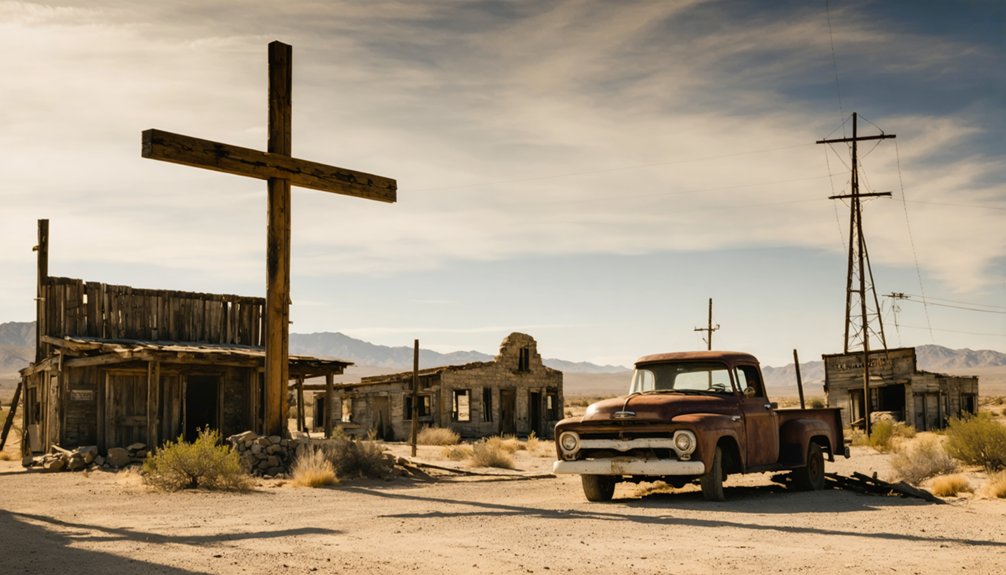
As you round the final bend on Skyline Drive, a towering cross emerges from the ridge like a skeleton’s finger pointing skyward—stark white against the chaparral, visible for miles across the Saddleback wilderness. I’ll never forget that first sighting at dusk, when the structure seemed to glow with an otherworldly light, casting long shadows over the crumbling stone foundations scattered below.
The cross marks only the beginning of Beeks Place’s eerie collection: collapsed homestead walls, rusted equipment half-buried in sage, and weathered trail markers that lead deeper into the canyon’s abandoned heart.
The Mysterious Ranch Cross
The giant steel cross looms at the ranch entrance like a sentinel from another era, its metal beams stark against the chaparral-covered hillsides of Black Star Canyon. You’ll spot this unusual landmark as you approach the trail fork, standing where Joseph Beek’s 1929 hobby retreat once harnessed wind power through experimental turbines.
Its presence carries powerful spiritual symbolism, possibly reflecting Native tribal influences from the nearby Tongva sites.
What makes this cross unforgettable:
- Vultures frequently perch atop the weathered steel beams
- Locals speculate it wards off the canyon’s rumored curse
- Visible after your 4.7-mile approach over the ridgeline
- Marks the entrance to abandoned cabin ruins
- Stands amid persistent legends of massacres and mysterious disappearances
The structure’s true purpose remains debated among freedom-seeking adventurers exploring these forgotten paths.
Abandoned Structures and Ruins
Wind-battered steel skeletons rise from the ridgeline where Joseph Beek’s experimental turbines once spun—monolithic frameworks that powered his entire 32-volt homestead through the 1920s and beyond. You’ll find these forgotten power relics standing guard over the restored river rock ruins below, evidence of off-grid ingenuity born from scavenged parts and ridge-caught winds.
The smooth stone structures echo distant miner’s cabins, now rebuilt from rubble but closed since the property’s sale and renaming to Beacon’s Pines. While you can’t enter past the “Beek’s Place” sign anymore, these curious excavation sites visible from Skyline Drive tell stories of self-sufficient living—Edison batteries storing wind energy, friends hauling materials up Black Star Canyon, dreams of freedom engineered from discarded steel.
Trail Markers of Darkness
Towering crosses pierce Southern California’s skylines like ancient sentinels marking territories where the living seldom venture after dusk. These monuments stand as eerie waypoints on your backcountry explorations near Beeks Place, where forgotten trails wind through shadowed canyons.
The notable Chaldean cross landmark in Jamul overlooks desolate neighborhoods from Hill 681, its ornate silhouette cutting through fog-shrouded mornings. Mount Soledad’s 43-foot concrete monolith has watched over countless abandoned homesteads since 1954, while Mount Davidson’s 103-footer looms visible from miles away—a beacon or warning, depending on your perspective.
Key landmarks you’ll encounter:
- Chaldean Cross perched above Jamul’s ghost roads
- Mount Soledad’s stepped platform base with veteran plaques
- Memorable views from hiking trails revealing coastal ruins
- Dawn patrols revealing cross shadows across empty valleys
- Eucalyptus groves concealing forgotten structures
These markers guide adventurers toward California’s forsaken corners.
Essential Gear and Safety Preparations for Remote Exploration
Before you set foot in Beeks Place’s crumbling structures, you’ll need gear that stands between you and serious injury. Durable boots with ankle support navigate unstable floors littered with broken glass and rusted metal. Heavy-duty gloves protect your hands from contaminated surfaces, while N95 respirators filter out asbestos and mold spores lurking in deteriorated buildings. A headlamp with backup batteries illuminates pitch-black rooms where sunlight hasn’t penetrated in decades.
Adequate pre planning procedures require downloading offline maps—cell service doesn’t exist here. Pack marking chalk to track your path through maze-like corridors. Your first-aid kit addresses inevitable scrapes, while pepper spray deters unexpected encounters. Scout the location during daylight first, testing floor stability with rocks before committing your weight. This necessary personal protection equipment transforms reckless wandering into calculated exploration.
Nearby Accommodations and Base Camp Options in Orange County
Your exploration gear secured, you’ll face an immediate logistical challenge: where to sleep after a dusty day prowling Beeks Place’s ruins. Orange County’s foothills offer diverse camping getaways, from primitive dispersed sites in Cleveland National Forest to full-service base camps 20-30 miles away.
Base camp options within striking distance:
- O’Neill Regional Park provides 200+ campsites with hookups in Trabuco Canyon
- Ronald W. Caspers Wilderness Park features RV sites with electric/water 15 miles southwest
- Irvine Regional Park offers tent areas and cabins for family groups
- Maple Canyon Ranch delivers glamping accommodations 20 miles from Silverado
- Free roadside camping along Main Divide Road for self-sufficient adventurers
Budget-conscious explorers score primitive sites near Black Star Canyon, while comfort-seekers grab Airbnb cabins ($200-400/night) in surrounding hills. Corona motels start at $100/night, just 10 miles east.
Frequently Asked Questions
Is Camping Allowed Overnight at Beeks Place or Black Star Canyon?
No, you can’t camp overnight at Beeks Place or Black Star Canyon due to Forest Order restrictions. You’ll find wildlife sightings rewarding during day visits, though nearby amenities offer alternative camping with proper permits nearby.
What Are the Best Months to Visit for Optimal Weather Conditions?
Spring’s spectacular stretches offer your best bet, with average temperatures hovering between 60-75°F and minimal precipitation levels. You’ll find freedom on sunny trails from March through May, escaping crowds while exploring under clear, comfortable skies.
Are There Entrance Fees or Permits Required to Access the Area?
You’ll need to respect private land access around Beeks Place, as it’s located on restricted property. There aren’t standard entrance fees, but you must secure authorized entry requirements through proper permissions before exploring this remote desert location.
Can You Reach Beeks Place by Vehicle or Only by Hiking?
You can’t reach Beeks Place by standard vehicle—locked gates block the road. Vehicle accessibility ends at Main Divide Road’s intersection. You’ll need hiking boots for the five-mile trek on Skyline Drive’s gravel surface.
Are Dogs Allowed on the Trails Leading to Beeks Place?
You’ll absolutely love that both trails welcome your four-legged adventure buddy under dog friendly policies! Skyline Drive offers easier hiking difficulty with flat terrain, while Black Star Canyon’s technical sections demand serious canine conditioning and protective paw booties.