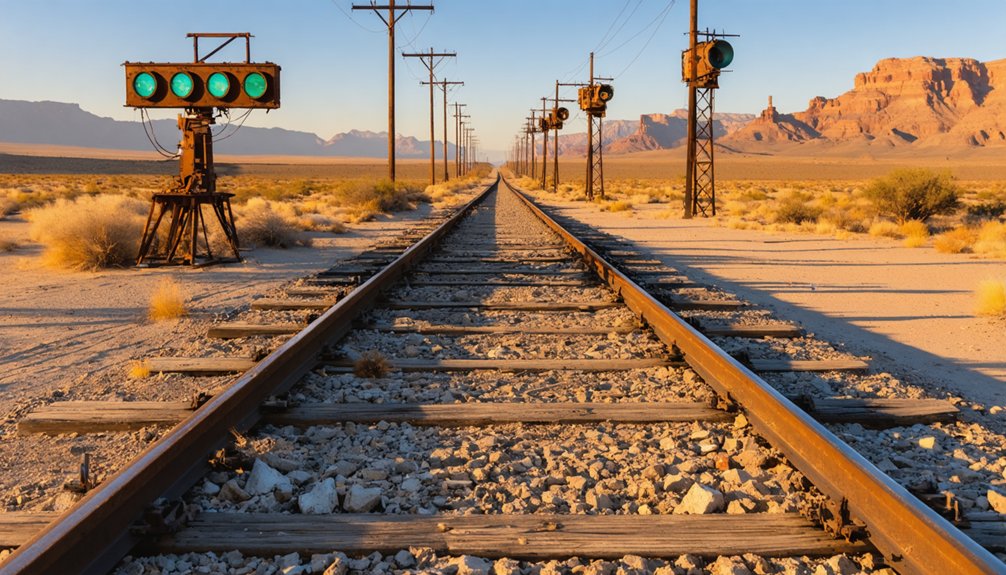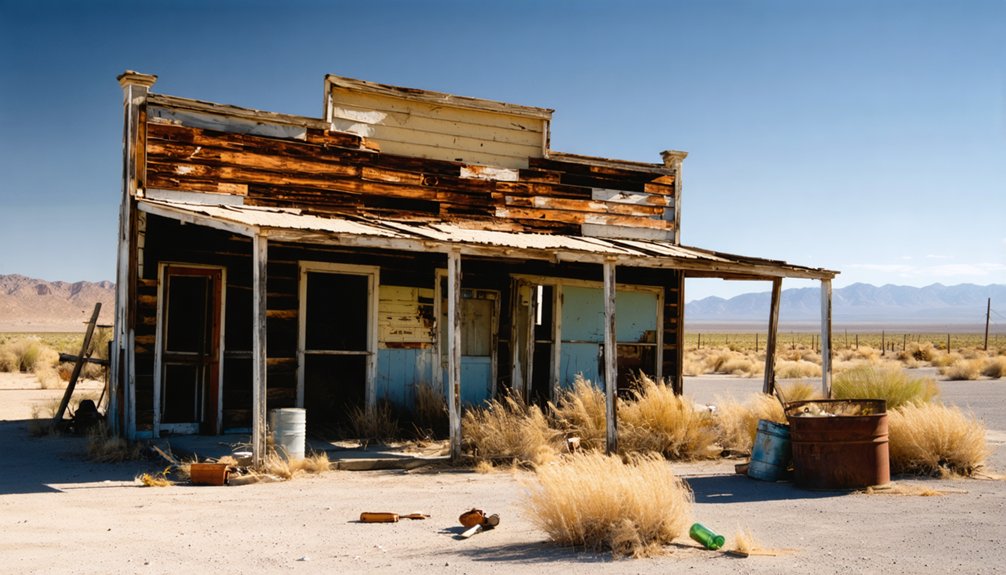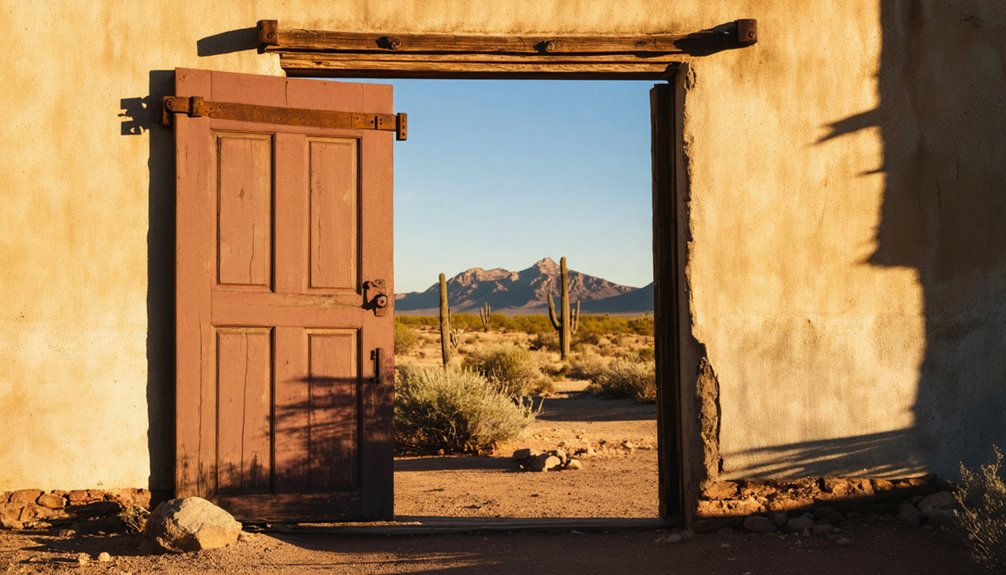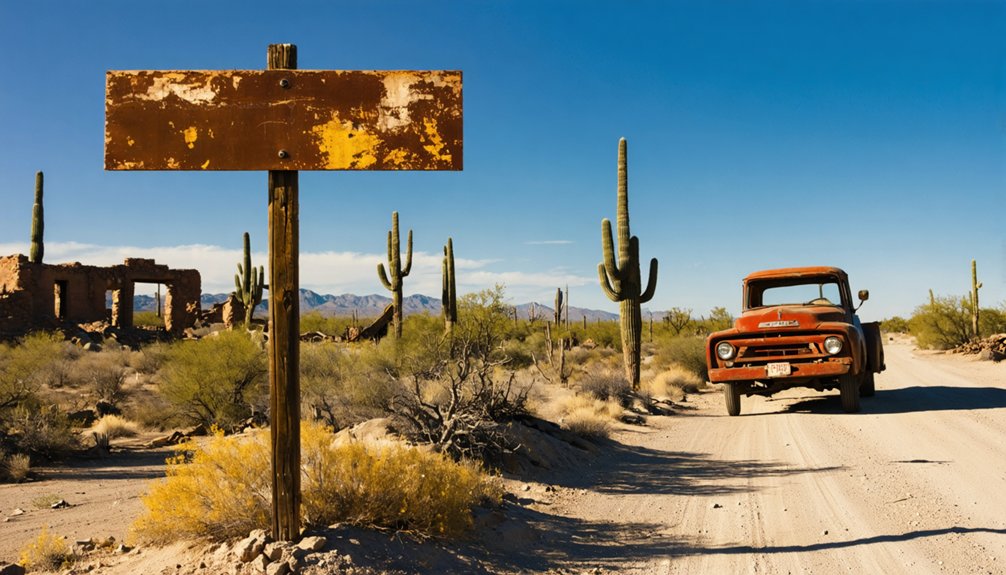
You’ll need a 4WD vehicle and strong navigation skills to reach Bellevue, a remote copper mining ghost town perched at 4,692 feet in Arizona’s Pinal Mountains. Located five miles southwest of Miami, this 1880s settlement features impressive concrete Gibson Copper mill ruins, scattered mining equipment, and two historic cemeteries with over 150 graves. Visit during spring or fall when temperatures stay comfortable, and always check current wildfire conditions before departing. The complete guide below covers everything from access roads to photography techniques.
Key Takeaways
- Bellevue sits 5 miles southwest of Miami, Arizona at 4,692 feet elevation, requiring a 4WD vehicle and navigation skills to access.
- Visit between late fall and early spring for comfortable 60-75°F temperatures and reduced wildfire risk; avoid summer’s extreme 120°F heat.
- Explore the massive Gibson Copper mill ruins, two accessible adits, scattered mining equipment, and two historic cemeteries with 149 cataloged graves.
- Bring GPS backup devices, two-way radios, and satellite communicators as cell service is unavailable on unmarked dirt roads.
- Check Arizona’s daily wildfire map before departure; the 2021 Telegraph Fire burned 180,757 acres and access restrictions still occur.
Getting to Bellevue: Routes and Road Conditions
Nestled in the rugged Pinal Mountains of Gila County, Bellevue sits at 4,692 feet elevation, approximately five miles southwest of Miami, Arizona. You’ll need solid terrain navigation skills and a reliable 4WD vehicle to reach this remote ghost town. From Miami, head southwest and locate Forest Road 349, where you can park before tackling the final approach on dirt roads and Jeep trails.
Off road accessibility requires careful planning—these aren’t your typical highways. The 2021 Telegraph Fire impacted the area, but existing tracks still lead to the ruins. You’ll encounter mining district roads threading through the Pinal Mountains, with metal equipment and mill foundations marking your destination. The challenging route rewards adventurers seeking authentic backcountry experiences away from crowds.
Best Time to Visit This Arizona Mining Settlement
You’ll find the best conditions for exploring Bellevue during spring and fall months when temperatures remain comfortable for hiking through this remote mining settlement.
Summer’s extreme heat—often exceeding 120 degrees—makes extended exploration dangerous, while winter offers acceptable conditions though shorter daylight hours limit your time on-site.
Before planning your trip, check current access restrictions since wildfire activity in Arizona can temporarily close roads and trails leading to abandoned mining areas.
Optimal Seasonal Weather Conditions
Timing your visit to Bellevue’s abandoned mining settlement can make the difference between a memorable exploration and an uncomfortable ordeal under Arizona’s unforgiving sun. Spring delivers progressive temperature warming from 60-70°F with 10+ hours of daily sunshine, while clear nights offer exceptional stargazing opportunities among the ruins.
Early fall matches spring’s comfort with 65-75°F highs and minimal precipitation under 3%. Winter surprises visitors with pleasant 57-65°F days despite occasional 28°F overnight lows. You’ll want to avoid June through August when temperatures exceed 100°F, though extended daylight hours tempt ambitious explorers. Year-round precipitation remains negligible, ensuring consistent access to remote sites.
The sweet spots? March through May and September through October provide ideal conditions for unrestricted wandering through Bellevue’s weathered remains.
Avoiding Extreme Summer Heat
Arizona’s summer transforms abandoned mining settlements into open-air furnaces where temperatures routinely exceed 100°F and ground surfaces around Bellevue’s crumbling structures hit 140°F—hot enough to blister skin on contact with sun-baked metal or stone. You’ll face serious danger exploring June through August when heat exhaustion strikes within 30 minutes and dehydration drains 1-2 liters of fluid hourly from your body.
Heat related illness prevention demands strategic timing—visit September through May when temperatures drop to manageable 75-95°F ranges. Plan dawn departures before 9 AM to escape peak afternoon intensity. Your hydration requirements increase dramatically in desert conditions: pack one gallon per person daily plus electrolyte packets. Wear lightweight long sleeves and wide-brimmed hats, stick to shaded creek-side trails, and monitor weather apps religiously for heat advisories across Tonto National Forest territory.
Post-Wildfire Site Access
When should wildfire activity influence your Bellevue exploration plans? You’ll need to monitor Arizona’s fire season carefully, as 2026 has already seen 7,895 fires—183% above average. Check Arizona 511 and NWCG Situational Awareness maps before departing, since post wildfire debris hazards like unstable terrain and fallen trees can block access roads.
The Southwest’s persistent dry conditions from February through March mean road closure impacts could affect your route unexpectedly. Visit between late fall and early spring when fire risk drops, but always verify current conditions through InciWeb and county emergency notifications.
Don’t let bureaucratic restrictions derail your adventure—stay informed about active perimeters using Arizona’s wildfire map, updated daily, so you’re free to explore safely.
What Remains at the Bellevue Ghost Town Site
You’ll find the massive concrete remnants of the Gibson Copper mill dominating the landscape, standing as the largest structure among the scattered mining ruins. Scattered metal equipment and ore piles dot the extensively plowed terrain, though the 2021 Telegraph Fire damaged many features and cleanup efforts removed most pre-1960s buildings.
Two accessible adits still offer underground exploration opportunities, including one tunnel displaying brilliant blue Chalcanthite deposits alongside vintage ore sample boxes.
Mining Structures and Equipment
The Bellevue ghost town site reveals a stark landscape where cleanup efforts and agricultural plowing have erased most traces of its mining past. You’ll find the state’s largest mill ruins standing as evidence to operations that once employed 270 workers. Environmental cleanup efforts dramatically altered the terrain, collapsing most underground workings that once extended 1000 feet deep.
What you’ll discover today:
- Original mill remains – Pre-1960s processing structure, largest in the region
- Post-1960 metal barn – Neglected structure containing leftover cleanup supplies
- Limited adit access – Short tunnel with ore sample boxes; longer passage displaying blue chalcanthite
- Collapsed shaft systems – Historic 400-foot Summit Vein shaft now sealed
- Ore concentration challenges – Evidence revealing high-grade shipments versus abandoned low-grade processing
The surrounding plowed fields consumed auxiliary structures, leaving scattered industrial remnants across this remote Arizona site.
Historic Cemetery Sites
Two distinct burial grounds mark Bellevue’s eastern hillside, where a half-acre pioneer cemetery established in the 1880s sits perched on a small rise overlooking the ghost town ruins. You’ll find approximately 40 visible graves enclosed by a crumbling stone wall, with the oldest dating to 1884 for miner James McPherson. Simple wooden crosses stand alongside ornate headstones, including founder Thomas Blackburn’s impressive granite monument.
The community cemetery contains 112 cataloged graves spanning 1900-1945, featuring Victorian-era iron fences and elaborate family plots. Historical preservation efforts began in the 1990s, culminating in the 2008 Arizona Pioneer Cemetery Research Project’s extensive documentation. Modern memorial practices continue through volunteer stabilization work, though researchers estimate actual burials greatly exceed visible markers.
Post-Wildfire Condition Changes
Recent wildfire activity has dramatically altered Bellevue’s landscape, leaving visitors with a vastly different scene than what existed just years ago. Arizona’s 2024 wildfire season consumed nearly 173,000 acres, with damage extending to Martin Canyon Road just three miles from the ghost town. Environmental impact assessments reveal significant terrain changes that’ll affect your exploration.
Before venturing out, you’ll need careful on-site hazard evaluation:
- Unstable ground from soil erosion after vegetation loss
- Downed trees blocking former access routes
- Fire restrictions limiting vehicle access during dry periods
- Road closures affecting eastern approach paths
- Minimal structural remnants where wooden buildings once stood
Stone foundations might persist where fire intensity remained lower, but expect ash and debris where wooden structures previously stood. Post-fire watershed impacts continue reshaping this already-remote destination.
The Gibson Copper Mine: Heart of the Settlement
Discovery transformed Bellevue from empty desert into a thriving mining camp when Sam Gibson and Tim Henderson sunk their first shaft into the Summit Vein in 1904. You’ll find the Gibson Copper Mine’s legacy written in impressive numbers: key mining operations reached 400 feet deep by 1907, employing over 270 workers who extracted high-grade chalcopyrite ore. The primary financial successes came between 1906-1918, when miners pulled 12 million pounds of copper from these Arizona hills.
You’d have witnessed remarkable productivity during the 1915 second boom—81 independent miners shipping 350-400 tons monthly at 20% copper content. The Robertson brothers even struck exceptionally rich ore grading 46.69% copper in 1916. Production continued sporadically until 1975, though the mine’s glory days ended in 1918.
Exploring the Historic Cemeteries
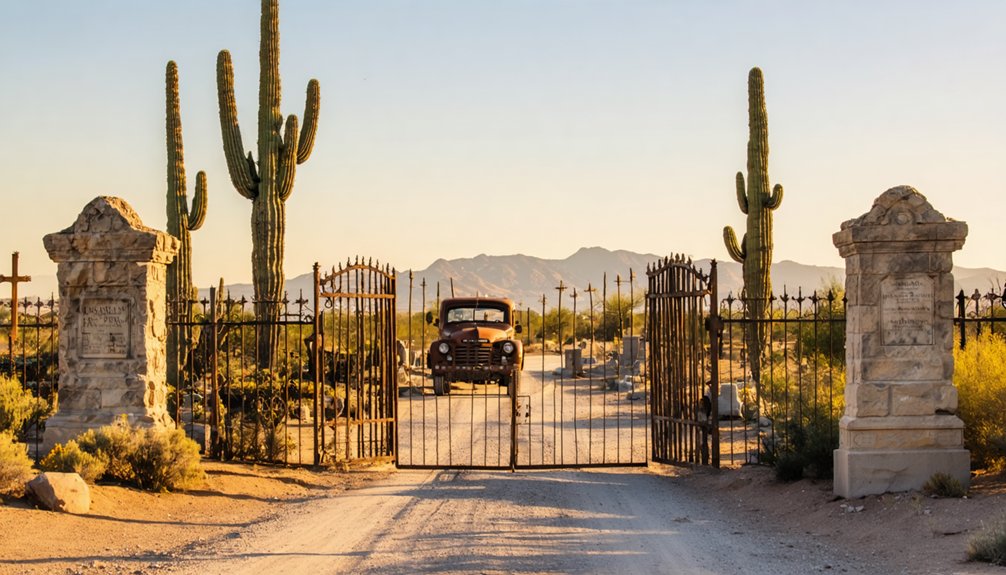
Beyond the mine shafts and processing facilities that drove Bellevue’s economy, two historic cemeteries preserve the human stories of those who lived, worked, and died here. You’ll find the pioneer cemetery perched on a small rise, enclosed by crumbling stone walls that frame approximately 40 visible graves dating back to 1884.
The larger community cemetery spans two acres with organized sections reflecting Bellevue’s diverse population.
What Cemetery Preservation Efforts Have Revealed:
- Volunteer organization activities since the 1990s documented and stabilized deteriorating markers
- The 2008 Arizona Pioneer Cemetery Research Project cataloged 149 identifiable graves across both sites
- Hispanic surnames and Orthodox crosses mark distinct ethnic sections honoring immigrant miners
- Actual burial numbers likely exceed documented graves due to wooden markers lost to weathering
- Digital databases now preserve burial information for future genealogical research
Walking Through the Original Town Layout
The compact footprint of Bellevue’s original town layout remains surprisingly legible despite decades of abandonment, with the concrete Gibson Cooper mill foundation serving as your primary landmark for orientation. You’ll find tracing architectural layout straightforward as scattered metal equipment and ore piles mark former processing areas and worker housing sites.
Footpaths cut through the desert following historic stagecoach routes that once connected this mining camp to Miami, five miles northeast. When identifying historic sites, overlay the available maps from 1901-1927 against present-day ruins—the boarding house, general store, and post office locations become clear.
The 300-person community’s infrastructure compressed into walkable terrain, letting you experience the entire settlement’s scope in a single afternoon of exploration through authentic Southwest mining history.
Impact of the 2021 Telegraph Fire
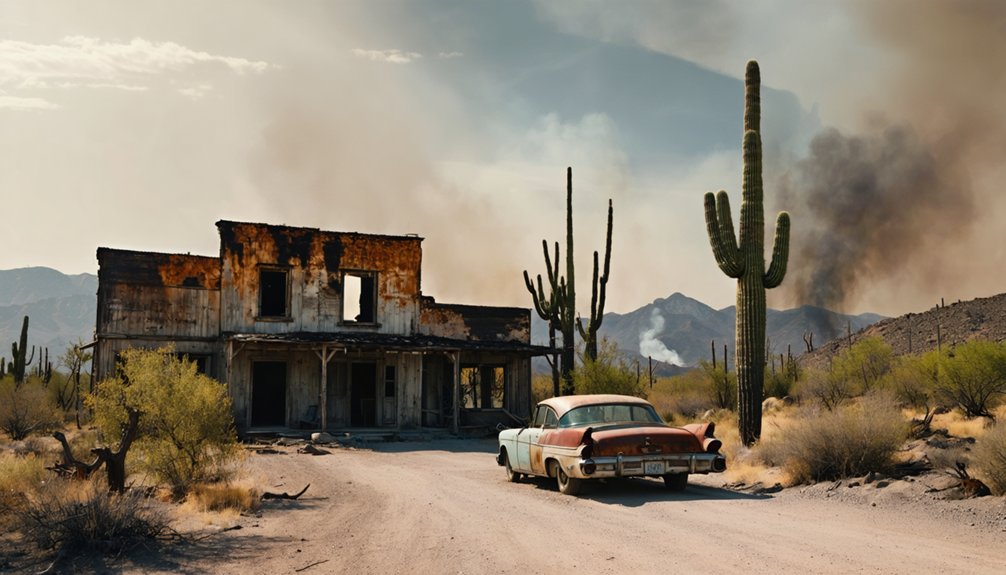
While exploring Bellevue’s abandoned buildings and mill foundations offers an intimate glimpse into 1900s mining life, modern wildfires have dramatically reshaped access to this historic site and surrounding communities. The 2021 Telegraph Fire burned 180,757 acres, placing Bellevue under “SET” evacuation status and creating significant impact on tourism revenue throughout the region.
The fire’s reach extended beyond immediate danger:
- Highway closures between Globe and Superior disrupted travel routes for months
- 211 homes lost power with uncertain restoration timelines
- Long term environmental damage altered the landscape you’ll encounter today
- Zero casualties occurred despite 51-52 structures destroyed
- Full containment wasn’t achieved until July 3, 2021
Understanding this recent history helps you appreciate both the resilience of these ghost towns and changing conditions you’ll navigate.
Essential Gear and Supplies for Your Visit
Your journey to Bellevue’s abandoned ruins demands careful preparation, as this remote BLM site offers zero amenities and unpredictable desert conditions. You’ll need reliable navigation tools since cell service doesn’t exist and unmarked dirt roads can confuse even experienced explorers.
Pack weather-appropriate layers for extreme temperature swings, from winter’s mild days to summer’s punishing 100-degree heat, while ensuring you’re equipped to handle the 15-mile trek across rough terrain.
Traversing to Bellevue requires proper preparation, as this remote ghost town sits well beyond reliable cell coverage and marked roads. Your navigation arsenal should include GPS backup devices to maintain course when electronic failures occur.
Google Maps works well for initial route planning using latitude/longitude coordinates, but you’ll need dedicated GPS units for off-road tracking along jeep trails and unmarked paths.
Essential equipment includes:
- Fully charged cell phones with downloaded offline maps
- Backup GPS units for redundancy after potential device loss
- Two-way radios for group communication in dead zones
- Satellite communicators where cellular signals don’t reach
- Paper maps as failsafe navigation tools
Establish effective communication plans by sharing your itinerary and expected return time with trusted contacts before departing.
Weather-Appropriate Clothing Essentials
Arizona’s extreme temperature swings demand strategic clothing choices that’ll keep you comfortable during Bellevue explorations. You’ll face seasonal variations from 28°F winter lows to 98°F September highs, requiring layered systems you can adjust throughout the day. Start with lightweight, breathable long-sleeves and wide-brim hats for UV protection during scorching afternoons.
Pack fleece mid-layers and insulated jackets for those dramatic day to day temperature shifts—mornings around 60°F can plummet to freezing nights.
Don’t overlook moisture-wicking fabrics and convertible pants with zip-off legs for managing 40°F+ daily ranges. Wind-resistant shells handle occasional gusts, while thermal leggings provide flexibility when temperatures drop. Bring polarized sunglasses, high-SPF sunscreen, and packable rain gear for unpredictable weather. This adaptable wardrobe lets you explore freely without weather constraints limiting your ghost town adventure.
Photography Tips for Capturing the Ruins
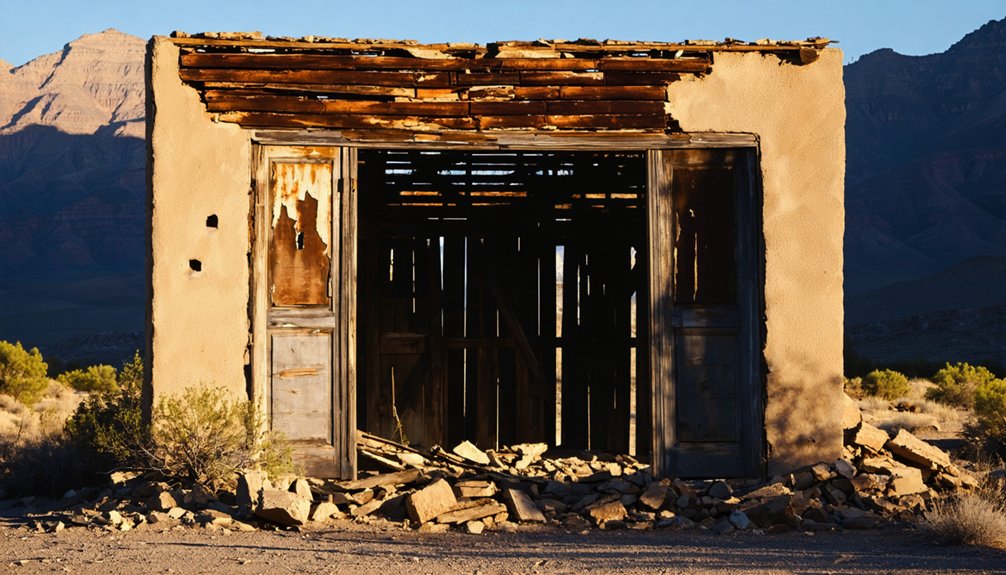
When light filters through the broken windows of Bellevue’s abandoned buildings, you’ll find photography opportunities that reward technical skill and artistic vision. Dawn and dusk deliver the soft, directional lighting that brings out texture in weathered wood and rusted metal.
Golden hour light transforms decay into art, revealing character in every weathered surface and forgotten corner of Bellevue’s derelict structures.
Your composition techniques should emphasize depth—use doorways and staircases as natural frames, and let leading lines guide viewers through desolate corridors.
Essential capture strategies:
- Shoot in RAW format with bracketed exposures for high-contrast scenes
- Keep ISO low and use a sturdy tripod for crisp long exposures
- Frame shots through broken windows, arches, and structural elements
- Detail artifacts like old signs, bottles, and tools that tell stories
- Balance technical settings by prioritizing shutter speed control
Remove modern distractions from your scenes to maintain authentic period atmosphere.
Nearby Ghost Towns and Attractions to Explore
Your journey to Bellevue opens doors to a network of forgotten copper towns scattered across Gila County‘s rugged terrain. Just four miles northwest of Globe, you’ll find Copper Hill, where remnants of local businesses like the boardinghouse and general store stand silent since 1933.
Pioneer, fifteen miles southwest of Globe, rewards explorers with traces of its 1885-era brewery and saloons. For a more ambitious adventure, McMillanville lies twenty-eight miles north, showcasing the ghostly footprints of casinos and stores that served the Stonewall Jackson Mine until 1882.
Though farther afield, Swansea near Parker stands as Arizona’s premier preserved ghost town among nearby attractions, featuring dozens of intact structures from its early 1900s smelting operations.
Frequently Asked Questions
Is It Legal to Visit Bellevue Ghost Town?
Yes, you’re free to explore Bellevue—it’s on public BLM land, not private property ownership. No permits needed for casual visits, though seasonal accessibility varies. You’ll face rough roads and extreme heat, but there’s no formal restriction stopping your adventure.
Are There Camping Facilities Near Bellevue?
While Bellevue itself lacks facilities, you’ll find campsite availability at nearby Organ Pipe Cactus National Monument’s Twin Peaks and Alamo Canyon campgrounds. Several Arizona state parks also offer nearby lodging options for your ghost town adventure.
What Wildlife Should Visitors Watch Out for in the Area?
The desert’s wild heart beats around you—watch for rattlesnakes and scorpions hiding in shadows, while coyotes and javelina roam freely at dawn and dusk. You’ll need awareness to navigate this untamed terrain safely.
Can Artifacts or Relics Be Collected From the Site?
No, you can’t collect artifacts or relics from Bellevue. Arizona antiquities laws and federal regulations strictly prohibit removal, protecting artifact preservation. Relic identification is fine, but touching or taking items risks $100,000 fines and jail time.
Is Cell Phone Reception Available at Bellevue Ghost Town?
You’ll likely be off the grid—cell phone signal strength is spotty at best due to Bellevue’s remote location. Proximity to nearest town doesn’t help much; expect minimal to no reception in this isolated Arizona ghost town.