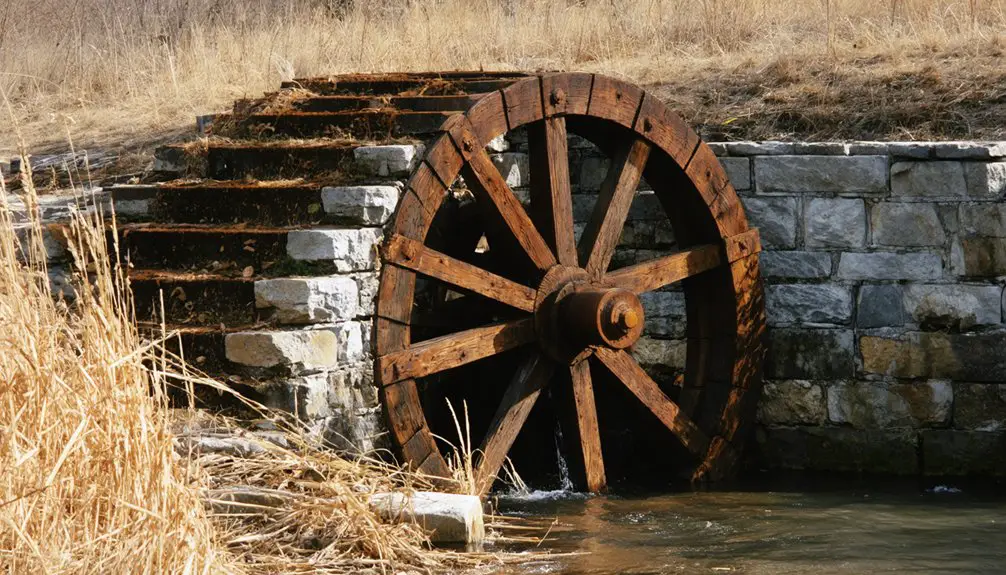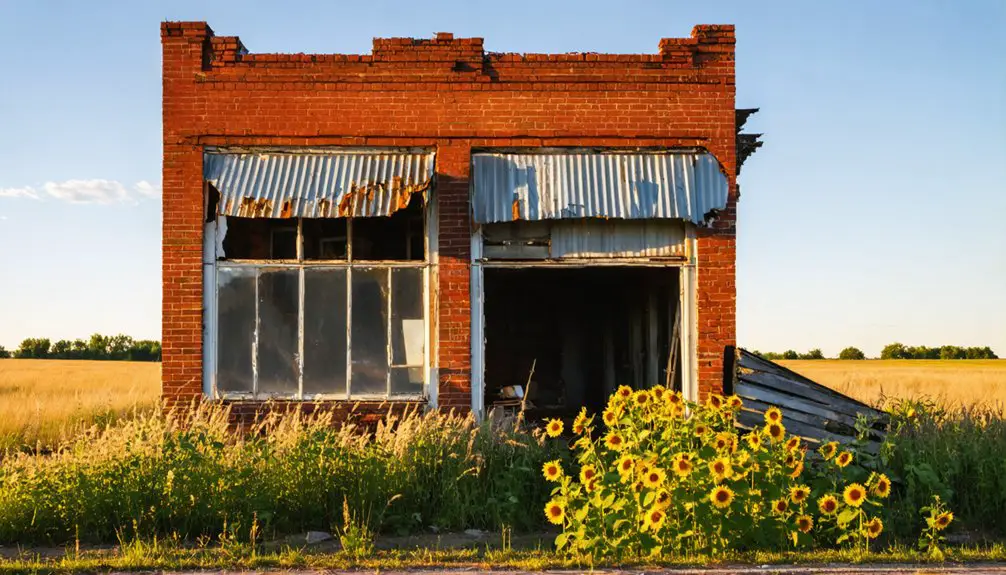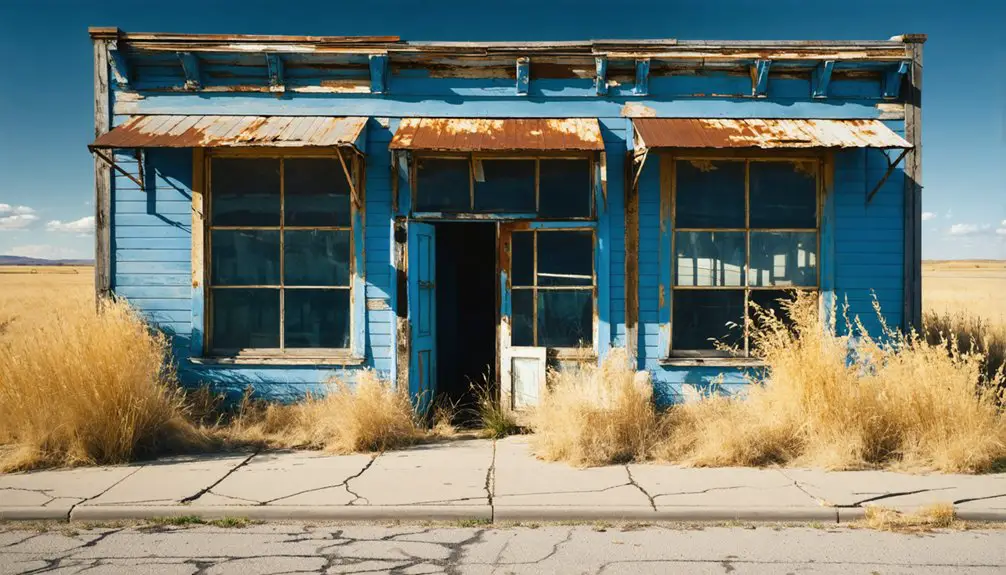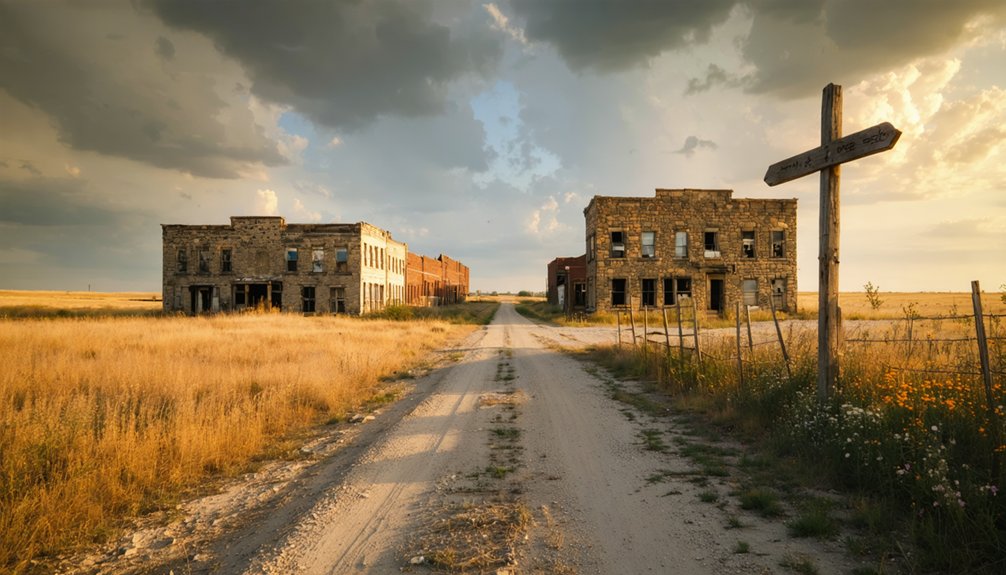
Your ghost town road trip to Belmont, Kansas begins two miles west of Buffalo in Woodson County, where open land marks the haunting site of Fort Belmont. No buildings remain, but the ground holds unmarked graves from the Trail of Blood on Ice, where over 240 refugees perished in the brutal winter of 1861-1862. Plan your visit for spring or fall, pack sturdy boots, and bring offline maps. There’s far more to this story than the silent landscape reveals.
Key Takeaways
- Fort Belmont, located two miles west of Buffalo, Kansas, features open land and unmarked graves tied to the tragic Trail of Blood on Ice.
- Visit nearby ghost towns—Redbud, Utopia, and Defiance—to gain deeper context about frontier Kansas history alongside the Belmont site.
- Spring and fall offer the most comfortable exploration conditions, with mild temperatures and scenic landscapes enhancing the experience.
- Pack water, sturdy boots, insect repellent, snacks, and a detailed county map, as cell service is unreliable in rural areas.
- Respect the historically significant grounds by avoiding soil disturbance, leaving artifacts untouched, and photographing sites without removing anything.
What’s Left of the Fort Belmont Site Today?
Though Fort Belmont once stood as a critical frontier outpost, you won’t find much left of it today. The buildings are gone, leaving only open land two miles west of Buffalo, Kansas in Woodson County.
Yet the site’s historical significance runs deep — this ground witnessed the tragedy of Opothle Yahola’s refugees, who traveled the harrowing Trail of Blood on Ice during the brutal winter of 1861-1862.
Unmarked graves of those who perished remain near the location, making the visitor experience a quietly sobering one. You’re fundamentally standing on hallowed frontier ground.
County records and historical publications document what once existed here, so researching before you visit will enrich your understanding of what this unassuming stretch of Kansas land truly represents.
The Bloody History That Put Belmont, Kansas on the Map
What reduced Belmont, Kansas to silent, empty land didn’t happen overnight — it grew from years of brutal conflict, desperation, and tragedy that left permanent marks on the region.
Border Warfare between pro-slavery Missouri ruffians and Union-aligned Kansans forced settlers to arm themselves, build Fort Belmont, and embrace Militia Life just to survive daily threats.
Then came the devastating winter of 1861-1862. Creek leader Opothle Yahola led roughly 10,000 refugees fleeing Confederate forces in Oklahoma toward Kansas.
The Union Army couldn’t provide adequate food or shelter, and more than 240 people died along what survivors called the Trail of Blood on Ice — barefoot, starving, freezing.
Opothle Yahola himself died and was buried in an unmarked grave near the fort you’re visiting today.
The Trail of Blood on Ice: How Fort Belmont Failed 10,000 Refugees
When Creek leader Opothle Yahola led roughly 10,000 followers north through Oklahoma toward Kansas in the winter of 1861, he wasn’t marching toward safety — he was marching toward a slow-motion catastrophe.
These refugees were fleeing Confederate forces, hoping Union protection awaited them. It didn’t.
The winter hardships they endured were brutal. Barefoot and starving, they trudged through ice and snow, leaving bloodstained footprints across the frozen landscape — earning their exodus the haunting name: Trail of Blood on Ice.
More than 240 refugees died.
Fort Belmont’s Federal Indian Agency was supposed to help. Instead, the Union Army couldn’t provide adequate food or shelter for the refugee experiences unfolding at their doorstep.
Opothle Yahola himself eventually died and was buried in an unmarked grave near the fort.
What the Fort Belmont Site Actually Looks Like Now
When you visit the Fort Belmont site today, you’ll find an open stretch of land two miles west of Buffalo, Kansas, where none of the original buildings remain standing.
The grounds offer little visual drama, but knowing what happened here transforms the landscape — somewhere nearby lie unmarked graves of the Trail of Blood on Ice refugees who perished during the brutal winter of 1861-1862.
You’re fundamentally standing on a burial ground with no headstones to guide you, only historical records to confirm what the earth quietly holds.
Remnants Of The Grounds
Today, not a single building remains standing at the Fort Belmont site, and what you’ll find instead is an open stretch of land two miles west of Buffalo, Kansas, where history has quietly dissolved into the earth.
The ghost town remnants offer no dramatic ruins or marked monuments, just quiet terrain shaped by Sandy Creek’s wooded surroundings.
You’re fundamentally walking ground where militiamen once patrolled, where thousands of Creek refugees suffered through a brutal winter, and where a frontier trading post once buzzed with activity.
The historical significance runs deep beneath your feet, including unmarked graves of Trail of Blood on Ice refugees still resting nearby.
County records remain your best guide for understanding what once stood here.
Unmarked Graves Nearby
Perhaps the most sobering detail about the Fort Belmont site is that somewhere beneath the quiet ground near Buffalo, Kansas, Opothle Yahola and his daughter lie in unmarked graves, their resting places lost to history.
This Creek leader guided roughly 10,000 followers through brutal winter conditions along what became known as the Trail of Blood on Ice, only to have more than 240 refugees perish from cold and starvation.
Standing near this site, you’ll feel the weight of that historical significance.
No markers identify where these individuals rest, leaving their stories largely untold by the land itself.
Yet knowing they’re there transforms your visit into something far deeper than curiosity about a ghost town — it becomes a genuine reckoning with the human cost of that turbulent frontier era.
How to Get to the Belmont Ghost Town Site
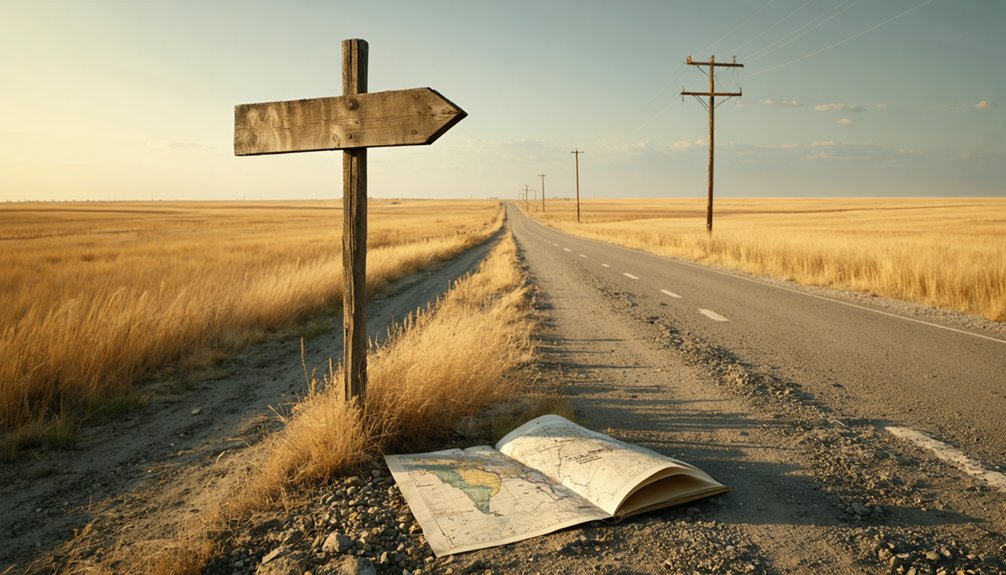
If you’re plotting your course to the Belmont ghost town site, you’ll want to set your GPS for Buffalo, Kansas, in Woodson County, then head two miles west to reach the historic Fort Belmont location.
Your navigation app may not recognize the exact site, so watch for local road markers and county records that can help orient you once you’re in the area.
When you arrive, you won’t find standing structures, but the open landscape itself tells the story of a frontier outpost that once sheltered militiamen, refugees, and a federal Indian Agency.
Finding the Belmont ghost town site takes just a few turns off the beaten path in Woodson County, Kansas.
Start your journey in Buffalo, Kansas, a small town that serves as your ideal base. From Buffalo, head two miles west, and you’ll reach the general area where Fort Belmont once stood.
Your navigation tips are straightforward: use a reliable GPS app, but don’t solely depend on it since rural Kansas roads can be poorly marked.
Download offline maps before leaving town.
The site’s historical significance makes every mile worthwhile. You’re traveling ground once crossed by Creek Indian refugees on the Trail of Blood on Ice, militia soldiers, and frontier settlers.
Keep your eyes open — history hides in plain sight out here.
Arriving At The Site
Once you’ve pulled out of Buffalo heading west, the two-mile drive to the Fort Belmont site unfolds quickly across open Kansas countryside. The flat terrain gives way to Sandy Creek’s wooded surroundings, where the fort once stood protecting settlers during the turbulent Border War years.
You won’t find standing buildings here — just open land carrying deep historical significance beneath its quiet surface.
That absence is precisely what draws ghost town lore enthusiasts to places like this. You’re standing where militiamen patrolled, where Creek refugees fled Confederate forces, and where Opothle Yahola himself was eventually buried in an unmarked grave.
Look around carefully. The crossroads of old frontier trails once intersected nearby, making this location far more consequential than its empty fields suggest today.
Best Times of Year to Visit the Belmont Ghost Town
Planning your visit to the Belmont ghost town site in Woodson County requires some thought about Kansas’s unpredictable seasonal weather. The best seasons to explore this historic site are spring and fall, when ideal weather makes outdoor exploration comfortable and rewarding.
April through May offers mild temperatures, wildflowers along Sandy Creek, and manageable trail conditions.
Spring breathes life into Belmont’s landscape, with wildflowers carpeting Sandy Creek’s banks and comfortable temperatures perfect for exploration.
September through October brings crisp air, stunning foliage, and less humidity than summer’s brutal heat. You’ll also enjoy longer daylight hours during these windows, giving you more time to explore the surrounding landscape where Fort Belmont once stood.
Avoid midsummer visits if possible, as Kansas heat becomes oppressive and dehydration risks increase considerably.
Winter visits are challenging due to frozen ground and limited accessibility.
Pack water, sturdy boots, and a detailed county map regardless of when you go.
Kansas Ghost Towns Near Belmont Worth Adding to Your Route
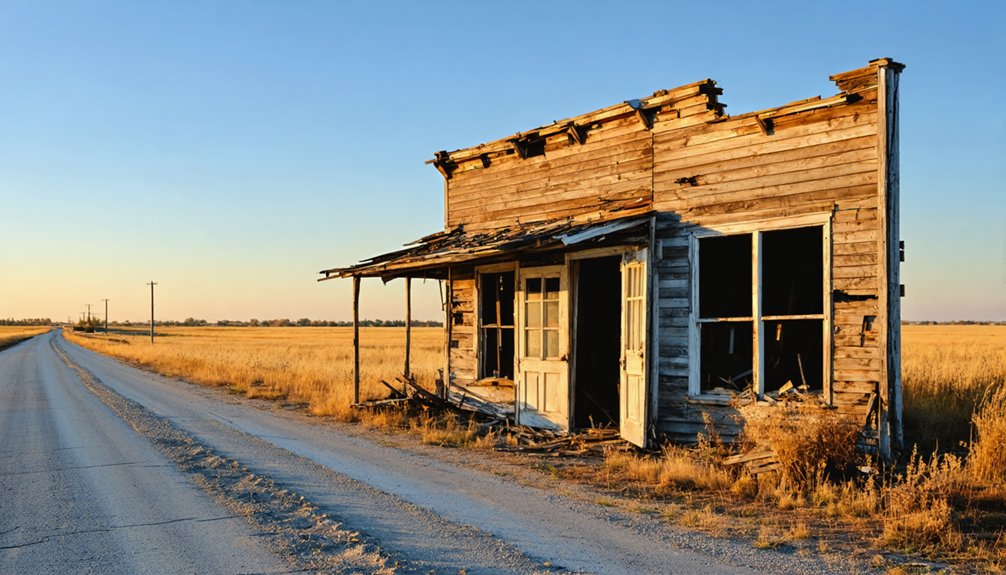
While you’re already making the drive out to Woodson County, it makes sense to string together a few nearby ghost towns into a full-day route.
This region holds layers of forgotten histories and abandoned settlements worth exploring beyond Belmont alone.
- Redbud, Kansas – A small farming community that quietly faded after railroad routes bypassed it entirely.
- Utopia, Kansas – Once promising settlers a fresh start, this Woodson County settlement dissolved as quickly as it appeared.
- Defiance, Kansas – Its bold name couldn’t save it from economic decline and population drift westward.
Each stop adds context to Belmont’s story, painting a fuller picture of frontier Kansas.
Pack snacks, download offline maps, and give yourself the freedom to linger wherever curiosity pulls you.
What to Bring and Know Before Visiting Kansas Ghost Towns
Visiting remote Kansas ghost towns like Belmont rewards the prepared traveler and punishes the careless one. Pack water, sturdy boots, and a paper map since cell service disappears fast in Woodson County.
Bring insect repellent during warmer months and dress in layers when autumn winds cut across the open prairie.
Ghost town etiquette matters here. You’re walking through historically significant ground where Trail of Blood on Ice refugees and unmarked graves deserve your respect.
Don’t disturb soil, remove artifacts, or treat the site like a playground. Historical preservation depends on visitors who understand that these fragile locations can’t defend themselves against careless hands.
Photograph everything, touch nothing, and leave the site exactly as you found it. Your restraint keeps this history alive for the next traveler.
Frequently Asked Questions
Who Was Captain Joseph Gumby and What Was His Role at Fort Belmont?
You’ll find Gumby’s Legacy woven into Fort History — Captain Joseph Gumby commanded local militia, leading Kansas 16th Regiment companies stationed at Fort Belmont, protecting settlers from Border Ruffians and safeguarding your frontier freedom during turbulent Civil War times.
What Indian Tribes Were Serviced by the Federal Agency at Fort Belmont?
Thousands of lives hung in the balance as the Federal Agency Services at Fort Belmont served two essential Native American Tribes: you’d find both the Osage and Creek Indians receiving critical support there.
When Was the Belmont Trading Post Established Relative to the Fort?
You’ll find the Belmont Trading Post‘s history predates the fort establishment by four years — it opened in 1856, while the fort wasn’t built until around 1860, giving pioneers an early, independent foothold in frontier Kansas.
Which Kansas Regiment Provided Soldiers to Garrison Fort Belmont?
While it’s thought only regulars served, you’d find the Kansas 16th Regiment’s companies alongside local militiamen garrisoning Fort Belmont — a fascinating Civil War Military History detail revealing freedom-seeking settlers actively defending their own frontier ground.
Why Did Governor Thomas Carney Relieve the Militia From Duty?
The knowledge base doesn’t explain why Carney made his decision, but you’ll find that militia history shows he relieved them on October 30, 1864, shortly after the Indian Agency closed, effectively ending Fort Belmont’s frontier mission.
References
- https://travelnevada.com/ghost-town/belmont-ghost-town/
- https://www.legendsofamerica.com/fort-belmont-kansas/
- https://johnsoncoks.cottonhills.net/historic-records/old-towns.html
- https://www.youtube.com/watch?v=dF7vGl5xasI
- https://en.wikipedia.org/wiki/Fort_Belmont
- https://esirc.emporia.edu/bitstreams/b4b4cde4-15d4-4284-a3b5-8430fb9e324e/download
- https://www.youtube.com/watch?v=SyTlkr_4aFM