You’ll find Belvidere where ambitious dreams met brutal reality—a Kansas ghost town born from the Santa Fe Railroad‘s whistle in 1887 and abandoned when the water ran out. From Greensburg, county roads lead you through Medicine River Bottom farmland to weathered buildings and landmark elms marking where 924 souls once thrived. Bring your camera for the crumbling church and schoolmaster’s house, but visit before the remaining guardians vanish and this beautiful view becomes just another prairie memory worth understanding.
Key Takeaways
- Belvidere is located near Greensburg, Kansas, accessible via county roads through the former railroad town’s remaining landscape.
- Visit weathered buildings including a church and schoolmaster’s house that still stand despite serious disrepair and abandonment.
- Look for landmark trees like elms and cottonwoods that mark where the town once thrived with nearly 1,000 residents.
- Explore farmland in the Medicine River Bottom still worked by descendants who chose to remain on their heritage land.
- Best visited as part of a southeast Kansas ghost town route exploring former mining communities near Galena.
The Story Behind Belvidere’s Beautiful Name
The wives of two ambitious bankers stood on a Kansas hillside in the 1880s and saw poetry in the prairie. Mrs. Watson and Mrs. Fullington, watching their husbands promote this railroad town site along the Medicine River, declared it “Belvidere”—Italian etymology meaning “beautiful view.” You can almost picture them there, wind catching their skirts, gesturing toward cottonwoods and elms clustering near the water.
The founders’ wives chose perfectly. This former Osage land, stretching across 250 miles of southern Kansas, had opened to settlement just years before. While their husbands dealt in lots and railway schedules at Greensburg State Bank, these women named what they witnessed: a landscape worth claiming, worth settling, worth remembering. Sometimes the truest pioneers are those who simply know beauty when they see it.
From Boomtown to Ghost Town: A Brief Timeline
Beautiful names don’t guarantee longevity. Belvidere’s transformation from prairie promise to phantom town happened fast. By 1888, you’d have seen 25 homes rising from dust, railroad tank cars hauling water to thirsty settlers who couldn’t even find drinkable springs for wildlife.
The community spirit exploded when mining struck in the 1890s—lead, zinc, iron, and coal pulled nearly 1,000 souls here by 1900. Local industries peaked at 924 residents in 1920, fueling fierce rivalry with neighboring Galena.
Then cheaper coal surfaced elsewhere. The boom collapsed. Mining died by 1970, the school shuttered in 1964, and tornados finished what economic death started. You’ll find remnants now—a church, a schoolmaster’s house, foundations where fortunes were weighed and lost.
The Railroad’s Role in Belvidere’s Rise and Fall
The Santa Fe Railroad breathed life into Belvidere on October 1, 1887, and those steel tracks carried more than passengers—they hauled the town’s very survival in tank cars filled with drinking water.
You can still trace where the rails once ran through Medicine River bottomland, imagining how $100,000 in property changed hands within ten days of that first locomotive’s whistle.
When the tracks were torn up decades later, they ripped away the town’s lifeline, leaving behind the empty storefronts and weathered foundations you’ll encounter today.
Railroad Sparked Initial Boom
When Santa Fe Railroad workers hammered the final spike through Belvidere on October 1, 1887, they unknowingly set the timer on this town’s entire existence. The tracks brought an initial settlement surge that transformed empty prairie into bustling streets almost overnight. Promoters Watson and Fullington, backed by Greensburg State Bank money, sold $100,000 worth of property within ten days—a staggering figure for 1887. Their wives christened it “Belvidere,” Italian for beautiful view, as elm and cottonwood trees lined the Medicine River banks.
Within a year, twenty-five homes rose from the grassland. The rapid economic growth seemed unstoppable. Settlers flooded in, drawn by railroad access and promises of fertile bottom farmland. But that same railroad would ultimately seal Belvidere’s fate.
Water Shipped by Train
Every gallon of drinking water in early Belvidere arrived by train. You’d think a town nestled beside the Medicine River wouldn’t face water scarcity solutions, but underground aquifers held nothing a rabbit could stomach—saline, mineral-laden poison. So the railroad became lifeline, shipping tank cars filled with drinkable water from distant sources. They’d pump it into a cistern by the depot, establishing the town’s entire municipal infrastructure constraints around that single delivery point.
Later, crews drilled two miles east, finding clean water and piping it back. This dual system—tanker deliveries plus the distant well—freed Belvidere from nature’s limitations. Twenty-five homes sprouted within months. Property sales exploded. Settlers bought freedom from thirst.
But freedom built on railroad dependency isn’t freedom at all.
Decline After Railroad Era
Railroad companies giveth, and railroad companies taketh away. You’ll see this truth carved into Belvidere’s abandoned streets. The same Santa Fe Railroad that sparked the town’s explosive 1887 boom eventually sealed its fate through railway decommissioning. When the tracks came up, Belvidere’s lifeline vanished.
Town depopulation followed a predictable pattern across Kansas:
- Santa Fe abandoned the Haviland line, tearing up tracks and stations that once promised prosperity
- Rock Island’s 1980 collapse triggered a domino effect, with C&NW abandoning the Chicago Great Western route by mid-1980s
- Kansas lost 90% of its depots—nearly 2,000 dwindling to fewer than 200
You’re witnessing what happens when freedom-loving communities built around steel rails discover those rails weren’t permanent. Belvidere became another casualty of America’s shifting transportation landscape.
The Water Crisis That Shaped the Town
Beneath the windswept plains where Belvidere once thrived, an invisible catastrophe has been unfolding for decades. You’re standing above the Ogallala Aquifer‘s epicenter of depletion—where the water table’s dropped over 200 feet since 1958. Three-fourths of the groundwater that sustained this region has simply vanished.
The local community impacts hit hard when wells ran dry after eight decades of irrigation. By 2014, even deeper drilling couldn’t save some operations. State-imposed aquifer management strategies arrived too late—the Walnut Creek restrictions of the 1990s slashed irrigation rights, but bureaucrats in distant capitals made these decisions without local say.
You’ll find that half the remaining aquifer will hit minimum threshold within 50 years. What remains can’t sustain the life that once flourished here.
What Remains: Exploring Belvidere Today
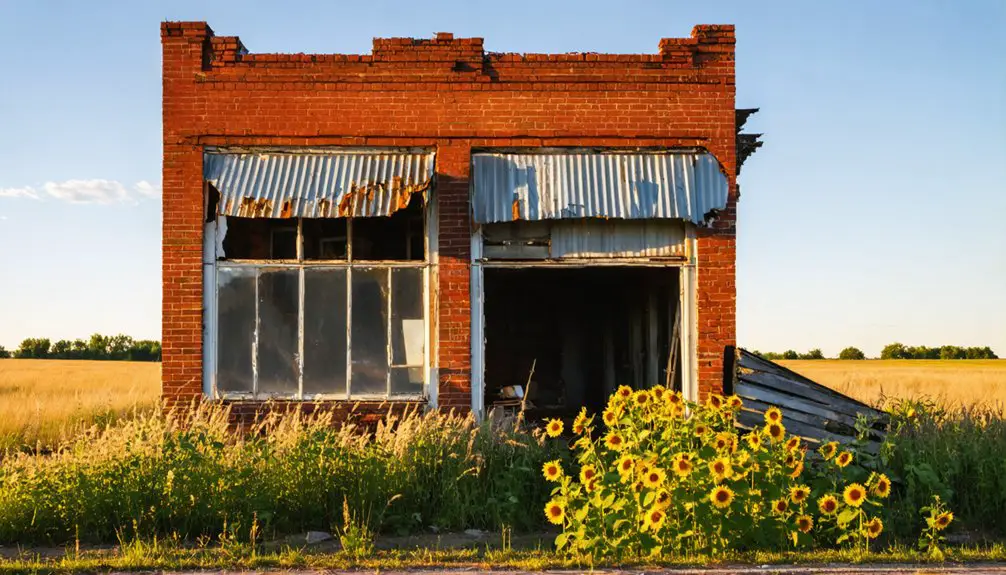
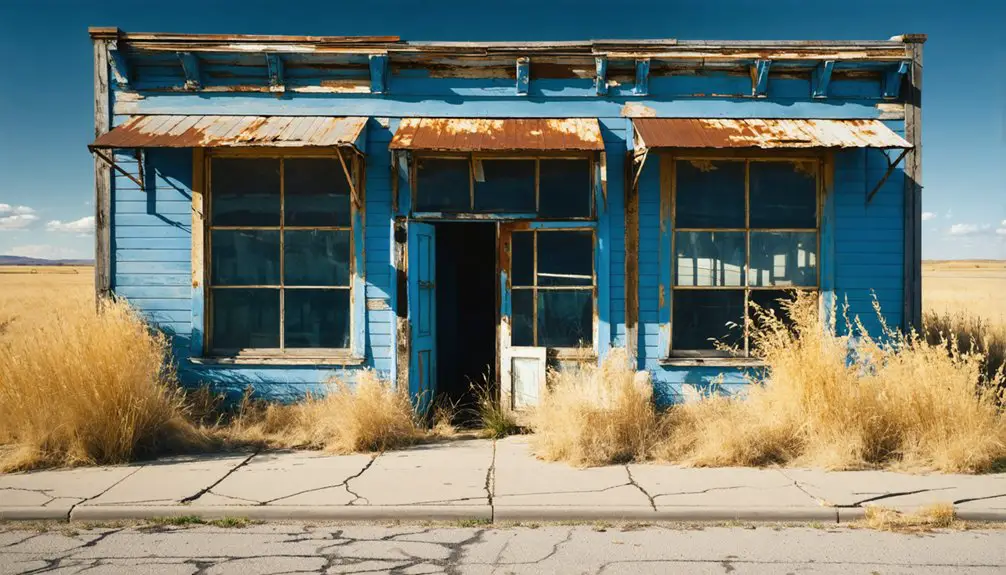
When you arrive in Belvidere today, you’ll find a settlement caught between existence and erasion. The remaining structures tell stories of stubborn resilience—old business buildings standing guard over empty streets, homes scattered across what was once a thriving grid, and that brick high school crumbling into memory.
A settlement suspended between survival and surrender, where weathered walls whisper tales of those who stayed when others left.
What You’ll Discover:
- The Landmark Trees – Elms and cottonwoods cluster together, marking civilization against endless prairie
- Architectural Ghosts – Weathered buildings defying gravity and time, accessible via county roads near Greensburg
- Medicine River Bottom – Farmland still worked by descendants who refused to abandon their heritage
Despite serious disrepair everywhere, there’s undeniable community spirit among those who remain. They’re the last guardians of Belvidere’s soul, choosing roots over retreat in Kansas’s unforgiving landscape.
Getting There: Directions and Access Routes
You’ll find Belvidere tucked along the Medicine Lodge River in southern Kiowa County, accessible via rural roads that branch off from U.S. Highway 54 near Greensburg, roughly 25 miles to the northeast.
The gravel county roads wind through the Medicine River Valley, where cottonwoods mark the watercourse and open prairie stretches toward distant horizons.
From Greensburg, follow Highway 54 southwest before turning south onto county routes that trace the old railway corridor where freight trains once stopped at this vanished junction.
Primary Highway Access Points
- From Greensburg: Follow the historical Atchison, Topeka and Santa Fe Railway corridor, now transformed into county roads threading through wheat fields
- Via Dodge City: Track south through Area Code 620 territory, where NOAA transmitter WNG534 guides weather-conscious adventurers
- Medicine Lodge River approach: Wind through rolling grasslands at 1,841-foot elevation, where cottonwoods signal civilization’s former foothold
Expect unmarked turns and self-reliance—exactly what ghost town hunters crave.
Medicine River Valley Route
Though Medicine Lodge anchors your departure point with its last reliable services, the true character of this route reveals itself once you’ve cleared Sun City’s outskirts. The pavement surrenders to raw earth for nearly the entire stretch to Belvidere, testing your vehicle’s mettle through river valley terrain that demands respect.
High clearance vehicle requirements aren’t suggestions here—they’re survival necessities when challenging terrain navigability meets seasonal washouts and rutted tracks. The Medicine Lodge River carves your corridor through Kiowa County’s backcountry, where Thompson Creek and Champion Draw mark wilderness intersections few travelers witness.
Only that final mile into Belvidere offers pavement again, a civilized ribbon welcoming you to Kansas’s forgotten edge. This isn’t a Sunday drive; it’s an expedition into authentic remoteness.
Distance From Greensburg
- US-183 northbound from Greensburg’s rebuilt downtown
- County road shifts via KS-47 eastward connections
- Grid-pattern navigation through unincorporated farmland
The flat terrain accelerates your escape from modern congestion. No fuel stops required, no GPS recalculations—just honest rural asphalt stretching toward a settlement that refused to die completely.
Pack water, trust your odometer’s incremental climb, and embrace the slow revelation of ghost town horizons.
Best Time to Visit and What to Bring
The Kansas prairie transforms dramatically with each passing season, and timing your ghost town expedition to Belvidere means understanding how weather patterns shape your experience.
Late spring through early fall delivers ideal conditions—May to September offers temperatures between 50°F and 95°F, perfect for wandering abandoned streets without battling winter’s brutal winds or snow-blocked roads. You’ll need strategic packing strategies: waterproof gear for May’s 4.81 inches of rainfall, sun protection against relentless summer heat, and layers for those unpredictable spring temperature swings.
Winter visits demand serious preparation—heavy outerwear, emergency supplies, and acceptance that rural access roads might become impassable. Bring sturdy footwear for uneven terrain, plenty of water, and first-aid essentials. Remote exploration means self-reliance.
Nearby Ghost Towns Worth Adding to Your Trip
Belvidere’s haunting emptiness becomes even more compelling when you realize it’s just one thread in Kansas’s vast tapestry of abandoned settlements. Within striking distance, you’ll find forgotten places that’ll satisfy your wanderlust for desolation.
The prairie holds countless secrets beyond Belvidere—each abandoned town a weathered monument to dreams that couldn’t survive the unforgiving Kansas winds.
Three ghost towns to expand your exploration:
- Gem (250 miles northwest) – Navigate to Thomas County where a crumbling schoolhouse stands sentinel over scattered homes. The preserved homesteads here whisper stories of prairie dreamers who couldn’t outlast the drought.
- Prairie City (170 miles east) – Douglas County’s earliest casualty features nearby historical buildings including church ruins and an abandoned stone house guarding a windswept cemetery.
- Galatia (100 miles northeast) – Barton County’s phantom settlement maintains a population of 36 souls clinging to memories where a bustling post office once anchored community life.
Tips for Photographing and Documenting Your Visit
After exploring multiple ghost towns across Kansas’s windswept plains, you’ll want to capture these ephemeral places before they disappear entirely into the prairie grass. Detailed photo compositions work best during golden hour, when warm light illuminates weathered farmhouses against rolling grasslands. Position your horizon low using the rule of thirds—let that expansive sky dominate.
Frame shots through Belvidere’s cottonwoods along Medicine River, creating natural depth that draws viewers into crumbling town remnants.
Strategies for historical documentation require more than stunning images. Log GPS coordinates, note that 25 homes were under construction in 1888, and record water scarcity details that doomed this settlement. Drive those dirt roads slowly—the dust you’ll kick up creates atmospheric haze that Kansas knows well, scattering light like echoes of vanished communities.
Frequently Asked Questions
Are There Any Safety Concerns When Exploring the Abandoned Structures in Belvidere?
You’ll face real dangers exploring Belvidere’s crumbling structures. Structural instability threatens with every rotted floorboard and sagging beam, while potential hazardous materials like asbestos lurk in walls. Your adventure demands respect for these decaying ruins and careful awareness.
Is Camping Allowed Near the Belvidere Ghost Town Site?
You can’t pitch your tent among Belvidere’s crumbling facades—camping’s forbidden there. Instead, you’ll find freedom at nearby campgrounds with seasonal accessibility. Scout designated spots where rules fade into prairie winds, letting you explore ghost town mysteries by daylight.
What Historical Artifacts Have Been Found at the Belvidere Site?
You’ll discover Old West relics like the Bayless family’s spectacles and Bible, plus hand-painted treasures from the 1904 World’s Fair. While Native American artifacts from the original Osage lands exist, the mansion’s preserved items steal the spotlight.
Are There Guided Tours Available for Belvidere and Nearby Ghost Towns?
No guided tours exist—you’re gloriously on your own in Belvidere’s windswept silence. These preserved buildings stand as your self-guided tour through authentic abandonment, where freedom means exploring unmarked paths without schedules, ropes, or someone’s rehearsed ghost stories.
Does Belvidere Have Any Reported Paranormal Activity or Ghost Stories?
No documented paranormal activity exists for Belvidere, Kansas itself. However, you’ll find whispered tales of an alleged haunted schoolhouse among explorers, with unexplained sightings reported by some visitors who’ve wandered these windswept, forgotten streets at dusk.