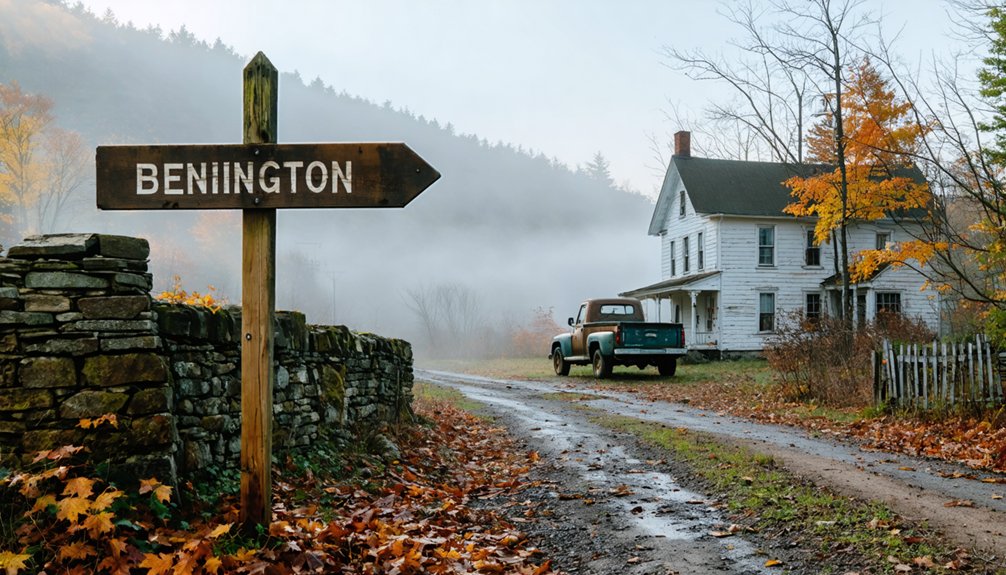
Your ghost town road trip through Bennington, Vermont’s wilderness takes you deep into the Bennington Triangle, where five people mysteriously vanished between 1945 and 1950. You’ll hike the 22,425-acre Green Mountain National Forest trails to Glastenbury Mountain‘s 3,748-foot summit, exploring abandoned settlements like Fayville’s brick school foundations and South Glastenbury’s eerie post office ruins. The 11.6-mile route passes five mysterious cairns and three water crossings, but you’ll need two hiking companions—these isolated trails demand serious safety precautions. The following sections reveal what happened to those missing victims and exactly where they disappeared.
Key Takeaways
- Explore Fayville’s brick school foundations, South Glastenbury post office ruins, and Eagle Square sawmill remains along Glastenbury Mountain’s trails.
- Hike the 11.6-mile route over five hours or the challenging 16.8-mile trail gaining 3,877 feet of elevation.
- Visit the 3,748-foot summit observation tower maintained by Green Mountain Club for panoramic views of Bennington County.
- Never hike alone; bring two companions, the Ten Essentials, emergency shelter, and keep your phone fully charged.
- Access ghost towns through the 22,425-acre Green Mountain National Forest via the Long Trail and Appalachian Trail.
The Dark History Behind the Bennington Triangle
Deep in the southwestern corner of Vermont, where Glastenbury Mountain rises through 36 square miles of suffocating forest, there’s a place that swallows people whole. You’ll find the Bennington Triangle centered on this cursed peak, though it’s not actually triangular at all.
The darkness here runs deeper than unproven urban legends about UFOs and Bigfoot. Native Americans supposedly warned of strange lights and sounds emanating from the mountain, though these tales emerged through conflicting historical accounts that blur fact and folklore. Algonquin legend spoke of a malevolent stone hidden somewhere in these mountains.
What’s undeniable? Real people vanished here. Real violence stained these woods. Between abandoned mine shafts, disorienting wind patterns, and documented murders, Glastenbury earned its reputation the hard way—not through sensationalized mystery-mongering, but through genuine tragedy. The Appalachian Trail cuts directly over Glastenbury Mountain, drawing hikers through the area where these disappearances occurred.
Mysterious Disappearances That Made This Region Infamous
Between 1945 and 1950, something turned the forests around Glastenbury Mountain into a graveyard without bodies. You’ll find five victims who simply vanished mid-afternoon within 36 square miles of wilderness. Experienced hunting guide Middie Rivers disappeared first, leaving only a handkerchief.
College student Paula Welden walked the Long Trail in her red coat and never returned. Her disappearance inspired the 1951 novel “Hangsaman” by Shirley Jackson. Eight-year-old Paul Jepson, also wearing red, evaporated near the town dump. War veteran James Tetford dissolved from a moving bus, his belongings still warm on the seat. Frieda Langer’s body surfaced seven months later in previously searched territory. The cause of death remained undetermined despite medical examination. Native American folklore influences still echo through these woods, while psychological trauma narratives attempt explaining what 400 searchers, aircraft, and tracking dogs couldn’t find.
Mapping Your Route Through Glastenbury Mountain Territory
The same wilderness that swallowed five people now beckons you into 22,425 acres of Green Mountain National Forest, where the Long Trail and Appalachian Trail converge over Glastenbury Mountain’s 3,748-foot summit. You’ll navigate 15 miles of trails through wildlife habitat diversity—white birch mingles with mountain ash, while red spruce and balsam fir tower overhead.
The geology of the mountain range tells an ancient story: 400-million-year-old bedrock from the Rodinia supercontinent, once soaring 20,000 feet before erosion sculpted today’s peaks.
Start from FS71 parking area, tackling three water crossings before ascending old woods roads. The 11.6-mile route gains 1,704 feet over five and a half hours. At 3,700 feet, you’ll discover five mysterious cairns—including barrel-shaped Cairn A, its 200-pound boulders supporting century-old moss mats. The summit features an observation tower maintained by the Green Mountain Club, offering panoramic views across Bennington County. For more experienced hikers, the 16.8-mile route challenges you with 3,877 feet of elevation gain over nearly ten hours.
Essential Stops Along Your Ghost Town Adventure
Five abandoned settlements form the skeleton of Vermont’s most infamous wilderness, each stop revealing another layer of the Bennington Triangle‘s haunting history. You’ll start at Fayville, where brick foundations from a destroyed school whisper of the 241 souls who once called this place home.
As you journey deeper into this mystifying region, you’ll discover the best seasons for Vermont ghost towns, each offering a unique charm and eerie allure. In the fall, vibrant foliage contrasts against crumbling structures, while winter blankets the remnants in a ghostly stillness. Spring brings an unexpected vibrancy, as wildflowers bloom around the relics of lives once lived, reminding visitors of the stories waiting to be uncovered.
The eerie folklore deepens at South Glastenbury‘s post office ruins, accessible via the Long and Appalachian Trails. Somerset’s six remaining residents guard stories of why Natives avoided these woods, sensing their spiritual significance.
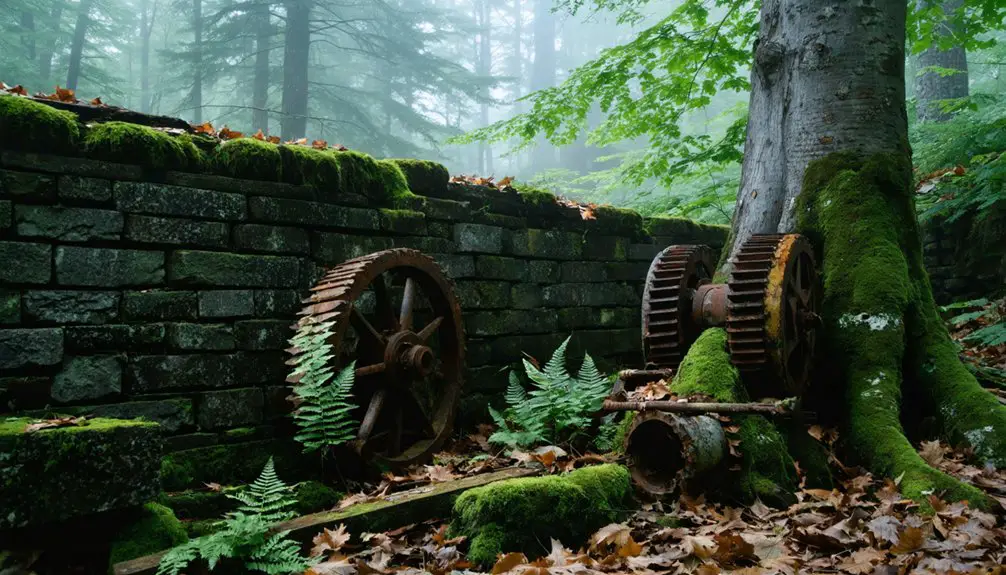
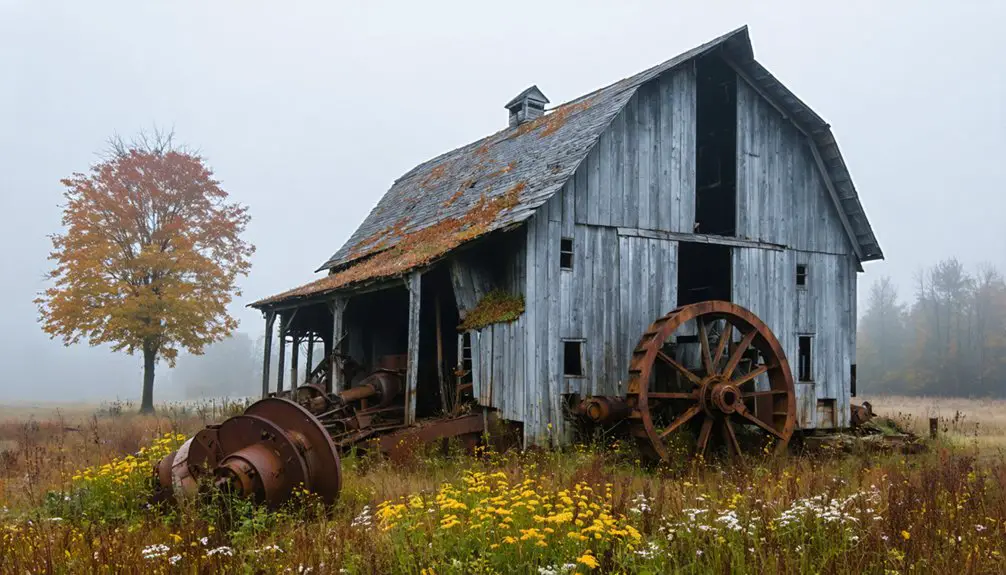
Climb Glastenbury Mountain‘s 3,747 feet to find charcoal kilns and the exact spot where guide Middie Rivers vanished in 1945. Old railroad ties and cairns mark where five people disappeared without explanation between 1945-1950, their mysteries unsolved. The most intact structure you’ll encounter is the foundation of the former Eagle Square sawmill. These abandoned settlements have been reclaimed by nature, their ruins now hidden among the encroaching forest.
Safety Precautions for Exploring Remote Vermont Wilderness
Exploring these forgotten settlements demands respect for nature’s unpredictable power—I learned this the hard way during my first solo attempt at the Glastenbury trail in 2018. Never venture into Vermont’s backcountry alone.
Bring at least two companions so someone can fetch help while another stays with an injured hiker. Before you leave, tell a trusted contact your exact route and worst-case return time, instructing them to call 911 if you don’t check in. Pack the Ten Essentials plus emergency shelter, fire-starting gear, and calorie-dense food.
Personal communication strategies matter—leave backup plans on your dashboard. Weather changes fast here, especially rain that creates hypothermia conditions. Keep your fully charged cell phone close to your body to preserve battery life in cold temperatures. Use airplane mode to conserve battery power so your phone remains functional for true emergencies. Consider Wilderness First Aid certification to master advanced first aid techniques before tackling these isolated trails.
Frequently Asked Questions
What Accommodations Are Available Near the Bennington Triangle Area?
You’ll discover charming local bed and breakfasts like Four Chimneys Inn, named Vermont’s best by Yankee Magazine. Nearby historic inns include Hotel Vervana’s mid-century elegance and Harwood Hill Motel’s period charm, offering authentic experiences beyond ordinary hotels.
Are There Guided Tours of Glastenbury Mountain and Ghost Town Sites?
No guided tours available exist for these abandoned settlements—ironically, you’ll need to forge your own path through the wilderness. Some locals offer private ghost town tours, though most explorers tackle the rugged terrain independently, embracing true backcountry freedom.
What’s the Best Time of Year to Visit for Paranormal Activity?
Visit during fall when spectral sightings peak at dusk, especially around autumn harvest festivals. You’ll experience the same eerie conditions that surrounded the 1945-1950 disappearances—disorienting winds, shadowy trails, and that unsettling sensation of being watched.
Can You Camp Overnight in the Green Mountain National Forest?
Yes, you can camp overnight at dispersed camping sites below 2,500 feet, staying 200 feet from remote hiking trails and water. You’ll find freedom exploring established spots while following Leave No Trace principles throughout the forest.
Are There Any Museums Documenting the Bennington Triangle Disappearances?
You’ll find haunting accounts at Bennington Museum, which featured the Bennington Triangle exhibit through 2023. Curator Jamie Franklin documented five unexplained occurrences between 1945-1950, displaying original records and period artifacts from these mysterious disappearances near Glastenbury Mountain.
References
- https://sharonahill.com/triangle-trope-of-vermont-bennington/
- https://www.vermonter.com/vermonts-bennington-triangle/
- https://happyvermont.com/2014/10/23/glastenbury-ghost-town/
- https://www.vermontpublic.org/podcast/brave-little-state/2025-03-06/the-bennington-triangle-how-5-mysterious-disappearances-developed-a-cult-following-online
- https://www.youtube.com/watch?v=ScW-H7A8yL8
- https://en.wikipedia.org/wiki/Bennington_Triangle
- https://www.youtube.com/watch?v=siZJhhrk_FY
- https://www.legendsofamerica.com/bennington-triangle-vermont/
- https://vocal.media/journal/unraveling-the-mystery-of-vermont-s-bennington-triangle-a-legacy-of-unsolved-disappearances-231se0yxr
- https://shunpikingwithray.com/haunted-happenings-in-the-bennington-triangle-and-beyond/