Planning a ghost town road trip to Benton, Oklahoma means heading into the heart of the Panhandle, where the Beaver River once supported a wild frontier settlement of up to 1,000 residents. You’ll find no standing structures today, just open prairie and quiet history beneath your boots. Visit in fall or spring, pack plenty of water, and bring sturdy shoes for uneven ground. There’s far more to this story than empty fields suggest.
Key Takeaways
- Benton, located east of Beaver along the Beaver River, was a thriving Old West settlement with a peak population of 500–1,000 residents.
- The site is barren with no standing structures, so visitors should explore the open landscape rather than expect visible historical remnants.
- Visit during fall or spring for ideal weather, and bring water, sturdy boots, layered clothing, sun protection, and a reliable GPS.
- Nearby ghost towns Beer City, Gate, and Kenton complement the road trip, each reflecting unique boom-and-bust frontier stories.
- Buffalo hunters, outlaws like the Doolin-Dalton Gang, and peaceful Indian bands all shaped Benton’s lawless, historically rich past.
What Was Benton, Oklahoma?
Before Oklahoma ever became a state, Benton was already living and dying by the brutal rhythms of the frontier. Nestled east of present-day Beaver along the Beaver River, this raw settlement emerged from traders and buffalo hunters carving out existence in No Man’s Land — a lawless stretch where outlaws roamed freely and rules meant nothing.
At its peak, Benton’s population swelled between 500 and 1,000 souls. Hotels, stores, and stables lined its streets, making it a genuine Old West town through the 1860s.
At its peak, Benton buzzed with 500 to 1,000 souls — hotels, stables, and storefronts defining a true Old West town.
But when the buffalo vanished, so did Benton’s reason for existing. By 1880, it was fading fast.
Today, Benton history survives only in ghost town legends — nothing visible remains. You’re visiting pure Oklahoma prairie where a forgotten world once breathed.
Where Exactly Was Benton Located?
Knowing where Benton stood gives your ghost town road trip a real anchor point.
You’ll find its historical significance tied directly to the Beaver River, east of present-day Beaver, Oklahoma. That geographical context matters because Benton thrived in No Man’s Land, a lawless stretch of the Oklahoma Panhandle before statehood arrived in 1907.
Today, Benton County sits within old Beaver County, designated number 07. You can reach the site using standard 2WD roads, so you won’t need a specialized vehicle.
The grid 1 location puts you on flat prairie terrain near the river’s path.
Nothing marks the spot visually, but standing there, you’re planting your feet where 500 to 1,000 people once lived rough, untamed lives on Oklahoma’s wild frontier.
The Outlaws and Buffalo Hunters Who Built Benton
When you picture Benton’s earliest days, you’ll see a raw, restless world shaped by buffalo hunters who tracked massive herds across the Beaver River corridor, trading hides and building a rough economy almost overnight.
No Man’s Land attracted a darker crowd too — outlaws and cattle rustlers who found the lawless Oklahoma Panhandle a perfect refuge from justice, with the infamous Doolin-Dalton Gang‘s influence casting a long shadow across the region.
You’re looking at a town that didn’t grow from settlers seeking quiet homesteads but from hard, dangerous men whose trades ran on violence, survival, and profit.
Buffalo Hunters’ Wild Origins
Back in the 1860s, Benton wasn’t built by settlers chasing homestead dreams — it was carved out of the prairie by buffalo hunters and traders who recognized the Beaver River’s strategic value long before any government surveyor did.
These weren’t cautious men. They operated in No Man’s Land, a territory answering to nobody, where freedom meant surviving on your own terms.
Trading posts sprang up naturally here, supplying hunters deep in the hunt season. The buffalo legacy fueled everything — hotels, stables, and stores that transformed a raw riverbank into a town of 500 to 1,000 people.
When the herds vanished by 1880, so did Benton’s reason for existing. The hunters moved on, leaving the prairie to reclaim what they’d briefly tamed.
Outlaws Shaped Benton
No Man’s Land didn’t attract the cautious — it drew outlaws, cattle rustlers, and gunslingers who found Benton’s lawless geography perfectly suited to their trade.
Before Oklahoma statehood in 1907, no federal authority claimed this strip, making it a refuge for those dodging the law.
The Doolin-Dalton Gang‘s influence rippled through the region, and their outlaw influence left a historical impact still felt in Panhandle lore today.
Peaceful Indian bands also roamed these plains alongside these dangerous figures, creating a striking contrast of cultures sharing uneasy territory.
When you walk Benton’s barren grounds today, you’re standing where desperados once moved freely.
That freedom came with violence, shaping every saloon, stable, and trading post that briefly defined this forgotten Oklahoma ghost town.
What’s Left to See at Benton Today?
What remains of Benton today? Honestly, very little. The site’s classified as barren, meaning you won’t find standing structures, crumbling saloons, or weathered storefronts.
The Benton remnants have surrendered entirely to Oklahoma’s prairie, reverting to open fields along the Beaver River.
Yet don’t let that discourage you. The historical significance of this location runs deep beneath that empty soil. You’re standing where 500 to 1,000 people once hustled, traded, and survived in genuine No Man’s Land.
Outlaws passed through. Buffalo hunters camped nearby. Entire livelihoods rose and collapsed here.
Bring your curiosity rather than your camera. Walk the river’s edge, breathe the Panhandle air, and let the landscape tell its story.
Sometimes absence speaks louder than ruins ever could.
When Is the Best Time to Visit Benton Ghost Town?
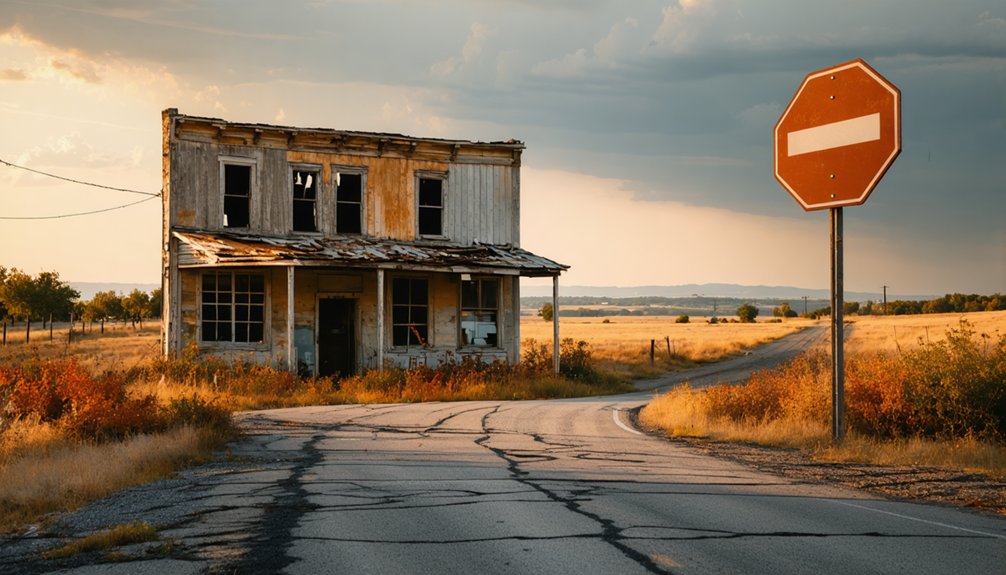
Timing your visit matters just as much as finding the site itself. The best seasons for Benton are fall and spring, when ideal weather turns the Oklahoma Panhandle into something genuinely beautiful.
Summer brings brutal heat across the open prairie, and winter delivers biting cold winds that make outdoor exploration miserable. You don’t want either extreme ruining your experience at a barren site with no shelter.
In fall, the light hits the Beaver River valley at a golden angle, making even empty grasslands feel cinematic.
Spring offers mild temperatures and wide-open skies before summer’s fury arrives. You’ll move freely across the terrain, soak in the frontier atmosphere, and actually enjoy piecing together what once stood here.
Plan accordingly, and Benton rewards you.
How to Get to Benton, Oklahoma
Getting to Benton takes you deep into the Oklahoma Panhandle, where highways thin out and the landscape opens into wide, unbroken prairie.
Head toward Beaver County using the main highways accessing the Panhandle, then navigate east of Beaver town along the Beaver River‘s path. You’ll follow grid 1 coordinates on standard 2WD roads, so no specialized vehicle is necessary.
Follow the main Panhandle highways into Beaver County, then trace the Beaver River east on standard 2WD roads.
The drive itself sets the mood — flat, windswept terrain that once sheltered ghost town legends and historical mysteries beneath its quiet surface.
Watch for weather extremes, since conditions shift fast out here. Combine your route with nearby stops like Beer City or Gate to build a fuller itinerary.
The roads are straightforward, but the history waiting along them is anything but ordinary.
What to Pack Before You Visit Benton
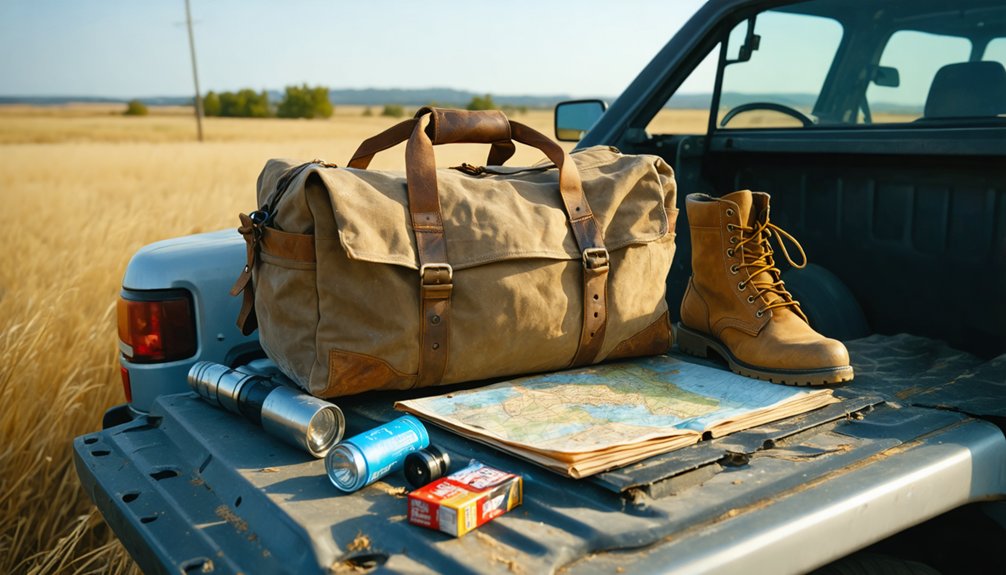
Before you set out across the Oklahoma Panhandle‘s unforgiving prairie, you’ll want to pack smart for Benton’s unpredictable extremes—scorching summers, bitter winters, and sudden weather shifts that catch unprepared travelers off guard.
Your gear checklist should include sturdy walking shoes, layered clothing, sun protection, and enough water to handle long stretches of exposed terrain with no shade or shelter.
Since nothing remains standing at this barren site, you’re fundamentally equipping yourself for a raw, open-air history hunt across windswept fields rather than a structured tourist stop.
Essential Gear For Exploration
Packing 5 essential items will make your trip to Benton far more rewarding than showing up empty-handed to a barren Oklahoma Panhandle prairie.
Your ghost town gear should prioritize function over comfort, because this terrain rewards the prepared explorer.
Here are your exploration essentials:
- Detailed topographic map – GPS fails on remote prairie grids
- Weather-appropriate layers – temperatures swing violently between seasons
- Sturdy boots – uneven ground hides beneath tall grass
- Water supply – no services exist for miles around
That fifth item? A quality camera.
Benton’s story lives in its landscape now, not its structures. Capturing the Beaver River’s horizon or a crumbling fence line transforms your visit from a disappointing empty field into genuine historical discovery worth remembering.
Weather-Ready Clothing Choices
How you dress for Benton can mean the difference between a memorable adventure and a miserable retreat to your car. Oklahoma’s Panhandle weather patterns shift fast — scorching afternoons can surrender to cold winds within hours, especially during changing seasons.
Clothing layers are your best defense against this unpredictability. Start with a moisture-wicking base layer, add an insulating mid-layer, and top it with a windproof shell you can strip off quickly.
Sturdy, broken-in boots handle the prairie terrain without punishing your feet across uneven ground.
Fall and spring visits demand sun protection too — wide-brimmed hats and UV-blocking sunglasses cut the glare across open flatlands.
Pack light, pack smart, and you’ll move freely through Benton’s barren landscape without weather dictating your experience.
Beer City and Gate: The Best Ghost Towns Near Benton
While Benton may be the ghost town drawing you to Oklahoma’s Panhandle, two nearby sites deserve a spot on your itinerary: Beer City and Gate.
Both reveal how fragile Benton’s economy truly was across these untamed plains.
Here’s why you’ll want to visit both:
- Beer City (1888–1890) thrived by selling liquor to Kansans dodging prohibition laws.
- Gate peaked at 1,000 residents before the Depression and Dust Bowl crushed it.
- Both ghost towns share Benton’s story of boom-and-bust cycles defining Panhandle life.
- Combining all three sites creates a seamless road trip through Oklahoma’s most rebellious forgotten history.
You’re not just visiting ghost towns — you’re walking through America’s rawest, freest frontier era.
Four Ghost Towns Near Benton Worth the Detour
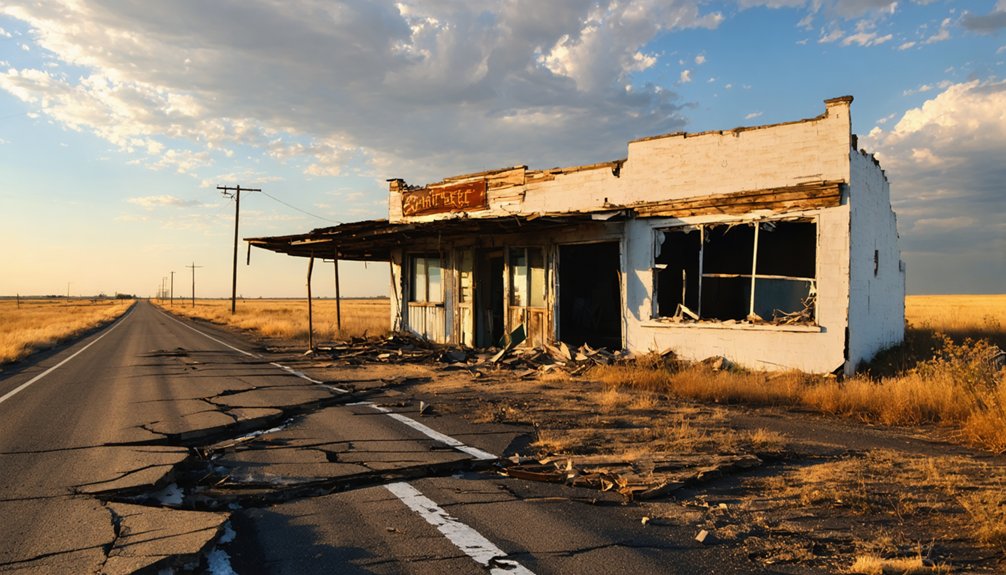
While you’re out exploring Benton’s barren stretch of Oklahoma Panhandle history, you’d be doing yourself a disservice to skip the equally compelling ghost towns nearby.
Beer City earned its notoriety as the rowdiest spot in No Man’s Land, operating from 1888 to 1890 as a haven for Kansans dodging prohibition, while Gate rose and fell on ranching dreams before the Depression and Dust Bowl stripped it bare.
If outlaws and lawlessness fuel your curiosity, Kenton’s violent past ties it directly to the infamous figures who once terrorized this untamed region.
Beer City’s Rowdy Legacy
Just a short detour from Benton’s quiet prairie site, Beer City stands as one of the Oklahoma Panhandle‘s most gloriously chaotic footnotes in history. Operating from 1888 to 1890, it thrived by offering Kansans an escape from prohibition’s grip — rowdy nightlife at its most unapologetic.
Its historical significance lives in what it represented: absolute freedom from outside law in No Man’s Land.
Here’s what defined Beer City’s brief, blazing existence:
- Saloons operated without restriction or oversight
- Dance halls ran day and night
- Kansas prohibitionists crossed the border specifically to drink freely
- The town collapsed once Kansas laws loosened
You won’t find structures today, but standing on that open prairie, you’ll feel the echo of a place that refused every rule imposed on it.
Gate’s Ranching History
Swap the lawless chaos of Beer City for Gate’s quieter but equally compelling story, and you’ll find a town that once hummed with the rhythms of Oklahoma’s ranching frontier. At its peak in the early 1900s, Gate supported nearly 1,000 residents whose livelihoods depended on cattle drives and evolving ranching techniques that shaped the Panhandle’s economic identity.
The town’s historical significance runs deeper than its modest footprint suggests. Ranchers here mastered open-range management, driving herds across unforgiving prairie terrain with remarkable efficiency. Their economic impact fueled local trade, built infrastructure, and established Gate as a genuine ranching hub.
Then the Depression and Dust Bowl arrived, stripping away prosperity one brutal season at a time.
Today, Gate stands as a quiet reflection of resilience — worth every mile of your detour.
Kenton’s Outlaw Past
Kenton carries a darker reputation than Gate, and it earns every bit of it. Nestled deep in No Man’s Land, this town attracted the worst characters the frontier produced. Its outlaw legends aren’t folklore—they’re documented history worth standing in.
When you visit, keep these facts in mind:
- No federal law governed No Man’s Land before 1890
- Cattle rustlers operated freely through Kenton’s surrounding territory
- The Doolin-Dalton Gang influenced criminal activity across this region
- Its historical significance stems from genuine lawlessness, not Hollywood mythology
You’ll find no dramatic structures waiting, but the landscape itself tells the story. The open prairie holds weight here.
Standing where outlaws once rode freely reminds you exactly why this untamed corner of Oklahoma still fascinates.
How Benton Fits Into a Panhandle Ghost Town Road Trip
Benton fits naturally into a broader Panhandle ghost town circuit, anchoring the eastern stretch of a route that can carry you through some of Oklahoma’s most lawless and forgotten history.
From Benton, you can push west toward Beer City, where Kansas prohibitionists once crossed the border for illegal drinks, then continue to Gate and finally Kenton, where outlaws roamed freely.
Benton’s significance lies in its role as an early commercial hub that preceded these later settlements, making it the starting point that contextualizes ghost town culture across the entire Panhandle.
You’re not just visiting empty fields — you’re tracing a timeline of boom, bust, and abandonment.
String these stops together over a weekend and you’ll experience No Man’s Land’s wild spirit firsthand.
Frequently Asked Questions
Can You Camp Overnight Near the Benton Ghost Town Site?
You’ll find no designated campsite at Benton’s barren site, but you can explore nearby attractions while checking local camping regulations. Beaver County’s open prairie invites free spirits seeking adventure under Oklahoma’s vast, star-filled panhandle skies.
Are There Any Guided Tours Available for Benton and Nearby Ghost Towns?
You won’t find formal guided tours, but you can explore Benton’s historical significance independently, chasing ghost stories across the wild Oklahoma Panhandle. Combine nearby Beer City and Kenton for an evocative, freedom-filled self-guided adventure through No Man’s Land.
Is the Benton Ghost Town Site on Private or Public Land?
The knowledge doesn’t confirm whether Benton’s land is private or public, so you’ll want to verify before visiting. Respecting Benton history and ghost town preservation guarantees you’re free to explore responsibly without trespassing on potentially private Oklahoma Panhandle property.
Were Any Famous Outlaws Specifically Documented Living in Benton?
No specific famous outlaws are documented living in Benton, but you’ll feel the outlaw legends echo through its historical significance—infamous Wild West figures like the Doolin-Dalton Gang roamed and influenced this lawless No Man’s Land territory.
Are There Any Annual Events or Festivals Celebrating Benton’s History?
You won’t find annual events or festivals celebrating Benton’s history directly, but you can explore nearby Panhandle gatherings featuring historical reenactments and local folklore that’ll ignite your imagination about this forgotten outlaw haven.
References
- https://www.ghosttowns.com/states/ok/benton.html
- https://okmag.com/blog/gone-but-not-forgotten/
- https://www.okhistory.org/publications/enc/entry?entry=GH002
- https://www.youtube.com/watch?v=aeAXyEw70io
- https://kids.kiddle.co/List_of_ghost_towns_in_Oklahoma