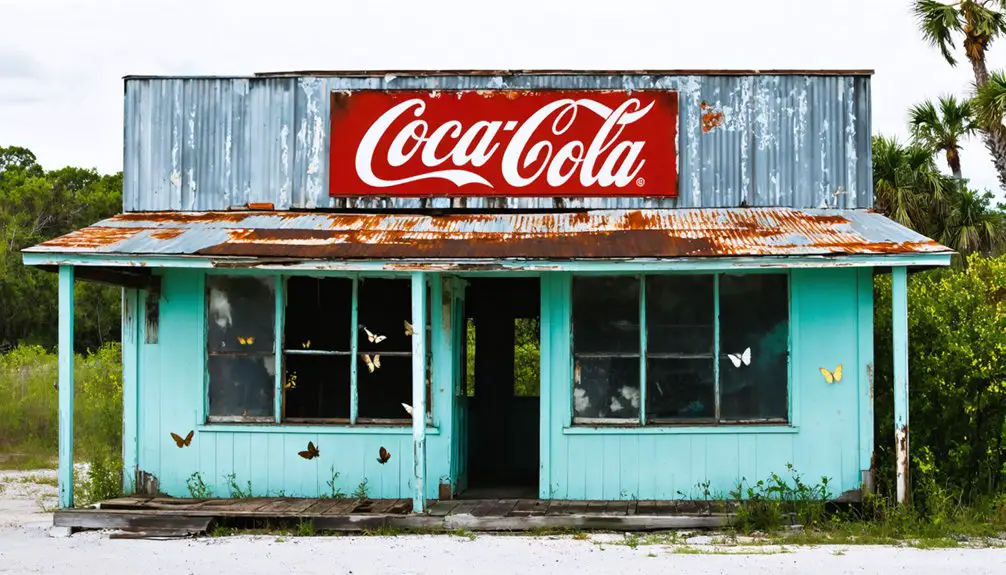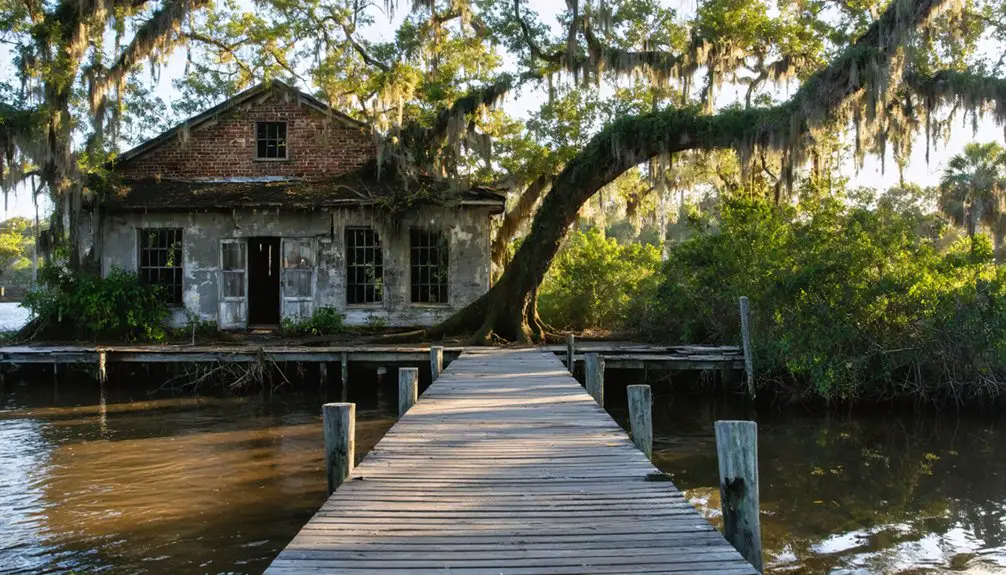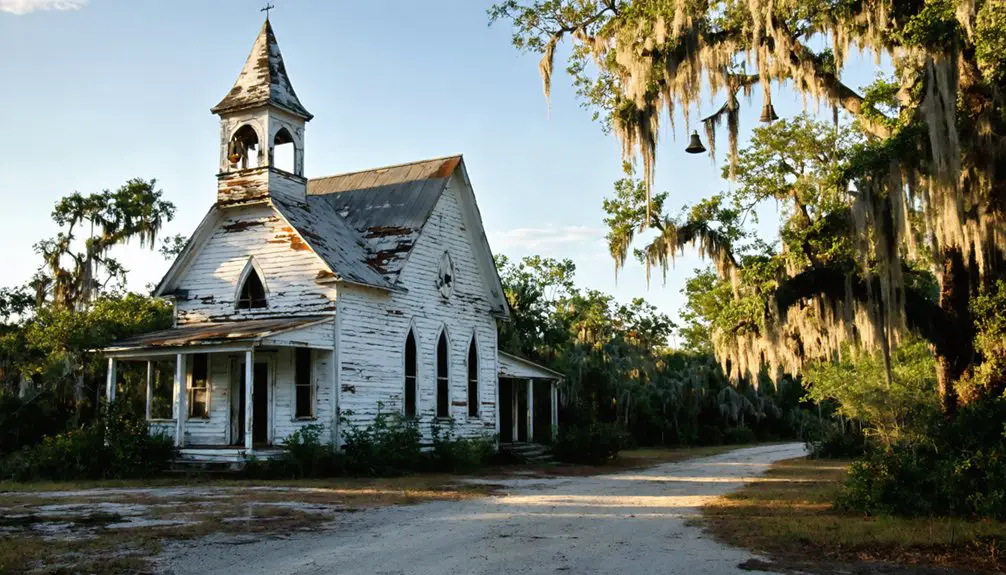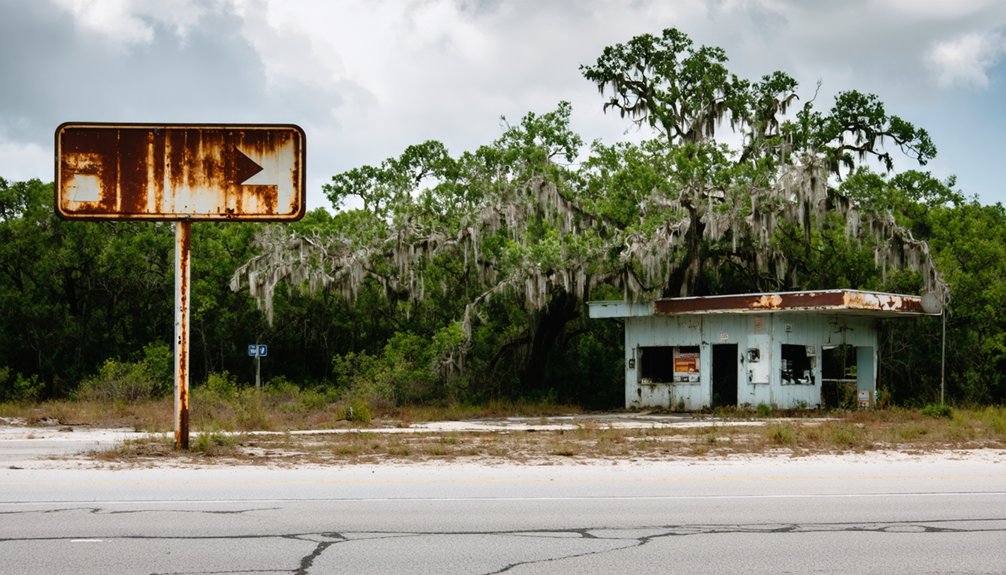
You’ll find Bereah 6.2 miles northwest of Avon Park in Polk County, where a once-thriving citrus community vanished after the catastrophic freezes of 1894-1895. Navigate through today’s orange groves to discover the Corinth Primitive Baptist Church Cemetery, where weathered headstones from 1881-1893 mark the settlement’s brief existence. The isolated location requires careful planning—bring GPS coordinates (27°39′20″N 81°37′25″W) since signage is minimal. Combine your visit with nearby ghost towns like Centralia and Kerr City for a complete central Florida historical exploration that reveals the region’s forgotten agricultural past.
Key Takeaways
- Bereah is located 6.2 miles northwest of Avon Park in Polk County, Florida, at coordinates 27°39′20″N 81°37′25″W.
- The Corinth Primitive Baptist Church Cemetery is the only remaining landmark, featuring weathered headstones dating from 1881 to 1893.
- Bereah flourished in the 1880s but collapsed after catastrophic freezes in 1894-1895 destroyed the citrus groves and economy.
- The site is overgrown with persistent vegetation, making it an off-the-beaten-path exploration with minimal visible infrastructure remaining.
- Nearby ghost towns include Centralia, Balm, Kerr City, and Kismet, allowing for an extended regional road trip itinerary.
Discovering Bereah’s Location in Polk County
Nestled within the grove-covered heartland of central Florida’s Polk County, Bereah exists today as little more than a whisper of its former self. You’ll find this hidden ghost town approximately 6.2 miles northwest of Avon Park, marked precisely at coordinates 27°39′20″N 81°37′25″W.
The original settler families who established this community left behind minimal traces—today, only the Cemetery of Corinth Primitive Baptist Church stands as evidence, monument, or record to their lives.
When you’re planning your visit, use Avon Park as your reference point and head northwest through the groves. The agricultural infrastructure development that once sustained this settlement has vanished beneath Florida’s persistent vegetation, making Bereah a true adventure for those seeking off-the-beaten-path exploration.
The Rise and Fall of a Florida Citrus Community
Bereah flourished in the 1880s as citrus groves stretched across Polk County’s fertile landscape, transforming the wilderness into a prosperous farming community where packinghouses hummed with activity and orange-laden wagons rolled toward distant markets.
Then the catastrophic freezes of 1894-1895 struck with brutal force, obliterating the groves that had produced 5 million boxes just months earlier and reducing the entire region’s harvest to a mere 147,000 boxes. By 1895, you’d find Bereah’s streets emptying as families abandoned their frozen orchards, leaving behind a community that had literally withered on the vine.
Farming Prosperity in 1880s
While Spanish explorers first brought citrus seeds to Florida’s shores near St. Augustine in the 1500s, it wasn’t until the 1880s that Bereah’s landscape transformed into golden groves. You’ll find this era marked the pinnacle of “orange fever,” when industrious settlers carved productive farms from raw pinewood.
The arrival of railroad lines in 1883 changed everything—suddenly, your harvest could reach northern markets in refrigerated cars instead of rotting during slow wagon journeys.
Ambitious entrepreneurs flooded Polk County, drawn by reports of groves yielding extraordinary profits. By 1893, Florida shipped 5 million boxes annually. You’d have witnessed packinghouses rising alongside tracks, steamboats traversing waterways, and communities like Bereah flourishing around this citrus empire. Fortunes seemed limitless until nature intervened.
The Devastating Great Freezes
Just when Bereah’s citrus empire seemed unstoppable, Mother Nature delivered a catastrophic one-two punch that would reshape Florida’s agricultural landscape forever.
The back-to-back freezes of December 1894 and February 1895 struck with brutal precision. Temperatures plummeted to -2°F in Tallahassee that January, catching growers completely off guard. You’d have witnessed entire groves reduced to frozen wastelands overnight—years of cultivation destroyed in hours.
The economic disruption was immediate and total. Bereah’s farmers watched helplessly as their life’s work died in the fields. Northern Florida’s citrus industry simply couldn’t recover. The agricultural decline forced survivors to abandon their land and relocate southward, leaving Bereah’s once-thriving community to wither.
This wasn’t just crop loss—it was the death knell for Bereah’s entire economy.
Community Collapse by 1895
The collapse came swiftly—within months of the February 1895 freeze, Bereah’s streets fell silent. You’ll find no romantic slow fade here—this was economic devastation. Shrinking employment prospects forced families to abandon homesteads overnight, seeking survival elsewhere.
The social fabric breakdown followed predictably: church services stopped, neighbors scattered, and community bonds severed.
By year’s end, Bereah existed only in memory:
- Remaining structures surrendered to encroaching wilderness and scavengers
- The Corinth Primitive Baptist Church cemetery became the sole landmark
- Grove owners reclaimed the land, erasing settlement traces beneath new plantings
Today, you’re exploring what complete abandonment looks like. The cemetery markers represent your only physical connection to Bereah’s residents—those who gambled on Florida’s citrus promise and lost everything to a single winter’s cruelty.
What Remains: Corinth Primitive Baptist Church Cemetery
When you arrive at the Corinth Primitive Baptist Church Cemetery, you’ll find weathered headstones marking graves from 1881 to 1893—silent witnesses to Bereah’s brief existence.
Among the marked plots, you’ll notice several small burial sites for infants, a stark reminder of the era’s brutal toll from diseases like influenza when medical care meant whatever remedies the general store could provide.
Beyond the visible perimeter, the ground likely holds many more unmarked graves, their occupants now anonymous beneath the encroaching Florida brush.
Graves Dating 1881-1893
Hidden beneath decades of overgrowth, weathered headstones mark the final resting places of Bereah’s earliest settlers, their inscriptions spanning just twelve years from 1881 to 1893. These marked graves tell a concentrated story of frontier life, capturing a community’s brief existence before its mysterious abandonment. You’ll find grave inscriptions barely legible, etched by weather and time, yet they’re your most tangible connection to the people who carved out lives in this remote Florida wilderness.
When exploring the cemetery, you’ll discover:
- Twelve-year timeline revealing the settlement’s active period during late 19th century
- Hand-carved markers showing craftsmanship and personal dedication despite frontier hardships
- Family clusters indicating multiple generations briefly called Bereah home
These stones represent documented history that won’t be found in official records—raw, unfiltered evidence of forgotten lives.
Infant and Unmarked Burials
Among the 579 documented memorials at Corinth Primitive Baptist Church Cemetery, you’ll find the smallest graves tell the hardest stories. Infant burials scatter throughout the grounds, reflecting 19th-century infant mortality rates that claimed countless young lives. Many family plots hold multiple child graves linked through cemetery databases, though several lack age details entirely.
You’ll notice gaps in the memorial count—those unmarked fieldstone markers and sunken depressions hint at burials lost to time. Early Primitive Baptist sites favored simple stones that weather into anonymity. The difference between 579 and 697 memorial counts across related records suggests dozens of undocumented graves remain.
Walk carefully here. Each depression might mark someone’s final rest, their story surviving only through the earth itself.
Cemetery Perimeter and Access
The cemetery’s weathered fence line traces an irregular boundary through palmetto scrub and orange groves, marking where Bereah’s faithful tended their dead before the freezes came. You’ll find the perimeter access straightforward—park along West Bereah Road and approach respectfully. The boundary suggests unmarked grave locations extend beyond visible headstones, so tread carefully through reclaimed ground where nature’s slowly erasing human history.
Navigation essentials:
- The protective perimeter encloses documented burial plots from 1881-1893
- Palmetto scrub and citrus groves conceal potential unmarked grave locations outside mapped areas
- Year-round access via 2WD-friendly West Bereah Road requires no special permits
The fence serves dual purposes: protecting known graves while acknowledging that forgotten souls likely rest beyond its posts. This isolation preserves Bereah’s haunting authenticity—no crowds, no commercialization, just you and Florida’s forgotten frontier.
The Great Freezes That Ended an Era
Within just six weeks during the winter of 1894-95, two catastrophic freezes obliterated Florida’s thriving citrus industry and reshaped the state’s agricultural landscape forever.
The first freeze on December 29, 1894, stripped fruit and foliage from trees across Central Florida. Then February 7 delivered the killing blow—temperatures plummeted 62°F in under 24 hours, reaching the high teens statewide. Snow fell as far south as Tampa while trees split open and died to their roots.
In 24 hours, temperatures dropped 62 degrees and snow blanketed Tampa as citrus trees split open and perished.
Lake County lost 99% of its citrus trees. Production collapsed from 5 million boxes to zero. The lasting impact on Florida’s citrus industry was staggering—recovery took two decades.
You’ll see the fragility of agricultural communities reflected in Bereah’s abandoned structures, where bankrupt settlers walked away from their frozen dreams.
Getting There: Routes Through the Orange Groves
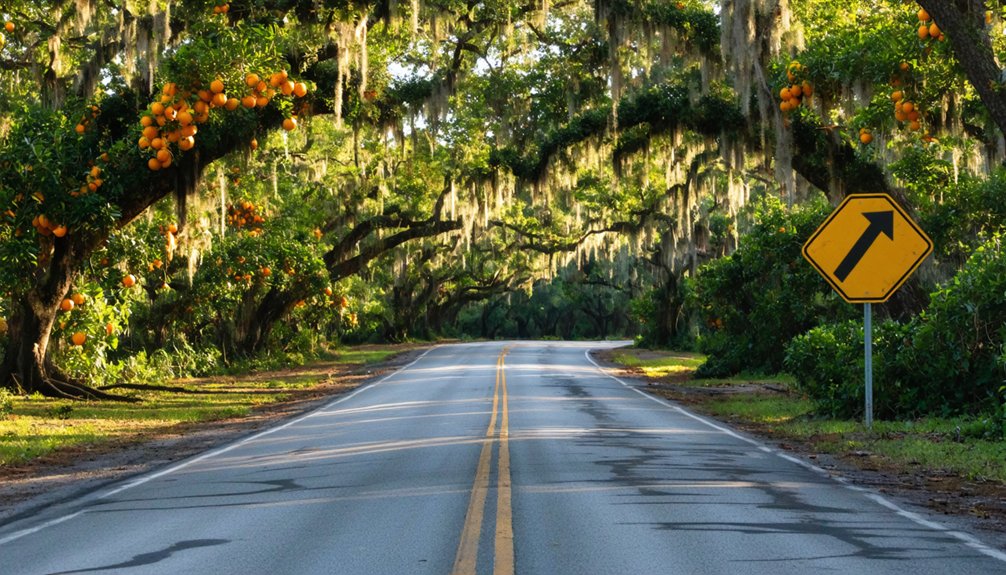
Nestled in the heart of Polk County at coordinates 27°39′20″N 81°37′25″W, Bereah lies roughly six miles northwest of Avon Park, concealed beneath corridors of citrus trees that replaced the settlers’ original groves. Your journey begins north of town, where orange grove access routes wind through working farmland that’s changed little since the railroad days.
Driving directions for navigation:
- Head west on Avon Park Cutoff from your starting point
- Turn south onto West Bereah Road (skip East Bereah Road entirely)
- Follow the route through active citrus groves on standard 2WD-friendly roads
The path reveals why this settlement faded—hidden among endless rows of fruit trees, it’s easy to miss entirely. You’ll traverse Polk County’s agricultural heartland, where year-round climate still sustains the industry that outlasted Bereah itself.
Preserving the Memory of Post-Civil War Settlements
While Bereah slipped quietly into obscurity, other post-Civil War settlements fought harder to preserve their stories. You’ll find Freemanville’s legacy just miles away in Port Orange, where ongoing preservation initiatives keep history alive through Mt. Moriah Baptist Church‘s annual gatherings.
The 2002 Florida Heritage Site marker stands as record, proof, or evidence to what city planning efforts can achieve when communities refuse to let freedom’s earliest chapters fade. Search the woods south of the church for a rusty water pump—it’s all that marks where 1,500 freed people once built their lives.
Local historians like Harold Cardwell and Hans Lempel documented how survivors transformed defeat into prosperity through orange groves and railroad work, proving that some settlements refuse to become ghosts.
Exploring Nearby Ghost Towns and Historical Sites
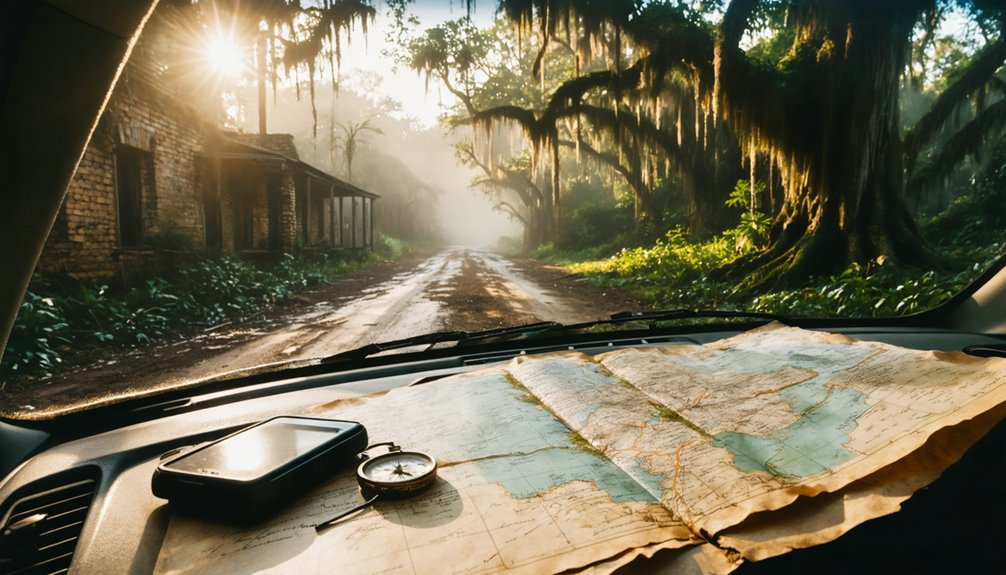
Your journey to Bereah shouldn’t end at the cemetery gates—Polk County sits at the crossroads of Central Florida’s forgotten communities, each offering its own chapter of abandonment and resilience.
Centralia in Hernando County once housed 2,000 souls who built secondary industries around its massive sawmill. You’ll find architectural remnants including concrete ramps and a ghost of the old log pond. The railroad path lies somewhere beneath tangled vines.
Essential ghost town stops within striking distance:
- Balm (Hillsborough County) – partially inhabited crossroads community
- Kerr City (Marion County) – northernmost outpost worth the drive
- Kismet (Lake County) – mysterious settlement sharing Bereah’s longitude
Each site demands 2WD capability and respect for protected lands. Skip the metal detector—preservation trumps treasure hunting in these Wildlife Management Areas.
Frequently Asked Questions
Is Permission Required to Visit the Corinth Primitive Baptist Church Cemetery?
No explicit permission’s required, but you’ll want to respect cemetery visitation rules and confirm private property access boundaries. The site’s reachable via public roads, though courteously checking with nearby farm residents guarantees you’re exploring responsibly and freely.
What Safety Precautions Should Visitors Take When Exploring the Overgrown Area?
You’re chasing freedom in abandoned places, yet safety still matters. Wear protective clothing against Florida’s wild overgrowth, exercise caution around unstable structures, pack recovery gear, and drag your feet through vegetation—stingrays don’t respect your adventurous spirit.
Are There Guided Tours Available for Bereah and Nearby Ghost Towns?
No organized excursions operate at Bereah—you’ll explore independently through overgrown paths and weathered cemetery stones. Self-guided tours offer complete freedom to discover this abandoned citrus settlement at your own pace, without crowds or schedules constraining your adventure.
Can Visitors Take Photographs or Rubbings of the Historic Grave Markers?
You’ll find no photography allowed restrictions aren’t enforced at this abandoned cemetery, though you should obtain permission for rubbings from local historical societies. Respect these forgotten graves—they’re fragile remnants of Florida’s pioneering past awaiting your thoughtful exploration.
What Is the Best Time of Year to Visit the Cemetery?
Visit during October through May’s dry season for ideal conditions. You’ll find early morning visits most comfortable, avoiding summer’s intense heat. Overcast weather conditions provide perfect lighting for photography while keeping temperatures pleasant as you explore these forgotten graves.