Planning a ghost town road trip to Big Rock, Michigan starts on M-32, between Gaylord and Atlanta, where a glacial boulder marks what’s left of a once-thriving logging community. Founded by German immigrants, Big Rock peaked near 100 residents around 1910 before timber depletion silenced the town. Today, you’ll find a surviving Congregational Church, a stone berm spelling “BIG ROCK,” and a historical marker. There’s far more to this forgotten place than meets the eye.
Key Takeaways
- Big Rock is located along M-32 between Gaylord and Atlanta, marked by a massive glacier-transported granite boulder at Thornton Road.
- Founded by German immigrants, Big Rock peaked near 100 residents around 1910 before declining after the logging industry collapsed.
- Key attractions include the surviving Congregational Church, a historical marker, Indigenous-marked boulder, and a stone berm spelling “BIG ROCK.”
- Nearby ghost towns worth visiting include Rust, Hillman, Vienna, and Lachine, each offering unique historical and architectural features.
- Visit between late spring and early fall, packing walking shoes, a camera, binoculars, and weather-appropriate layered clothing.
What Is Big Rock, Michigan: and What’s Buried Under It?
Tucked along M-32 between Gaylord and Atlanta in northern Michigan, Big Rock isn’t much to look at today — but that’s exactly what makes it fascinating.
The town takes its name from a massive granite boulder sitting at the corner of M-32 and Thornton Road, and what you see above ground is just 10% of the actual rock.
A massive granite boulder marks Big Rock’s heart — but only 10% of it is visible above ground.
Glaciers pushed it down from Canada thousands of years ago, burying its history deep beneath the soil — much like the town itself. Those geological features hint at something enormous hidden underneath, comparable to an iceberg.
In 1940, one determined store owner actually tunneled beneath it trying to uncover its full size. He never succeeded.
Some things are meant to stay buried — and that’s what keeps you coming back.
The Ghost Town History of Big Rock, Michigan
Big Rock didn’t start as a ghost town — it started as a genuine community. German immigrants Charles Meyer and August Barger founded it, and by 1910, nearly 100 people called it home.
The logging industry fueled everything — the sawmill, the blacksmith shop, the grange hall, the Congregational church. When Montmorency County’s timber boom collapsed around 1910, the town began its slow fade.
The post office closed in 1920, the general store burned in 1966, and Big Rock quietly crossed into ghost stories territory.
But its cultural significance runs deeper than decline. The Ojibway and Ottawa peoples used the massive boulder as a ceremonial gathering place long before settlers arrived.
You’re not just visiting a forgotten town — you’re standing inside layered history.
Why Big Rock’s Granite Boulder Is Bigger Than It Looks
The boulder that gave this town its name looks modest at the roadside — a large rock, sure, but nothing that seems worth naming a settlement after.
But boulder myths don’t do it justice. This is a geological wonder hiding in plain sight.
Here’s what you’re actually looking at:
- Only 10% is visible above ground
- Glaciers pushed it down from Canada during prehistoric times
- In 1940, a store owner tunneled *underneath* it — and never found the bottom
- It bears markings resembling Ojibway and Ottawa ceremonial tracks — moccasins, deer, possibly bear
Think of it like an iceberg. What you see from M-32 is just the introduction.
The real story runs deep beneath your feet.
Why the Ojibway and Ottawa Called Big Rock Sacred Ground
Before European settlers ever named this place, the Ojibway and Ottawa peoples already knew this boulder as something worth gathering around. Long before logging roads cut through Montmorency County, this massive granite formation served as a ceremonial meeting place, rooted in sacred traditions that predate any post office or general store.
Look closely at the boulder’s surface today, and you’ll notice something remarkable — markings resembling moccasin prints, deer tracks, and possibly bear tracks. These imprints hint at the cultural significance this site once carried, connecting generations of Indigenous peoples to a landscape they understood far more deeply than any settler map could capture.
When you stand beside this rock, you’re stepping into a story that stretches back thousands of years before Big Rock ever appeared on Michigan’s records.
How the Logging Boom Built and Buried Big Rock
When you look at what built Big Rock, you find one answer: timber.
Between 1880 and 1910, Montmorency County’s logging boom drove the settlement’s growth, filling its streets with workers, its lots with businesses, and its future with promise.
Then the trees ran out, the industry moved on, and Big Rock had nothing left to hold it together.
Timber Boom Fuels Growth
The economic impact followed a brutal but predictable cycle:
- 1880s — Loggers flood in, sawmill roars to life, settlers arrive hungry for opportunity.
- 1890s–1900s — Population peaks near 100; stores, churches, and trades multiply.
- 1900–1910 — Forests thin out, demand drops, workers move toward fresh timber.
- 1910–1920 — County logged out completely, post office closes, silence reclaims the land.
You’re looking at a town that lived and died by the axe — roughly 30 years of boom, then gone.
Logged Out, Left Behind
Once the last white pine fell, Big Rock’s fate was sealed. The logging impact hit fast and hard. Between 1880 and 1910, Montmorency County’s forests were stripped bare, and the sawmill that kept Big Rock humming fell silent.
Workers drifted elsewhere chasing work, and businesses shuttered one by one.
By 1917, roughly 100 residents held on, carrying community memories of a once-thriving crossroads town. The post office closed in 1920, and the general store—the last real heartbeat of Big Rock—burned down in 1966.
The town didn’t collapse overnight; it simply exhaled slowly until nothing remained.
You can still feel that quiet when you stand there today. The land doesn’t lie. It tells you exactly what happens when an economy built on extraction runs out of things to take.
What You Can Still See at Big Rock Today
Despite being over a century removed from its logging boom heyday, Big Rock still offers a surprising amount to discover.
You’ll find historic artifacts and local wildlife sharing this quiet northern Michigan crossroads. Here’s what awaits you:
- The Boulder – The namesake granite giant sits at M-32 and Thornton Road, its mysterious moccasin prints and animal tracks still visible on the surface.
- The Congregational Church – This weathered structure stands as the settlement’s lone surviving building.
- “BIG ROCK” Stone Berm – Rocks spell out the town’s name behind the old store’s footprint.
- Historical Marker – A roadside sign details settlement dates and community life.
Foundations and old barn remnants dot the surrounding fields, letting you piece together what once thrived here.
Other Ghost Towns Near Big Rock in Montmorency County
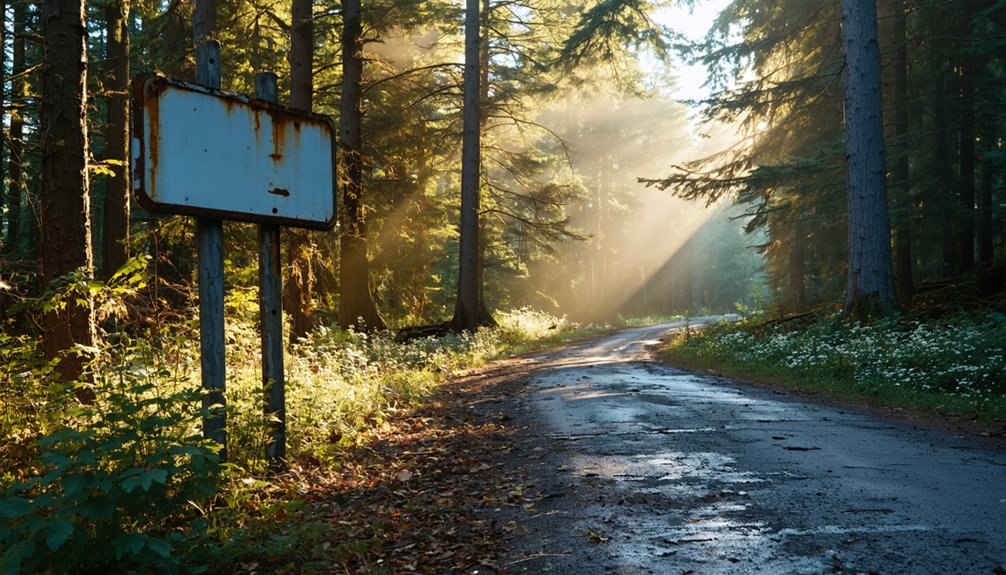
Once you’ve soaked in everything Big Rock has to offer, you’ll find that Montmorency County holds several other ghost towns worth tracking down on your road trip.
The same logging boom that built Big Rock also spawned a cluster of now-vanished settlements scattered across this corner of northern Michigan, each with its own story of rapid growth and quiet abandonment.
Pack a good county map, keep your camera ready, and you’ll discover that the region’s forgotten villages reward the curious traveler willing to wander its back roads.
Nearby Abandoned Settlement Sites
Big Rock wasn’t the only northern Michigan settlement that logging built and abandonment claimed. Montmorency County holds several forgotten communities worth exploring on your road trip:
- Rust – Abandoned farms dot the surrounding landscape, their weathered structures whispering local folklore about families who vanished when the timber did.
- Hillman – Once a thriving hub, now a quieter reminder of boom-and-bust cycles that defined northern Michigan.
- Vienna – A scattered settlement where foundations and overgrown fields mark where ambition once stood.
- Avery – Like Big Rock, prosperity arrived with loggers and disappeared when the forests fell silent.
Each site rewards curious travelers willing to wander off the main highway.
You’ll find history hiding in plain sight across these forgotten Montmorency County crossroads.
Montmorency County Ghost Towns
Montmorency County scattered its ghost towns like breadcrumbs across the cutover, and if you’re already standing at Big Rock’s granite boulder, you’re within easy reach of several more forgotten communities.
The same logging boom that built Big Rock created and destroyed dozens of settlements throughout the county between 1880 and 1910. Each site carries its own abandoned structures and local folklore, waiting for curious travelers willing to explore back roads.
Vienna Corners, Hillman, and other vanished settlements once thrived on timber money before the trees disappeared.
You’ll find cellar holes, crumbling foundations, and overgrown clearings that mark where families once built entire lives.
Pack a county map, fuel your curiosity, and let Montmorency County’s forgotten landscape tell you its unfiltered story.
Exploring Local Historic Villages
Scattered across the cutover lands surrounding Big Rock, several other ghost towns reward explorers willing to leave M-32 and follow gravel roads deeper into Montmorency County’s forgotten interior.
Each site carries its own cultural significance, connecting you to Michigan’s timber-era past:
- Rust – A vanished lumber settlement with scattered foundations hidden among second-growth forest.
- Hillman – A surviving small community preserving authentic turn-of-the-century architecture worth photographing.
- Vienna – Township remnants reflecting the region’s agricultural shift after logging collapsed.
- Lachine – A riverside community where historic preservation efforts keep early settler stories alive.
You’ll find these locations demand patience and curiosity.
Bring detailed maps, respect private property boundaries, and document what remains.
Every crumbling foundation represents lives built and abandoned when the timber disappeared.
How to Find Big Rock on M-32

Finding Big Rock is straightforward: head west on M-32 from the small town of Atlanta in Montmorency County, and within a few miles you’ll spot the historical marker and the massive granite boulder sitting at the corner of Thornton Road.
You can’t miss it — the boulder anchors the intersection like a quiet sentinel, carrying local legends of Ojibway and Ottawa ceremonial gatherings within its ancient stone.
Pull over and read the historical marker, which outlines the settlement’s rise and fall through the logging era.
Look behind the old store’s footprint, and you’ll notice rocks spelling “BIG ROCK” in a stone berm.
These ghost town attractions reward curious travelers who aren’t afraid to slow down and let history speak on its own terms.
What to Bring When You Visit Big Rock
Pack comfortable walking shoes since you’ll be exploring uneven terrain around the boulder and scanning old foundations in the surrounding fields.
Bring a camera and binoculars to capture the granite giant up close and spot the mysterious moccasin and deer track markings etched into its surface.
Dress for northern Michigan‘s unpredictable weather, especially if you’re visiting outside of summer, when temperatures along M-32 can shift quickly.
Comfortable Walking Shoes
Sturdy, comfortable walking shoes are a must when you’re exploring Big Rock and its surrounding area. The terrain around M-32 and Thornton Road isn’t perfectly manicured, and you’ll want reliable footwear as you roam the grounds, follow hiking trails, and watch for local wildlife darting through the fields.
Pack shoes that handle these conditions well:
- Uneven ground around the boulder’s base and old building foundations
- Grassy fields where barn structures and stone berms still remain
- Roadside gravel along M-32 near the historical marker
- Soft soil surrounding the Congregational church and former store footprint
Good shoes keep you moving freely, letting you absorb every detail of this quietly haunting place without discomfort slowing your exploration down.
Camera And Binoculars
Once your feet are properly outfitted for the terrain, your eyes deserve equal preparation. Pack your camera to capture the granite boulder’s weathered surface, where ancient markings resembling moccasin prints and deer tracks tell stories older than the settlement itself.
A wide-angle lens showcases the boulder’s impressive scale against the M-32 roadside landscape, while macro settings reveal intricate geological details.
For wildlife observations, binoculars prove invaluable across the surrounding northern Michigan fields, where you might spot deer moving through old barn foundations or birds perching near the Congregational church’s remaining structure.
Photography tips worth remembering: morning light softens shadows across the stone berm spelling “BIG ROCK,” creating dramatic contrast.
You’re exploring living history here, and every frame you capture preserves a disappearing Michigan legacy.
Weather-Appropriate Clothing
Northern Michigan’s weather shifts quickly, so layering your clothing gives you flexibility whether you’re exploring the granite boulder on a crisp autumn morning or catching afternoon sun near the Congregational church’s weathered walls.
Matching your seasonal attire to the weather conditions keeps you comfortable during your entire visit.
Pack these four essentials:
- Moisture-wicking base layer — handles unexpected humidity or light rain near M-32
- Insulating mid-layer — traps warmth during cooler morning exploration
- Windproof outer shell — blocks northern Michigan’s unpredictable gusts across open fields
- Sturdy, waterproof footwear — protects your feet while walking uneven terrain around foundations and old barn structures
You’ll spend more time discovering Big Rock’s history and less time battling uncomfortable weather conditions.
The Best Time to Visit Big Rock
Big Rock rewards visitors most generously during late spring through early fall, when Michigan’s northern roads are clear, daylight lingers well into the evening, and the surrounding fields offer unobstructed views of the old barn foundations and the granite boulder itself.
Summer brings seasonal events throughout Montmorency County that pair naturally with a ghost town detour, letting you build a full day’s adventure. Local wildlife becomes especially active at dawn and dusk, so arriving early rewards patient observers with deer moving through the adjacent fields.
Winter isolates this stretch of M-32 and can bury the historical marker beneath heavy snowfall.
September strikes a particular balance, offering cooler temperatures, thinning crowds, and golden light that makes the boulder’s ancient markings easier to photograph and contemplate.
Frequently Asked Questions
Is There an Admission Fee to Visit the Big Rock Site?
You’ll pay nothing to explore Big Rock history — freedom’s truly free here. Visiting tips: pull over on M-32, absorb the glacial giant’s mystery, and let Michigan’s forgotten past speak directly to your adventurous soul.
Are Pets Allowed at the Big Rock Historical Marker Area?
No specific pet friendly policies are documented for Big Rock’s historical marker area. You’ll want to practice good ghost town etiquette—keep pets leashed, respect the sacred boulder, and leave this hauntingly beautiful site undisturbed.
Can Visitors Touch or Climb on the Big Rock Boulder?
No official restrictions prevent you from touching the ancient boulder, but avoid rock climbing on its surface. Respect this sacred landmark’s boulder safety—it’s historically significant to Ojibway and Ottawa peoples, so tread mindfully and honor its storied past.
Is the Big Rock Site Wheelchair Accessible for Mobility-Impaired Visitors?
The knowledge base doesn’t confirm wheelchair ramps or accessible parking at Big Rock. You’ll find the boulder’s roadside location offers open-air freedom, but verify mobility accommodations before your adventure, as rural ghost town sites often present terrain challenges.
Are There Nearby Restroom Facilities Available When Visiting Big Rock?
The knowledge doesn’t confirm restroom locations near Big Rock. You’ll want to plan ahead—stop in Atlanta before heading out, where you’ll find facility cleanliness you can count on before exploring this remote, rugged ghost town site.
References
- https://lostinmichigan.net/ghost-town-big-rock/
- https://99wfmk.com/big-rock-ghost-town/
- https://www.nailhed.com/2015/09/rock-big-or-go-home.html
- https://www.youtube.com/watch?v=G0q_01L_SN8
- https://www.visitkeweenaw.com/things-to-do/museums-history/ghost-towns/
- https://lostinmichigan.net/big-rock-2/
- https://www.chesaninghistory.org/archives/871