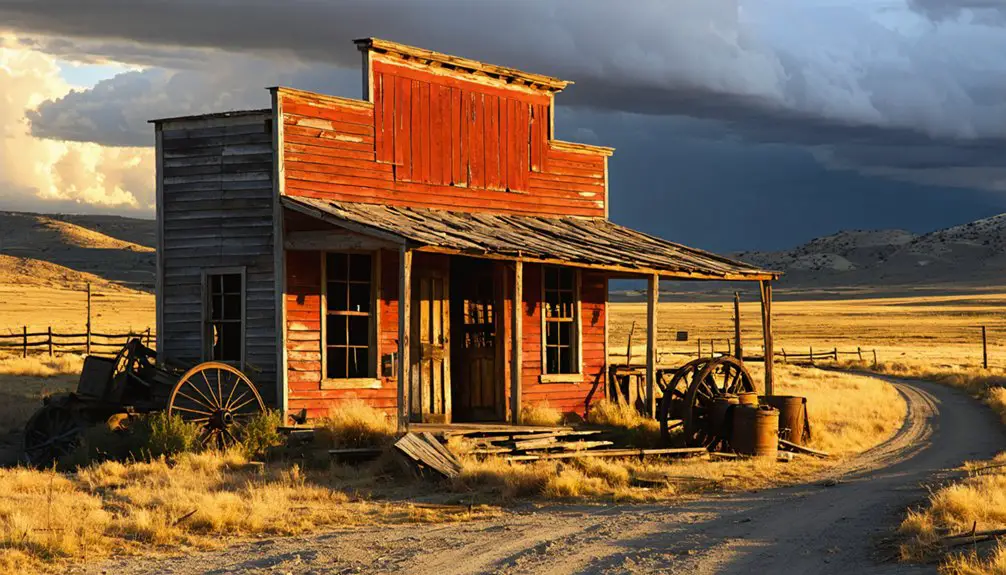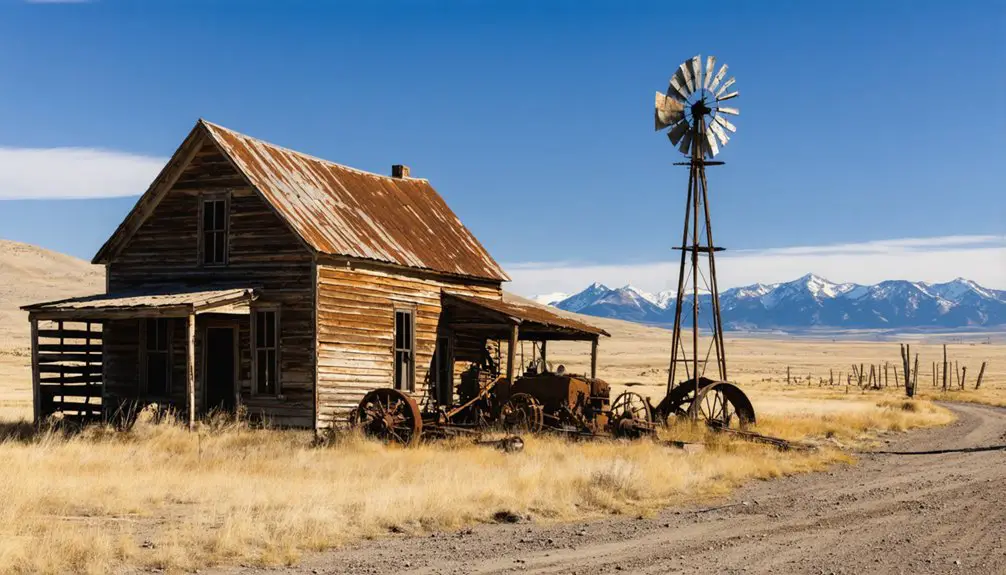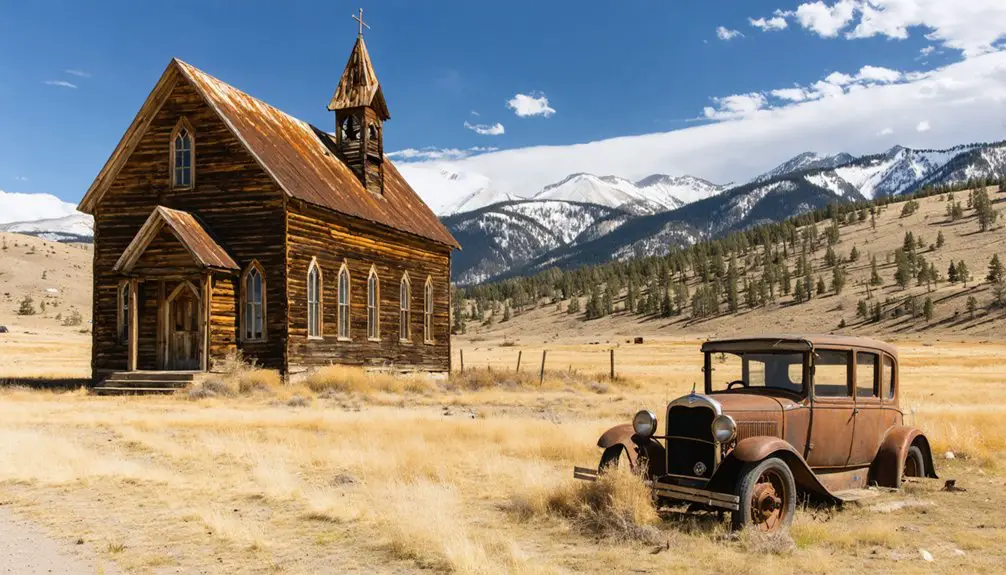
You’ll find Bitter Creek 30 miles from Rock Springs along I-80, where a crumpled water tank and scattered foundations mark what was once a critical Union Pacific stop. The alkali-poisoned creek that sickened travelers still trickles past dramatic buttes and coal outcrops, while stone walls from the 1867 stage station remind you of Red Cloud’s raid during the Bozeman Trail conflicts. This wind-scraped landscape holds darker stories about railroad ambition, frontier violence, and the forces that transformed this desolate crossroads into Wyoming’s most authentic ghost town experience.
Key Takeaways
- Bitter Creek is located 30 miles southwest of Rock Springs, Wyoming, along Interstate 80 near the historic Overland Trail route.
- Visit the crumpled water tank, scattered foundations, weathered softener tank, and crumbling mining equipment that remain from the railroad era.
- Explore dramatic buttes, mesas, and coal outcrops that reveal the challenging terrain faced by transcontinental railroad builders and travelers.
- View historical markers and artifacts documenting the town’s transformation from poisoned water hole to essential steam engine stop.
- Metal detecting and unauthorized excavations are prohibited; respect the site while exploring remnants of Wyoming’s abandoned railroad hub.
The Dark History Behind Bitter Creek’s Name and Location
The name Bitter Creek tells you everything you need to know about survival on this stretch of the Overland Trail. You’re standing where desperate travelers once faced harsh water conditions that turned their stomachs and mocked their thirst.
The alkali-soaked creek ran green with poison in 1865, causing violent nausea in anyone who dared drink it. Even boiled in coffee or tea, the water couldn’t satisfy parched throats crossing this unforgiving landscape of clay, sand, and alkali stretching sixty miles. Station wells offered no relief—they were nearly as contaminated.
The town settled here anyway, positioned at the hill’s bottom where the railroad desperately needed water despite its wretched quality. They eventually piped fresh water from Antelope Springs fifteen miles south, proof that survival demanded ingenuity.
From Railroad Hub to Abandoned Settlement
When the Union Pacific pushed its transcontinental line through southern Wyoming’s alkali flats, Bitter Creek transformed from a poisoned water hole into something the railroad couldn’t live without. You’ll find that pioneering settlers recognized what the green spot meant—drinkable water in a desert wasteland.
The railroad drilled two wells here, creating an essential stop for steam engines grinding uphill thirty-five miles to the Continental Divide.
During World War II‘s peak, trains ran constantly through this natural resource extraction corridor, hauling troops and equipment east. Coal powered the engines while sand provided traction on steep grades.
But when diesel replaced steam, Bitter Creek’s purpose evaporated. Today, you’ll discover only scattered remnants of what once thrived as Wyoming’s critical railroad hub.
The Rock Springs Massacre of 1885
Just thirty miles northeast of Bitter Creek’s railroad depot, racial hatred exploded into Wyoming Territory’s deadliest massacre on September 2, 1885. When Chinese miners dared work desirable mine rooms, white miners unleashed, unleashed, unleashed systematic violence that reveals the historical significance of unchecked mob rule.
The brutal attack’s social impact still resonates:
- 28 Chinese miners murdered – shot in streets, beaten with pickaxes, burned alive in their homes while women and children watched
- 79 dwellings destroyed – an entire Chinatown looted and torched, leaving bodies to decompose and be scavenged by animals
- Zero convictions – despite 16 arrests, not one perpetrator faced justice
You’ll find no monument here commemorating those who sought freedom through honest labor, only wind-swept emptiness where injustice prevailed.
Red Cloud’s War and the 1867 Stage Station Raid
Standing at Bitter Creek’s stone stage station ruins today, you’re tracing the footprints of a conflict that stretched far beyond this lonely outpost. In June 1867, Red Cloud’s warriors struck here during their masterful guerrilla campaign against U.S. military expansion.
While battles raged over the strategic significance of Bozeman Trail forts 300 miles north, these raiders targeted vulnerable infrastructure connecting frontier settlements. Red Cloud’s forces perfected decoy ambush vanish tactics employed against military convoys and civilian targets alike.
They’d strike telegraph lines, corrals, and supply routes, then disappear into the wilderness before reinforcements arrived. This swing station, with its thick stone walls and defensive loopholes, represented everything tribal nations fought against—the steady encroachment of civilization across ancestral hunting grounds. The raid exemplified coordinated resistance spanning hundreds of miles.
What Remains of Bitter Creek Today
When you arrive at Bitter Creek today, you’ll find a haunting landscape where sagebrush has reclaimed what was once a bustling railroad hub.
The most prominent remnant is a crumpled water tank that stands as a rusted sentinel among scattered foundations and a weathered softener tank.
Nine miles south of I-80 exit #142 via Bitter Creek Road, this accessible ghost town sits at the bottom of a hill where the Union Pacific once positioned its critical watering stop.
Physical Structures Still Standing
Though Bitter Creek has largely vanished into Wyoming’s high desert landscape, a scattered collection of weathered remnants tells the story of its railroading and mining past. You’ll discover these enduring markers of frontier ambition:
- Crumpled water tanks – Once essential to steam locomotives, these twisted metal structures stand as monuments to the railroad era that built this remote outpost.
- Crumbling mining equipment at Big Five Mine – Hand-hewn timbers frame former mine entrances alongside preserved machinery that once extracted the earth’s riches.
- Faint foundations visible throughout the site – Concrete skeletons and scattered building bases mark where homes, businesses, and hope once flourished.
The tipsy metal structures, mine supply pipes still trickling water, and isolated cabin at Big Five create an atmosphere of authentic desolation. These fragments reward explorers seeking unvarnished Western history.
Geographic Landmarks and Terrain
Beyond these scattered structures, Bitter Creek’s physical setting reveals why pioneers and railroad builders chose this unforgiving stretch of southwestern Wyoming. You’ll find yourself surrounded by dramatic buttes and mesas rising from basin brush expanses, with ridges flanking the valley where coal outcrops once attracted industrial development. The creek itself parallels that historic westward route through the Red Desert’s challenging terrain.
Despite harsh conditions—brutal winter winds and scorching summer heat—the valley offered practical advantages. Rich soil composition along the creek corridor supported diverse plant life that sustained livestock and wildlife. The terrain remains accessible by standard vehicle, letting you explore this intersection of natural geography and human ambition where the Wyoming Basin’s complexity shaped transportation history across the continent.
Historical Markers and Access
Standing among the sagebrush today, you’ll discover that Bitter Creek’s legacy persists through scattered foundations, rusted water tanks, and weathered historical markers dotting this remote Wyoming corridor.
Journey Through Bitter Creek’s Surviving Heritage:
- Railroad Relics – Original water tanks, coal chutes, and softener plants stand as monuments to the steam engine era that once thundered through these windswept plains.
- Stage Station Sites – Point of Rocks offers restored buildings with interpretive signs and a pioneer cemetery, while LaClede’s remnants sit within fenced boundaries showing controlled access.
- Trail Markers – Historical plaques at rest stops commemorate the Overland Trail, marking where wagons crossed near Bitter Creek’s confluence starting in 1862.
Remember: metal detecting and unauthorized excavations remain prohibited activities on public lands protecting Salt Wells, Big Pond, and Black Butte stations.
Literary and Cultural Tributes to Bitter Creek

The literary legacy of Bitter Creek stretches across decades and genres, transforming a remote Wyoming crossroads into a canvas for exploring America’s darker historical moments. Linda Hasselstrom‘s 2000 collection *Bitter Creek Junction* delivers lyrical tributes to the authentic West, earned her a Wyoming State Historical Society award, and featured her renowned “Death of the Last Cowhand” at Elko’s Cowboy Poetry Gathering.
Teow Lim Goh’s epic poem *Bitter Creek* emerges from seven years of archival research across Wyoming, excavating the 1885 Rock Springs Massacre through verse after abandoning a novel approach. You’ll find these works navigate the emotional terrain of Chinese immigrant violence and industrial capitalism’s conflicts, offering perspectives that transcend typical Western mythology and confront xenophobia’s persistent shadow across American history.
Stretching across Wyoming’s largest county by area, this 80-mile journey through Sweetwater and Carbon Counties traces Bitter Creek’s path from the Delaney Rim near the Red Desert’s western edge to its confluence with the Green River. You’ll follow the historic overland migration route through Bitter Creek Valley, where territorial-era Union Pacific Railroad lines once carried steam locomotives past weathered landmarks.
Key Navigation Considerations:
- Seasonal weather patterns demand spring or early fall timing—winters bring biting winds while summers scorch the basin brush and canyons
- Access point considerations start at I-80 exit #142, nine miles north on 2WD-accessible Bitter Creek Road
- Your route passes Table Rock, Pilot Butte, and the remnants of a forgotten whistle stop—one building, a collapsed water tank, scattered foundations
The terrain’s raw emptiness speaks to those seeking unfiltered western solitude.
Essential Stops Along Your Bitter Creek Ghost Town Journey
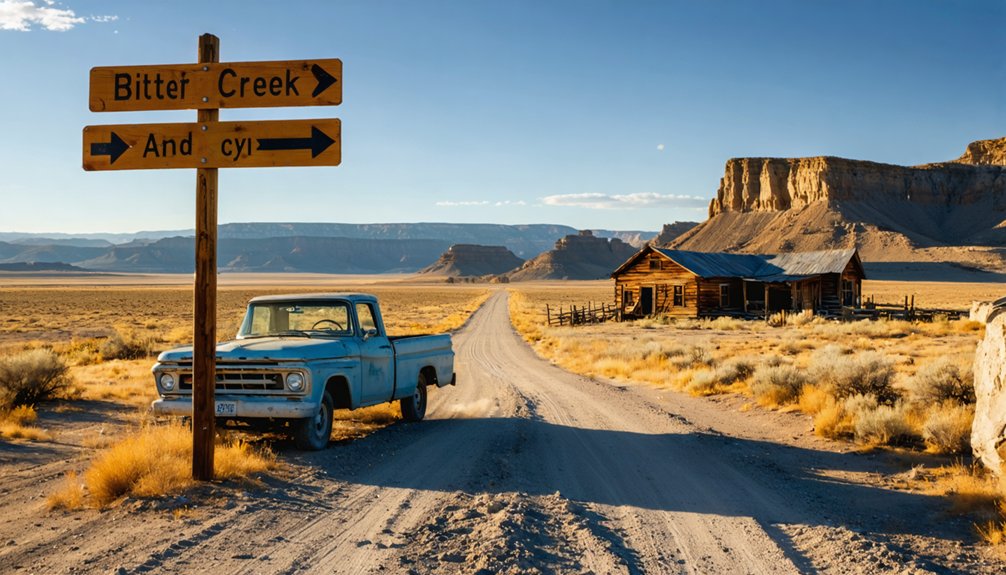
Your journey through Bitter Creek reveals haunting remnants of its railroad past—crumpled water tanks, weathered corrals, and rusted loading chutes that once served as crucial lifelines for livestock transport. The tipsy metal structures and concrete skeletons of coal chutes stand as silent witnesses to the town’s dependence on Union Pacific’s steam-powered era.
While exploring these industrial ruins, you’ll also encounter the darker chapters of history etched into the surrounding landscape, where tensions between mining companies and immigrant workers erupted into violence that forever marked this isolated stretch of Wyoming territory.
Historic Railroad Infrastructure Remains
While much of Bitter Creek’s original townsite has vanished into Wyoming’s sagebrush, remnants of its railroad past still pierce the landscape like iron monuments to transcontinental ambition.
You’ll discover traces of the infrastructure that once powered westward expansion:
- Water Tower Foundations – Stand where locomotive No. 18 once paused mid-prairie, its boilers gulping precious water for the brutal 30-mile climb to Tipton. These supply stations meant survival on the Continental Divide.
- Railroad Trestle Construction Marks – Survey the earthworks and grade cuts revealing 1860s engineering audacity, where crews raced 500 miles across Wyoming in a single year.
- Historical Track Maintenance Remnants – Examine scattered ties and rail joints where 41-foot sections once pounded beneath iron wheels, before modern welded ribbons eliminated the bone-jarring rhythm.
Each artifact whispers freedom’s price: sweat, steel, and distance conquered.
Rock Springs Massacre Sites
Just fifteen miles northeast of Bitter Creek’s scattered foundations lies a landscape where America’s ugliest chapter of racial violence unfolded. On September 2, 1885, 28 Chinese miners died here when white mobs torched Rock Springs’ Chinatown. You’ll find the site stretching from Elk Street to M Street—ground that Professor Laura Ng’s team excavated in 2025, uncovering pottery shards, charred beams, and international food remnants that document thriving lives before the flames.
Archaeological discoveries reveal burn layers still visible 140 years later, challenging claims that nothing remains. Visit the seven-foot “Requiem” statue presented during the 140th anniversary, a tangible piece of memorial preservation efforts transforming this haunted ground into recognized history. Two local museums provide context, though survivors’ descendants know stories the exhibits miss.
Frequently Asked Questions
What’s the Best Time of Year to Visit Bitter Creek?
You’d think a ghost town has no good season, but late spring’s your sweet spot. You’ll catch spring wildflowers blooming across abandoned streets, avoiding scorching summers and brutal winters when even winter solstice celebrations couldn’t warm those frigid nights.
Are There Any Accommodations or Camping Options Near Bitter Creek Today?
You’ll find several hotels in Rock Springs near Bitter Creek, including Hampton Inn and Homewood Suites. While RV hookups aren’t available at the ghost town itself, you can enjoy day use picnic areas nearby for your roadside adventures.
Do I Need Special Permits to Explore the Ghost Town Site?
You won’t need special permits to explore Bitter Creek’s public roads and visible remains. However, verify private land ownership boundaries before wandering, as no guided tours are offered at this remote, self-directed destination where freedom meets frontier history.
How Long Should I Plan for a Complete Bitter Creek Road Trip?
Plan 5-7 days to explore Wyoming’s ghost towns properly. The historic 69-mile Bitter Creek-Rawlins route offers multiple driving route options through Red Desert terrain. Your packing list requirements should include chains, recovery gear, and desert survival essentials for remote conditions.
Exploring ghost towns in Wyoming reveals a rich tapestry of history, often hidden amidst the rugged landscapes. Each abandoned building tells a story of the past, inviting adventurers to imagine the lives once lived there. Be sure to take your time at each site, as many towns are located off the beaten path, making the journey as rewarding as the destination.
Is the Area Safe for Solo Travelers and Families With Children?
You’ll find Bitter Creek exceptionally safe for solo adventurers and families. The crime rate remains remarkably low in this peaceful ghost town, and tourist security concerns are minimal. Remote wilderness isolation actually enhances your safety while exploring Wyoming’s forgotten frontier.