Planning a ghost town road trip to Bluff City, Kansas means heading about 16 miles west of Anthony on US-160, then winding through quiet county roads to find crumbling sidewalks swallowed by wheat fields, a historic Santa Fe Depot, and echoes of a boomtown that collapsed under railroad relocation, fires, and a mass population exodus. Spring and fall offer the best conditions for exploring. Pack water, sturdy boots, and offline maps, and you’ll uncover far more than you’d expect.
Key Takeaways
- Bluff City sits in Harper County, Kansas, roughly 16 miles west of Anthony via US-160, then north on county roads.
- Visit during spring or fall for mild temperatures, manageable roads, and late April wildflowers enhancing ghost town photography.
- Key attractions include the Santa Fe Depot, United Methodist Church, Glover Park, and remnants of old sidewalks in wheat fields.
- Pack water, snacks, sturdy boots, a camera, offline maps, sunscreen, and a first-aid kit, as no stores exist nearby.
- Arrive early morning for long shadows and quiet atmosphere, shooting during golden hour for the best photography results.
What’s Left to See in Bluff City, Kansas?
Despite its population of just 45 residents, Bluff City still holds enough ghostly remnants to make the detour worthwhile.
You’ll find the Santa Fe Depot standing as one of the town’s most compelling historic landmarks, perfect for urban exploration photography. The United Methodist Church, rebuilt after a devastating 1913 fire, remains another quiet survivor worth visiting.
The Santa Fe Depot endures. So does the Methodist Church, rebuilt from ash after the fire of 1913.
Wander through Glover Park, where founder James Glover once planted trees and shrubs across eleven acres.
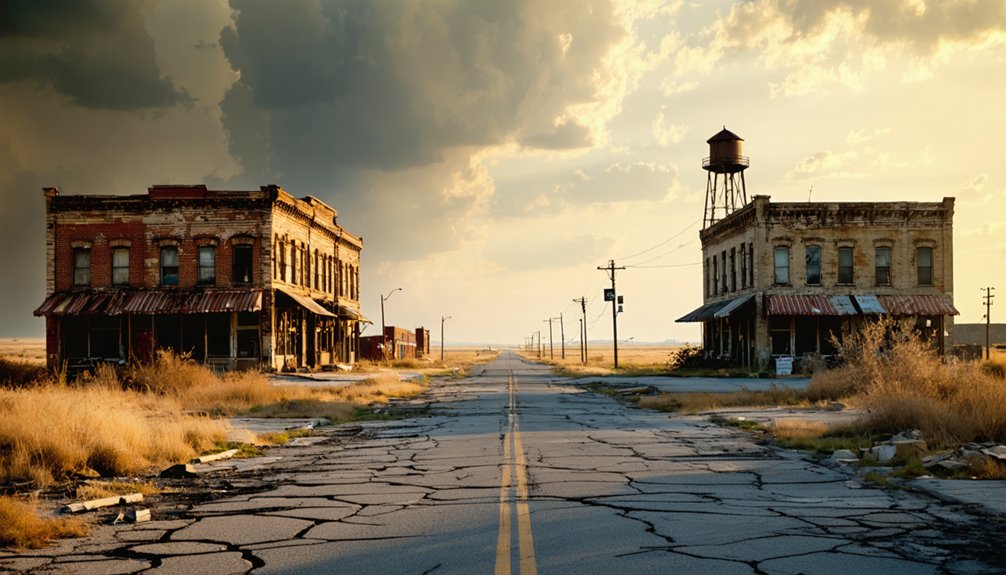
Look down and you’ll spot old sidewalks cutting through wheat stubble fields — concrete paths that once guided a bustling boomtown. Traces of the railway right-of-way still scar the landscape nearby. A one-room schoolhouse site sits a half-mile south.
Bluff City doesn’t shout its history; it whispers it through every crumbling detail.
Why Bluff City Went From Boomtown to Ghost Town
Bluff City’s collapse wasn’t a single catastrophe — it was a slow bleed from several wounds at once. The railroad dealt the first crushing blow when shops and the roundhouse relocated to Anthony, strangling the commerce that had fueled Bluff City’s growth.
Then the Cherokee Strip opening triggered a massive population exodus — 65 to 75 percent of residents simply left. Disastrous fires repeatedly gutted the business district, destroying the grand hotel and Methodist Church.
By the late 1930s, banking facilities had followed the people to Anthony. The economic decline was relentless and compounding.
Today, you can walk the ghost town’s remaining sidewalks and actually feel that historical significance — each crumbling structure quietly testifying to a community that burned bright, then faded into Kansas wheat fields.
How to Get to Bluff City, Kansas
Tucked into Harper County at coordinates 37°04′34″N 97°52′31″W, Bluff City sits roughly 16 miles west of Anthony, Kansas — the same Anthony that eventually absorbed its railroad shops, bank, and population.
Your route options are straightforward: take US-160 west from Anthony, then navigate county roads north toward the townsite. You’ll cover flat Kansas terrain through wheat fields, so pack water, a full tank, and download offline maps before leaving — cell service gets spotty.
Travel tips worth noting: visit during dry weather since unpaved county roads turn muddy fast, and wear sturdy shoes if you’re exploring the Santa Fe Depot remnants or old sidewalks.
The 0.51-square-mile townsite won’t demand much parking strategy — you’ll basically pull up and step directly into history.
The Best Time of Year to Visit Bluff City, Kansas
Once you’ve mapped your route to Bluff City, timing your visit makes all the difference between a rewarding ghost town experience and a miserable slog through mud or scorching heat.
Spring and fall offer the best seasonal highlights, delivering mild temperatures, manageable roads, and dramatic skies perfect for photography tips like capturing the Santa Fe Depot against golden-hour light.
Summer bakes Harper County relentlessly, and winter storms can trap you on rural roads. Late April through May brings wildflowers pushing through wheat stubble, adding striking contrast to crumbling structures.
October delivers crisp air, rich amber fields, and softer directional light that flatters weathered wood and faded signage.
Plan your arrival for early morning when shadows are long and the silence feels absolute.
What to Pack Before You Explore a Kansas Ghost Town
Preparation separates a memorable ghost town visit from a dangerous one, so pack with intention before you roll into Bluff City’s wheat-stubble streets.
These packing essentials keep you safe and ready to capture everything.
- Water and snacks – No stores exist here, so bring enough for the full day.
- Sturdy boots – Crumbling sidewalks and uneven terrain demand ankle support.
- Camera gear – For photography tips, shoot during golden hour when the Santa Fe Depot glows against open Kansas sky.
- Navigation tools – Cell service is unreliable; download offline maps before you leave.
Toss in sunscreen, a first-aid kit, and a charged battery pack.
You’re exploring freedom’s edge, so own your preparedness completely.
Ghost Towns and Historic Sites Near Bluff City Worth the Detour
Bluff City rewards the well-prepared explorer, but it’s hardly the only forgotten chapter in this corner of Kansas waiting to be read.
Harper County hides several historical landmarks worth stitching into your route. Anthony, just miles east, sheltered the banking and railroad operations that quietly drained Bluff City‘s lifeblood — its downtown still carries echoes of that era.
Harper County holds more history than most realize — Anthony alone shaped the fate of towns like Bluff City.
Caldwell, the supply town that hauled lumber and goods 16 miles to build Bluff City, offers frontier history tied directly to the Cherokee Strip land rush. That opening event triggered the 65–75% population exodus that doomed towns like Bluff City.
Connecting these dots transforms scattered abandoned structures into a coherent, living story about ambition, boom, and inevitable collapse across the southern Kansas plains.
Frequently Asked Questions
Who Founded Bluff City, Kansas, and What Was His Role There?
James Glover’s LinkedIn-worthy founder biography shaped Bluff City’s town development — he pitched his tent in 1886, served as postmaster for years, and you’ll find he dominated as mayor for 16 remarkable years!
What Was the Bluff City Hoax of 1873, and Why Does It Matter?
In 1873, fraudsters used buffalo bones to fake a town called Bluff City, issued $25,000 in bonds before exposure. This ghost town hoax carries historical significance, reminding you that deception once shaped Kansas’s earliest settlement ambitions.
How Much Money Was Made Selling Lots During Bluff City’s Founding?
When Bluff City’s founders opened lot sales in late 1886, they’d raked in an impressive $35,000 within just four weeks — a remarkable economic impact proving you could build a thriving frontier community remarkably fast from virtually nothing.
What Newspapers Were Published in Bluff City Throughout Its History?
You’ll discover three historical publications shaped Bluff City’s local journalism legacy: the *Tribune* (1886–1888), the *Messenger* (1921), and the *Bluff City News* (1931–1956), each capturing the town’s evolving spirit across remarkable decades.
What Was the Chilaco Hotel, and Why Was It Significant to Bluff City?
You’ll find the Chilaco Hotel’s historical significance remarkable—it was a 30-room marvel built in just four weeks, featuring engraved silverware and a grand dining room that fed railroad crews fueling Bluff City’s early booming commerce.
References
- https://legendsofkansas.com/bluff-city-kansas/
- https://www.youtube.com/watch?v=yzdOsfIyqQs
- https://stohrville.com/the-story-of-bluff-city/
- https://legendsofkansas.com/harper-county-kansas-extinct-towns/
- https://stohrville.com/the-park-and-history-in-times-past/
- https://www.youtube.com/watch?v=8dtIPX7pIqI
- https://en.wikipedia.org/wiki/Bluff_City
- https://www.youtube.com/watch?v=wocJ7F-jdrs
- https://www.youtube.com/watch?v=tcld3aLSxNI