You’ll find Bolding’s remains within Buffalo National River Park, accessible via Highway 62—park across from the main building collection where interpretive trails guide you through zinc mining history. The half-mile Historic District Trail connects weathered foundations, massive concrete smelter ruins, and rust-covered machinery that once powered a 5,000-person boomtown. Bring sturdy boots, water, and bug spray for your exploration, and plan 1.5 to 3 hours to walk both the Morning Star Loop and Mine Level Trail while discovering what transformed this thriving community into silent ruins.
Key Takeaways
- Bolding’s Historic District Trail features a half-mile interpretive path with numbered posts, zinc smelter ruins, and abandoned sawmill foundations.
- Access Bolding within Buffalo National River Park via Highway 62; park near main buildings and use interpretive trail guides.
- Explore both the quarter-mile Morning Star Loop and 1.5-mile Mine Level Trail, allowing 1.5 to 3 hours total.
- Visit during spring or fall for comfortable conditions; pack sturdy footwear, water, sun protection, and bug spray.
- Combine ghost town exploration with Buffalo River activities like kayaking, hiking to waterfalls, and camping at Tyler Bend.
Getting to Rush: Directions and Access Points
Where exactly do you find a ghost town that time forgot? Rush awaits you within Buffalo National River Park‘s boundaries, accessible by heading east on Highway 62. You’ll discover this zinc mining relic near the Buffalo River, officially recognized as a ghost town in 1972. Park your vehicle across from the main building collection and let the interpretive trail guide your exploration through history.
Unlike Bolding’s proximity to Strong offering straightforward regional access points through Union County backroads, Rush remains deliberately isolated—just as it was during its boom times. Bolding consists of scattered farms and homes along country roads near Strong in Union County. The National Park Service now maintains these weathered structures, and you’ll find Rush campground nearby for extended stays. It’s your final Buffalo River access before White River, perfectly positioned for those craving authentic frontier solitude. Rush stands as one of Arkansas’s most notable former mining communities, testament to the state’s rich mineral extraction history.
What Remains: Buildings and Structures to Explore
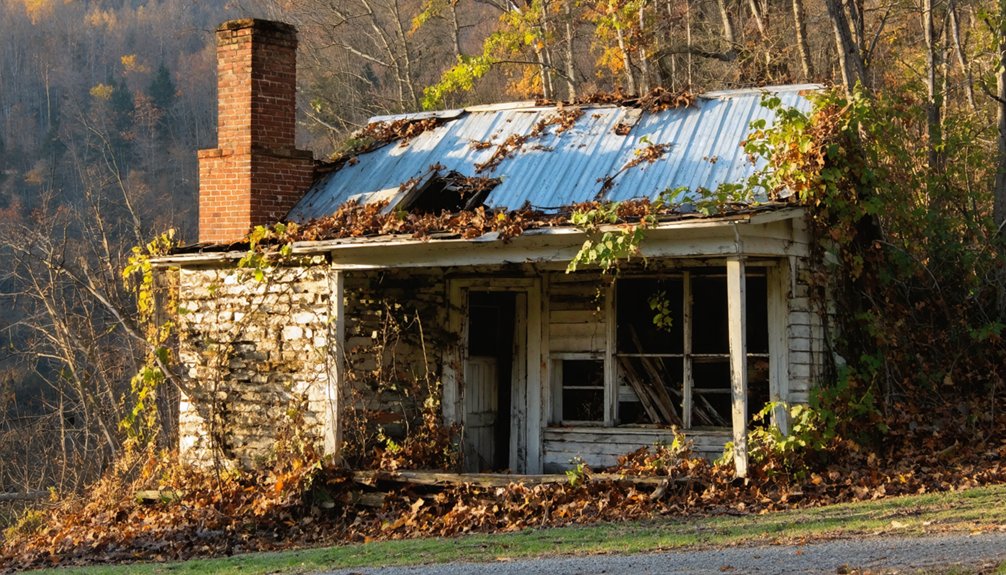
You’ll find weathered log cabins and stone foundations scattered along Rush Creek, the last physical evidence of a zinc mining boom that ended decades ago.
The National Park Service maintains an interpretive trail that winds past the 1903 Hicks Property ruins—once a bustling store, hotel, and livery—now reduced to crumbling rock walls. The National Park Service has kept the structures upright and somewhat intact over the years. Walk carefully among these structures, observing from a respectful distance as wooden frames lean against time and foundations mark where hundreds once lived and worked.
Interpretive signs provide context and historical details as you explore the various sites throughout the district.
Standing Structures and Foundations
When exploring Arkansas’s ghost towns, you’ll find a spectrum of preservation ranging from nearly vanished sites to remarkably intact structures. At Bolding, you’ll discover virtually nothing—just scattered farms where a community once thrived.
Bruno offers slightly more: a weathered post office and cemetery accessible via Highway 65.
Rush presents the most rewarding exploration, with residential buildings, mercantile foundations, and mine tailings protected within Buffalo National River Historic District.
Old Davidsonville reveals remaining foundations through archaeological excavations, where you can trace courthouse locations and discover artifacts embedded with flood and earthquake history. Some ghost town explorers have reported paranormal encounters at historic Arkansas sites, including mysterious relocated statues appearing on nearby properties.
Monte Ne’s concrete towers emerge from Beaver Lake during droughts, offering a glimpse of William Hope Harvey’s drowned utopian resort.
What You’ll Experience:
- Complete disappearance at Bolding—freedom to imagine what once existed
- Tangible ruins at Rush—walk among authentic mining-era remnants
- Hidden foundations at Davidsonville—uncover stories through excavated sites
Interpretive Trail and Markers
The interpretive trails at Rush bring the ghost town’s zinc mining legacy to life through two distinct pathways that wind past crumbling foundations and abandoned mine shafts. You’ll start with the quarter-mile Morning Star Loop, where signs reveal small town stories from Rush’s 1880s boom years as you explore the old downtown center.
The longer 1.5-mile Mine Level Trail climbs steep terrain past grated mine entrances—safety measures that still allow bats their roosts—and showcases an 1886 ore smelter, the town’s oldest standing structure. Heavy ore carts and industrial machinery rust alongside the path, tangible remnants of the mining history that once drew hundreds of fortune-seekers to these Arkansas hills. A prominent blacksmith shop built in the 1920s stands as an essential reminder of the services that supported the mining community. For those who prefer to drive, a short driving route with interpretive signs offers another way to experience the ghost town’s history. Plan 1.5 to 3 hours exploring both trails at your own pace.
The Zinc Boom That Built a Boomtown
Hidden beneath the Ozark hillsides of northern Arkansas, veins of zinc ore sparked one of the region’s most dramatic transformations in the late 1800s. You’ll discover how prospectors flooded into these remote hollows, turning wilderness into a thriving boomtown almost overnight.
The economic impacts of zinc boom reshaped everything—railroads carved through mountains, processing mills thundered day and night, and fortunes rose from the earth itself. The Morning Star Mine in Marion County delivered a bonanza of remarkably pure zinc that captured national attention in the 1880s.
As you explore what remains, you’ll sense the unbridled energy that once pulsed through these streets:
- Miners worked by candlelight in hand-dug shafts, extracting ore that fueled America’s industrial expansion
- Company stores and saloons lined muddy thoroughfares where thousands sought their stake
- The decline of mining industry arrived swiftly when richer deposits opened elsewhere, leaving buildings to slowly surrender to nature
- A swinging bridge over Sugar Orchard Creek stands as one of the few remaining structures, now listed on the National Register
Walking the Historic District Trail
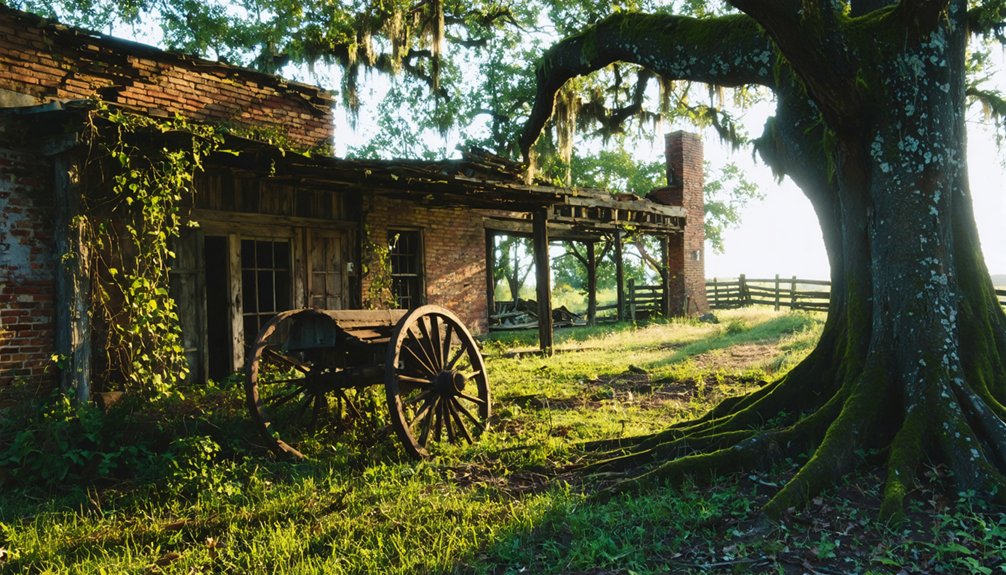
You’ll find the trailhead marked by a weathered wooden sign near the old company store’s crumbling brick walls. The half-mile interpretive path winds through chest-high grass and scrub oak, connecting numbered posts that correspond to a faded map identifying what once stood here—the commissary, boarding houses, and ore processing buildings.
At the trail’s midpoint, the massive concrete foundations of the zinc smelter rise from the earth like ancient ruins, their rusted iron rebar exposed where winter freezes have cracked away chunks of industrial-age concrete.
Interpretive Trail Highlights
Walking Bolding’s historic district trail feels like stepping through a portal where each weathered structure whispers stories of Arkansas’s timber boom era. You’ll discover authentic remnants that historic preservation efforts have maintained, allowing you to connect with a vanished way of life on your own terms.
The interpretive markers reveal layers of community memories:
- Abandoned sawmill foundations where workers once shaped virgin timber into America’s building materials
- Overgrown home sites marked by stone chimneys and hand-dug wells, evidence of families who carved lives from wilderness
- Original roadbeds winding through second-growth forest, tracing routes loggers traveled daily
You’re free to explore at your pace, photographing details others miss, touching sun-warmed timber, feeling the weight of history without barriers or guides dictating your experience.
Smelter and Foundation Ruins
Beyond the forest pathways and abandoned home sites, Bolding’s most striking architectural survivors emerge where industry once roared—the smelter complex and its sprawling foundation ruins. You’ll navigate crumbling stone walls that once channeled molten zinc through processing stations.
Massive concrete footings mark where furnaces blazed twenty-four hours daily, transforming raw ore into marketable metal. Weathered iron frames and rusted gears lie scattered among the foundations—abandoned machinery slowly surrendering to vegetation.
Keep your eyes sharp for hidden mining artifacts tucked in foundation crevices: corroded tools, ceramic insulators, fragments of ore carts. The interpretive trail markers provide historical context, but you’re free to explore at your own pace, touching these industrial relics and imagining the heat, noise, and ambition that once defined this remote Arkansas hollow.
Best Times to Visit and What to Bring

While Bolding’s rural location allows year-round exploration, spring and fall offer the most comfortable conditions for wandering these Union County backroads. Summer brings oppressive humidity and heat, while winter delivers cold dampness with occasional snow. Weather fluctuations between seasons mean you’ll need flexibility in your approach.
Time your visit for spring or fall when temperatures cooperate—summer’s heat and winter’s dampness make backroad exploration considerably less pleasant.
For packing for comfort, prepare accordingly:
- Sturdy footwear and layered clothing for unpredictable conditions and exploring crumbling foundations
- Water, sun protection, and bug spray to combat humidity and rural insects year-round
- Camera, GPS, and first aid supplies for documenting your discoveries safely
The gravel roads remain accessible with standard vehicles, giving you freedom to roam at your own pace. View structures from a respectful distance, pack out your trash, and leave these remnants undisturbed for future wanderers seeking their own connection to Arkansas’s forgotten past.
Combining Your Trip With Buffalo River Activities
Just ninety miles northwest of Bolding’s forgotten foundations, the Buffalo National River carves through limestone bluffs and ancient valleys, transforming your ghost town expedition into a weekend adventure. You’ll find over 100 miles of trails leading to hidden waterfalls and pioneer cabins that echo Bolding’s abandonment.
Launch your kayak from Ponca or Steel Creek, where 500-foot bluffs tower above rapids and swimming holes. Visitor facilities at Tyler Bend provide camping between exploring ruins and paddling expeditions.
Book seasonal horse rides March through August, letting your mount splash through shallow crossings while you search for elk in Boxley Valley. After photographing Bolding’s crumbling structures at dawn, you’re fishing for smallmouth bass by noon, sleeping under star-filled darkness by night.
From 5,000 Residents to Zero: The Collapse
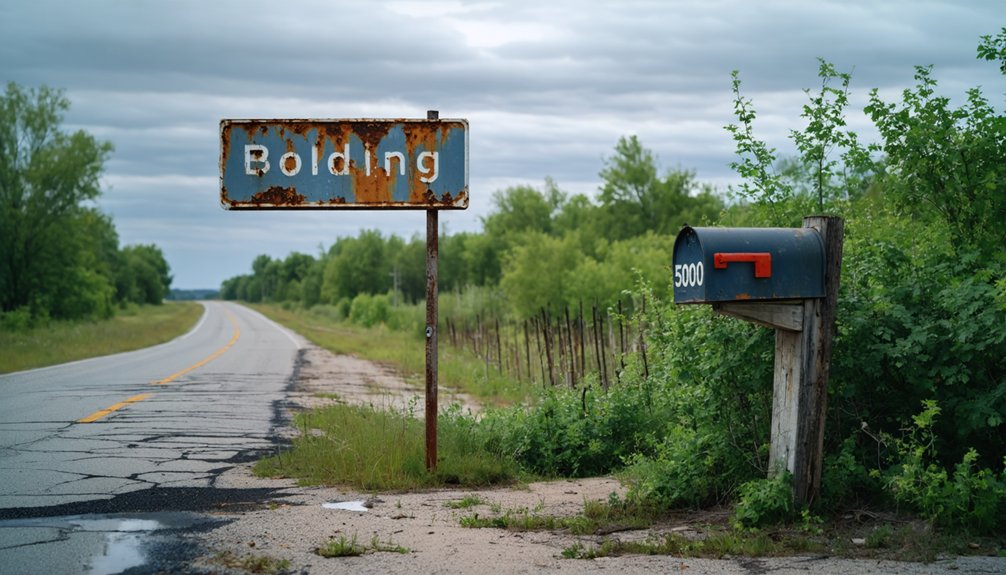
How does a thriving town of 5,000 vanish so completely that only foundation stones remain? You’ll witness firsthand how job loss ripple effects devastated communities throughout Arkansas’s Delta. When Bolding’s sawmills closed, workers scattered like autumn leaves, chasing opportunities beyond state lines.
When the mill whistle went silent, 5,000 souls became ghosts, leaving only stone memories of what once was.
The changing economic landscape forced over 355,000 Arkansans to abandon their homes between 1951 and 1955 alone.
Consider these stark realities:
- Economic dependency creates fragility – Single-industry towns collapse when that industry fails
- Population loss accelerates decline – Each departing family weakens schools, stores, and infrastructure
- Geographic isolation becomes a trap – Remote Delta locations couldn’t attract replacement industries
You’re exploring more than ruins. You’re standing where American dreams dissolved, where freedom meant leaving everything behind for survival elsewhere.
Nearby Attractions in Marion County
The ruins of Bolding tell one story, but Marion County holds countless others worth discovering. At the Sultana Disaster Museum in Marion, you’ll uncover America’s worst maritime tragedy through artifacts and survivor accounts that local museums rarely preserve.
Head north to Yellville, where the restored courthouse anchors a town that refused to fade. From here, Buffalo National River beckons through the Ozark Mountains—your gateway to regional outdoor recreation via float trips and hiking trails.
Cast a line in Crooked Creek‘s trout-rich waters, or tackle the 30-mile Marion Countryside Loop on two wheels. The Rush Historic District‘s abandoned zinc mines echo Bolding’s ghostly silence, while Natural Artesian Well flows as persistently as history itself through these hills.
Frequently Asked Questions
Is There Camping Available Near the Rush Ghost Town Site?
You’ll find primitive campsites available at Rush Campground, perfectly positioned near the ghost town. While amenities are limited to vault toilets and seasonal water, you’re free to explore twelve first-come sites at $16 nightly during peak season.
Are There Entrance Fees to Visit the Buffalo National River Historic District?
You won’t pay entrance or parking fees to explore the Buffalo National River historic district. Access remains completely free, though you’ll find visitor amenities like campgrounds require fees. Your freedom to roam these historic corridors costs nothing.
Can You Still Find Zinc Ore Remnants at Rush Today?
You’ll spot zinc ore remnants along mine walls and trail rubble—yellow smithsonite clusters on quartz and bow-tie formations. Abandoned mining equipment dots the landscape, though collectors can’t remove specimens. These relics showcase historic zinc ore mining techniques throughout Rush’s trails.
What Wildlife Might Visitors Encounter While Exploring the Ghost Town?
You’ll encounter diverse bird species like great blue herons and woodpeckers while exploring. Potential wildlife sightings include white-tailed deer, foxes, and wild turkeys roaming freely through the abandoned structures and surrounding forests of this ghost town.
Are Guided Tours Available or Is Rush Self-Guided Only?
Rush operates primarily as self-guided exploration with interpretive trail markers leading you through abandoned structures. While guided tours aren’t regularly scheduled, you can arrange private ghost tours through local historians who’ll share untold stories of this haunting settlement.
References
- https://www.barefoottraveler.com/rush.html
- https://www.discovervintage.com/ken/only-ghosts-remain-in-arkansas-mining-town/
- https://www.youtube.com/watch?v=s2a3hAf5d-Y
- https://encyclopediaofarkansas.net/entries/rush-ghost-town-marion-county-1270/
- https://www.youtube.com/watch?v=U4kJjjbcnMM
- http://freepages.rootsweb.com/~gtusa/history/usa/ar.htm
- https://everafterinthewoods.com/forgotten-ghost-towns-in-arkansas-that-are-eerially-scenic/
- https://en.wikipedia.org/wiki/List_of_ghost_towns_in_Arkansas
- https://www.onlyinyourstate.com/experiences/arkansas/ar-ghost-towns
- https://www.ghosttowns.com/states/ar/ar.html