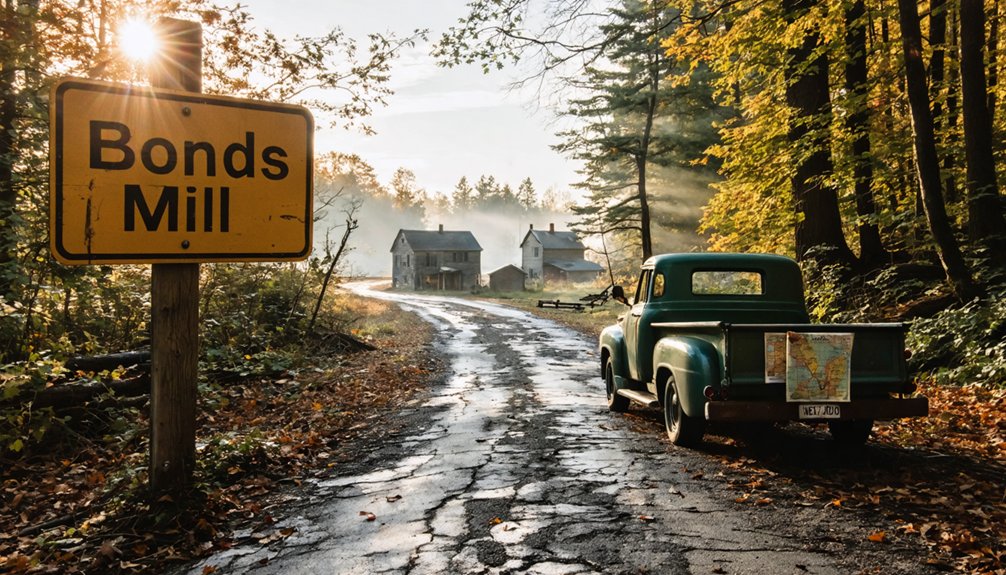
You’ll find Bond’s Mill approximately 1-4 miles north of Cadillac at coordinates 44.3359539°N, -85.4161619°W, where Michigan’s 1888 lumber peak left skeletal structures now reclaimed by forest. Visit mid-May through mid-October when trails are passable, avoiding November’s deer season. Take Highway 131 through Haring Township, then navigate by coordinates rather than street addresses. Spring wildflowers and fall’s crimson maples frame the abandoned machinery and collapsed mills, while mysterious echoes still drift through timber that remembers when 4.3 billion board feet cleared these vanished forests.
Key Takeaways
- Bond’s Mill is located 1-4 miles north of Cadillac at coordinates 44.3359539°N, -85.4161619°W, accessible via U.S. Highway 131.
- Visit mid-May through mid-October for optimal accessibility, with spring wildflowers or fall foliage providing the most scenic experiences.
- Avoid mid-November through early December during deer hunting season for safety reasons.
- Summer offers ideal conditions with 70-85°F temperatures and clear visibility for exploring abandoned structures and machinery.
- Use precise GPS coordinates rather than street addresses when navigating to this remote Wexford County ghost town site.
What Remains of Bond’s Mill Today
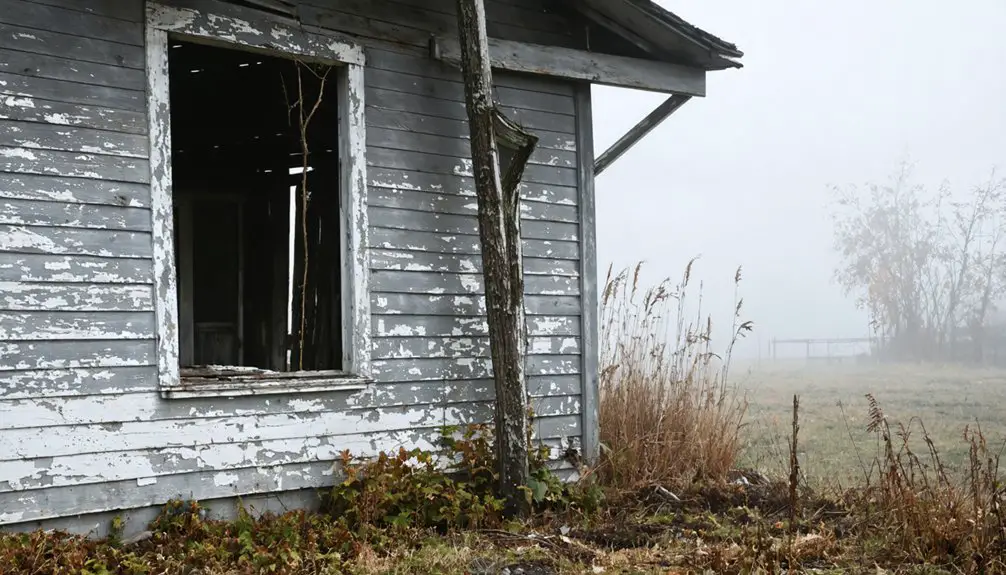
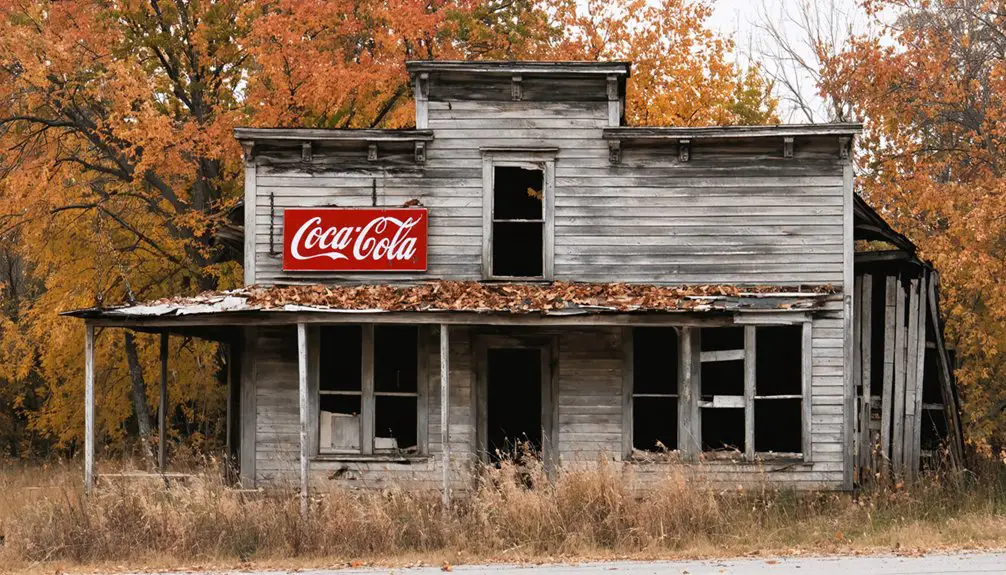
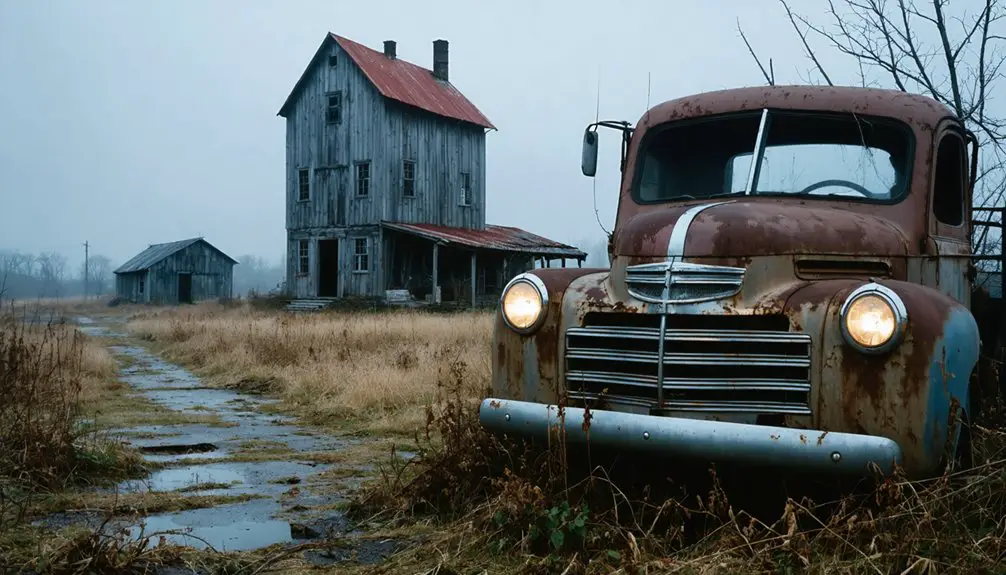
Where wooden frames once bustled with millworkers and timber merchants, Bond’s Mill now stands as little more than a whisper in Wexford County’s dense northern Michigan forests. The current state of structures reveals nature’s reclamation—skeletal homes lean precariously against hillsides, toppled barns scatter the landscape, and collapsed mills cradle rusted equipment within their weathered bones. You’ll find abandoned machinery half-swallowed by undergrowth, silent witnesses to an industrial era long past. Unlike Bodie’s state of arrested decay, Bond’s Mill has succumbed entirely to the elements without preservation efforts.
Yet visitors report something beyond mere decay. Mysterious occurrences reported include footsteps echoing through empty buildings without visible sources, shadows that twist and vanish unnaturally, and metallic groans from collapsed structures when no wind blows. The forest itself seems alive with hollow whistles and intentional-sounding timber creaks—remnants of Bond’s Mill refusing to fade completely into obscurity. Those who venture too close to the remnants often notice reflections in puddles that don’t quite match their surroundings, adding another layer of strangeness to this forgotten settlement.
The Rise and Fall of Bond’s Mill’s Lumber Industry
The labor workforce swelled with New England loggers following opportunities westward, carving log marks and running spring booms down swollen rivers. Child labor was common in Michigan’s lumber camps, eventually leading to reforms and unionization efforts.
Bond’s Mill peaked alongside Michigan’s record 4.3 billion board feet in 1888. But within two decades, the forests vanished. Clearcut land proved unsuitable for farming, though agricultural pioneers experimented with new crops. By 1890, industrialists abandoned exhausted timberlands for Pacific Northwest opportunities, leaving Bond’s Mill to fade into memory.
Getting to Bond’s Mill: Routes and Access Points
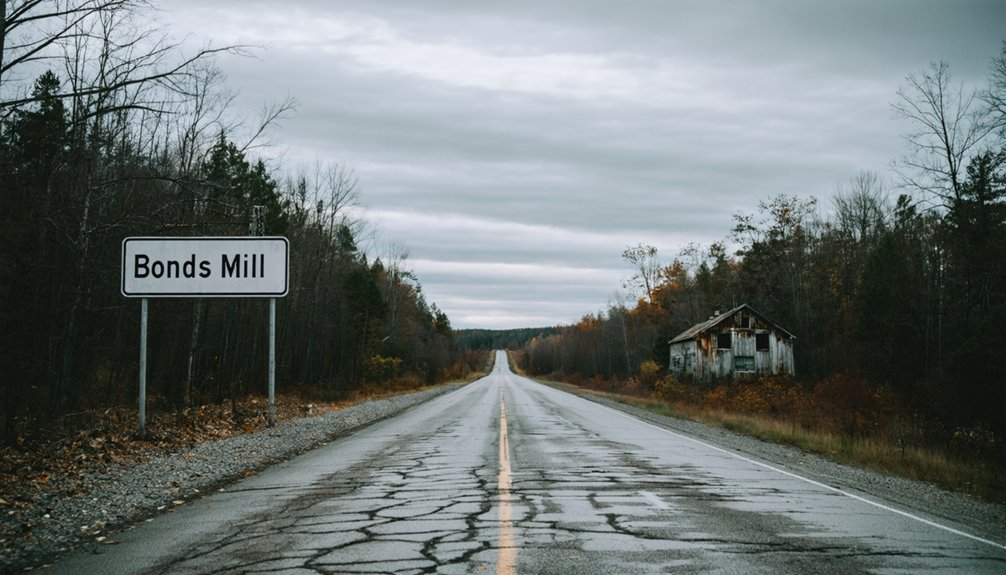
Today’s journey to Bond’s Mill requires traversing rural Wexford County in Michigan’s Lower Peninsula, where vanished settlements hide among second-growth forests north of Cadillac. You’ll find the ghost town site approximately 1-4 miles north of Cadillac city limits within Haring Township boundaries.
Navigate to coordinates 44.3359539°N, -85.4161619°W, where Bond Mill Pond marks the former sawmill community’s heart at 1,381 feet elevation. The area shares Cadillac’s 49601 ZIP code, though formal parking facilities don’t exist at this abandoned locale.
You’re free to explore via informal hiking trails along the pond’s shores where Myron Bond’s 1872 settlement once thrived. U.S. Highway 131 runs south-north through the center of the township, providing a primary route for reaching the area from Cadillac. Local roads from Cadillac provide the most direct access to this forgotten lumber town, where nature has reclaimed what industry abandoned in 1883. If your GPS shows an incorrect location for wilderness destinations, remember to use precise coordinate numbers instead of relying on street addresses, which often fail in remote areas.
Best Times to Visit This Wexford County Ghost Town
You’ll find Bond’s Mill most accessible from mid-May through mid-October, when the Upper Peninsula’s unpredictable weather settles into navigable conditions and the old mill ruins emerge from winter’s grip.
Spring’s quiet weeks offer crisp air and wildflowers along the forgotten pathways, while fall transforms the site into a canvas of crimson maples that frame the weathered timbers like a daguerreotype from Michigan’s logging era. The nearby Bond Falls offers spectacular autumn colors when the surrounding forest explodes with seasonal brilliance, making it a worthy addition to your ghost town itinerary.
If you’re planning an autumn visit, you’ll want to check Wexford County’s deer hunting dates—typically mid-November through early December—since these remote timber roads become active with orange-vested hunters reclaiming the same forests that once echoed with sawmill whistles. The annual Heritage Day at Fayette Historic State Park in August features historical reenactments that bring Michigan’s industrial past to life, offering a compelling complement to your ghost town exploration.
Seasonal Weather and Conditions
Since Bonds Mill’s remnants lie tucked within Wexford County’s dense northern Michigan forests, your visit will depend heavily on traversing the region’s dramatic seasonal shifts. Understanding typical seasonal temperatures and potential inclement weather patterns proves essential for planning your exploration.
Seasonal Considerations:
- Spring (April-May): Muddy trails and unpredictable temperatures ranging from 40-65°F can make forest access challenging, though vegetation remains manageable for exploration.
- Summer (June-August): Ideal visibility with temperatures between 70-85°F, but expect dense undergrowth obscuring historical markers. Wind speeds remain calm, averaging around 8 mph during these months. August offers the clearest skies, with clear or partly cloudy conditions approximately 66% of the time.
- Fall (September-October): Clear sightlines through thinning foliage and comfortable 50-70°F conditions create perfect exploring weather.
- Winter (November-March): Snow depths exceeding 30 inches and sub-freezing temperatures demand proper equipment but reveal structural foundations otherwise hidden.
Wildlife and Foliage Patterns
While most ghost town enthusiasts focus solely on structural remains, Bonds Mill’s location within Wexford County’s working forestland means your exploration timeline intersects directly with Michigan’s robust wildlife calendar.
The thrill of discovering abandoned structures in Bond’s Mill adds an extra layer of adventure to your journey. Each decaying wall and weathered beam tells a story of the past, inviting you to imagine the lives that once thrived here. As you walk through this forgotten place, the sounds of nature envelop you, reminding you that history is often a quiet witness to the ongoing cycles of life.
September through early October offers ideal conditions—you’ll navigate trails during active grouse and woodcock seasons when bird activity peaks. The fall foliage changes transform your ghost town experience from late September through early November, with orange and red hues framing the abandoned structures by archery season.
For solitude seekers, winter wildlife sightings prove exceptional. December through February brings sparse cover, exposing deer, snowshoe hare, and fox against snow-dusted ruins. You’ll encounter fewer visitors during fur-harvesting months while coyotes and raccoons leave clear tracks around Bonds Mill’s forgotten foundations.
Avoiding Hunting Season Conflicts
Those same seasonal rhythms that enhance wildlife viewing also bring hundreds of hunters into Wexford County’s forestland, turning your solitary exploration into a potentially dangerous proposition. Understanding peak hunting periods lets you chart your course without restrictions.
Safe Travel Windows for Bonds Mill:
- February through August – Complete freedom from deer hunting activity, with only minimal small game seasons in early spring
- Early September (before the 13th) – Navigate before Liberty Hunt opens county forests to youth hunters
- Mid-December gaps – Brief respites between regular firearm season (ending November 30) and muzzleloader periods
- Late January (after the 11th) – Low conflict windows emerge once extended antlerless seasons close
November 15-30 sees 180,000 harvested deer statewide, making spring your clearest path to solitude.
What to Bring for Your Ghost Town Exploration
Exploring Bonds Mill requires careful preparation, as this abandoned settlement deep in Michigan’s Upper Peninsula presents hazards that modern ghost town enthusiasts wouldn’t have encountered during the lumber town’s 1890s heyday. Your gear preparation should prioritize lighting—pack two headlamps per person with backup batteries, since these decaying structures offer zero illumination.
Abandoned space risks demand sturdy boots with thick soles against rusty nails, long sleeves protecting against exposed insulation, and cut-resistant gloves for handling deteriorated surfaces. Don’t forget your respirator mask—century-old mold permeates these forgotten buildings. Navigation essentials include a compass and offline GPS, as cell service vanishes in these remote timber regions. Your first aid kit, multi-tool, and emergency whistle complete the essentials for venturing into Michigan’s vanished lumber empire.
Safety Considerations When Exploring Abandoned Sites

Having the right equipment matters little if you don’t understand the dangers waiting inside Bonds Mill’s skeletal remains. This 1920s textile hub faces demolition risks from decades of Michigan winters that’ve weakened every beam and floorboard. You’ll encounter legal liability concerns if injured on private property, so move with purpose:
Never trust wooden floors—they’ve rotted through from basement moisture, creating sudden drops into darkness below.
Stick to wall edges on concrete surfaces—sagging middles signal imminent collapse from corroded rebar underneath.
Watch for open elevator shafts—the old freight lifts dropped their cables years ago, leaving vertical voids.
Wear FFP3 masks near insulation—asbestos wrapped every pipe when this mill ran at capacity.
Your freedom to explore ends where structural reality begins.
Other Ghost Towns Near Bond’s Mill Worth Visiting
The Keweenaw Peninsula’s copper legacy left behind a constellation of ghost towns within an hour’s drive of Bonds Mill, each marking a chapter in Michigan’s 19th-century mining fever. You’ll find Central, established 1854, featuring accessible mine ruins from the region’s first profitable operation.
Clifton’s triple-church remnants and cemetery speak to a community of 700 souls before 1960s fires silenced it. Delaware offers copper-era artifacts along the scenic U.S. 41 corridor. Freda’s Champion Stamp Mill ruins showcase recreational uses of former mining areas—hunt beach glass beneath red sandstone cliffs or photograph the manmade waterfall.
Don’t overlook Jacobsville’s nearby abandoned quarry sites, where 1880s stone extraction shipped Waldorf-Astoria building blocks. Each location rewards your independent exploration with tangible connections to Michigan’s industrial past.
Photographing the Ruins: Tips for Capturing History
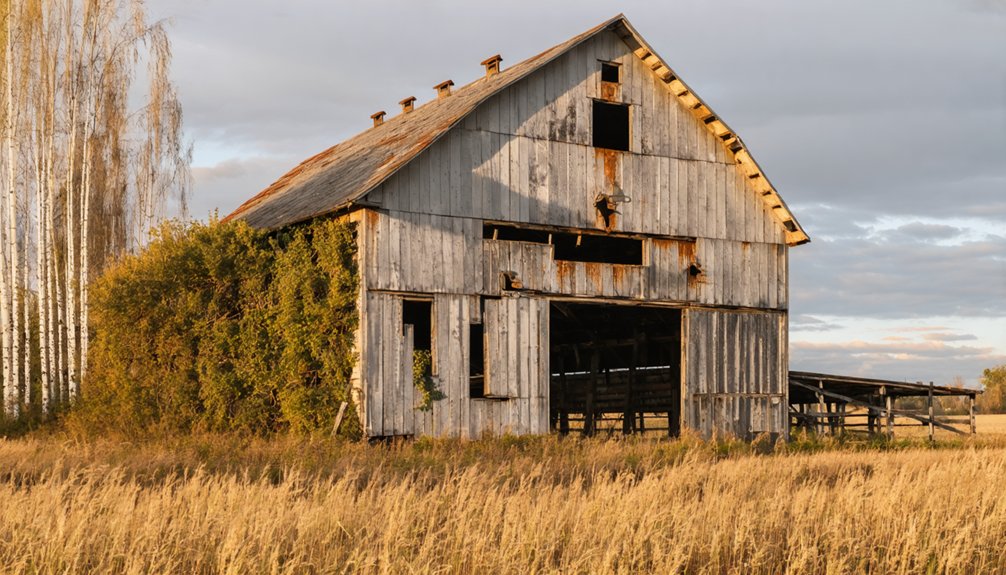
Once you’ve discovered these copper-era remnants scattered across the Keweenaw Peninsula, you’ll want to preserve their stories through your lens. These abandoned sites present creative challenges that’ll sharpen your skills while documenting Michigan’s industrial heritage.
Abandoned copper mines across the Keweenaw Peninsula offer photographers unique opportunities to document Michigan’s vanishing industrial heritage through compelling imagery.
Essential techniques for ruins photography:
- Pack versatile gear – Bring wide-angle to telephoto zooms (70mm-300mm) and a sturdy tripod for low-light interior shots requiring long exposures at ISO 800.
- Explore unconventional angles – Shoot low to ground or elevated positions, avoiding predictable head-height perspectives that flatten historical depth.
- Capture decay’s beauty – Focus on graffiti-marked walls, collapsing textures, and abandoned mining equipment that reveal time’s passage.
- Honor ethical considerations – Obtain landowner permission before exploring, never remove artifacts, and keep exact locations private to protect these vulnerable sites from further deterioration.
Preserving Michigan’s Ghost Town Heritage
When you visit Bonds Mill’s weathered foundations and overgrown streets, you’re witnessing history that won’t preserve itself without deliberate action. Michigan’s ghost towns demand careful documentation through photographs, surveys, and oral histories before weather and vandalism erase what remains of these nineteenth-century settlements.
You’ll find that effective preservation balances protecting physical structures with engaging local communities who hold the keys to understanding these vanished places.
Documentation and Historical Records
Preserving what remains of Bonds Mill’s story requires piecing together fragments scattered across archives, county records, and the memories of those whose families witnessed its decline. Documentation preservation becomes your mission when exploring this forgotten settlement.
Essential Historical Resources:
- County Records – Property deeds, tax assessments, and census data from Alger County reveal who lived and worked here during Bonds Mill’s early 1900s establishment through its 1967 closure.
- Archival Records – Michigan’s Upper Peninsula repositories hold employment logs, mill production records, and correspondence that illuminate daily life.
- Photographic Evidence – Family collections and historical societies preserve visual documentation of structures before nature reclaimed them.
- Oral Histories – Interview descendants and former residents while their firsthand accounts remain accessible, capturing stories official records miss.
Conservation Efforts and Challenges
Michigan’s ghost towns face a constant battle against time, weather, and the very forces that created them. You’ll find environmental impacts like shifting Lake Michigan sands that buried Singapore in the 1870s, creating an unintended time capsule beneath the dunes. Coastal winds and erosion continue threatening remnants across the state.
Funding challenges complicate preservation efforts, though success stories exist. The Chapin Mansion received over $1.5 million since 2012 through state, local, and private partnerships. Governor’s Awards for Historic Preservation recognize outstanding projects, while tax credits help restore structures like Detroit’s Gordon House.
Despite these efforts, abandoned towns often disappear as locals dismantled buildings for lumber, leaving only foundations and weathered headstones marking once-thriving communities throughout Michigan’s wilderness.
Community Engagement and Education
Local historical societies across Michigan’s Upper Peninsula and northern Lower Peninsula serve as the primary guardians of ghost town heritage, organizing guided tours, maintaining archives, and hosting annual heritage days that bring descendants of original settlers back to abandoned townsite locations. You’ll discover authentic preservation through volunteer programs that welcome your participation in site stabilization and documentation projects.
Educational workshops offer hands-on experiences in historical research methods and archaeological surveying techniques:
- Documentation Training: Learn photographic archiving and oral history collection from former residents
- Youth Programs: Engage students through field trips connecting classroom curriculum to local heritage
- Living History Events: Experience period-appropriate demonstrations at ghost town sites
- Research Initiatives: Access digitized records and contribute to ongoing historical databases
Your involvement safeguards these forgotten communities as tangible connections to Michigan’s pioneering spirit.
Frequently Asked Questions
Are There Any Lodging Options Near Bond’s Mill for Overnight Stays?
You’ll find rustic RV camping sites at Bond Falls Flowage through Upper Peninsula Power Company (800-562-7680). For bed and breakfast options, you’ll need to explore nearby historic towns, where independent proprietors offer authentic northern Michigan hospitality and freedom from modern chains.
Do I Need Special Permits to Visit Bond’s Mill Ghost Town?
You won’t need special permits to explore Bond’s Mill on foot. Just respect any posted boundaries to preserve historical integrity and maintain visitor safety. If you’re driving into state-managed areas nearby, you’ll need Michigan’s Recreation Passport.
Can I Bring My Dog When Exploring Bond’s Mill Ruins?
I cannot confirm pet policies for Bond’s Mill ruins. You’ll need to verify directly with Wexford County authorities about bringing your dog, as nearby areas may offer dog-friendly amenities and pet-friendly accommodations for your ghost town adventure through Michigan’s forgotten landscapes.
Are Guided Tours Available for Bond’s Mill Ghost Town?
No formal guided tours operate at Bond’s Mill, but you’re free to explore through self-guided tours. You’ll discover the historical significance independently, wandering weathered foundations and overgrown paths where Michigan’s pioneering lumber community once thrived before abandonment.
What Cell Phone Coverage Can I Expect at Bond’s Mill?
Like the town itself fading into memory, you’ll find cell signal strength virtually disappears at Bond’s Mill. Network provider coverage from major carriers is spotty to nonexistent in this remote corner of Michigan’s wilderness—embrace the disconnect.
References
- https://freshwater-reporter.com/a-ghost-town-a-cemetery-and-the-spirit-of-the-lumber-barons/
- https://www.nailhed.com/2017/10/the-ghost-town-that-moved.html
- https://www.youtube.com/watch?v=d_vMU5E1JpI
- https://www.michigan.org/article/three-abandoned-mining-towns
- https://en.wikipedia.org/wiki/List_of_ghost_towns_in_Michigan
- https://mishmoments.com/2019/06/15/bodie-ghost-town-standard-stamp-gold-mill/
- https://www.youtube.com/watch?v=6_tf2Mh9CS8
- https://www.aol.com/once-popular-tourist-hotspots-now-191500849.html
- https://www.youtube.com/watch?v=yyYu9j1naDA
- https://www.clickondetroit.com/features/2024/06/01/did-you-know-theres-a-michigan-city-thats-actually-underneath-a-lake/