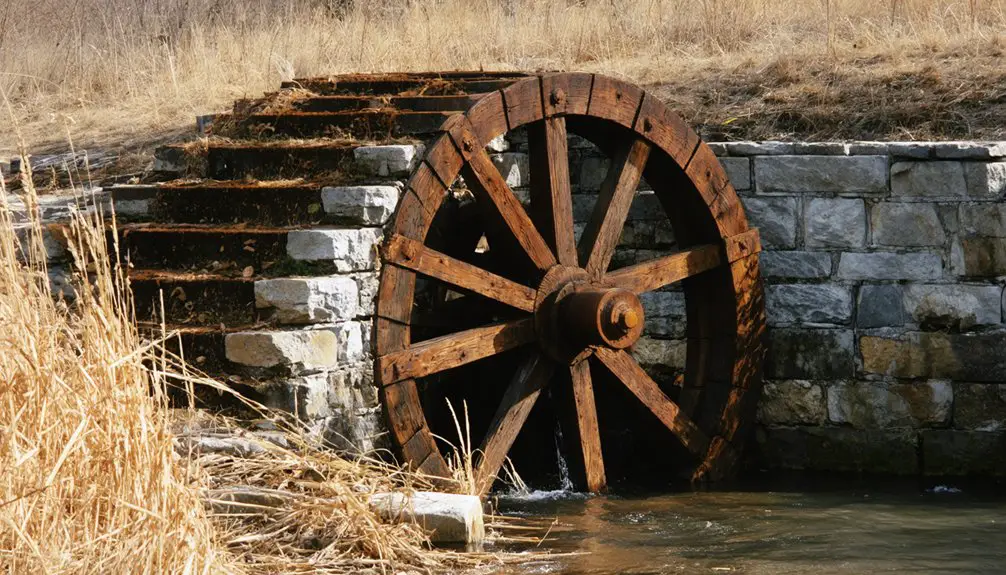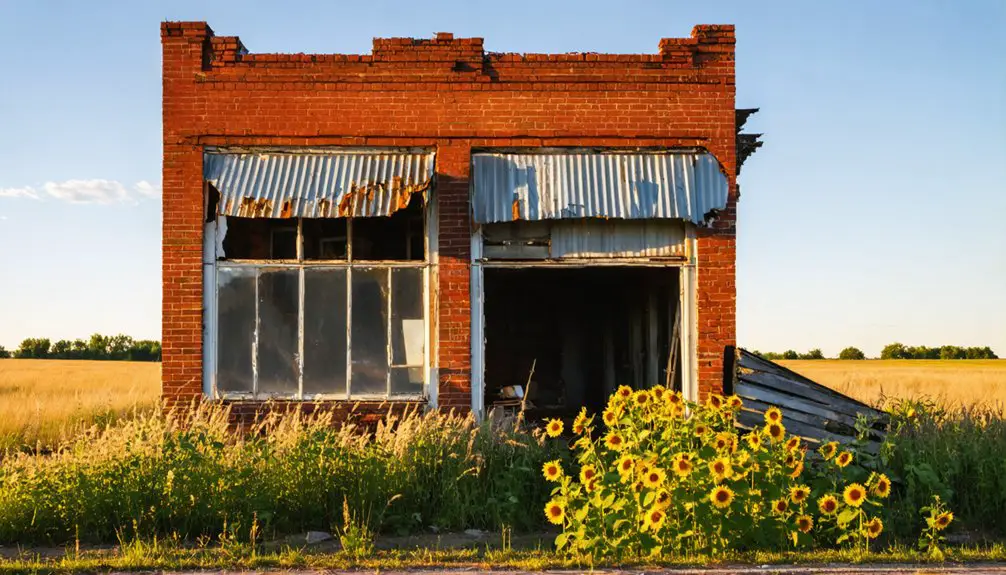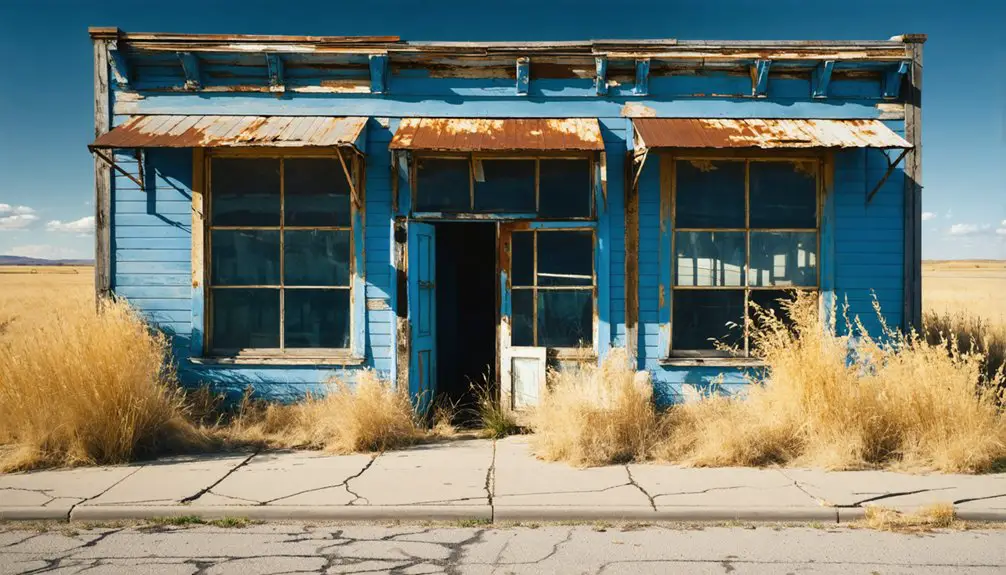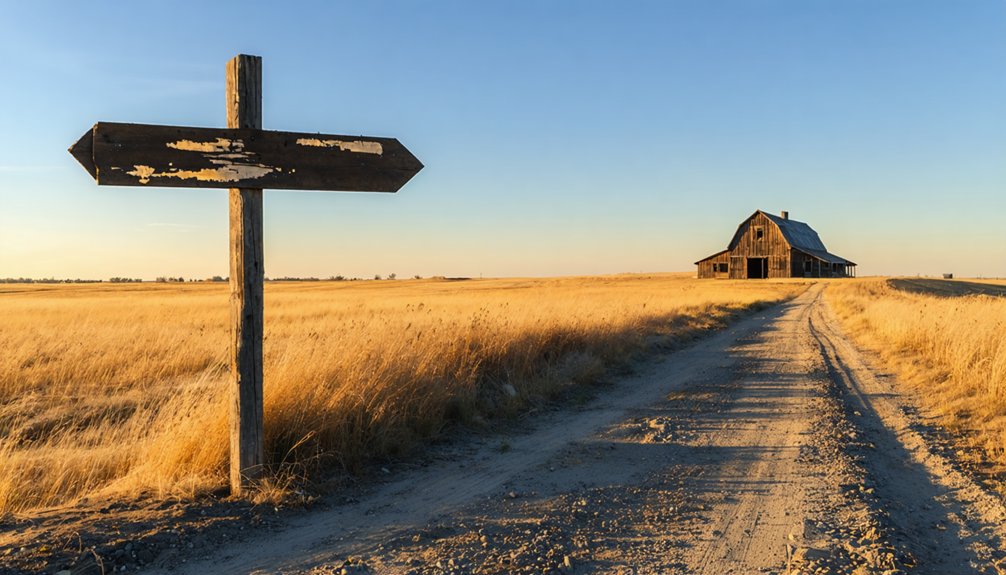
You’ll find Boomer City’s haunting remains near modern Galena in southeastern Kansas, where crumbling mine shafts and a weathered cemetery mark the site of 1880s territorial warfare and mining ambition. Drive along rural Cherokee County roads to discover limestone foundations, rusted equipment, and the ghostly footprint where 2,000 residents once extracted lead, zinc, and coal from prairie soil. Spring and fall offer ideal lighting for photographing the ruins, while exploring nearby abandoned mining settlements reveals the full scope of Kansas’s vanished frontier empire.
Key Takeaways
- Boomer City originated in the 1880s when drought-stricken farmers and illegal “Sooners” rushed to claim disputed Oklahoma Indian Territory land.
- The town experienced rapid growth with hundreds of settlers establishing makeshift settlements within days of Captain William L. Couch’s 1884 caravan arrival.
- Kansas ghost towns stemmed from mining booms, railroad expansion, and utopian experiments, with over 6,000 documented dead towns across prairies.
- Mining operations extracted lead, zinc, and coal from 1869-1945, attracting nearly 2,000 residents before environmental degradation and economic decline.
- Visit remnants including sprawling cemeteries, LeHunt’s cement factory ruins, and evidence of the 76-year mining frenzy that transformed the prairie.
Discovering Boomer City’s Turbulent Origins and Rapid Rise
When drought scorched the farmlands of Kansas, Texas, and Missouri in the early 1880s, desperate farmers and ambitious developers turned their eyes toward Oklahoma’s Indian Territory—nearly two million acres of the last available land under the Homestead Act. These “Boomers” pressured Congress relentlessly throughout the decade, determined to claim their stake in America’s final frontier.
Captain William L. Couch led the charge on December 8, 1884, guiding a caravan across the Cherokee Outlet to a promising creek. Within days, six hundred settlers established makeshift settlements, digging wells when water ran short and constructing cisterns for protection. Disputed land claims became common as “Sooners” jumped the gun illegally.
The Legendary Stockade Battle Between Empire City and Galena
You’ll find one of Kansas mining country‘s most dramatic confrontations unfolded just three-quarters of a mile from where you stand—a territorial feud so intense that Empire City built an eight-foot wall to strangle its rival’s prosperity.
On the night of August 15, 1877, fifty armed men from Galena rode through darkness to tear down the barricade, their torches blazing as gunfire cracked through the pre-dawn air. The charred remnants of that stockade marked the beginning of Empire City’s slow decline, a thirty-year death rattle that ended when the town surrendered its identity entirely and merged with its conqueror in 1907.
Wall Construction and Blockade
In the dead of night on July 25, 1877, Empire City’s council passed a resolution that would spark one of Kansas’s most bizarre conflicts—ordering construction of a massive wooden stockade to literally wall off their prosperous neighbor. The planning challenges were immense: reports varied on whether the barrier stretched half a mile or three-quarters, but the ambition remained clear.
You’d have witnessed workforce logistics in action as crews sank ten-to-twelve-foot logs three feet deep along Galena’s north and west boundaries. Police guarded workers against angry protests while they enclosed Columbus Street’s south end and the Short Creek bridge. Armed sentries blocked the town line, transforming a public highway into a militarized border—trapping traffic and even hindering U.S. mail delivery in this desperate territorial standoff.
The Midnight Raid
As tensions reached their breaking point, Galena’s leadership made a calculated decision that would become legend in Kansas border conflicts. At 4:00 a.m. on August 15, 1877, fifty citizens launched their assault on Empire City’s stockade under direct mayoral authority. You’ll find this wasn’t mere vigilantism—it was organized civic action driven by political motivations and local power struggles over economic survival.
The posse tore down and burned the barrier blocking Columbus Street and the Short Creek bridge, restoring the U.S. mail route their petitions couldn’t protect. Minimal shots were exchanged; surprise proved their greatest weapon. Empire City’s desperate attempt to trap residents and businesses through physical force crumbled in flames, cementing Galena’s dominance over the mineral-rich territory that determined which community would survive.
Aftermath and Reconciliation
The flames from the burning stockade barely died before lawyers descended on both communities, threatening lawsuits and criminal charges that never materialized. You’ll find this pattern repeated throughout frontier mining disputes—raw violence giving way to quiet settlements.
For thirty years, Empire City and Galena nursed their grudge while competing for lead miners’ allegiance. The stockade’s ashes marked Empire’s last stand against inevitable decline.
When Empire City finally surrendered its independence in 1907, accepting annexation into Galena, the economic legacy became clear: collaboration beats confrontation. Today you can trace their former boundary along streets that once divided rivals. Red Hot Street, connecting both camps, flourished with saloons and gambling dens that profited from their feud while smart businessmen recognized opportunity in conflict.
Mining Boom Legacy: Lead, Zinc, and Coal That Built the Town
Coal dust still clings to the memories of this southeastern Kansas landscape, where Heim Nelson’s 1869 discovery near Concordia sparked a 76-year mining frenzy that birthed over 30 operations. You’ll find evidence of lead, zinc, and lignite coal that drew foreign born settlers to these company-controlled lands, where script payment systems bound workers to corporate stores and housing.
The Southwestern Development Company’s $4,000 land purchase in 1890 proved wildly profitable once coal seams revealed themselves. Miners descended 25 to 75 feet with their own picks and carbide lamps, extracting earth by rope and bucket while company owners built stone houses above their dugout shelters. By the early 1900s, nearly 2,000 residents had transformed raw prairie into bustling downtowns—before economic shifts drained these communities dry.
What Remains Today: Cemetery, Schoolhouse, and Forgotten Structures
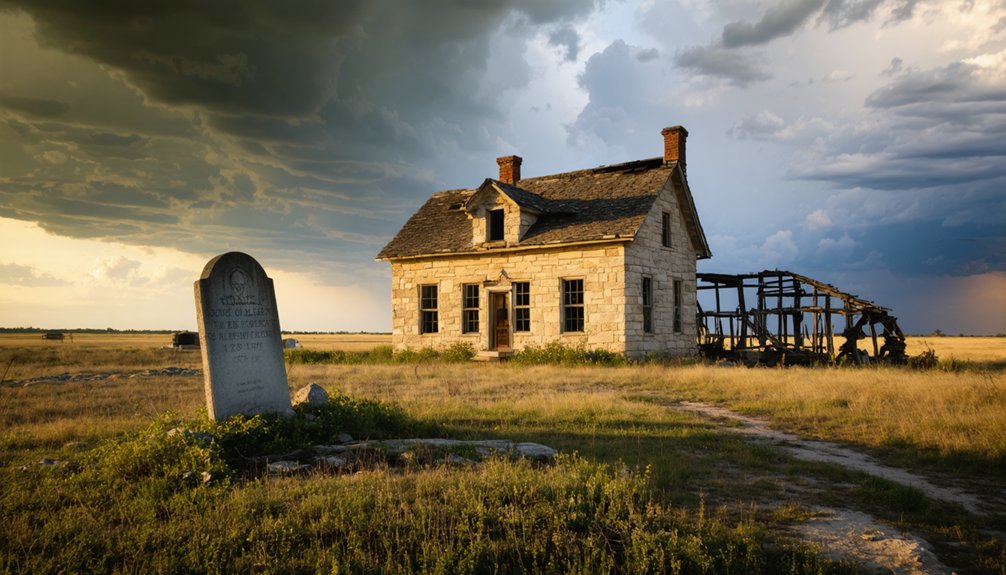
When you arrive at Boomer City’s overgrown site, you’ll find the weathered cemetery still standing guard over its departed miners and their families, with headstones dating back over a century.
The crumbling brick walls of the 1918 schoolhouse rise from the prairie grass like skeletal fingers, offering a haunting glimpse into where children once learned their lessons between mining shifts.
These two structures—one honoring the dead, the other symbolizing hope for the future—are the most substantial remnants of a town that once thrived on extracting fortune from beneath Kansas soil.
Visible Cemetery and Graves
Standing alone amid endless farm fields west of the original town site, Imminence Cemetery marks the loneliest chapter of this vanished community’s story. Established in 1887, it’s surrounded entirely by cropland—no houses, no neighbors, just wind-swept prairie near the Pawnee River’s former path.
You’ll find memorial stones in various states of decay. Many inferior 19th-century markers have crumbled beyond recognition, while others stubbornly persist after 130 years. Erosion’s worn inscriptions smooth, making names difficult to decipher. Nearby, a limestone storage building demonstrates why some structures survived—its immovable limestone foundation anchored it permanently to the earth while the town migrated to New Ulisses.
Scattered around are weathered stones with squared chisel edges, rounded by decades of Kansas weather. These fragments whisper stories of settlers who never imagined their thriving community would disappear.
1918 Brick School Ruins
Nothing testifies to Kansas’s ghost town legacy quite like the skeletal remains of abandoned schoolhouses scattered across the prairie. You’ll find structural integrity concerns plague these century-old buildings—from unstable foundations forcing closures to crumbling brick walls exposing primitive nogging insulation.
These ruins span eras: one-room 1870s structures relocated by crane, massive 90-year-old buildings still remarkably intact, and 1960s-era schools ravaged by vandals and nature.
Developer repurposing opportunities exist, particularly with properties offering historic tax credits and low prices. Yet funding challenges consistently derail conversion plans, leaving these monuments to education frozen between preservation and demolition.
Access most through broken windows and rusted pipes—your portal into Kansas’s educational past. Explore these ghost town classrooms where lessons ceased decades ago, now teaching only abandonment’s relentless march.
Understanding the Ghost Town Phenomenon Across Kansas
The windswept prairies of Kansas harbor more than 6,000 documented dead towns—silent memorials to ambition, innovation, and the harsh realities of frontier economics.
You’ll discover settlements born from elaborate hoaxes like Bluff City, utopian experiments like Silkville, and railroad boom-towns that vanished when the trains stopped coming.
Empire City exploded to 3,000 souls during its mining heyday, leaving behind environmental degradation from abandoned mining practices and a sprawling cemetery. LeHunt’s cement factory ruins tell tales of industrial ambition crushed by the Great Depression.
These ghost towns represent unbridled entrepreneurial spirit—homesteaders claiming 160-acre parcels, oil roughnecks chasing black gold, and speculators platting entire communities that never materialized. Each crumbling structure you’ll encounter represents freedom’s double-edged sword: limitless opportunity meeting unforgiving reality.
Getting There: Directions and Proximity to Modern Galena
From Kansas City’s sprawling metropolitan embrace, you’ll navigate 140 miles of southeastern highways to reach Galena—your gateway to Boomer City’s skeletal remains. This 2.5-hour journey cuts through Kansas prairies before delivering you to Cherokee County’s historic mining sites, where modern town growth contrasts starkly with abandoned settlements.
Your Route Options:
- Primary Path: Take I-35 south, merge onto US-169, then follow US-69 southeast through mining country’s dramatic curves
- Direct Alternative: Ride US-69 straight from Overland Park through Pittsburg—145 miles of uninterrupted exploration
- Fuel Strategy: Stock up in Fort Scott, your last major stop 50 miles out
- Airport Access: Fly into Joplin Regional (15 miles away) or Kansas City International for full-service convenience
Pack your curiosity and reliable transportation—public transit won’t reach these forgotten corners.
Must-See Sites Within Boomer City’s Historic Footprint
Walking Boomer City’s ghostly footprint reveals a haunting landscape where prairie grass reclaims what saloons and gambling halls once dominated. You’ll find scattered remnants of old buildings amid the chaotic street patterns that defined this wild camp’s pre-annexation culture. Head north to the large cemetery overlooking the site—it’s where miners, gamblers, and brawlers from the 1877 boom rest beneath weathered stones.
The lead mining legacy persists in abandoned structures and the irregular town layout, remnants of when 3,000 fortune-seekers threw up buildings without architectural consideration. Trace the path of legendary Red Hot Street between modern Galena and the historic Empire district. Though most structures vanished after the 1910 annexation, you’ll discover authentic evidence of frontier chaos—crumbling foundations marking where orgies and all-night gambling once exceeded other Western camps.
Combining Your Visit With Nearby Abandoned Mining Communities
Your exploration of Boomer City sets the stage for a broader journey through Southeast Kansas’s haunting mining landscape, where dozens of abandoned coal and lead-zinc camps dot the countryside within an hour’s drive.
Essential stops for your mining ghost town circuit:
- West Mineral – Tour inside Big Brutus, the colossal dragline excavator, while photographing remaining artifacts from 1970s strip mining operations
- Galena – Balance your ruins exploration by touring restored historic structures at the town’s mining museum, documenting lead-zinc heritage
- Empire City – Wander past century-old buildings in this Galena suburb where over 1,000 miners once lived
- Treece – Witness the cautionary tale of environmental devastation at this evacuated 2012 ghost town near Oklahoma’s border
You’ll find solitude and unrestricted access across these forgotten landscapes.
Best Times to Explore and Photography Tips for Ruins
Since Southeast Kansas experiences dramatic seasonal shifts, plan your Boomer City expedition for late September through November when cooler temperatures hover between 50-70°F and autumn’s golden light transforms weathered structures into photographer’s gold.
You’ll capture stunning architectural details during the hour after sunrise when shadows emphasize crumbling brick textures and morning mist clings to abandoned foundations. Spring’s unpredictable storms create dramatic skies but muddy access roads, limiting your exploration freedom.
Pack a wide-angle lens for capturing entire facades and a macro for weathered wood grain and rust patterns. Seasonal light changes affect your shots drastically—winter’s harsh angles reveal structural bones, while summer’s green overgrowth adds mysterious depth.
Shoot during golden hour when horizontal rays illuminate peeling paint and broken windows, creating the haunting atmosphere that makes ghost town photography unforgettable.
Frequently Asked Questions
Is It Legal to Enter the Abandoned School Building and Other Structures?
No, it’s illegal. Kansas trespassing laws prohibit unauthorized entry regardless of building condition assessments showing decay. You’ll face criminal charges and fines. Respect property boundaries—true freedom means exploring legally accessible places, not risking prosecution for adventurous impulses.
Are There Any Guided Tours Available for Boomer City Historical Sites?
No guided tour options exist—you’ll blaze your own trail through these forgotten ruins! The historical significance of sites remains yours to discover independently, exploring crumbling structures and weathered gravestones where Wild West chaos once ruled Kansas’s mining frontier.
As you venture through ghost towns to explore in Kansas, keep an eye out for remnants of the past that tell stories of resilience and hardship. Each location offers a unique glimpse into the lives of those who once called these desolate places home. The eerie silence is a testament to the bustling communities that thrived here before the dawn of modernization.
What Safety Precautions Should Visitors Take When Exploring Old Mining Areas?
You’ll need to avoid trespassing on private property and exercise caution near unstable structures. Watch for hidden mine shafts, test ground stability before stepping forward, wear sturdy boots, and never explore alone in these wild, forgotten territories.
Can Artifacts or Relics Be Collected From the Ghost Town Ruins?
No, you can’t collect artifacts—Kansas law protects these ruins due to their historical significance. Conservation concerns demand preservation over possession. Instead, capture memories through photography, honoring the past while respecting legal boundaries and future generations’ right to explore.
Are There Any Restaurants or Facilities Near Boomer City for Travelers?
Boomer City’s desolate prairie offers limited dining options and minimal visitor amenities—you’ll find civilization’s comforts in Bonner Springs, twenty miles east. Pack provisions, embrace self-reliance, and fuel up before venturing into Kansas’s forgotten frontier.