To reach Bradshaw City’s ghost town, you’ll head west from Sedona on Highway 89A, then turn onto Forest Road 525 where pavement transforms to dirt. A high-clearance 4WD vehicle is essential for traversing the rough terrain. Plan your visit during spring or fall when temperatures range from 60s-80s°F, as winter snow can block access and summer heat becomes extreme. You’ll discover weathered stone foundations, a historic cemetery, and scattered mining remnants among towering ponderosa pines—with several nearby ghost towns extending your backcountry adventure.
Key Takeaways
- Start from Sedona heading west on Highway 89A, then turn onto Forest Road 525 requiring a high-clearance 4WD vehicle.
- Visit during spring or fall for optimal temperatures (60s-80s°F) and accessible roads; winter snow closes routes December through March.
- Explore stone foundations, cemetery, and mining remnants scattered among Ponderosa pines at 6,300 feet elevation.
- Pack essential supplies including water, detailed maps, camping gear, and obtain wood cutting permits from Bradshaw Ranger District office.
- Extend your trip to nearby ghost towns including Crown King, Cleator, Oro Belle, Big Bug, and Briggs.
The Rise of a Mining Boomtown in 1863
When William D. Bradshaw stood atop a mountain in the Silver Range during autumn 1863, he surveyed untamed wilderness that would soon transform into a thriving community. That same year, prospectors discovered gold on Mount Wasson’s northwest slope, establishing mining camp origins that sparked Arizona’s next great rush. You’ll find the original site two miles north of present-day Crown King along Senator Highway, where Bradshaw’s group first struck pay dirt on nearby creeks.
The prospectors’ initial settlement started modestly—just a loose collection of tents scattered across pine-covered slopes. By September 14, 1864, the Bradshaw Mining District was officially established, encompassing ten square miles of promising terrain. What began as canvas shelters would soon evolve into Bradshaw City, a bustling mining hub that embodied every prospector’s dream of striking it rich. The town was officially settled in 1871 near the productive Tiger mine, marking the beginning of its transformation from scattered claims to an organized community. To the north, Alexandra’s post office operated from August 6, 1878, serving the mining community high in the Bradshaw Mountains.
Understanding Bradshaw City’s True Population Numbers
One of history’s most persistent myths about Bradshaw City involves wildly exaggerated population figures that have circulated for decades. You’ll encounter conflicting population estimates claiming 5,000 residents, but these numbers inflate reality.
Contemporary newspaper accounts tell a different story—The Arizona Republic documented on August 9, 1896, that this “very prosperous place” held “a population of 1,000 souls” at its peak.
That 5,000 figure? It referenced the entire mining district, not just Bradshaw City proper. Forest Service markers inadvertently perpetuated this confusion for years.
When you explore the abandoned site today, remember those 1,000 pioneers who actually built hundreds of buildings—dance halls, saloons, hotels, and restaurants—creating a genuine boomtown before economic collapse scattered them across Arizona’s wild frontier. The settlement existed in what became Yavapai County, established as one of Arizona’s four original counties in 1864. Today, Yavapai County has grown to a population of 252,013 as of 2024, a dramatic transformation from its frontier mining days.
What Caused the Town’s Rapid Decline
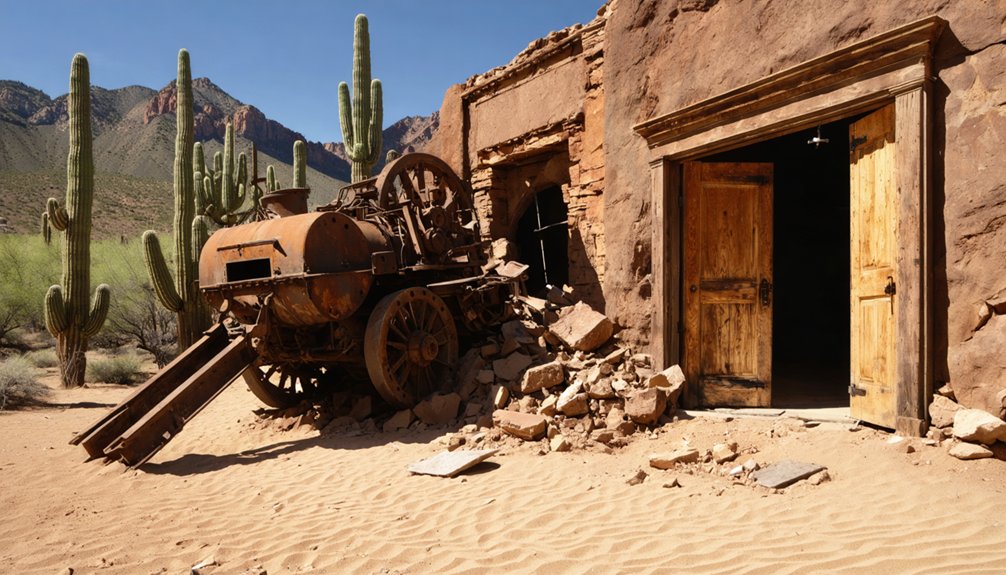
Several devastating forces converged in 1878 to trigger Bradshaw City’s economic collapse. You’ll discover that mine management strategies failed when high-grade ore deposits ran dry, forcing operators to abandon increasingly unprofitable claims. The environmental impacts of intensive extraction left only low-quality ore requiring costly processing methods.
Four critical factors sealed the town’s fate:
- Ore depletion – Accessible deposits were completely exhausted by 1878
- Jerome’s rise – The United Verde mine dominated production after 1894
- Silver crash – The 1893 Sherman Act repeal devastated eastern Bradshaw’s silver operations
- Post-WWI collapse – Plummeting copper prices and labor shortages crippled remaining operations
The town’s isolation worsened as it never secured railroad access, leaving it dependent on expensive wagon transport while better-connected mining camps thrived. Nearby Cleator, which grew along the route of Murphy’s Impossible Railroad, demonstrated how critical rail connections were for mining town survival.
What You’ll Find at the Site Today
When you arrive at Bradshaw City’s remote location, you’ll first spot a weathered Forest Service sign marking where this once-thriving mining community stood. Beyond the marker, stone foundations and partial rock walls emerge from the forest floor, their lichen-covered surfaces tracing the ghostly outlines of the general store, assay office, and saloons that lined the main street.
A short hike through overgrown trails leads you to the historic cemetery, where eroded grave markers stand as silent witnesses to the miners and families who called this mountain settlement home. The site experiences cool winters with possible snow and running water, while summers bring warmer temperatures ideal for exploration.
Forest Service Site Marker
A weathered Forest Service marker stands as your primary greeting at Bradshaw City’s ghost town site, positioned at coordinates 34°11’48.1″N 112°21’19.0″W within Section 27 of the Prescott National Forest’s Bradshaw Ranger District.
This interpretive sign contains marker inaccuracies you’ll want to note—it claims 5,000 residents at peak, though historical records show closer to 1,000.
The marker tells Bradshaw City’s story through:
- William Bradshaw’s 1863 mineral discoveries that sparked settlement
- The town’s actual 1871 establishment date (not 1863 as stated)
- Its position near the productive Tiger Mine operations
- The settlement’s decline through the late 1870s
Beyond the marker, you’ll find scattered stone foundations and a wooden archway believed to be remnants of the mining operations that once defined this boomtown.
If you encounter forest service personnel during your exploration, simply explain you’re visiting this historical site. Their forest ranger duties include monitoring these remote locations on public land. You can obtain wood cutting permits and motor vehicle use maps at the Bradshaw Ranger District office before your visit.
Scattered Stone Foundation Remnants
Beyond the weathered marker, Bradshaw City reveals itself through scattered stone foundations that dot the forested landscape along what was once the town’s bustling main street. You’ll discover partial rock walls and crumbling stonework preservation marking where general stores, saloons, and assay offices once thrived. These weather-worn remnants, now draped in lime green lichen, cluster near 6,000 feet elevation among towering Ponderosa pines and junipers.
The historic architectural details tell stories of hundreds of structures that housed a booming mining community. You can explore overgrown trails on foot, finding foundation piles in small canyons and granite boulders strewn across hillsides blooming with pink jojobas. The site also features rusted mining equipment and other industrial artifacts from the gold rush era. Nature’s reclaiming these substantial buildings, but the stonework endures, offering tangible connections to Arizona’s mining frontier without formal maintenance.
Historic Cemetery Access Point
Three weathered tombstones mark the entrance to Bradshaw City’s historic cemetery, positioned 705 feet west of the Tiger Mine road at 6,300 feet elevation. You’ll discover this solemn hillside site among towering Ponderosa pines, where unmarked graves extend beyond the visible historical burial markers.
What awaits your exploration:
- Minimal gravesite inscriptions following 1800s frontier practices
- Multiple burial locations scattered throughout the pine-needled slope
- Views of southern mountains just yards beyond the graveyard
- Wooden mining archway connected to Tiger Mine operations
The cemetery holds miners from the 1863-1880s era, including Jack from the August 1879 Tiger Mine disaster. A Forest Service sign marks the nearby camping area across the road. You’ll need a high-clearance vehicle for the unpaved approach.
How to Reach Bradshaw City
Your journey to Bradshaw City begins in Sedona, approximately 5 miles east of this ghost town tucked into Arizona’s rugged backcountry. Head west on Highway 89A through West Sedona, watching for mile marker 365 past the final traffic light. Turn right onto Forest Road 525, where pavement gives way to smooth dirt after 6.5 miles.
Bear left at fork 525D, continuing another mile toward the Bradshaw gate. You’ll need a high-clearance 4WD vehicle—this isn’t negotiable. The red dirt road ascends and descends steep hills with rough road conditions that’ll test your suspension. Limited signage means staying alert at intersections.
Alternative access via Boynton Pass Road offers similar challenges through gray gravel terrain. Either route delivers you to authentic backcountry adventure.
Best Times to Visit and Camping Options
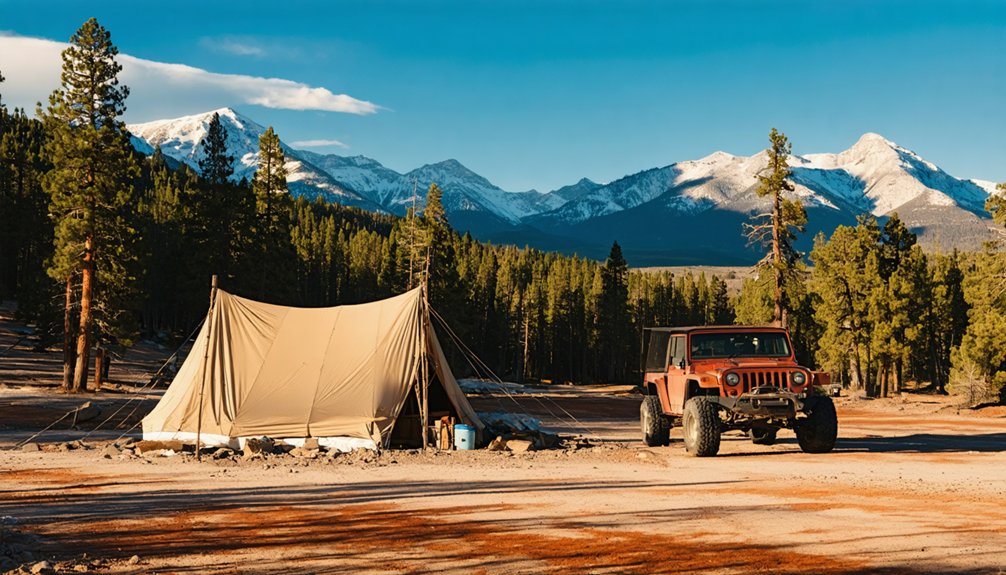
You’ll find the most comfortable conditions for exploring Bradshaw City during spring and fall, when temperatures hover in the pleasant 60s-80s°F range and wildflowers paint the mountain landscape.
The primitive camping sites near this ghost town operate on a first-come basis with no facilities, so you’ll need to pack all water, supplies, and waste removal equipment.
Winter snow can render the rough access roads completely impassable from December through March, making late spring through early fall your safest window for this backcountry adventure.
Ideal Seasonal Weather Conditions
Bradshaw City’s semi-arid climate delivers over 260 sunny days each year, creating year-round exploration opportunities with distinct seasonal personalities that’ll shape your ghost town adventure. The seasonal temperature variability ranges from spring’s mild 64-86°F days to summer’s scorching 115°F peaks, while winter brings comfortable 60-71°F afternoons followed by near-zero nights.
Optimal visiting windows for comfortable overnight camping conditions:
- Spring (March-April): Crisp mornings and warm afternoons with minimal rainfall make this prime exploration season
- Fall (September-November): Temperate 76°F days and cool 53°F evenings create ideal conditions for extended stays
- Winter (December-February): Abundant sunshine paired with cold nights requires insulated sleeping systems
- Summer (June-August): Dawn and dusk activities beat extreme midday heat reaching triple digits
Primitive Camping Site Guidelines
When planning your ghost town expedition, understanding the camping infrastructure around Bradshaw City becomes essential for a successful backcountry experience.
Exploring the ghost towns near Brigham City offers a unique glimpse into the past, showcasing the remnants of a once-thriving region. As you navigate through these eerie landscapes, take note of the historical significance and the stories each town holds. This adventure not only brings the thrill of discovery but also enriches your understanding of the area’s rich heritage.
Hazlett Hollow Campground offers 15 semi-primitive sites with three-sided wooden shelters and concrete floors, featuring historic stone walls built by the CCC in the 1930s. You’ll find the maximum RV length ranges from 22-40 feet per site, though there are no hook-ups available. The facility includes vault toilets but requires you to pack out all trash. High-clearance vehicles are recommended for the rough access roads.
For dispersed camping, explore 487.8 miles of designated roads throughout the Bradshaw Ranger District, where you’ll embrace true backcountry freedom. Remember to follow Leave No Trace principles and secure food storage against bears.
Avoiding Extreme Winter Closures
Since Bradshaw City sits in Arizona’s high country at approximately 6,000 feet elevation, timing your visit correctly means the difference between an accessible adventure and a snow-blocked disappointment. Understanding seasonal closure timelines protects your road trip investment, as routes like Perkinsville Road face extended closures from October through May during active storm systems.
Plan your ghost town expedition during these ideal windows:
- Late spring through early fall (June-September) offers reliable access without winter interference
- Check ADOT’s AZ511 system before departure for current closure status
- Avoid March through May when spring storms still threaten accessibility
- Monitor winter storm watches for the Bradshaw Mountains region
Recognizing road condition hazards keeps you mobile—blowing snow creates zero-visibility situations, while plowed snow clouds obscure sudden obstacles ahead.
Exploring the Historic Cemetery
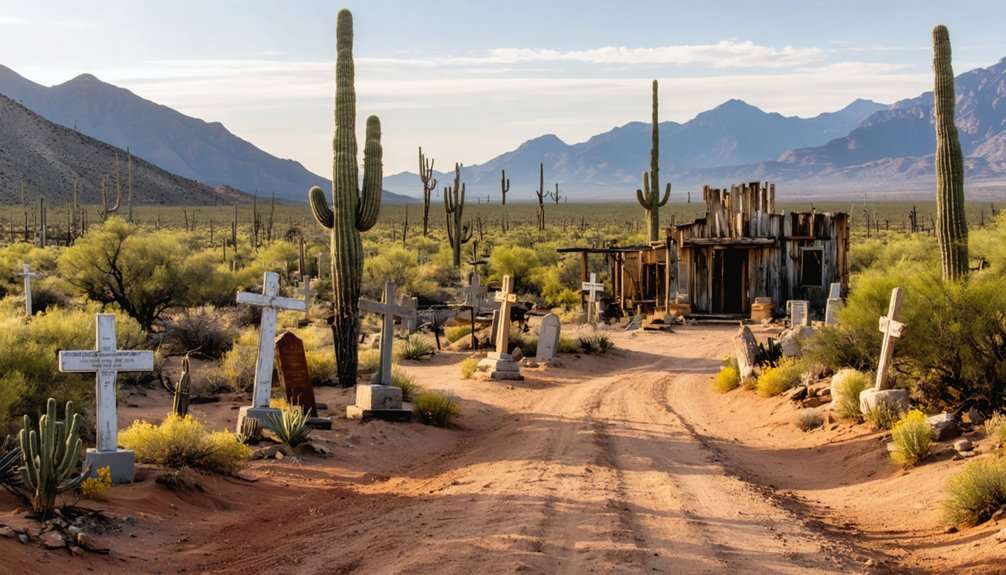
The cemetery sits quietly among towering pines, three-quarters of a mile south of Senator Highway, marked by weathered stone foundations and a simple Forest Service sign. You’ll discover solemn gravesites scattered throughout the forested clearing, where scattered stone piles hint at structures long vanished. A wooden archway from mining operations stands sentinel near the remnants.
Notable burial histories include Tiger Mine superintendent Mr. MacPherson, who succumbed to lockjaw after an accident, and multiple victims from the devastating August 1879 Tiger Mine Disaster. Children’s graves, including those belonging to families named Jack and Jackson, remind you of the harsh realities faced by boomtown residents.
Take time wandering these peaceful grounds—they’re powerful memorial to the 5,000 souls who once called this rugged mountain home.
Nearby Ghost Towns Worth Visiting
After paying your respects at Bradshaw City’s cemetery, you’ll find the surrounding Bradshaw Mountains harbor several remarkable ghost towns within easy driving distance. Your Crown King mining history exploration takes you to this 1870s settlement perched at 5,900 feet, where weathered timber cabins and a functioning general store await.
The route winds past fascinating stops:
- Oro Belle – Home of the abandoned Oro Belle saloon, later dismantled and hauled by mule to Crown King where it still operates today.
- Cleator – Once the ore train terminus and smelting center, owned by the Cleator family for generations after James purchased everything in 1905.
- Big Bug – Another remnant from the 19th-century gold boom scattered throughout these forested peaks.
- Briggs – A sparse but authentic mining camp reflecting the region’s decline.
Essential Tips for Your Desert Ghost Town Adventure
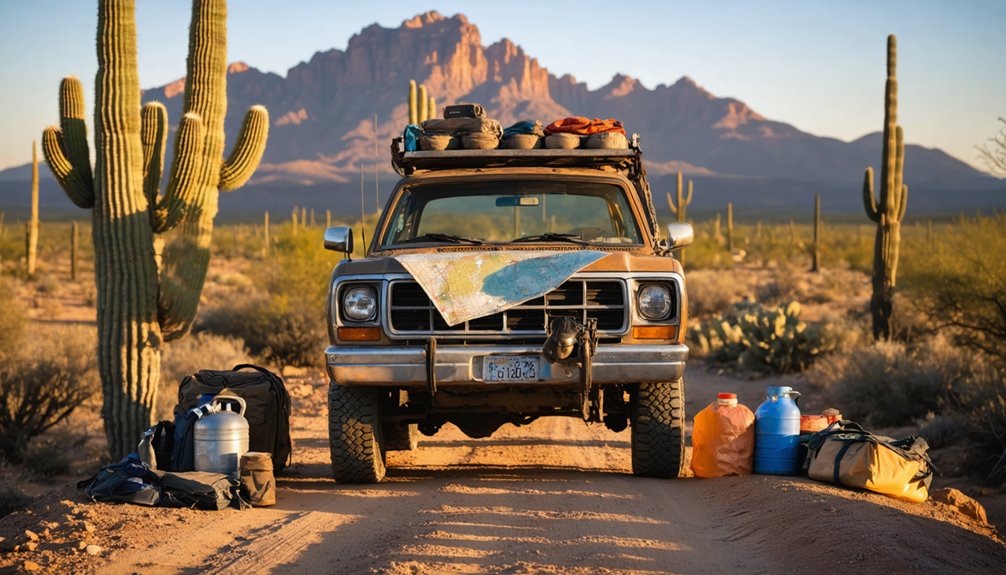
Before venturing into Bradshaw City’s scattered remains, you’ll need proper preparation for this remote backcountry destination. Pack essential supplies including water, detailed maps, and 4×4 tools since local transportation options are limited to off-road vehicles traversing Senator Highway’s rugged terrain.
Spring and fall offer ideal conditions, avoiding brutal desert heat while exploring on site hiking trails through pine-covered landscapes toward Tiger Mine’s proximity.
Bring camping gear to fully experience the peaceful forest surroundings and scattered stone foundations. Maneuver carefully through small canyons and unmarked side roads where unstable ruins pose trip hazards. Respect the cemetery as you wander, and check Forest Service updates before departure.
This isolated backcountry demands self-reliance, but rewards prepared adventurers with authentic remnants of Arizona’s untamed mining heritage.
Frequently Asked Questions
What Happened to the Original Buildings From Bradshaw City?
Time waits for no one—Bradshaw City’s abandoned buildings crumbled into ruins or were removed by 1896. Today, you’ll find only scattered foundations and decayed infrastructure marking where this once-thriving mining town stood before nature reclaimed its freedom.
Is the Tiger Mine Still Accessible to Visitors Today?
The Tiger Mine’s accessibility remains uncertain due to restricted mining activities and legal ownership concerns. You’ll find remote mountain terrain with abandoned workings, but recent operations on private land and environmental protections greatly/substantially/considerably complicate visitor access.
Are There Entrance Fees for Visiting Bradshaw City?
You won’t pay entrance fees at Bradshaw City since it’s within Prescott National Forest’s free-access areas. However, you’ll find limited parking options and minimal facilities available, so come prepared with supplies for your adventurous ghost town exploration.
What Wildlife Might I Encounter in the Area?
You’ll encounter mountain lions, bobcats, black bears, and mule deer roaming freely. Desert bighorn sheep navigate rocky slopes while cactus wrens nest among vegetation. Wild turkeys, javelinas, and various reptiles complete your wildlife adventure through these untamed Bradshaw Mountains.
Can I Take Artifacts or Souvenirs From the Site?
No, you can’t take “souvenirs”—federal law protects these treasures. Do not remove artifacts; respect historical preservation keeps Bradshaw City authentic for future adventurers. Photograph freely instead, capturing memories without compromising the site’s wild, untouched character and your freedom.
References
- https://azgw.org/yavapai/ghosttowns.html
- https://www.azplaces.com/best-camping-locations/bradshaw-city-ghost-town
- http://prescottazhistory.blogspot.com/2020/06/story-behind-place-name-bradshaws.html
- https://janmackellcollins.wordpress.com/2021/04/13/ghosts-of-the-bradshaw-mountains-arizona/
- https://westernmininghistory.com/towns/arizona/bradshaw-city/
- http://www.apcrp.org/Bradshaw City/Bradshaw_CitY_Master.htm
- http://bradshawmountains.com/mines.htm
- https://asmi.az.gov/resources/abandoned-mine-history
- https://en.wikipedia.org/wiki/Bradshaw_City
- https://www.asrs.us/wp-content/uploads/2021/09/0044-McBride.pdf